


Lightning Protection for Weighbridges: A Technical Guide for Australian Industry
A single lightning bolt can carry up to 30,000 amps of current, reaching temperatures of 30,000°C. This is a force capable of instantly vaporizing sensitive electronic components. For Australian industrial operators, a summer storm often results in more than just a temporary delay. It frequently leads to catastrophic load cell failure, expensive emergency repairs, and significant revenue loss due to extended weighbridge downtime.
Implementing professional lightning protection for weighbridges is a technical necessity for maintaining operational continuity. You'll learn how to safeguard your weighing assets from strikes and electrical surges using multi-layered protection strategies. This guide details the three pillars of a reliable system, focusing on structural grounding, electrical surge suppression, and the advantages of digital component selection. We'll also address how to ensure your site meets the rigorous requirements of the AS 1768:2021 standard to lower long-term maintenance costs and improve system reliability.
Key Takeaways
- Identify the specific vulnerabilities of weighbridge components to both direct strikes and induced electrical surges.
- Establish a robust system for lightning protection for weighbridges by utilizing high-conductivity copper braided earth straps and low-impedance grounding paths.
- Determine the strategic placement of Surge Protection Devices (SPDs) to isolate sensitive indicator electronics from signal line transients.
- Evaluate the technical advantages of digital load cells, which offer inherent resistance to electrical interference and internal transient protection circuitry.
- Ensure regulatory compliance with AS 1768:2021 through systematic lightning protection audits and integrated maintenance schedules.
The Impact of Lightning on Industrial Weighbridge Systems
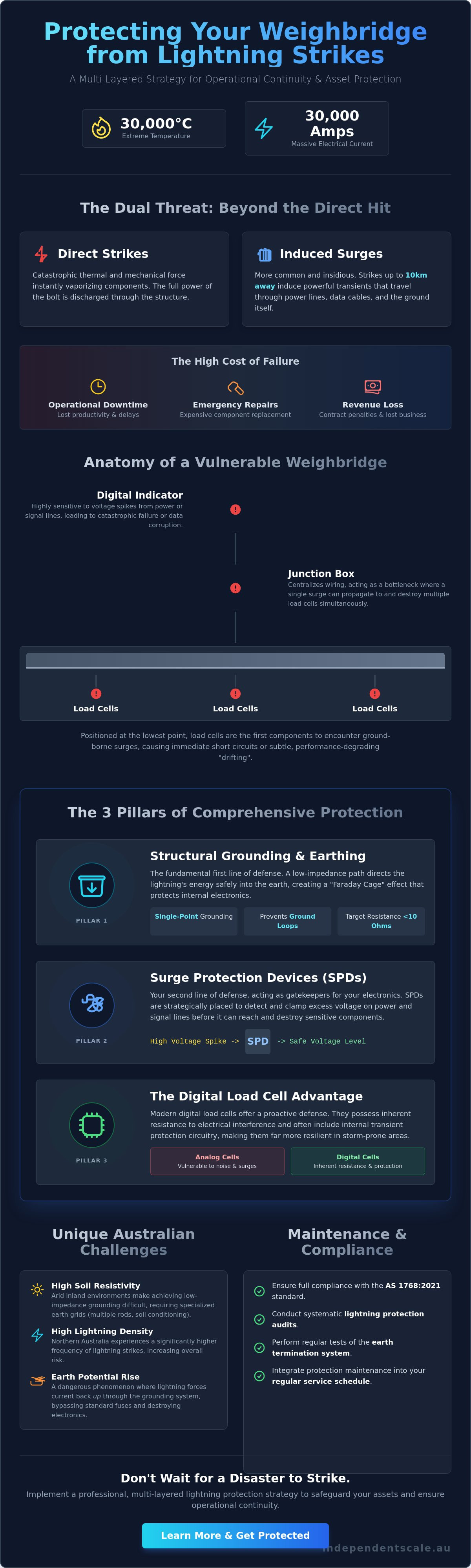
Industrial weighbridges are lightning magnets. Their massive steel decks, often situated in flat, exposed areas, provide a low-resistance path for cloud-to-ground flashes. A direct strike delivers the full thermal and mechanical force of an average bolt, which can carry 30,000 amps of current and reach 30,000°C. However, direct hits aren't the only threat. Induced surges from strikes up to 10 kilometers away are far more common. These transients travel through power lines, data cables, or even the earth itself to reach your equipment.
The financial impact of a strike extends well beyond the replacement cost of a single load cell. Operators must account for lost productivity, logistics delays, and potential breach of contract penalties when weighing operations cease. To mitigate this, industrial systems rely on Surge Protection Devices (SPDs) to clamp excess voltage before it reaches sensitive circuitry. Without a robust strategy for lightning protection for weighbridges, your facility remains vulnerable to three primary failure points:
- Load Cells: These precision sensors sit at the lowest point of the structure and are the first to encounter ground-borne surges.
- Indicators: Digital indicators are highly sensitive to voltage spikes entering via the power supply or signal cables.
- Junction Boxes: These centralize signal wiring and often act as a bottleneck where surges can propagate to multiple cells simultaneously.
How Electrical Transients Destroy Load Cells
High voltage transients cause a dielectric breakdown of the insulation within the load cell strain gauge. This results in an immediate short circuit. The current then seeks the path of least resistance, which is typically the signal cable leading back to the indicator electronics. While a massive surge causes catastrophic failure, smaller transients cause "drifting." This is a subtle degradation where the scale fails to hold a stable zero or returns inconsistent readings. Such issues require professional load cell calibration to identify and rectify.
Environmental Risk Factors in Australia
Geographic location dictates the frequency of storm activity. Northern Australia experiences significantly higher lightning ground flash density compared to Southern regions. However, arid inland environments present a unique challenge: high soil resistivity. Dry soil makes it difficult to achieve the low-impedance grounding necessary for effective lightning protection for weighbridges. Earth potential rise is a localized increase in voltage at the ground surface during a lightning discharge that can force current back up through the grounding system and into the electronics. This phenomenon often bypasses standard fuses, making specialized protection hardware essential for Australian industrial sites.
Structural Grounding and Earthing Requirements
Effective grounding is the fundamental requirement for any lightning protection system. Without a low-impedance path to the earth, even the most advanced surge arrestors will fail. A weighbridge structure, when correctly earthed, functions as a Faraday cage. This means the steel deck and frame intercept the strike and direct the current around the internal electronic components rather than through them. This mechanical bypass is the first line of defense in comprehensive lightning protection for weighbridges.
To achieve this, the system must adhere to a single-point grounding philosophy. This prevents ground loops, which occur when different parts of the system sit at different electrical potentials. According to the regulatory guidelines in AS/NZS 1768:2007, all metallic components must be bonded to a common ground point. This ensures that during a strike, the entire system rises and falls in potential simultaneously, preventing destructive current flow between connected devices.
Designing an Effective Earth Grid
Designing an effective earth grid involves more than driving a single rod into the soil. In many Australian industrial zones, high soil resistivity necessitates the use of multiple interconnected earth rods or chemical soil conditioning agents to lower resistance. Industrial standards typically mandate a resistance level of less than 10 ohms for the earth termination system. Regular testing ensures the grid remains within these parameters as soil moisture levels fluctuate. If your current system's integrity is in question, reviewing your load cell supply and grounding infrastructure is a necessary maintenance step.
Proper Bonding Techniques for Load Cells
Proper bonding techniques for load cells are critical for shunting high-amperage current away from precision sensors. Every load cell must be equipped with a heavy-duty, copper braided earth strap. These straps are superior to standard wire because they offer a higher surface area to handle the high-frequency skin effect of a lightning discharge.
- Install straps to bypass the load cell entirely, connecting the top mounting plate directly to the bottom plate or weighbridge frame.
- Ensure all contact points are clean, free of paint, and treated with anti-corrosion grease to maintain low resistance.
- Avoid tight loops or sharp bends in the straps, as these increase inductance and impede the rapid discharge of current.
Corrosion is a common cause of bonding failure. Increased resistance at the connection point forces lightning current to find an alternative path, which is often through the sensitive internal strain gauges. Maintaining these connections is as vital as the initial installation to ensure long-term reliability.
Surge Protection Devices (SPD) and Signal Line Isolation
Grounding provides the primary path for high-energy discharge, but it cannot eliminate the risk of voltage spikes entirely. Surge Protection Devices (SPDs) act as electronic gatekeepers. They clamp excess voltage to levels that sensitive weighing components can tolerate. A comprehensive strategy for lightning protection for weighbridges requires SPDs at both the weighbridge structure and the remote indicator location. This dual-point protection creates a buffer zone. It prevents transients from traveling along signal cables between the field and the control room.
Protecting the AC power supply to the indicator is just as critical as protecting the signal lines. Lightning often enters a facility through the mains power grid. Without a dedicated surge arrestor on the power input, a strike kilometers away can easily destroy an indicator's power board. Implementing galvanic isolation for data communication lines further enhances security. This process physically separates the electrical circuits, ensuring that a surge on the field side cannot reach the internal logic of the weighing terminal.
Protecting Junction Boxes and Data Lines
The field-side protection begins within the weighbridge pit. High-quality junction boxes and surge arrestors serve as the first line of defense for individual load cells. Within these enclosures, gas discharge tubes (GDT) handle high-current surges, while metal oxide varistors (MOV) provide fast-acting voltage clamping. Proper wiring of these components is vital. The GDT shunts the bulk of the surge to ground, while the MOV refines the remaining pulse. Using shielded signal cables is equally important. These cables minimize induced currents from nearby strikes, provided the shield is correctly bonded at a single point to prevent ground loops.
Indicator and Transmitter Protection
The office end of the system is where the most expensive electronics reside. It's essential to use conditioners and transmitters that offer built-in isolation. This technology ensures that a surge on the field side cannot jump to the control system. Similarly, indicators and displays must be shielded from mains power surges. A dedicated SPD on the AC power supply is mandatory. Conducting a formal lightning risk assessment helps determine the specific surge rating required for your site's power infrastructure. Use this checklist to verify system integrity during routine inspections:
- Inspect surge modules for visual signs of heat damage or "blown" status indicators.
- Verify all grounding connections to the SPD modules are tight and free of oxidation.
- Check that signal cable shields remain intact and properly terminated to the common ground.
- Ensure the AC power arrestor is operational and hasn't reached its end-of-life cycle.
The Advantage of Digital Load Cells in Storm-Prone Areas
While structural grounding and surge arrestors provide a robust external defense, the technical specifications of the load cells themselves determine the system's ultimate resilience. Standard analog load cells operate on millivolt signals, typically ranging from 2 to 3mV/V. These low-voltage signals are highly susceptible to electromagnetic interference (EMI) and electrical noise. In contrast, digital load cells utilize high-level RS-485 or similar communication protocols. This digital signal offers a significantly higher signal-to-noise ratio, making it far less likely to be corrupted by the electrical turbulence of a nearby lightning strike.
Selecting digital components is a strategic move for enhancing lightning protection for weighbridges. Digital systems provide a level of diagnostic clarity that analog systems cannot match. When a surge occurs, a digital indicator can identify exactly which cell in the network has been compromised. This precision eliminates the time-consuming process of manually testing each cell with a multimeter. While digital technology is more resilient, it is not a substitute for the structural grounding methods discussed in previous sections. A digital cell still requires a low-impedance path to ground to protect its internal processor from catastrophic failure.
Analog vs. Digital: A Comparison for High-Risk Sites
The primary vulnerability of analog systems lies in their aggregate signal path. Because all cells are summed in a junction box, a single surge can propagate through the entire network, potentially damaging every sensor simultaneously. Digital systems isolate individual cell communication. If one cell fails due to a localized transient, the rest of the system can often remain operational, or at the very least, report the specific point of failure immediately. For sites requiring high uptime, upgrading to modern load cell supply options is a necessary investment. Digital signals are also less prone to "drifting" after minor surges, maintaining calibration integrity longer than their analog counterparts.
Built-in Transient Protection Features
High-end industrial digital load cells often feature integrated transient protection circuitry. This typically includes internal "spark gaps" or specialized diodes designed to shunt small voltage spikes directly to the cell's stainless steel housing before they reach the strain gauge. These internal features reduce the complexity of external wiring and provide an additional layer of redundancy. Digital systems can self-report health status and signal integrity immediately after a storm event. This automated diagnostic capability allows maintenance teams to respond with urgency, replacing only the affected components and minimizing total site downtime. To ensure your system remains compliant and protected, view our complete range of digital and analog load cells to upgrade your site's resilience.
Implementation and Maintenance of a Protection Strategy
A robust strategy for lightning protection for weighbridges is only as effective as its most recent maintenance check. Industrial environments are harsh. Corrosion, vibration, and soil shifts can degrade grounding systems over time, rendering even the best hardware useless. A professional lightning protection audit is the first step in ensuring your site remains compliant with AS 1768:2021. This audit evaluates the integrity of the earth termination system and the strategic placement of surge arrestors across all power and signal lines.
Integrating these checks into your scheduled weighbridge calibration and repair services ensures that protection hardware is scrutinized by technicians who understand the specific tolerances of weighing electronics. Even if a system appears functional after a storm, a post-strike inspection is necessary. Subtle damage often manifests as intermittent errors or weight fluctuations that only become apparent during heavy usage. Independent Scale Service provides the technical expertise required to maintain NATA-compliant industrial weighing systems in high-risk environments.
Routine Inspection Checklist
Regular maintenance prevents small faults from becoming catastrophic failures during a storm. Technicians should perform these checks quarterly to maintain the integrity of the lightning protection for weighbridges:
- Conduct a visual inspection of copper braided earth straps for signs of corrosion, oxidation, or mechanical breakage.
- Use a dedicated earth resistance meter to test the grounding grid, ensuring it remains below the 10-ohm industrial threshold.
- Examine surge protection modules for status indicator changes; replace any modules showing red or "tripped" signals immediately.
- Check all cable glands and junction box seals to ensure moisture hasn't compromised internal transient protection components.
Professional Fault Diagnosis and Calibration
When a surge occurs, the damage isn't always obvious. Professional load cell calibration is the primary method for identifying internal strain gauge degradation that causes "drifting" or non-linearity. Our NATA accredited calibration process ensures your equipment meets legal metrology standards while verifying that the lightning protection system effectively shielded the sensors from the latest weather event. This process provides documented proof of accuracy and compliance for your quality management system.
Ensure your system is storm-ready. Contact Independent Scale Service for a technical audit to protect your assets and minimize expensive downtime.
Secure Your Weighing Infrastructure Against Storm Damage
Implementing robust lightning protection for weighbridges is a technical necessity for maintaining industrial uptime. A reliable defense relies on the precise integration of low-impedance grounding, strategic surge suppression, and the diagnostic advantages of modern digital load cells. These technical layers work together to shunt destructive currents away from your most sensitive electronics. Reactive repairs are expensive and lead to significant logistics delays. Proactive engineering is the only reliable method to ensure operational continuity during the intense Australian storm season.
Independent Scale Service provides the specialized expertise to audit and secure your weighing assets across Sydney, Melbourne, and regional Australia. Our technicians are NATA Accredited to ISO/IEC 17025 and deliver AS 1379 compliant services; this ensures your facility meets the highest regulatory standards for both precision and safety. Protect your industrial weighing assets—Get a technical quote from Independent Scale Service. Taking these steps now ensures your weighbridge remains a dependable asset, regardless of the weather conditions.
Frequently Asked Questions
Can lightning protection completely prevent weighbridge damage?
No system can guarantee 100% protection against a direct lightning strike, but a multi-layered strategy significantly reduces the risk of catastrophic failure. The goal is to shunt the majority of the electrical energy to the earth and clamp any remaining transients to levels that sensitive weighing electronics can tolerate. This approach prevents the total destruction of load cells and indicators during most storm events.
How often should I check the earthing straps on my weighbridge?
You should perform a visual inspection of earthing straps at least quarterly and immediately following any major electrical storm. Environmental factors like salt air or industrial runoff can cause rapid corrosion at connection points. Checking these straps during your regular calibration cycle ensures that the low-impedance path to ground remains intact and effective.
Do digital load cells need separate surge arrestors?
Yes, digital load cells still require external surge arrestors to provide comprehensive lightning protection for weighbridges. While digital cells often feature internal transient protection diodes, these are designed to handle minor spikes rather than the high-amperage current of a lightning discharge. External arrestors at the junction box provide the necessary primary defense for the cell's internal processors.
What is the most common sign of lightning damage in a weighing system?
Unstable weight readings or a "drifting" zero point are the most frequent indicators of electrical surge damage. This often signifies a dielectric breakdown in the insulation of the load cell's strain gauge. While the system might still power on, the accuracy is compromised, requiring professional diagnostic testing and likely component replacement to restore NATA-compliant performance.
Are weighbridges in pits more or less at risk than surface-mounted ones?
Pit-mounted weighbridges often face higher risks due to moisture accumulation and their proximity to ground-borne transients. While surface-mounted units are more exposed to direct strikes, pit installations are more susceptible to "earth potential rise" where current travels through the soil and enters the system from below. Both configurations require specialized grounding designs tailored to their specific mounting style.
Can I install lightning protection myself or do I need a specialist?
Professional installation is mandatory to ensure the system functions correctly and meets Australian regulatory requirements. Specialist technicians understand how to avoid common errors like ground loops, which occur when multiple ground points sit at different potentials. Incorrect installation can actually attract surges into the electronics rather than directing them away from the assets.
How does soil moisture affect weighbridge grounding in Australia?
Soil moisture levels directly impact the resistivity of the ground and the efficiency of your earthing grid. In arid regions of Australia, dry soil increases resistance, making it harder to achieve the required low-impedance path. Technicians often use soil conditioning agents or deeper earth rods in these environments to maintain a resistance level below the 10-ohm industrial standard.
What Australian standards govern weighbridge earthing and safety?
AS 1768:2021 is the current standard providing the requirements for the design, installation, and testing of lightning protection systems in Australia. This standard promotes a risk-based approach to determine the necessary level of protection for industrial sites. Adhering to this code is essential for maintaining safety compliance and ensuring the long-term reliability of your weighing infrastructure.
