


Justifying Calibration Costs to Management: A Strategic ROI Framework for 2026
A single weighing error of 1% on a high-volume production line can result in over A$75,000 of lost material annually, based on 2024 Australian industrial supply benchmarks. While many operations directors view scheduled maintenance as a discretionary expense, precision directly dictates your profit margin. You’ve likely faced pressure to slash operational budgets, leaving you with the difficult task of justifying calibration costs to management while trying to avoid a NATA audit failure or unexplained material wastage.
It’s common to feel that compliance is a burden on your expenditure. We’ll show you how to transform this perception by shifting the focus from a "compliance tax" to a strategy for protecting your yield. This article provides a data-backed ROI framework for 2026 that converts technical requirements into a compelling business case. You'll learn how to leverage ISO/IEC 17025 standards and AS 1379 requirements to secure budget approval, eliminate the risk of heavy regulatory fines, and optimise production through verified technical accuracy.
Key Takeaways
- Reframe calibration from a "compliance tax" into a strategic performance tool that validates measurement accuracy against traceable industrial standards.
- Quantify the financial impact of weighing inaccuracies by calculating the annual cost of material "give-away" to your production bottom line in A$.
- Navigate Australian regulatory requirements by understanding the necessity of AS 1379 compliance and NATA accreditation to ISO/IEC 17025.
- Build a high-value business case for justifying calibration costs to management by auditing bottleneck equipment and the projected costs of unscheduled downtime.
- Discover how 24/7 emergency support and 30+ years of technical expertise act as a critical insurance policy for maintaining continuous industrial reliability.
Understanding the Strategic Value of Calibration Beyond Compliance
Industrial calibration is the technical validation of measurement accuracy against established, traceable standards. While many facility managers view this as a mandatory "compliance tax" required to pass audits, this narrow perspective ignores the role of calibration as a high-level performance tool. When What is Calibration? is integrated into a broader operational strategy, it ensures that every gram or kilogram recorded matches the actual physical mass. This precision is vital for justifying calibration costs to management in an era where margins are increasingly thin. In Australia, NATA accreditation to ISO/IEC 17025 provides the only framework for legally defensible data, protecting businesses during contract disputes or regulatory inspections.
Effective measurement requires managing "measurement drift," which is the gradual degradation of sensor accuracy over time. Drift occurs due to environmental factors like temperature fluctuations, vibration, and mechanical wear. While a 0.5% variance might seem negligible in a single batch, the cumulative effect on industrial output is severe. For a high-volume facility, this drift results in thousands of kilograms of unaccounted material over a standard financial quarter. By maintaining a strict calibration schedule, businesses eliminate these compounded errors and ensure that production data remains a reliable foundation for financial forecasting.
The Shift from Maintenance Expense to Operational Asset
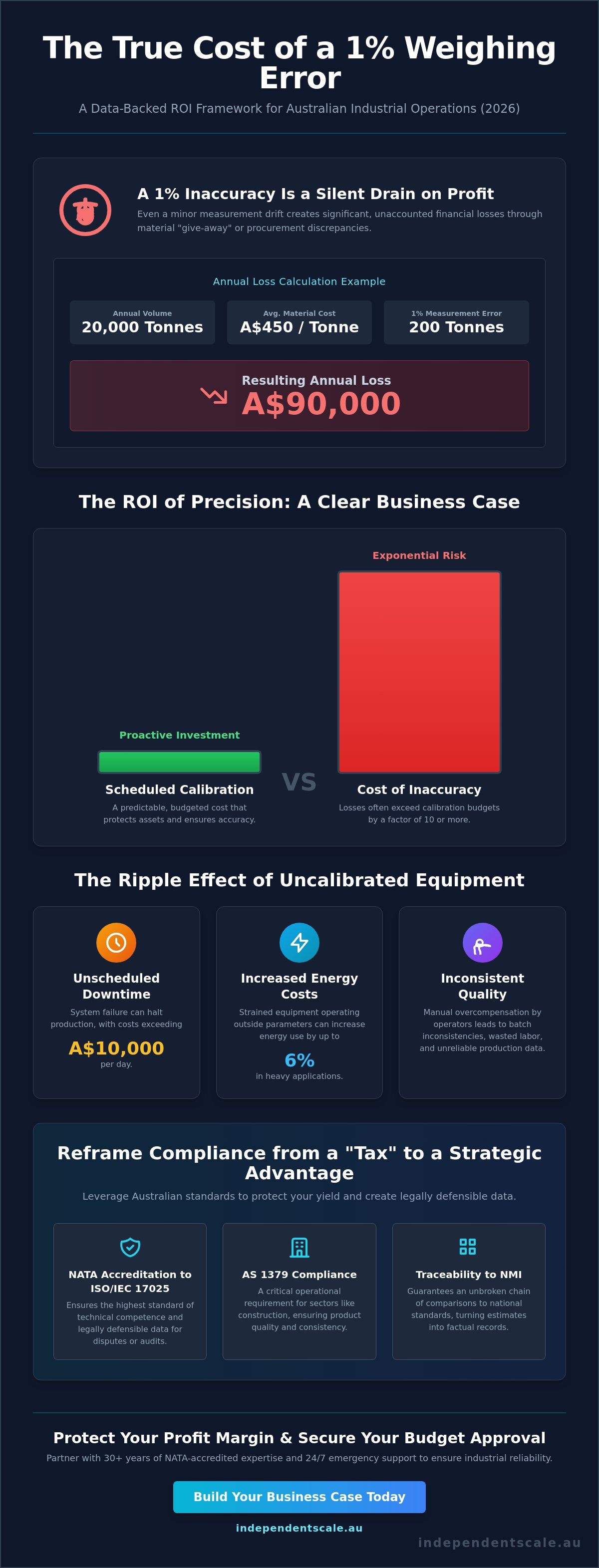
Accurate weighing systems directly impact product quality and consistency. In the Australian construction sector, particularly for the 98% of Sydney concrete plants serviced by ISS, adherence to AS 1379 is a critical operational requirement. Proactive servicing is a strategic investment; the cost of a scheduled calibration is a fraction of the exponential costs associated with a total system failure. A sudden breakdown can result in emergency repair fees and lost production time exceeding A$10,000 per day. Regular load cell calibration extends equipment lifespan by identifying mechanical fatigue or moisture ingress in summing circuits before they cause a catastrophic system shutdown. This transition from reactive maintenance to strategic asset management is a core component in justifying calibration costs to management.
The Hidden Costs of Uncalibrated Equipment
Uncalibrated equipment creates "invisible" losses that erode the bottom line. Inaccurate scales often lead to overfilling, where a 1% error in a high-volume facility can result in over A$50,000 of "given away" product annually. There are also mechanical consequences. Equipment strain increases when systems operate outside of calibrated parameters, which can raise energy consumption by up to 6% in heavy industrial applications.
Staff reliability is another casualty of poor calibration. When operators cannot trust their digital displays, they often over-compensate manually, leading to further batch inconsistencies and wasted labor. Traceability is the unbroken chain of comparisons to national standards. Without this chain, data is merely an estimate rather than a factual record. Maintaining this traceability ensures that every measurement taken on the factory floor is backed by the authority of the National Measurement Institute (NMI).
Quantifying the Financial Impact of Inaccurate Weighing Systems
Inaccurate weighing systems represent a silent drain on operational capital. When scales drift from their calibrated state, the resulting data errors cascade through procurement, production, and distribution. For many Australian facility managers, justifying calibration costs to management requires shifting the conversation from a maintenance expense to a risk mitigation strategy. Precision isn't a luxury; it's a fundamental requirement for maintaining projected profit margins.
The financial impact of a 1% inaccuracy is often underestimated. Consider an industrial facility processing 20,000 tonnes of raw material annually with an average cost of A$450 per tonne. A 1% measurement error results in 200 tonnes of unaccounted material. At these volumes, the business loses A$90,000 in annual margin through either material "give-away" or procurement discrepancies. These losses often exceed the total annual budget for NATA-accredited calibration services by a factor of ten.
Inaccurate data also compromises inventory management. If weighing systems report higher stock levels than what is physically present, procurement cycles are delayed. This leads to emergency stock orders at premium rates or, in worse cases, total production downtime. In Australian manufacturing, unplanned downtime can cost upwards of A$2,500 per hour in lost productivity and fixed overheads.
Material Give-Away and Yield Loss
Material give-away is the most direct form of profit erosion. In the concrete industry, plants must adhere to AS 1379 standards to ensure structural integrity and cost-efficiency. If a batching plant over-pours cement by just 1% due to uncalibrated tank and silo weighing assemblies, the cumulative cost is staggering. For a plant producing 60,000 cubic metres of concrete a year, a 1% over-batching of cement can cost over A$18,000 in wasted raw materials alone. Out-of-tolerance results don't just affect the current batch; they indicate a systemic failure that erodes the yield of every load leaving the site.
Product Liability and Rework Costs
The financial consequences of delivering sub-standard industrial materials extend far beyond material waste. Incorrect mixing ratios caused by faulty load cells can lead to entire batches being rejected by Tier 1 contractors or infrastructure authorities. This triggers a cycle of expensive rework:
- Labor Costs: Staff must be diverted from active production to re-test, transport, and dispose of faulty batches.
- Disposal Fees: Industrial waste disposal in states like New South Wales and Victoria involves significant environmental levies and transport costs.
- Brand Damage: Delivering out-of-spec material to a major project like the WestConnex or North East Link can result in immediate contract termination and long-term exclusion from government tenders.
If you haven't reviewed your equipment tolerances lately, you might be losing thousands to invisible measurement drift. Ensuring your systems meet compliance standards through professional calibration is the only way to lock in your production ROI for 2026.
Navigating Australian Regulatory Risks and NATA Requirements
Compliance in the Australian industrial sector isn't a suggestion; it's a legal mandate that carries significant financial and personal risk for company leadership. When justifying calibration costs to management, the conversation must shift from "maintenance expenses" to "risk mitigation." In Australia, the regulatory framework is governed by strict standards that ensure structural integrity and fair trade. Ignoring these requirements creates a liability profile that no modern board of directors should accept.
AS 1379 Compliance for Concrete Batching Plants
For any organization involved in concrete production, AS 1379 is the primary benchmark. This standard dictates the requirements for the specification and manufacture of concrete, including the precision of weighing equipment. To maintain compliance, concrete batching plant calibration must occur at intervals not exceeding six months. Accuracy isn't negotiable here. The standard prefers the Gravimetric Method, a validation technique where known physical weights are used to test the scale's performance across its full range.
Failing a state level infrastructure audit, such as those conducted by Transport for NSW or Victoria's Department of Transport, can lead to immediate site shutdowns. If a plant can't prove its scales were accurate at the time of a pour, the entire batch, and potentially the entire structural element, may be rejected. The cost of such a failure far exceeds the annual budget for professional calibration services.
The Weight of NATA Accreditation
Management often questions the price delta between a standard "scale check" and a NATA-accredited calibration. The difference is legal traceability. NATA accreditation to ISO/IEC 17025 is the gold standard because it confirms the technical competence of the laboratory and the equipment used. Non-accredited checks don't hold up in Australian courts or during complex insurance claims. A NATA-certified report provides a bulletproof paper trail that proves equipment was performing within specified tolerances.
For a more detailed breakdown of these requirements, refer to our Calibration Services guide. The distinction is simple: a test tells you if the scale is working; a NATA calibration proves it to the regulator.
The National Measurement Institute (NMI) also plays a critical role. Under the National Measurement Act 1960, any equipment used for trade, where goods are sold by weight or volume, must be verified. Using non-compliant equipment for trade is a breach of federal law. Beyond trade, the legal liability of directors is a primary factor in justifying calibration costs to management. If a structural failure occurs because of incorrect batching ratios, directors can be held personally liable for negligence if they haven't maintained NATA-traceable calibration schedules. Professional calibration is the only way to ensure the business remains on the right side of the NMI and Australian standards.
Building the Business Case: An ROI Framework for Management
Management often views calibration as a recurring operational expense rather than a strategic investment. To shift this perception, you must present a data-driven case that connects technical precision to the bottom line. Justifying calibration costs to management requires a four-step framework that focuses on risk mitigation and asset availability.
- Step 1: Audit Equipment. Identify high-risk bottleneck scales where a 1% deviation results in batch rejection or equipment damage.
- Step 2: Quantify Downtime. Calculate the total cost of 24 hours of unscheduled downtime. In high-volume Australian production environments, this figure often exceeds A$50,000 when accounting for lost throughput and idle labour.
- Step 3: Regulatory Benchmarking. Compare the cost of proactive NATA-accredited calibration against the potential for heavy regulatory fines and legal liability.
- Step 4: The CoQ Model. Present the "Cost of Quality" model to the CFO. This demonstrates that spending on prevention is always cheaper than paying for internal and external failures.
Gathering Workload and Performance Data
Effective justification starts with hard data. You should track the Mean Time Between Failures (MTBF) for all industrial load cells across your facility. Historical maintenance logs consistently prove that regular calibration intervals reduce the frequency of emergency repairs by identifying component drift before it leads to total system failure. Records show that 98% of Sydney concrete plants rely on accredited calibration to maintain 24/7 operations and meet strict AS 1379 compliance standards. Without this data, management won't see the correlation between scheduled service and reduced emergency call-out fees.
Expressing Gains in Business Metrics
Executives care about profit margins, not technical tolerances. You must translate "milligrams of accuracy" into "dollars of profit" for the executive summary. If a scale drifts and causes a 0.5% overfill on every unit, the annual loss in raw materials can reach tens of thousands of AUD. Upgrading to high-resolution indicators and displays improves throughput by reducing settling times and operator errors. This isn't just a technical upgrade; it's a direct boost to plant efficiency. Additionally, emphasize "Risk Transfer." When you hire a NATA-accredited expert, you transfer the legal and technical burden of accuracy to the service provider, protecting the company from liability during audits.
Ensure your facility meets AS 1379 standards and avoids costly downtime by booking an accredited calibration service today.
Partnering with Independent Scale Service for Industrial Reliability
Selecting a technical partner is a critical step in justifying calibration costs to management. Independent Scale Service (ISS) brings over 30 years of Australian industrial experience to every site visit. We currently service 98% of concrete plants across Sydney, providing a level of specialised knowledge that generalist providers can't match. Our 24/7 emergency support isn't just a convenience; it's a vital insurance policy against the massive financial losses of unplanned downtime. When a batching plant or production line stops, the costs often exceed A$5,000 per hour in lost productivity and wasted materials. Having a technician on-site immediately mitigates these risks.
We operate as a single provider for supply, calibration, and repair. This integrated approach eliminates the inefficiencies of managing multiple vendors and ensures that equipment is maintained to its original specifications. All hopper and silo calibrations involve NATA-accredited processes. This accreditation guarantees that measurements are traceable to national standards, which is essential for legal compliance and quality assurance in high-pressure industrial sectors.
NATA-Accredited Expertise Across Sydney and Melbourne
Our technicians based in Sydney and Melbourne possess deep insights into local environmental stressors. Dust, vibration, and the extreme Australian heat can cause rapid drift in sensitive weighing components. We ensure that your facility maintains simultaneous compliance with ISO/IEC 17025 and AS 1379. This dual compliance is necessary for any operation supplying materials to major infrastructure projects. For niche requirements, we provide special purpose shackle pins designed to withstand rugged site conditions. By using local experts who understand these specific technical requirements, you reduce the risk of non-compliance penalties and audit failures.
Reducing Total Cost of Ownership (TCO)
Effective justifying calibration costs to management requires a focus on long-term savings rather than just initial service fees. ISS helps clients select the right indicators and displays to reduce future calibration drift. High-quality hardware stays within tolerance longer, which extends the intervals between required adjustments. We also focus on protecting your investment from external damage. The installation of robust surge arrestors and junction boxes prevents electrical spikes from destroying expensive load cells during storms. These small investments in protective hardware significantly lower the TCO by preventing catastrophic system failures and extending the equipment's operational life.
Contact Independent Scale Service to schedule your NATA-accredited audit today.
Future-Proofing Your Industrial Accuracy and Compliance
Transitioning from a compliance-only mindset to a strategic ROI model ensures your facility remains competitive in the 2026 landscape. By quantifying the financial impact of inaccurate weighing and adhering to strict NATA requirements, you protect your bottom line from preventable losses. Successfully justifying calibration costs to management becomes straightforward when you present data regarding raw material waste and potential regulatory fines. Independent Scale Service brings the technical authority required for these high-stakes industrial environments. We're NATA Accredited to ISO/IEC 17025 and currently maintain the accuracy of 98% of concrete plants across Sydney. Our technicians provide 24/7 emergency support to ensure your production never stalls due to equipment failure. Precise measurement isn't a luxury; it's a fundamental requirement for operational integrity and long-term profitability. You can rely on our proven track record to maintain your standards and your reputation. We look forward to helping you achieve total measurement confidence through expert service.
Request a NATA-Accredited Calibration Quote
Frequently Asked Questions
Is calibration really necessary if my scales are only used for internal tracking?
Yes, calibration is essential for internal tracking because it prevents cumulative inventory shrinkage and material waste. A 0.5% drift on a scale processing 10,000 tonnes annually results in a 50 tonne discrepancy. This financial leak directly impacts the bottom line, making justifying calibration costs to management a matter of operational efficiency. Accurate data ensures your internal production metrics reflect reality rather than equipment error.
How often should industrial load cells be calibrated to satisfy Australian standards?
Industrial load cells should be calibrated every 6 to 12 months depending on usage volume and environmental conditions. For concrete batching plants, AS 1379 mandates a 6 month interval for all weighing systems to maintain compliance. High volume facilities often opt for quarterly checks to mitigate the risk of load cell drift. Maintaining this schedule ensures your equipment stays within the required ±0.5% tolerance for production accuracy.
What is the difference between a standard calibration and a NATA-accredited one?
A standard calibration verifies accuracy against known weights, while a NATA-accredited calibration provides formal traceability under ISO/IEC 17025. NATA certification includes a detailed report of measurement uncertainty and is legally required for trade related weighing. It offers the highest level of assurance for audits and quality control. Standard checks are often insufficient for meeting strict Australian regulatory or contractual obligations.
Can I use my own test weights to justify skipping professional calibration?
You can't use uncertified test weights to bypass professional calibration because they lack the necessary NATA traceability. Weights lose or gain mass due to wear, moisture, and corrosion over time. Professional technicians use certified weights that are regularly verified against national standards. Using DIY methods puts your facility at risk of failing an AS 1379 audit or producing out of specification batches.
What happens if our concrete batching plant fails an AS 1379 audit?
Failing an AS 1379 audit results in the immediate loss of certification and potential plant closure. Major contractors and clients won't accept product from non compliant facilities. You'll face significant rectification costs and lost revenue during the shutdown period. Regaining compliance requires a full system re-calibration and a follow up audit to prove the equipment meets the required accuracy thresholds.
How much does unscheduled downtime typically cost an Australian industrial facility?
Unscheduled downtime costs Australian industrial facilities between A$5,000 and A$20,000 per hour on average. These figures include lost production capacity, idle labor costs, and potential liquidated damages for late deliveries. Preventative maintenance and regular calibration significantly reduce the probability of these catastrophic failures. Investing in routine service is a cost effective strategy for protecting your facility's annual revenue and operational stability.
Does calibration include the repair of faulty weighing equipment?
Calibration is a verification process and doesn't automatically include the repair of faulty equipment. If a technician identifies issues like damaged summing circuits or moisture in a junction box, these require separate repair services. Calibration confirms whether the system is accurate, while maintenance restores it to working order. We provide detailed reports on any faults found so you can schedule necessary repairs immediately.
How do I include calibration in my annual CAPEX or OPEX budget?
Routine calibration should be categorized as an OPEX line item under preventative maintenance. If you're replacing entire weighing systems or installing new load cells, these costs fall under CAPEX. When justifying calibration costs to management, present them as a risk mitigation expense. Use historical data to show how regular servicing prevents the A$10,000 hourly costs associated with emergency breakdowns and production errors.
