


Industrial Weighing System Installation and Load Cell Indicator Programming: The 2026 Compliance Guide
A perfectly installed load cell is effectively useless if the digital brain behind it hasn't been calibrated to the latest 2026 Australian standards. With the publication of AS 1379:2026 and updated NATA accreditation criteria, the margin for error in industrial weighing has disappeared. You likely understand the frustration of material waste or the costly downtime that follows a failed inspection. Inaccurate readings aren't just a technical glitch. They're a direct threat to your operational compliance and bottom line. Mastering load cell indicator programming is no longer an optional skill for site engineers. It's a mandatory requirement for maintaining NATA-endorsed accuracy.
You need a system that performs reliably in harsh environments while meeting every ISO/IEC 17025 benchmark. This guide provides the technical roadmap to ensure your installation passes its NATA audit the first time. We'll examine the critical mechanical mounting requirements, the essential programming parameters for modern digital indicators, and the documentation needed to satisfy the latest 2026 regulatory updates. By following these protocols, you'll minimize downtime and ensure your concrete batching or silo weighing system remains fully compliant.
Key Takeaways
- Understand why mechanical installation serves as the foundation for all weighing accuracy, preventing physical errors that software cannot fix.
- Identify how to select and position specific load cell types, including shear beam and canister cells, while respecting critical bearing dimensions.
- Master the essential parameters for load cell indicator programming to ensure your system achieves NATA-accredited precision for every batch.
- Navigate the 2026 updates to AS 1379 and ISO/IEC 17025 to maintain strict regulatory compliance for concrete batching and industrial weighing.
The Fundamentals of Industrial Weighing System Installation
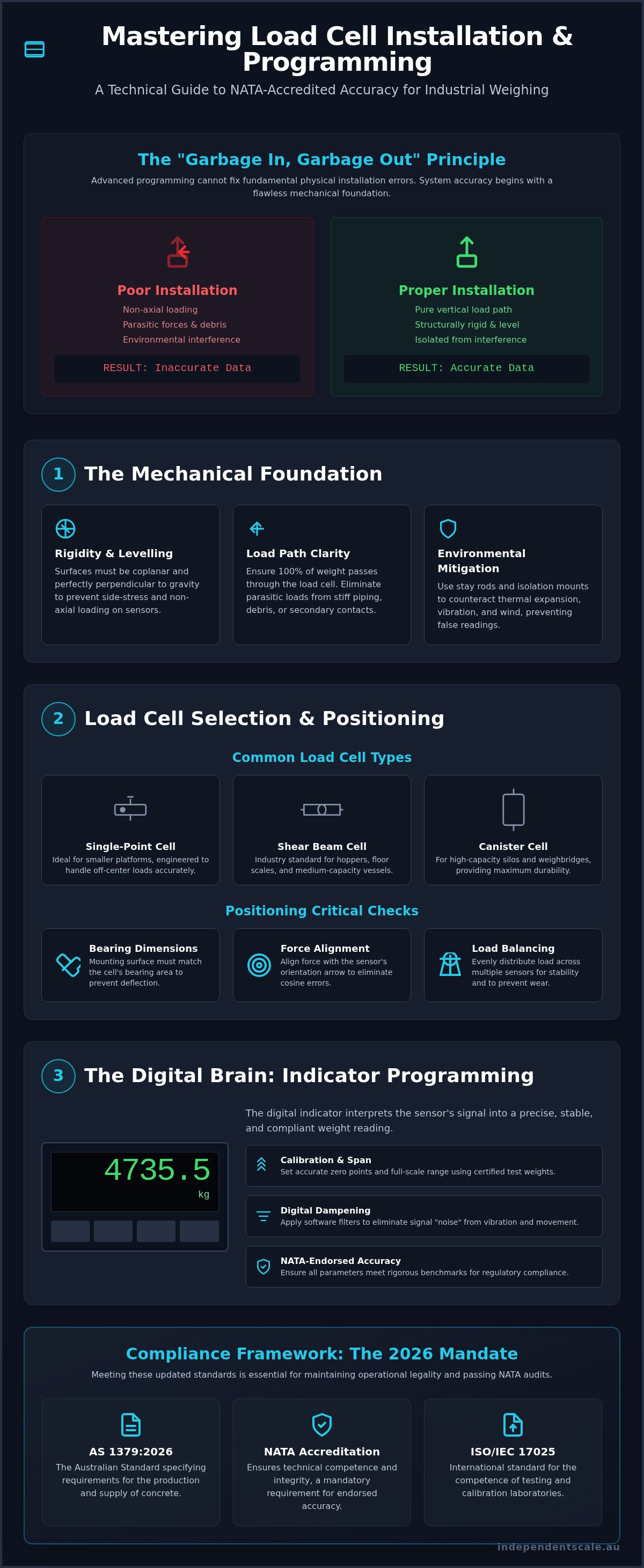
Installation is the single most critical factor for long-term accuracy and system reliability. We operate on the "garbage in, garbage out" principle. If a sensor receives skewed or inconsistent force data due to poor mounting, the output will remain inaccurate regardless of software filtering. A primary objective is achieving absolute load path clarity. This means ensuring every kilogram of the vessel's weight passes directly through the vertical axis of the sensor. To understand the physics behind these components, it helps to review What is a Load Cell? and how it converts force into a measurable electrical signal. Any secondary contact point, such as stiff piping or debris buildup, creates a parasitic load that bypasses the sensor and invalidates your calibration.
The Mechanical Foundation: Structural Rigidity and Levelling
The surfaces supporting your weighing assembly must be coplanar and perfectly perpendicular to the force of gravity. Misaligned mounting plates cause non-axial loading, which introduces side-stress and potential damage to the internal strain gauges. For large-scale projects involving tank and silo weighing assemblies, structural deflection is a significant risk. If the support beams flex under a full load, the load distribution changes, leading to non-linear readings. We use specialized mounting kits to compensate for minor surface imperfections, ensuring the load cell remains the only point of contact between the vessel and its foundation.
Environmental Factors: Vibration, Wind, and Thermal Expansion
Industrial environments present harsh variables that threaten measurement stability. Thermal expansion is a common culprit in Australian outdoor installations. As a silo expands in the sun, it can exert horizontal force on the sensors. This side-loading is often mistaken for weight gain, complicating your load cell indicator programming efforts. To mitigate this, we utilize stay rods and check rods to stabilize the vessel without interfering with vertical movement. Additionally, vibration from mixers or nearby heavy machinery can introduce "noise" into the signal. We install isolation mounts and employ digital dampening techniques to ensure the indicator displays a steady, reliable value despite the surrounding mechanical activity.
Selecting and Positioning Load Cells for Maximum Precision
Selecting the correct hardware is the prerequisite for successful load cell indicator programming. You can't compensate for an incorrectly specified sensor through software alone. Industrial applications typically require one of three primary types. Single-point cells are ideal for smaller platforms where off-centre loading occurs. Shear beam cells serve as the industry standard for hoppers and medium-capacity floor scales. For high-capacity silos and weighbridges, canister cells provide the necessary durability and axial load resistance.
Precision depends on respecting the bearing dimensions specified in technical data sheets. If the mounting surface is smaller than the load cell's bearing area, the sensor will deflect incorrectly, causing non-linear readings. You must also ensure the direction of force aligns perfectly with the orientation arrow etched on the sensor body. Misalignment introduces cosine errors that degrade accuracy. For systems with multiple sensors, balancing the load is essential to prevent premature component wear and ensure signal stability. Technical standards, such as those found in the NIST Handbook 44, provide the rigorous framework necessary for maintaining these commercial-grade tolerances.
Compression vs. Tension Weighing Assemblies
Static loads, such as large storage vessels, typically utilize compression-based tank and silo weighing assemblies. These modules provide a stable base and simplify the installation process in outdoor environments. In contrast, tension modules are superior for suspended hoppers or mixers where floor space is limited. For heavy lifting and specialized construction applications, special purpose and shackle pins offer a robust solution by integrating the sensor directly into the lifting hardware.
Managing Lateral Forces and Overturning Risks
Outdoor installations face lateral forces from wind and potential seismic activity. You must implement mechanical constraints, such as stay rods, to prevent the vessel from overturning. However, these constraints shouldn't introduce friction. If a stay rod is too tight, it "steals" weight from the sensor, leading to consistently low readings. Co-planarity ensures that the load is distributed evenly across all sensors, preventing corner-loading errors. Achieving this level of physical precision makes the subsequent load cell indicator programming straightforward and reliable. If you're unsure about your current setup, a professional NATA-accredited load cell calibration can identify these mechanical discrepancies before they lead to compliance failure.
Electrical Integration and Load Cell Indicator Programming
Properly wiring junction boxes and surge arrestors is the primary defense against the volatile Australian climate. Outdoor vessels are particularly susceptible to lightning strikes and power grid surges, which can instantly destroy sensitive electronics. We recommend using hermetically sealed stainless steel boxes for any wash-down or dusty environment to prevent moisture ingress. During setup, technicians must check for signal leakage and insulation resistance to ensure no ghost loads are introduced by electrical faults. A single grounding point is vital to avoid ground loops that cause erratic readings.
Load Cell Indicator Programming Parameters
Effective load cell indicator programming begins with selecting indicators and displays that offer the resolution required for your specific application. Once the hardware is energized, the programming sequence typically follows a structured hierarchy. You'll first establish the zero point by capturing the dead weight of the empty vessel. Next, span calibration is performed by applying a known test weight to define the relationship between the electrical signal and the physical mass. Finally, digital filtering parameters are adjusted to ignore mechanical vibrations while maintaining a responsive update rate.
For advanced automation, configuring conditioners and transmitters allows for seamless PLC integration via Modbus, 4-20mA, or Ethernet/IP. This ensures that the high-accuracy data captured at the source is transmitted without loss to the plant control system. Precise load cell indicator programming at this stage is what transforms a collection of components into a NATA-compliant weighing system. Don't overlook the importance of these digital settings; they're the final seal on your system's performance and compliance.
Compliance Framework: AS 1379 and NATA Standards in Australia
Adherence to national standards is the only way to guarantee that your weighing data holds legal and commercial weight. In Australia, the construction and manufacturing sectors rely on AS 1379 to define the specification and supply of concrete. This standard isn't a suggestion; it's a mandatory framework for ensuring structural integrity. If your batching plant operates outside these tolerances, you risk costly material rejection or structural failure. NATA accreditation to ISO/IEC 17025 represents the gold standard for technical competence. It proves that your calibration provider has been independently verified to deliver accurate, traceable results. Without a NATA-endorsed certificate, your load cell indicator programming lacks the formal validation required for high-stakes industrial projects.
Meeting AS 1379 Requirements for Concrete Production
AS 1379:2026 mandates strict tolerances for every component of a concrete mix. Cement and other cementitious materials typically require an accuracy of ±1%. Aggregates and water measurement must generally fall within ±2%. Achieving these figures consistently requires more than just high-quality hardware. It demands precise load cell indicator programming to manage tare weights and material in-flight compensation. Most plants require a mandatory calibration cycle every six months to maintain compliance. For a deep dive into these technical requirements, review our Concrete Batching Plant Calibration guide.
The NATA Accreditation Process
The difference between a "standard check" and a NATA-endorsed report is significant. A standard service check might verify that a scale is roughly accurate, but a NATA validation involves a rigorous assessment of repeatability, linearity, and uncertainty of measurement. During an on-site audit, technicians test the system across its full operational range using certified masses. This process ensures that the digital output on your display matches the physical mass with absolute certainty. Government and major infrastructure contracts almost always specify NATA-certified systems as a prerequisite. It's the only way to provide the documented proof of accuracy that auditors and project managers demand. Ensuring your system meets these benchmarks protects your business from the legal implications of non-compliance.
Don't leave your site's compliance to chance. Ensure your facility meets all Australian standards by scheduling a professional AS 1379-compliant batching plant calibration with our specialist team.
Professional Commissioning with Independent Scale Service
Independent Scale Service functions as your technical partner for the entire lifecycle of your weighing equipment. We don't just sell components; we engineer compliant solutions. By utilizing a single provider for load cell supply and commissioning, you eliminate the communication gaps that often lead to installation errors. Our teams in Sydney and Melbourne are structured for responsiveness, recognizing that every hour of equipment downtime represents a direct loss in production revenue. This is a serious business for serious industrial clients who require absolute certainty in their measurement data.
From Supply to NATA Validation
Our end-to-end process begins with a comprehensive site survey to assess structural integrity and environmental risks. After selecting the appropriate hardware, our technicians execute a precision installation that adheres to the mechanical requirements discussed earlier in this guide. The final stage involves rigorous load cell calibration. This ensures that the physical installation and the load cell indicator programming are perfectly synchronized. In high-volume hopper and silo systems, this integrated approach is the only way to maintain the strict tolerances required by modern infrastructure standards. We verify that every kilogram is accounted for before the system is handed over for production.
Ongoing Maintenance and Fault Diagnosis
Precision is not a one-time event. Industrial environments cause mechanical wear and electrical drift over time. Regular weighing scale calibration is essential to detect these shifts before they result in non-compliance or material waste. When failures occur, our technicians provide rapid fault diagnosis to identify issues such as load cell fatigue, moisture ingress, or mechanical binding. We use advanced diagnostic tools to isolate the problem, ensuring your system returns to service with its NATA-accredited accuracy intact. Expert load cell indicator programming is then reapplied to verify the repair and confirm the system's operational integrity.
Don't risk your accreditation with sub-standard setup or unverified data. Contact Independent Scale Service for expert installation and NATA calibration to secure your facility's operational future.
Securing Your Operational Compliance for 2026
Achieving NATA-accredited accuracy requires a methodical approach that bridges the gap between physical hardware and digital configuration. The foundation of any reliable system lies in its mechanical mounting and the subsequent precision of load cell indicator programming. Without this technical alignment, your facility risks material waste, non-compliance with AS 1379:2026 standards, and the legal liabilities associated with unverified data. Precision isn't a luxury; it's a mandatory requirement for modern industrial operations.
Independent Scale Service provides the specialized expertise needed to navigate these complex regulatory requirements. Our technicians are NATA accredited to ISO/IEC 17025 and serve as recognized AS 1379 compliance experts across Sydney, Melbourne, and regional Australia. We focus on delivering a system that passes inspection the first time, ensuring long-term reliability in the harshest industrial environments. Don't let poor calibration or improper setup compromise your production output. Take the next step toward a fully optimized and compliant weighing system today.
Request a Quote for Professional Weighing System Installation
Frequently Asked Questions
How often should an industrial weighing system be calibrated?
Most industrial weighing systems require calibration every six to twelve months, depending on usage intensity and environmental conditions. For concrete batching plants, AS 1379 mandates a six-monthly calibration cycle to maintain compliance. High-precision systems in harsh environments or those running multiple shifts daily may require quarterly inspections to detect drift early. Regular testing with certified masses ensures the system remains within its specified tolerance and prevents costly material waste.
What is the difference between a load cell and a weigh module?
A load cell is the individual sensor that converts physical force into an electrical signal. A weigh module, also known as a weighing assembly, is a complete hardware kit that includes the load cell and specialized mounting plates. These modules provide essential features such as lift-off protection, stay rods for lateral stability, and compensation for thermal expansion. Using a complete assembly ensures the load is applied correctly to the sensor's vertical axis.
Does a new weighing system installation require NATA accreditation?
NATA accreditation is required whenever the weighing data is used for commercial trade, regulatory compliance, or high-stakes quality control. In Australia, NATA endorsement to ISO/IEC 17025 provides the necessary assurance of technical competence. This process involves verifying that the physical setup and the load cell indicator programming meet strict precision benchmarks. Most government infrastructure projects and major corporate contracts specifically mandate NATA-certified weighing systems to ensure legal and technical traceability.
How do I know if my concrete batching plant is AS 1379 compliant?
Compliance is confirmed through a NATA-accredited audit that verifies your system meets the specific tolerances defined in AS 1379:2026. For example, cementitious materials must typically be accurate to within ±1%. You must maintain a current calibration log and possess a valid NATA-endorsed certificate from a qualified specialist. If your plant has not been professionally calibrated within the last six months, it is likely operating outside of the required Australian compliance framework.
Can I install load cells myself or do I need a specialist?
Mechanical mounting can be performed by on-site teams; however, professional commissioning is essential for compliance. Specialists ensure that load paths are clear and mounting surfaces are perfectly coplanar. If the physical installation is flawed, even expert load cell indicator programming cannot eliminate the resulting non-linear errors. Engaging a specialist for the final setup and NATA validation prevents costly material waste and ensures the system remains reliable in harsh industrial environments.
What causes load cells to fail after installation?
The most common causes of failure include moisture ingress due to inadequate IP ratings and electrical damage from lightning strikes or power surges. Mechanical overloading and persistent side-loading also lead to premature sensor fatigue. In many Australian industrial sites, chemical corrosion or cable damage from machinery and rodents can compromise signal integrity. Proper use of hermetically sealed junction boxes and surge arrestors significantly reduces these risks and extends the system's operational lifespan.
How does thermal expansion affect the accuracy of silo weighing?
As steel silos expand in the sun, they exert horizontal forces on the sensors. This side-loading is often misinterpreted by the indicator as a change in weight, leading to inconsistent readings. To mitigate this, technicians use mounting kits that allow for horizontal movement while maintaining vertical load path clarity. Correct stay rod tensioning is also vital. Without these mechanical compensations, the system will suffer from significant accuracy errors that software cannot fix.
What is the benefit of a 4-wire vs 6-wire load cell connection?
A 6-wire connection is superior for industrial applications because it includes two additional sense wires. These wires monitor the actual voltage reaching the sensor, allowing the controller to compensate for voltage drops caused by temperature changes or long cable runs. In contrast, 4-wire systems cannot adjust for these fluctuations, leading to calibration drift. For high-precision silos and hoppers, 6-wire cabling is the standard requirement for maintaining long-term signal integrity and accuracy.
