


Industrial Weighing Equipment Australia: The 2026 Guide to Compliance & Precision
Did you know that using a non-approved weighing instrument for a commercial transaction in Australia can result in criminal charges and fines reaching $170,000 per offense? In a high-pressure industrial environment, your machinery isn't just a tool; it's a critical compliance asset. You already understand that even a minor deviation in accuracy can trigger production bottlenecks or lead to a failed NATA audit. These risks represent direct threats to your operational continuity and bottom line. Precision is not optional; it's a non-negotiable regulatory requirement for serious business operations.
This guide provides the technical roadmap you need to master the complexities of industrial weighing equipment Australia. You'll learn how to ensure your operations meet the rigorous demands of 2026 standards through precise calibration and robust equipment selection. We'll examine the critical updates to AS 1379:2026 for concrete batching plants, the necessity of NATA-accredited calibration under ISO/IEC 17025:2017, and how specialized load cell supply maintains long-term reliability. By following this structured framework, you'll secure full regulatory compliance and minimize downtime through expert local support and methodical maintenance protocols.
Key Takeaways
- Distinguish between standard and NATA-accredited calibration to meet ISO/IEC 17025 and AS 1379:2026 requirements for concrete batching and heavy industry.
- Evaluate the technical specifications of industrial weighing equipment Australia to ensure your hardware can perform accurately in extreme regional environmental conditions.
- Optimize system stability by matching high-performance sensors with compatible signal processing units across the entire weighing chain.
- Integrate specialized tank and silo weighing assemblies into existing structures to achieve precise measurement without requiring extensive facility redesigns.
- Transition to proactive maintenance schedules to identify common failure points early and avoid the significant expenses associated with reactive emergency repairs.
Understanding the Landscape of Industrial Weighing Equipment in Australia
The history of weighing scales has transitioned from rudimentary mechanical balances to highly integrated digital systems. In the Australian mining, construction, and logistics sectors, this evolution is driven by a necessity for real-time data and extreme hardware durability. Generic "off-the-shelf" solutions frequently fail in regional Australian environments because they aren't engineered for high ambient temperatures, abrasive dust, or corrosive conditions. Utilizing robust industrial weighing equipment Australia ensures that measurements remain stable despite these environmental stressors, preventing the premature sensor failure common in lighter-duty hardware.
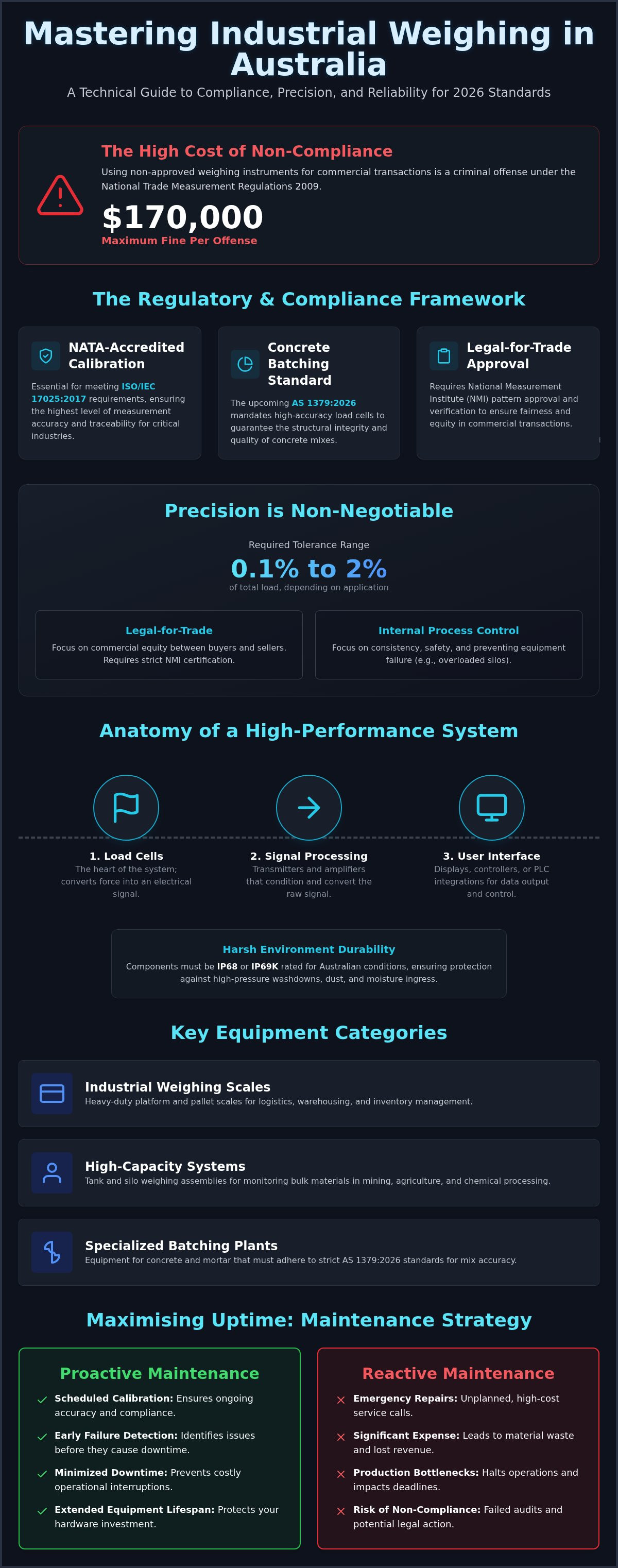
Financial consequences for weighing inaccuracies in high-volume production are severe. Using a non-approved instrument for trade is a criminal offense under the National Trade Measurement Regulations 2009, carrying fines of up to $170,000 per offense. Beyond legal penalties, even a 1% margin of error in a high-throughput facility results in massive material waste or over-supplied product. For a business processing thousands of tonnes of aggregate or cement monthly, these small deviations compound into hundreds of thousands of dollars in annual revenue loss. Reliability in measurement is a direct safeguard for your profit margins.
The Critical Role of Precision in Heavy Industry
Precision requirements differ significantly between legal-for-trade applications and internal process controls. Legal-for-trade systems require National Measurement Institute (NMI) pattern approval and on-site verification to ensure commercial equity between buyers and sellers. Conversely, internal process controls focus on consistency, safety, and structural integrity. Overloaded silos or hoppers pose severe structural risks; accurate weighing is the primary defense against catastrophic equipment failure and workplace safety incidents. Industrial weighing precision in 2026 is defined as the repeatable ability of a measurement system to maintain tolerances within 0.1% to 2% of the total load, depending on the specific Australian Standard and application requirements.
Key Categories: From Platform Scales to Batching Plants
Industrial systems are categorized by their application and capacity requirements. Heavy-duty hardware differs from commercial scales through higher IP ratings, stainless steel load cell construction, and the ability to withstand repetitive shock loading. Essential categories include:
- Industrial weighing scales: These include heavy-duty platform and pallet scales used in warehouse environments for logistics and inventory management.
- High-Capacity Systems: Large-scale tank and silo weighing assemblies are essential for monitoring bulk materials in mining, agriculture, and chemical processing.
- Concrete and Mortar Equipment: Specialized batching plants must adhere to the updated AS 1379:2026 standards, requiring high-accuracy load cells to ensure the structural integrity of the final mix.
Selecting the correct category ensures that the weighing chain can handle the specific stresses of your facility layout without compromising signal integrity or calibration longevity.
Essential Components of a High-Performance Weighing System
High-performance industrial weighing equipment Australia relies on a seamless "weighing chain" where every component must be electrically and mechanically matched. If a high-precision sensor is paired with a low-quality transmitter, the resulting signal degradation renders the entire system unreliable. Stability is achieved only when sensors, signal processing units, and user interfaces function as a unified circuit. For Australian facilities requiring frequent washdowns, components must carry IP68 or IP69K ratings. These standards ensure the hardware is hermetically sealed against high-pressure water jets and total immersion, preventing the moisture ingress that causes signal drift in regional processing plants.
Load Cells: The Heart of Industrial Measurement
Precision begins with load cells, which are transducers that convert mechanical force into measurable electrical signals. Selection depends on the specific application: compression cells for silos, tension cells for suspended hoppers, and beam cells for platform scales. In heavy industry, failure is typically caused by shock loading, side-loading, or lightning strikes. Choosing the correct capacity and mounting hardware is critical to prevent these mechanical failures. It's vital to ensure that your load cell selection aligns with the expected environmental stresses of your facility to avoid premature replacement costs.
Indicators, Displays, and Signal Conditioners
Data visibility is managed by indicators and displays, providing operators with real-time mass readings. For automated systems, conditioners and transmitters convert these signals into industry-standard protocols like 4-20mA or Modbus for PLC integration. To protect the integrity of this data, the National Measurement Institute (NMI) sets strict guidelines for instruments used in trade, ensuring that the entire signal path maintains accuracy from the sensor to the final display. Protecting this delicate electronics requires junction boxes and surge arrestors to mitigate electrical interference and voltage spikes common in outdoor installations.
Future-proofing your system involves integrating digital connectivity and IoT capabilities. These modern systems allow for predictive maintenance and remote monitoring, enabling facility managers to track performance metrics and identify potential issues before they cause a total system shutdown. If your current setup shows signs of signal instability, reviewing our complete range of technical components can help identify the necessary upgrades for your weighing chain.
Navigating Australian Standards: AS 1379 and NATA Accreditation
Operating high-capacity industrial weighing equipment Australia requires more than just functional hardware; it demands a rigorous adherence to national metrology standards. There is a critical legal distinction between a standard "calibration check" and a NATA-accredited calibration. A standard check confirms that a scale is currently accurate, but it lacks the third-party validation required for high-stakes audits or legal-for-trade compliance. In contrast, NATA-accredited calibration provides an unbroken chain of traceability to national standards, ensuring that your measurements are legally defensible and technically sound under ISO/IEC 17025:2017.
The Importance of NATA Accreditation
For industries where measurement error translates to safety risks or regulatory fines, NATA Accreditation is the non-negotiable benchmark for technical competence. Choosing NATA-endorsed calibration services ensures that the laboratory has been independently assessed for its equipment, staff expertise, and methodology. While a NATA-endorsed calibration typically costs between $45 and $155 more than a non-accredited check, this premium covers the administrative and technical rigor required to pass government and industry audits. Without this accreditation, your internal records may be deemed insufficient during an NMI inspection or a liability claim.
Compliance with AS 1379 for Concrete Batching
The construction sector is governed by specific requirements, most notably the updated AS 1379:2026 standard published on May 22, 2026. This standard mandates that weighing systems in concrete batching plants undergo verification at least every six months. Compliance requires adhering to strict accuracy tolerances: cement weighing systems must maintain ±1% of the required mass, while aggregate systems are held to a ±2% tolerance. Professional concrete batching plant calibration provides the necessary certification to prove these tolerances are met. Maintaining these records is essential for satisfying the quality assurance protocols required by major infrastructure projects across Australia.
Robust documentation acts as your primary defense against liability. Each calibration event must generate an audit trail that includes the date of testing, the specific standards used for comparison, and the identified "as found" and "as left" values. This methodical approach to record-keeping ensures that if a batch fails a structural test or an inspector arrives on-site, you have immediate, incontrovertible proof of compliance. Implementing these standards doesn't just satisfy the law; it protects your business from the catastrophic costs of product recalls or structural failures.
Industry-Specific Weighing Solutions and Applications
Customizing industrial weighing equipment Australia requires an engineering-led approach to facility integration. Standardized hardware kits rarely account for the structural nuances of regional Australian processing plants, where extreme temperature fluctuations and structural shifting can compromise signal integrity. For heavy lifting and rigging sectors, special purpose weighing solutions such as shackle pins and tension measurement tools are essential. These components allow for force monitoring in applications where traditional platform scales are impractical. By solving accuracy issues through bespoke hardware selection, facilities can eliminate the production bottlenecks caused by unreliable data.
Silo, Hopper, and Tank Weighing
Integrating tank and silo weighing assemblies into existing infrastructure is a primary method for achieving automated inventory management. However, hopper calibration in dusty or outdoor environments faces significant challenges, including wind loading and material buildup on the vessel exterior. To maintain precision, installation best practices must be followed to prevent mechanical binding. This involves:
- Utilizing self-aligning mounting kits to mitigate side-loading forces.
- Installing stay rods to stabilize the vessel against lateral movement without affecting the vertical load.
- Ensuring flexible piping connections to prevent "force shunting," where the pipe supports the weight instead of the load cell.
Using mass-based measurement for level control is inherently more reliable than volumetric sensors. While radar or ultrasonic sensors measure the top surface of a material, load cells measure the actual mass. This provides an accurate reading regardless of material bridging, dust clouds, or varying material densities inside the silo.
Liquid Flowmeter Calibration
In high-precision sectors like chemical processing and food production, liquid flowmeter calibration using the weighing method is the preferred technical standard. Mass measurement is superior to volumetric checking because it's unaffected by changes in liquid temperature, viscosity, or pressure. By capturing the liquid in a vessel on a high-precision scale and comparing the mass to the flowmeter’s reading, technicians can identify even the smallest discrepancies. This level of accuracy is vital for maintaining strict batch consistency and meeting regulatory quality standards.
To ensure your specific facility layout is optimized for precision and compliance, contact our team to discuss a tailored industrial weighing scale calibration and maintenance plan.
Maximising Uptime: Maintenance, Repair, and Lifecycle Support
The true cost of downtime in high-volume production far exceeds the invoice for a technician's call-out. When industrial weighing equipment Australia fails, the resulting production bottlenecks lead to missed delivery windows and wasted labor hours. Reactive repair is inherently more expensive than proactive maintenance because it often involves emergency shipping of parts and unplanned labor premiums. Identifying failure points early is essential for operational continuity. Common indicators of system degradation include erratic signal behavior, physical corrosion of mounting hardware, or a persistent inability to return to zero after a load is removed.
Selecting a service partner requires vetting for deep technical expertise across both electrical and mechanical domains. A technician must understand the structural mechanics of a silo or hopper just as well as the digital signal processing of a transmitter. This dual proficiency ensures that faults are diagnosed correctly the first time, preventing the cycle of "parts-swapping" that characterizes less experienced providers. A national service network with established infrastructure provides the responsiveness needed to mitigate these risks effectively.
Load Cell Testing and Diagnostic Services
Expert load cell calibration involves more than just verifying accuracy; it requires a systematic diagnostic approach to the entire weighing chain. Technicians perform millivolt-per-volt output checks to identify internal bridge imbalances within the sensor. Diagnostic signs of a drifting load cell include non-repeatable zero returns and fluctuating weight readings when a static, known load is applied. Beyond the sensors, system re-zeroing and indicator programming are necessary to compensate for changes in dead load or environmental interference. These methodical adjustments restore the system to its peak operational state, ensuring compliance with the ISO/IEC 17025:2017 standards discussed in previous sections.
Partnering with Independent Scale Service
Independent Scale Service maintains a commitment to NATA-accredited excellence across the Australian industrial landscape. Our primary hubs in Sydney and Melbourne are strategically positioned to provide rapid responsiveness to both metropolitan and regional operations. We provide a comprehensive technical lifecycle that spans from initial supply to specialized repair. Whether your facility requires routine force gauge calibration or an emergency overhaul of a concrete batching plant, our team delivers the technical competence required for serious industrial clients. Ensuring your equipment remains compliant with AS 1379:2026 is our priority. Request a quote for plant servicing to secure your facility's long-term reliability and minimize the risk of costly regulatory penalties.
Securing Your Operational Precision for 2026 and Beyond
Maintaining high-capacity industrial weighing equipment Australia requires a methodical approach to both hardware selection and regulatory adherence. Precision isn't merely a technical preference; it's a legal and financial necessity. Adhering to the updated AS 1379:2026 standards and maintaining NATA-accredited calibration records under ISO/IEC 17025 are the primary methods for mitigating liability and ensuring batch consistency. By integrating matched components and following a proactive maintenance lifecycle, your facility can eliminate the production bottlenecks that stem from measurement drift or mechanical failure.
Expertise in both electrical diagnostics and mechanical structural integrity is the differentiator between a temporary fix and long-term reliability. Independent Scale Service provides this comprehensive support through our specialized hubs in Sydney and Melbourne, serving regional industrial operations nationwide. You don't need to wait for a failed audit or a system breakdown to address your measurement accuracy. Contact Independent Scale Service for NATA-Accredited Calibration and Supply to secure your facility's compliance and operational uptime. We're ready to assist you in mastering the complexities of modern industrial weighing.
Frequently Asked Questions
What is the difference between NATA calibration and standard calibration?
NATA calibration is performed by a laboratory accredited to ISO/IEC 17025:2017, providing an unbroken chain of traceability to national standards. Standard calibration is a functional check of accuracy but lacks the formal certification required for legal-for-trade use or high-compliance audits. While standard checks are useful for internal process monitoring, NATA-endorsed certificates are the only documents recognized as legally defensible by Australian regulatory bodies and government inspectors during an audit.
How often should concrete batching plants be calibrated in Australia?
Under the updated AS 1379:2026 standard, weighing systems in concrete batching plants must undergo verification at least every six months. This frequency is a mandatory requirement for maintaining the structural integrity of the concrete supply. Regular calibration ensures that cement weighing systems stay within the ±1% tolerance and aggregate systems remain within ±2%. Failure to adhere to this six-month cycle results in non-compliance during industry audits or project-specific quality inspections across Australia.
Can a damaged load cell be repaired, or must it be replaced?
A damaged load cell can often be repaired if the fault is related to cable damage or minor mechanical binding, but internal bridge failures usually require a full replacement. Technicians perform millivolt-per-volt diagnostic tests to determine if the internal strain gauges are compromised. If the sensor body is deformed or the internal electronics have suffered a surge, replacement is the only way to guarantee the precision of your industrial weighing equipment Australia.
What are the requirements for AS 1379 compliance?
Compliance with AS 1379:2026 requires meeting strict accuracy tolerances for all batching ingredients and maintaining a comprehensive audit trail. Cement systems must be accurate to ±1%, aggregates to ±2%, and water or chemical admixtures to ±3%. You must keep detailed calibration certificates that show "as found" and "as left" values, the date of service, and the traceability of the test weights used. These records must be available for immediate government inspection.
Does Independent Scale Service provide on-site calibration in regional Australia?
Independent Scale Service provides comprehensive on-site calibration and repair services across regional Australia, supported by our primary hubs in Sydney and Melbourne. Our technicians are equipped to perform specialized testing on hoppers, silos, and batching plants in remote industrial environments. We maintain a commitment to minimizing client downtime by offering responsive servicing and technical support to ensure regional operations remain compliant with national measurement standards without requiring expensive equipment transport or extended shutdowns.
What is the benefit of using the weighing method for flowmeter calibration?
The weighing method for flowmeter calibration is superior because it measures actual mass, which is unaffected by changes in liquid temperature, viscosity, or aeration. Volumetric checks can be misleading if the liquid's density fluctuates during the test. By capturing the liquid on a high-precision scale and comparing the mass to the flowmeter reading, you achieve the highest possible accuracy for chemical processing and food production batches where consistency and quality control are non-negotiable requirements.
How do I know if my industrial scale needs NATA accreditation?
Your industrial scale needs NATA accreditation if the measurements are used for legal-for-trade transactions, government contracts, or if you operate under ISO quality management systems. It's essential for any application where an inaccurate reading could lead to legal liability, safety risks, or regulatory fines. If your business is subject to external audits by NATA or industry-specific bodies, having an ISO/IEC 17025 accredited calibration certificate is typically a mandatory requirement for maintaining your operational compliance.
What industries require ISO/IEC 17025 accredited calibration?
Industries that require ISO/IEC 17025 accredited calibration include construction, mining, pharmaceuticals, and food processing. These sectors rely on high-precision industrial weighing equipment Australia to ensure product safety and structural integrity. For example, concrete batching plants must meet these standards to comply with AS 1379. Any industry where technical competence and measurement traceability are audited by third parties or government agencies will necessitate calibration from an accredited laboratory to verify and document system accuracy.
