


Industrial Load Cell Repair: The Technical Guide to Restoring Accuracy and Compliance
For an Australian manufacturer, unplanned downtime can cost as much as A$427 per minute. When a load cell fails, the immediate impact goes beyond a halted production line. It introduces the risk of wasted materials and severe non-compliance with AS 1379. You likely recognize that maintaining precision isn't just about operational efficiency; it's a legal necessity under the National Measurement Act.
This technical guide focuses on the critical process of industrial load cell repair, offering a clear path to restoring weighing accuracy and securing NATA-accredited certification. We'll outline how to diagnose faults, determine when a component must be replaced to meet ISO/IEC 17025 standards, and ensure your equipment is correctly re-verified by a Licensed Servicing Entity. By understanding these technical requirements, you can minimize downtime and protect your facility from the costly penalties and remediation expenses associated with inaccurate batching.
Key Takeaways
- Identify the root cause of weighing inaccuracies by distinguishing between mechanical interference and electronic sensor failures.
- Determine the financial viability of industrial load cell repair by analyzing structural damage and zero-balance shifts against the cost of replacement.
- Maintain strict compliance with AS 1379 and ISO/IEC 17025 through mandatory NATA-accredited calibration and re-verification.
- Utilize specialized diagnostic tools like bridge resistance and Megger testing to detect moisture ingress before it causes total system failure.
- Reduce unplanned downtime and material waste by implementing professional restoration for high-capacity weighing systems.
Identifying Common Industrial Load Cell Failures
Effective industrial load cell repair starts with a precise diagnosis. Technicians must first determine if the inaccuracy stems from a mechanical obstruction or a core electronic failure. Understanding what a load cell is and how its internal strain gauge bridge functions is essential for this process. While mechanical issues often involve external binding, electronic failures usually relate to internal insulation breakdown or bridge imbalance.
Common failure modes include:
- Mechanical Interference: Debris or structural contact points that prevent the sensor from deflecting naturally.
- Moisture Ingress: Fluid penetrating the IP-rated seals, causing erratic readings and insulation leakage.
- Signal Drift: Gradual shifts in the output signal that compromise batching accuracy.
- Physical Damage: Severed cables, crushed connectors, or warped mounting plates.
Symptoms of Load Cell Signal Drift
Signal drift is a frequent indicator that a sensor requires professional intervention. If a scale refuses to return to a stable zero after unloading, it often suggests a permanent zero shift in the strain gauge. This can result from overloading or metal fatigue. Temperature fluctuations also play a role; uncompensated sensors may show varying weights as ambient heat changes. It's critical to verify if the drift originates in the load cell itself or if the digital indicator is malfunctioning. A technician will use a millivolt simulator to isolate the indicator and confirm the fault's source.
Environmental Impact on Industrial Sensors
Industrial environments subject sensors to extreme conditions that lead to premature degradation. High-pressure washdowns and chemical exposure can eventually bypass even high IP-rating seals, leading to internal corrosion. Power surges or lightning strikes often cause catastrophic bridge failure, necessitating immediate replacement rather than repair. In large-scale installations, mechanical binding is a primary concern. Hardened debris or misaligned components in tank and silo weighing assemblies can shunt the load. This prevents the full weight from reaching the sensor, resulting in consistently low readings and non-repeatable results. Regular inspection of these assemblies is a requirement for maintaining AS 1379 compliance and ensuring industrial load cell repair efforts are successful.
The Technical Process of Load Cell Diagnostics and Repair
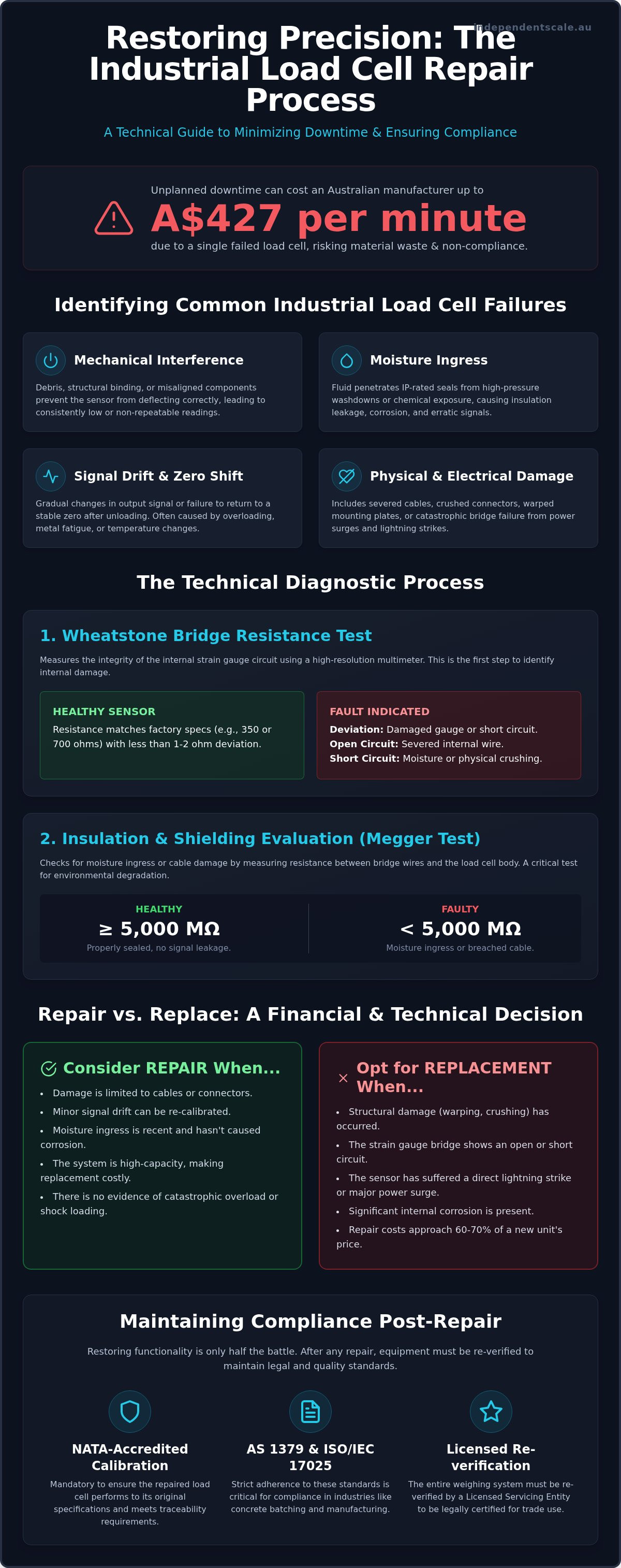
Diagnostics aren't subjective; they're governed by precise electrical tolerances. When performing industrial load cell repair, technicians follow a methodical sequence to isolate the failure point within the Wheatstone bridge or the surrounding circuitry. This process ensures that any restoration effort meets the stringent technical requirements for weighing devices, similar to those outlined in the NIST Handbook 44. Systematic testing prevents the premature disposal of viable sensors and ensures that repairs are grounded in hard data.
Wheatstone Bridge Resistance Testing
Testing begins with measuring the bridge resistance using a high-resolution digital multimeter. Technicians check the resistance between the excitation leads (input) and the signal leads (output) to confirm the integrity of the strain gauge circuit. A healthy bridge typically shows standard values, such as 350 or 700 ohms, depending on the sensor's design.
- Resistance Deviations: A reading that deviates by more than 1 or 2 ohms from the original factory calibration sheet usually indicates a damaged strain gauge or an internal short circuit.
- Open Circuits: These often point to a severed internal wire or a catastrophic overload event that has physically broken the circuit.
- Short Circuits: Drastic drops in resistance confirm that the bridge has been bypassed, often due to moisture or physical crushing of the internal components.
Insulation and Shielding Evaluation
Insulation integrity is the most common casualty of environmental degradation in Australian industrial sites. We use an insulation tester, or Megger, to check the resistance between the bridge wires and the load cell body. A healthy sensor should show a resistance of at least 5,000 megohms. Readings below this threshold confirm moisture ingress or a breached cable jacket, which creates a leakage path that corrupts the signal. Signal protection relies heavily on the integrity of junction boxes and surge arrestors, which shield the system from external electrical noise and voltage spikes.
In mobile or vibratory equipment, cable fatigue is a primary suspect. Technicians perform a "wiggle test" while monitoring the multimeter to catch intermittent signal drops that occur during operation. Once electrical integrity is confirmed, we verify the zero-balance. A shift exceeding 1% of the rated output suggests structural deformation of the load cell element. If your equipment shows these symptoms, arranging a professional load cell calibration is the fastest way to confirm whether the unit can be saved or requires replacement. This diagnostic rigor ensures that industrial load cell repair results in a system that is both accurate and compliant.
Repair vs. Replace: Evaluating the ROI of Industrial Weighing
Deciding between industrial load cell repair and full replacement requires a methodical ROI analysis. This decision isn't merely about the component's purchase price; it must factor in the cost of extended downtime, which can reach A$427 per minute for Australian manufacturers. Technicians evaluate the unit's age, the severity of the electrical failure, and the availability of replacement stock to determine the most efficient path forward. While standard sensors are often readily available, specialized equipment presents a different challenge.
Lead times are a critical variable. For special purpose load cells and custom-engineered shackle pins, sourcing a new unit from international manufacturers can take several weeks. In these scenarios, immediate technical repair often proves more cost-effective than waiting for a shipment. However, if the repair cost approaches 50% of the price of a new high-capacity unit, and that unit is in stock, replacement is usually the technically superior choice for long-term reliability.
When Repair is the Logical Choice
Repair is the standard recommendation when the core sensing element remains structurally sound. Technicians can effectively restore units suffering from peripheral damage without compromising NATA compliance. Repair is prioritized in the following instances:
- Discontinued Equipment: Restoring discontinued or custom-built weighing assemblies where a modern equivalent wouldn't fit the existing mounting hardware.
- Peripheral Failures: Addressing damaged cables, compromised connectors, or terminal corrosion within the junction box.
- Urgent Restoration: Situations where the cost of production downtime significantly outweighs the expense of a precision technical restoration.
When Replacement is Mandatory
There are technical thresholds where industrial load cell repair is no longer viable or safe. When the physical properties of the load-bearing element are compromised, the sensor can't be legally re-verified for trade use. Replacement is mandatory in these cases:
- Structural Deformation: If a zero-balance shift exceeds 1% of the rated output, it indicates metal fatigue or catastrophic overloading. This change is permanent and cannot be recalibrated out.
- Hermetic Seal Failure: In high-accuracy stainless steel cells used in corrosive environments, a breach in the hermetic seal leads to internal oxidation that makes the sensor permanently unstable.
- System Modernization: When existing sensors are incompatible with modern load cell conditioners and transmitters, upgrading the entire weighing chain provides better data integrity and IIoT integration.
Choosing to replace also provides an opportunity to reset the equipment's service life and ensure full compliance with current AS 1379 standards. Our technicians provide a clear fault cause analysis during the diagnostic phase to help you make this determination based on factual data rather than guesswork.
Maintaining Compliance: Post-Repair Calibration and Standards
A technical restoration isn't complete until the equipment is legally recertified. Under the National Measurement Act, any industrial load cell repair that involves breaking a seal or adjusting the internal bridge voids the existing verification. The device must be re-verified by a Licensed Servicing Entity (LSE) before it returns to trade service. Corporations using non-verified scales face fines up to A$222,000 per offense; this makes post-repair compliance a critical financial safeguard for your operations.
AS 1379 Compliance for Concrete Plants
For the construction sector, concrete batching plant calibration is a non-negotiable safety requirement. AS 1379 mandates strict tolerances for weighing systems to ensure batch repeatability and structural integrity. A repaired sensor that hasn't been properly calibrated can lead to a 1% batching error. In a 2024 Sydney case, such an error resulted in remediation costs exceeding A$85,000 for a single project. Accurate weighing ensures that the water-to-cement ratio remains consistent, protecting the concrete's design strength and meeting the audit requirements of major Australian infrastructure projects.
The NATA Accreditation Framework
Compliance is verified through the NATA accreditation framework, specifically ISO/IEC 17025. This international standard confirms the technical competence of the calibration laboratory. There's a significant difference between a standard check and a NATA-accredited calibration. A standard check simply confirms the scale is operational. An accredited calibration provides a traceable audit trail with documented uncertainties. This level of precision is essential for industrial clients who must maintain ISO 9001 quality systems or satisfy regulatory inspections by the National Measurement Institute (NMI). You can find detailed technical requirements in our guide to load cell calibration.
Every successful repair concludes with the issuance of a NATA-endorsed certificate. This document serves as legal proof of accuracy and is a mandatory component of any industrial audit trail. It records the "as found" and "as left" data, providing a clear history of the equipment's performance. If your facility requires urgent compliance testing to minimize downtime, contact us to schedule an on-site weighing scale calibration today.
Expert Industrial Load Cell Repair in Sydney and Melbourne
Independent Scale Service has supported the Australian industrial sector for over 30 years. We provide specialized technical support for complex weighing systems across Sydney, Melbourne, and regional Australia. Our 30-year tenure is built on a foundation of technical proficiency and a strict adherence to NATA-accredited standards. We recognize that industrial load cell repair is a time-critical requirement. By maintaining a local presence in major industrial hubs, we reduce the response times that otherwise lead to extended production stoppages.
Our service model integrates on-site diagnostics with full-system restoration. We don't just address the sensor; we evaluate the entire weighing chain. This includes the mechanical mounting, the junction box integrity, and the digital indicator performance. This holistic approach ensures that once a repair is complete, the subsequent weighing scale calibration yields results that are both accurate and repeatable.
Comprehensive Diagnostic and Maintenance Solutions
Technical faults often extend beyond the load cell itself. Our technicians are experts in indicator programming and system integration, ensuring that repaired components communicate correctly with your existing PLC or data management software. We provide a definitive fault cause analysis for every service call, distinguishing between electrical surges, moisture ingress, or mechanical binding. For maintenance teams looking to deepen their technical knowledge of these systems, we recommend reviewing The Essential Guide to Industrial Load Cells.
Responsive Service for Regional and Metro Australia
Infrastructure projects and manufacturing facilities in Sydney and Melbourne require immediate technical intervention when weighing systems fail. We maintain a fleet of service vehicles equipped with high-precision diagnostic tools and NATA-traceable test weights. This allows us to perform on-site hopper and silo calibration without the need to transport heavy equipment to a laboratory.
If our diagnostic process reveals that a component has suffered catastrophic structural failure, we offer an immediate transition to supply. We stock a comprehensive range of industrial load cells to ensure your facility returns to operational status without waiting for international shipping lead times. This integrated approach to industrial load cell repair and supply positions us as a single-point solution for maintaining compliance and operational continuity in the most demanding Australian environments.
Secure Your Facility’s Operational Reliability and Compliance
Maintaining the integrity of your weighing systems requires more than simple mechanical adjustments. It demands a rigorous diagnostic approach to identify whether a failure is structural or electronic. By choosing professional industrial load cell repair, you ensure that your equipment is restored to its original technical specifications while maintaining full compliance with AS 1379 and ISO/IEC 17025 standards. This methodical restoration process protects your facility from the significant financial penalties associated with inaccurate trade measurement and material waste.
Independent Scale Service brings over 30 years of Australian industrial experience to every site visit. As NATA-accredited experts, we provide the technical certainty needed to minimize downtime and avoid the legal risks of non-compliance. Whether you require on-site diagnostics for a concrete batching plant or laboratory calibration for specialized sensors, our methodical process delivers results you can depend on for long-term accuracy. We're committed to keeping your operations running at peak proficiency.
Don't let inaccurate batching or equipment failure compromise your production schedule. Request an Industrial Load Cell Diagnostic or Repair Service to secure your facility's operational reliability today. We look forward to helping you maintain a precise and compliant weighing environment.
Frequently Asked Questions
Can a load cell with a cut cable be repaired?
Yes, a cut cable is a common reason for industrial load cell repair. If the damage is external to the sensor body, the cable can be spliced or replaced entirely. Technicians must ensure the new connection is environmentally sealed to prevent moisture ingress. Following the repair, the system requires a full calibration. This confirms that the cable's resistance hasn't introduced a span error into the weighing signal.
How do I know if my load cell is faulty or if it is the indicator?
Technicians use isolation testing to distinguish between these components. We connect a millivolt simulator to the digital indicator to verify its ability to process signals accurately. If the indicator functions correctly, we then test the load cell's Wheatstone bridge using a high-precision multimeter. This process identifies whether the fault is an electronic failure in the sensor, a damaged cable, or a malfunction within the display unit's processing board.
Is it cheaper to repair or replace an industrial load cell?
Repair is typically the more cost-effective option for peripheral issues like cable damage or terminal corrosion. However, if the sensor has suffered structural deformation or a significant zero-balance shift, replacement is the only viable solution. You must also consider the cost of downtime. If a specialized replacement unit has a long lead time, a technical repair may be necessary to return the plant to operational status quickly.
Will a repaired load cell still be NATA compliant?
A repaired unit is only NATA compliant once it has been recalibrated by an accredited laboratory. Any industrial load cell repair that breaks the original manufacturer's seal or involves soldering the bridge circuit voids the previous certification. To restore compliance, the technician must perform a multi-point calibration to ISO/IEC 17025 standards. This ensures the equipment meets the legal requirements for trade and passes industrial audits.
How long does a typical industrial load cell repair take?
The duration of a repair depends on the fault's complexity. On-site diagnostics and minor terminal repairs can often be completed within a few hours to minimize immediate downtime. More extensive repairs, such as full cable replacements or laboratory-grade bridge balancing, typically take 24 to 48 hours. This timeframe includes the essential post-repair calibration and verification steps required to ensure the system returns to service in a fully compliant state.
What are the signs of a failing load cell in a concrete batching plant?
In concrete production, failing sensors often manifest as inconsistent batch weights or a refusal to return to zero after discharge. You might notice signal drift where the weight reading fluctuates without a change in load. These inaccuracies compromise the water-to-cement ratio, leading to potential structural issues. Regular inspections of the weighing assemblies are vital to detect mechanical binding or moisture ingress before they cause total system failure.
Can moisture inside a load cell be fixed?
Moisture ingress is difficult to resolve permanently because it often causes internal oxidation of the strain gauges. While some non-hermetically sealed units can be dried and resealed, their long-term stability is usually compromised. For high-accuracy applications or stainless steel cells, moisture inside the body typically indicates a seal breach. In these cases, replacement is the standard recommendation to prevent erratic readings and maintain strict AS 1379 compliance.
What is the standard for load cell accuracy in Australia?
Load cell accuracy in Australia is governed by the National Measurement Institute and specific industry standards. For commercial trade, equipment must comply with the National Measurement Act 1960. In the construction industry, AS 1379 mandates the specific tolerances for weighing systems in concrete batching plants. Compliance is verified through NATA-accredited calibration to ISO/IEC 17025, which ensures that measurements are traceable to national standards and are legally defensible during audits.
