


Industrial Load Cell Repair: The Complete Guide to Maintenance & Compliance
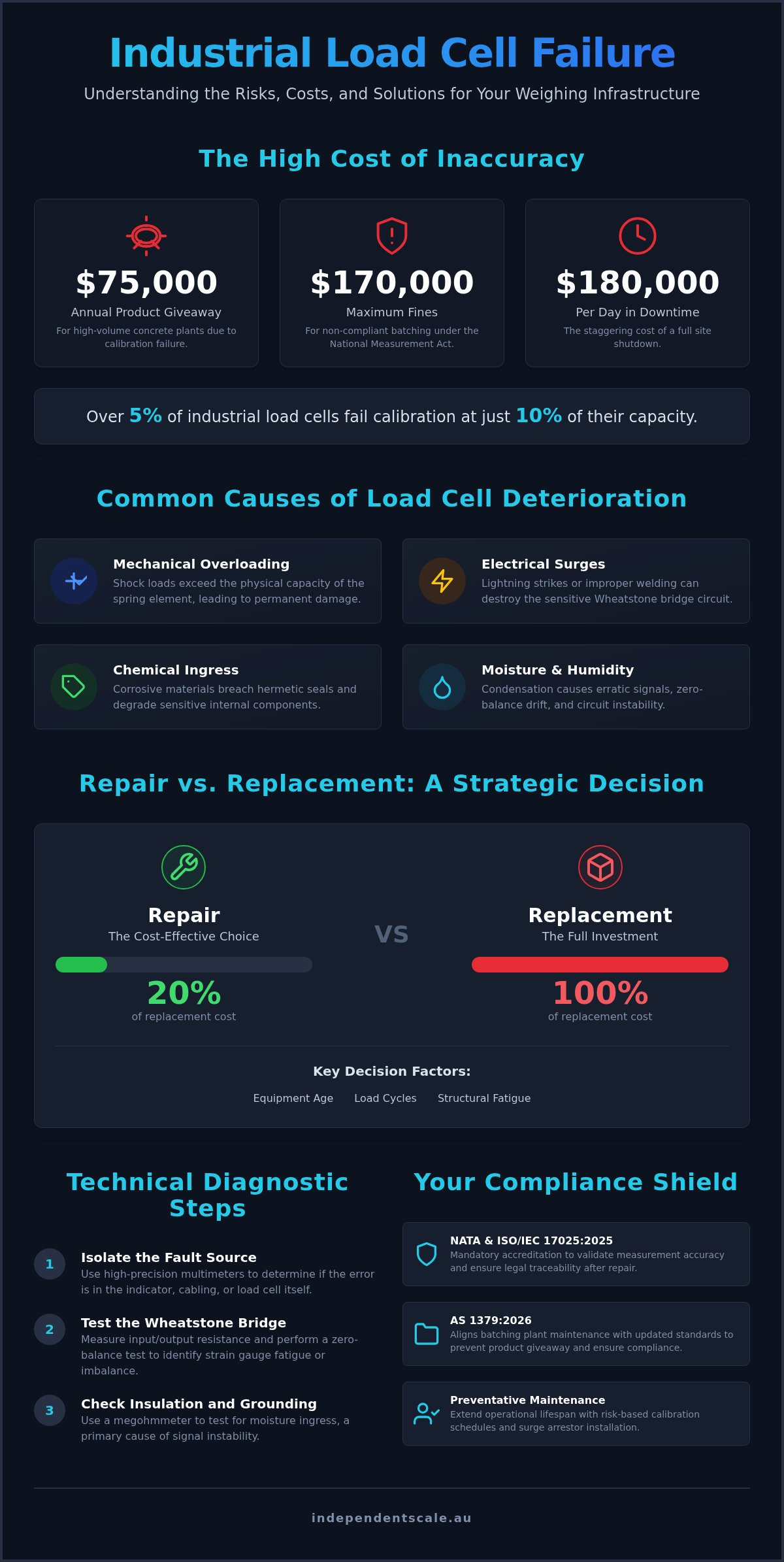
Did you know that over 5% of industrial load cells fail calibration at just 10% of their capacity; often leading to a $75,000 product giveaway annually for high-volume concrete plants? You're likely dealing with the pressure of production halts or the risk of $170,000 fines for non-compliant batching. It's frustrating when you're unsure if a fault is electrical or mechanical, especially when a site shutdown costs upwards of $180,000 per day. Professional industrial load cell repair is the only way to restore accuracy while meeting the rigorous tolerances of AS 1379:2026.
This guide provides a technical roadmap to diagnose and resolve faults while maintaining strict NATA and ISO/IEC 17025:2025 compliance. We'll analyze Wheatstone bridge circuits and the clear ROI of repair versus replacement, where fixing a unit often costs only one-fifth of the price of a new one. You'll learn to implement risk-based calibration schedules and leverage digital certification to ensure your measurements are traceable and legally defensible. This methodical approach minimizes downtime and secures the long-term reliability of your weighing infrastructure.
Key Takeaways
- Learn the methodical diagnostic steps using high-precision multimeters to accurately isolate Wheatstone bridge circuit faults and prevent misdiagnosis.
- Evaluate the cost-benefit of industrial load cell repair versus replacement by analyzing equipment age, load cycles, and structural fatigue life.
- Understand why NATA and ISO/IEC 17025:2025 accreditation is mandatory for validating measurement accuracy and maintaining legal traceability after any technical intervention.
- Discover how to extend the operational lifespan of your weighing systems through targeted preventative maintenance and the installation of surge arrestors.
- Align your batching plant maintenance with the updated AS 1379:2026 standards to ensure continuous compliance and prevent costly product giveaway.
Understanding Industrial Load Cell Failure and the Cost of Inaccuracy
Load cells act as the sensory system for every industrial weighing application. They translate physical force into measurable electrical data with high precision. To understand the engineering behind these transducers, it's helpful to review What is a Load Cell? and how it functions within a larger weighing assembly. In high-output environments like concrete batching, these components are under constant stress. Even a minor 1% deviation in measurement isn't just a technical glitch; it's a compliance emergency. For a 100-tonne cement silo, that 1% error represents a full tonne of discrepancy. This drift leads to massive product giveaway or, worse, structurally unsound concrete that fails project specifications.
Regulatory Consequences under AS 1379 and National Measurement Act
Operations must adhere to the updated AS 1379:2026 standards to remain legal. Failure to maintain accuracy levels within these specific tolerances can trigger immediate site shutdowns. Under the National Measurement Act, penalties for non-compliant batching can reach $170,000. For Victorian operators, corporate penalties for failing to maintain calibrated equipment can exceed $244,212 under the OHS Act. Professional industrial load cell repair ensures that all records are NATA accredited to ISO/IEC 17025, providing a legal shield during audits. Without these validated records, your business is exposed to significant liability and heavy fines.
Common Causes of Load Cell Deterioration
Industrial sites in Sydney and Melbourne face harsh environmental stressors that accelerate component failure. Mechanical overloading is the most frequent cause, where shock loads exceed the physical capacity of the spring element. Engaging in timely industrial load cell repair addresses these failures before they escalate into total system collapse. Other critical factors include:
- Chemical Ingress: Corrosive materials in mining or construction can breach hermetic seals and degrade internal components.
- Moisture and Humidity: Condensation inside junction boxes or cable entries causes erratic signals and zero-balance drift.
- Electrical Surges: Lightning strikes or improper welding on the scale frame can destroy the sensitive Wheatstone bridge circuit.
Identifying these issues early prevents a total system shutdown. Regular concrete batching plant calibration and repair is essential for maintaining the integrity of the weighing system. Ignoring the signs of deterioration leads to unpredictable downtime and compromised batch quality.
Technical Diagnostics: How to Troubleshoot Faulty Load Cells
Effective industrial load cell repair begins with a rigorous diagnostic sequence. Skipping steps leads to the unnecessary replacement of functional components, which inflates costs and extends downtime. A technician must first determine if the error originates in the indicator, the cabling, or the load cell itself. This requires high-precision multimeters and megohmmeters capable of measuring minute resistance changes and insulation integrity. Safety is paramount; technicians must isolate power where necessary and ensure the weighing system is physically stabilized before beginning on-site testing.
Testing the Wheatstone Bridge Circuit
The Wheatstone bridge circuit is the heart of the transducer. To diagnose a fault, measure the input resistance between excitation leads and output resistance between signal leads, then compare them to the manufacturer's data sheet. A deviation of even a few ohms often indicates a bridge imbalance. A critical diagnostic step is the zero-balance test, performed with no load on the cell. If the output signal exceeds 1% of the rated output, the spring element is likely permanently deformed. Research indicates that 5.26% of instruments fail at low-capacity points, making these initial checks vital for identifying strain gauge fatigue early. For complex diagnostics, a professional load cell calibration service provides the required precision.
Insulation and Grounding Checks
Moisture ingress is a primary cause of signal instability. Use a megohmmeter to test the insulation resistance between the bridge circuit and the load cell body. A healthy unit should show a reading greater than 5000 megohms at 50V DC. Any reading below 1000 megohms suggests moisture or chemical contamination within the housing. Technicians must also verify the shield-to-body resistance to ensure grounding integrity and protection against electrical noise. If the insulation fails, inspect the load cell cable for visible nicks or degradation. Replacing a compromised cable is often a permanent fix that restores system stability without the need for a full transducer replacement. If internal components are breached, a full load cell supply and installation may be the only compliant path forward.
Repair vs. Replacement: A Strategic Decision Framework
Deciding between industrial load cell repair and full replacement requires a methodical assessment of the component's fatigue life and operational history. Most load cell bodies are engineered to withstand 10,000,000 to 12,000,000 load cycles before metal fatigue compromises the structural integrity of the spring element. If a unit is approaching this threshold, replacement is the only reliable path to maintain AS 1379 compliance. However, for high-value components where the core element remains within tolerance, repair often provides a cost-effective solution at approximately one-fifth of the replacement price.
Lead times for specialized sensors can cause significant production halts in Sydney and Melbourne facilities. On-site repair offers an immediate alternative to waiting weeks for new stock, especially for custom-engineered systems. Technicians must evaluate the structural integrity of the body; if there's no visible yielding or corrosion on the spring element, electrical restoration is usually viable. This strategic approach ensures that you don't discard functional equipment while maintaining the strict accuracy required for industrial weighing.
When Professional Repair is the Best Option
Repairing minor cable damage or connector issues is a standard procedure that restores full functionality without the expense of a new unit. If a sensor shows stable zero drift but exhibits linearity errors, professional recalibration can often bring it back within the tolerances specified by ISO/IEC 17025:2025. This is particularly relevant for high-capacity tank and silo weighing assemblies, where the physical effort and cost of replacement are substantial. In these cases, restoring the electrical integrity of the Wheatstone bridge is the most efficient way to achieve NATA-accredited validation.
Signs a Load Cell is Beyond Economic Repair (BER)
Some failures are catastrophic and render industrial load cell repair impossible. Permanent physical deformation, known as yielding, occurs when a cell is subjected to a massive overload, making it impossible to return to a true zero balance. Severe lightning strikes can also fuse internal circuits, creating a total bridge failure that cannot be bypassed. As a general industry benchmark, if the total cost of repair and the subsequent NATA and ISO/IEC 17025:2025 validation exceeds 60% of the replacement cost, we recommend installing new hardware. This prevents the risk of recurring faults in aging equipment and ensures long-term reliability for your batching operations.
The Professional Load Cell Repair Process and NATA Requirements
A technical fix is only the first stage of a professional industrial load cell repair. In high-stakes environments, a repair is technically incomplete until the instrument has been validated through rigorous testing and certification. This process ensures the "As Left" data confirms the unit operates within the accuracy tolerances required for its specific application. Without this validation, a site operator has no objective proof of measurement integrity, which transforms a simple mechanical repair into a significant legal liability. Technicians prioritize long-term stability by ensuring all internal components are protected from environmental drift after the electrical circuit is restored.
Adherence to NATA and ISO/IEC 17025:2025 standards is mandatory for maintaining the technical competence required in Australian industry. These standards provide a framework for risk-based thinking and data integrity, ensuring that every repair is traceable to national measurement standards. For concrete batching facilities, this documentation creates a robust audit trail that satisfies the requirements of AS 1379:2026. Maintaining these records is the most effective way to protect your operation from the severe penalties associated with non-compliant batching.
NATA Accredited Calibration Post-Repair
There's a critical distinction between a standard "functional check" and a NATA-accredited calibration. While a functional check confirms the device is working, a NATA-accredited calibration provides a formal report with calculated uncertainties, which is essential for trade-legal weighing. These certificates offer vital legal protection for site owners during regulatory inspections or project audits. For a deeper understanding of these requirements, refer to our comprehensive guide to calibration services. If your equipment lacks a current NATA-endorsed report, it's considered non-compliant regardless of its physical condition.
On-Site vs. Laboratory Repair Services
Choosing between on-site and laboratory repair depends on the complexity of the fault and the urgency of the situation. Mobile service units are equipped for rapid plant restoration, which is vital when downtime costs can exceed $180,000 per day. These units perform essential tasks like cable replacement and bridge analysis directly at the hopper or silo. However, laboratory-controlled environments are superior for delicate work, such as reconstructing hermetic seals or performing high-precision Wheatstone bridge circuit analysis. Maintaining compliance during on-site concrete batching plant calibration requires specialized reference weights and hydraulic force standards to simulate material mass accurately.
To ensure your weighing systems meet all current Australian standards, book a NATA-accredited inspection today.
Maximizing Reliability: Preventative Maintenance for Load Cells
Preventative maintenance is the most effective strategy for reducing the frequency of industrial load cell repair. A structured inspection schedule allows technicians to identify signal drift or mechanical binding before these issues trigger a total plant shutdown. High-output facilities in Sydney and Melbourne should implement monthly visual inspections and quarterly technical audits to ensure ongoing compliance with AS 1379:2026. Correct installation is equally vital; ensuring the load is applied vertically prevents side loading, which is a leading cause of premature mechanical fatigue in the sensor body.
Modern weighing systems utilize advanced indicators and displays to monitor system health in real time. These digital units can track zero balance shifts and flag data outliers with high precision, providing an early warning system for potential transducer failure. By analyzing the "As Found" data during routine checks, operators can predict failure points and schedule repairs during planned maintenance windows. This proactive approach avoids the $180,000 daily downtime costs associated with emergency system failures.
Environmental Protection Strategies
Industrial environments expose sensitive electronics to moisture, dust, and electrical interference. Selecting components with the appropriate IP rating, typically IP68 or IP69K for washdown areas, is essential for long-term stability. To mitigate the risk of lightning strikes or welding-induced surges, technicians must install high-quality junction boxes and surge arrestors. These protective devices act as a barrier for the Wheatstone bridge circuit, significantly extending the operational lifespan of the weighing assembly. Routine cleaning is also necessary to remove debris from around the load cell mounts, as material buildup causes mechanical binding and measurement errors.
Partnering with Independent Scale Service
Independent Scale Service provides the technical expertise required to maintain high-stakes weighing infrastructure across Sydney and Melbourne. Our technicians are specialists in Wheatstone bridge circuit analysis and NATA-accredited diagnostic procedures. We focus on delivering precise results that minimize downtime and ensure your operation remains fully compliant with ISO/IEC 17025:2025 and AS 1379:2026. If your system shows signs of inaccuracy or erratic readings, contact us immediately for urgent load cell calibration and repair. We provide the technical assurance needed for serious industrial clients who cannot afford measurement failure.
Securing Your Measurement Integrity and Regulatory Compliance
Maintaining weighing systems requires more than just functional hardware; it demands a rigorous commitment to accuracy and legal standards. Accuracy is your primary defense against regulatory scrutiny. By implementing methodical diagnostics and preventative maintenance, you can significantly extend equipment life while avoiding the severe penalties associated with non-compliant batching. Professional industrial load cell repair ensures that every intervention is validated with NATA-endorsed documentation, providing the technical assurance required for high-stakes industrial environments.
Independent Scale Service provides specialized expertise in Wheatstone bridge circuit analysis and AS 1379 compliance. As NATA accredited specialists to ISO/IEC 17025, we support industrial sites across Sydney, Melbourne, and regional Australia. Don't let measurement drift compromise your production quality or expose your business to risk. Our team is ready to restore your system's precision and ensure your operations remain fully compliant with the latest Australian standards. Request Urgent Load Cell Repair or Calibration to secure your plant's reliability today.
Frequently Asked Questions
Can a load cell with a bent body be repaired?
No, a bent body indicates physical yielding of the spring element. This deformation is permanent and compromises the linearity and zero balance of the unit. Once the metal is deformed beyond its elastic limit, the unit is beyond economic repair. Structural damage cannot be reversed through electrical restoration. Replacement is the only compliant solution to maintain the strict accuracy tolerances required by AS 1379:2026.
How much drift is considered normal for an industrial load cell?
Normal drift is typically less than 0.1% of the rated output over a specific period, though this varies by environment. Excessive drift often signals moisture ingress or temperature-induced strain on the Wheatstone bridge. If your system exceeds the ±1% accuracy tolerance required by AS 1379:2026 for cement weighing, it requires immediate technical intervention. Monitoring drift through digital indicators helps identify these failures before they cause site shutdowns and production halts.
What is the difference between a load cell and a force gauge in terms of repair?
Load cells are transducers integrated into weighing structures, while force gauges are typically handheld or stand-mounted instruments for tension and compression testing. Repairing a load cell often involves on-site bridge analysis and cable restoration. Force gauge repair and calibration are usually laboratory-based processes. Both require NATA-accredited validation to ISO/IEC 17025 to ensure the measurement results are legally traceable and technically valid for Sydney and Melbourne operators.
How often should industrial load cells be calibrated after a repair?
An immediate NATA-accredited calibration is mandatory following any industrial load cell repair. After this initial validation, high-output facilities typically follow a six-month verification cycle as per AS 1379:2026. A risk-based approach may adjust this interval based on the stability of past "As Left" data. Regular intervals ensure that the system remains within the ±2% tolerance required for aggregate systems and prevent the risk of heavy non-compliance fines.
Is it possible to repair a load cell cable without affecting accuracy?
Yes, professional cable restoration is a common and effective part of industrial load cell repair. Technicians must maintain the original cable length and shielding integrity to prevent changes in resistance or signal interference. If the internal conductors aren't properly spliced and sealed against moisture, the resulting signal noise will degrade measurement precision. A post-repair calibration is essential to verify that the system's electrical characteristics remain within the manufacturer's original specification.
What does a "zero balance" shift indicate about a load cell’s health?
A zero balance shift indicates that the output signal has changed without a load being applied. A shift exceeding 1% of the rated output often signals permanent mechanical deformation or severe internal bridge damage. It can also be caused by moisture in the junction box or residual stress in the mounting hardware. Identifying the cause of a shift is a critical diagnostic step to determine if the unit is repairable or requires replacement.
Can I perform my own load cell diagnostics to save time?
Basic visual inspections and continuity checks can be performed by on-site staff to identify obvious mechanical binding or cable damage. However, technical diagnostics like bridge circuit analysis and insulation resistance testing require high-precision multimeters and megohmmeters. Misdiagnosis by untrained personnel often leads to unnecessary downtime or the replacement of functional components. Professional technicians provide the accredited results needed for regulatory compliance and robust audit trails in high-stakes environments.
Why is NATA accreditation important for my repair documentation?
NATA accreditation confirms that a facility has the technical competence to produce reliable data in accordance with ISO/IEC 17025. This accreditation provides legal and technical validity for your weighing records, which is essential for meeting AS 1379:2026 standards. In the event of a project audit or regulatory inspection, NATA-endorsed reports serve as proof of compliance. This documentation protects site owners from the significant liabilities and fines associated with inaccurate batching.
