


How to Choose an Industrial Weighing System: The 2026 Australian Guide
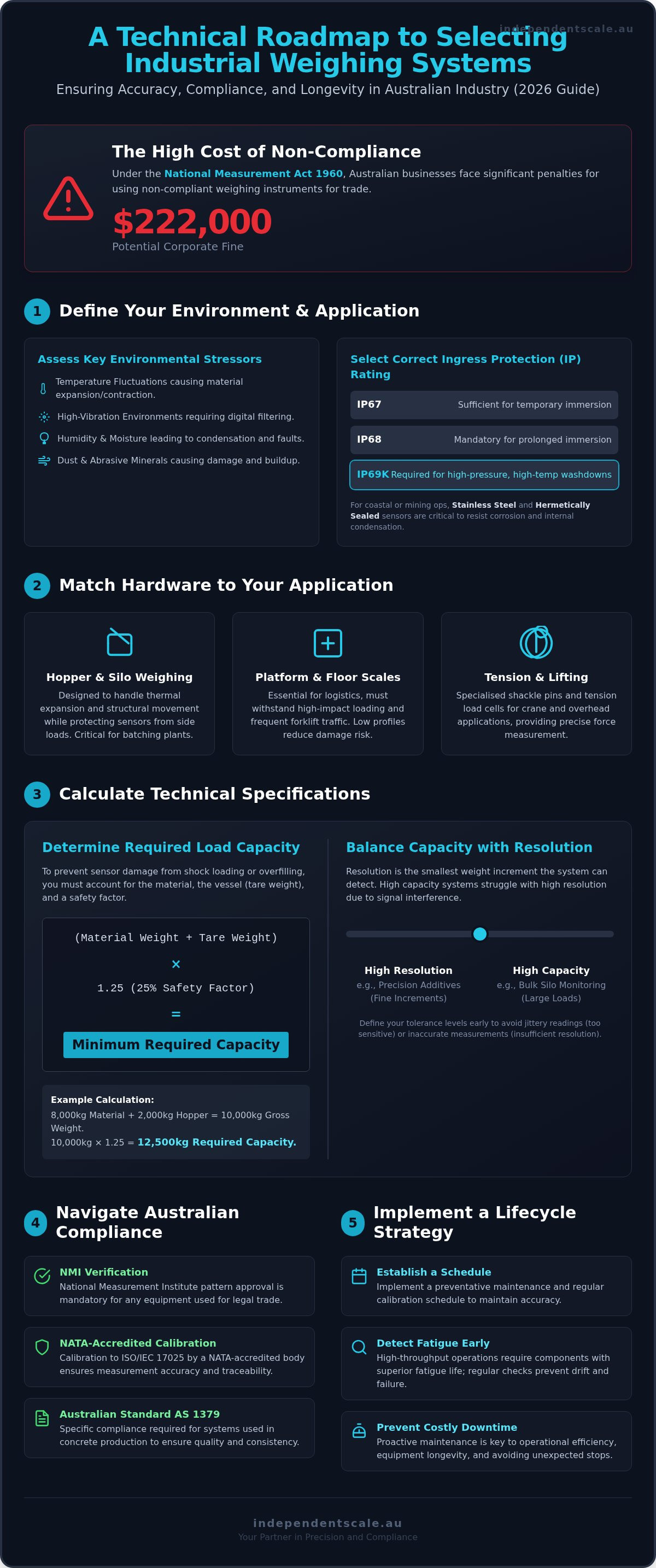
Under the National Measurement Act 1960, Australian businesses using non-compliant weighing instruments for trade face corporate fines of up to $222,000. You already know that equipment failure or inaccurate measurements lead to material wastage and project delays. It's a high-stakes environment where a single error in understanding how to choose an industrial weighing system can result in significant financial loss. You need a solution that remains accurate under harsh conditions while meeting every Australian regulatory benchmark.
This 2026 guide provides the technical roadmap to master these requirements. You'll learn to select high-precision systems that ensure full compliance with the National Measurement Institute (NMI) and Australian Standard AS 1379. We'll break down the distinction between NATA-accredited calibration and NMI verification, the necessity of pattern approval, and how robust engineering minimizes maintenance. By the end of this article, you'll have the expertise to implement a system that delivers both dependability and legal certainty.
Key Takeaways
- Identify the specific physical and environmental constraints of your facility to select load cells that resist interference and degradation.
- Ensure full regulatory compliance by prioritizing NATA-accredited calibration to ISO/IEC 17025 and meeting AS 1379 standards for concrete production.
- Master how to choose an industrial weighing system by calculating the optimal balance between maximum load capacity and required measurement resolution.
- Select high-performance indicators and signal conditioners to provide clear operator feedback and maintain data integrity across your network.
- Establish a preventative maintenance and calibration schedule to detect load cell fatigue early and prevent costly operational downtime.
Defining Your Industrial Weighing Environment and Application
The selection of a weighing system depends entirely on the physical characteristics of the material and the constraints of the installation site. Bulk solids in a hopper require different load cell configurations than liquid chemicals or individual palletized units. You must assess whether the system will be floor-mounted, suspended, or integrated into existing structures. Because there are many different types of weighing scales available, the first step in how to choose an industrial weighing system is matching the hardware to the application's physical geometry. Temperature fluctuations in regional Australia can cause significant material expansion; your system design must account for these shifts to avoid mechanical binding. High-vibration environments, such as those near heavy machinery or conveyors, require specialized digital filtering to maintain measurement stability.
Environmental Protection and IP Ratings
Australian industrial sites often present extreme stressors, including high humidity, dust, and abrasive minerals. In these conditions, the Ingress Protection (IP) rating is the primary indicator of reliability. IP67-rated sensors are sufficient for temporary immersion, but IP68 or IP69K ratings are mandatory for high-pressure washdown areas or outdoor installations. This level of protection is vital for companies like Riverina Fresh, where dairy production environments require frequent sanitisation without compromising sensor accuracy. Corrosion is a critical failure point in coastal or mining operations. While alloy steel is cost-effective for dry warehouse settings, stainless steel load cells offer the necessary resistance to chemical exposure and oxidation. Hermetically sealed sensors provide an additional layer of protection against internal condensation, which is a frequent cause of electrical fault in humid tropical environments.
Application-Specific System Types
Selecting the correct hardware architecture ensures long-term accuracy and minimal maintenance. Different applications demand specific mounting and sensor technologies to maintain precision over time.
- Hopper and Silo Weighing: These require tank and silo weighing assemblies designed to handle thermal expansion and structural movement while protecting the sensors from side loads. This is particularly vital for concrete batching plants where material buildup can affect sensor performance.
- Platform and Floor Scales: Essential for logistics, these systems must withstand high-impact loading and frequent forklift traffic. Choosing a system with a low profile reduces the risk of side-loading damage during loading and unloading.
- Tension and Lifting: For crane and overhead applications, specialised shackle pins and tension load cells provide precise force measurement without compromising structural integrity.
The frequency of weighing cycles also dictates the choice of load cells. High-throughput operations require components with superior fatigue life to prevent drift and premature failure. Understanding these environmental and application variables is the only way to ensure operational efficiency and equipment longevity.
Technical Specifications: Capacity, Resolution, and Load Cell Selection
Determining how to choose an industrial weighing system requires a precise calculation of the total system load. This calculation doesn't just involve the weight of the material. You must account for the tare weight, which includes the mass of the hopper, vessel, or platform itself. A safety factor is essential to prevent sensor damage from shock loading or accidental overfilling. For most industrial applications, a safety factor of at least 25% above the maximum expected gross weight is the technical standard. If your vessel weighs 2,000kg and holds 8,000kg of material, your sensors must collectively support a gross capacity that exceeds 12,500kg to ensure longevity and prevent structural deformation.
Required resolution is the smallest weight increment the system must detect and display. High resolution is critical for batching precision additives, whereas bulk silo monitoring often prioritizes capacity over fine increments. It's difficult to maintain extremely high resolution in high-capacity systems because the electronic signal becomes more susceptible to interference. You must define your tolerance levels early. A system that's too sensitive for its environment will exhibit jittery readings, while one with insufficient resolution will hide material wastage and lead to inaccurate inventory records.
The Role of Industrial Load Cells
At the heart of the system is the load cell. These components use strain gauge technology to translate mechanical force into a proportional electrical signal. Because load cell quality determines the baseline accuracy of the entire installation, matching the sensor geometry to the application is mandatory. S-type cells are designed for tension and suspended loads. Shear beam cells provide superior side-load resistance for floor scales. Compression cells are the standard for high-capacity silo weighing. Matching the cell's output sensitivity to the expected weight range prevents signal clipping and ensures a reliable data stream for your controllers.
Accuracy vs. Precision in Industrial Contexts
Precision is the system's ability to provide repeatable results under identical conditions. Accuracy is how closely those results align with a certified mass standard. Factors like non-linearity and hysteresis can degrade these metrics, leading to financial loss over time. Hysteresis is the difference in readings when a load is applied versus when it is removed. To ensure your system maintains its technical integrity, consider booking professional calibration services to verify performance against NATA standards. Regular verification prevents the gradual drift that often precedes total component failure and ensures your measurements remain legally defensible.
Navigating Australian Regulatory Standards and Compliance
Compliance is a non-negotiable factor when determining how to choose an industrial weighing system in Australia. The National Measurement Institute (NMI) enforces the National Measurement Act 1960, which governs any instrument used for trade. If your measurements determine the price of a product or a service fee, your system must be "Legal for Trade." This requires NMI pattern approval for the equipment design and subsequent on-site verification by a licensed technician. Operating non-compliant equipment for commercial transactions exposes your business to significant legal risk. Corporate fines for using non-verified instruments can reach up to $222,000 per offense, making regulatory adherence a core financial priority.
A common point of confusion for plant managers is the distinction between NATA accreditation and NMI verification. While NMI verification is a legal requirement for trade, NATA accreditation to ISO/IEC 17025 is the standard for technical competence and calibration accuracy. One is about the law of commerce; the other is about the science of precision. For industrial applications where safety and structural integrity are paramount, relying on NATA-accredited providers is the only way to ensure your data is technically defensible.
The Importance of NATA Accredited Calibration
NATA accreditation ensures that your measurements are fully traceable to national standards. While a standard calibration provides a basic check of accuracy, a NATA-accredited service involves independent verification of the laboratory's technical competence, equipment, and procedures. This level of oversight minimizes risk during external audits and provides a robust defense in the event of a quality dispute. It's the highest level of assurance that your weighing system is performing within its specified tolerances and that your data is reliable for high-stakes decision-making.
Compliance for Construction and Civil Engineering
In the construction sector, compliance is focused on the accuracy of material ratios to ensure structural safety. Australian Standard AS 1379 sets strict requirements for concrete batching plant calibration, often requiring tolerances within ±2%. Failure to meet these standards can lead to the rejection of entire batches or, in extreme cases, the failure of structural elements in infrastructure projects. Maintaining this level of precision requires a structured approach to equipment health.
- Calibration Cycles: AS 1379 mandates regular re-verification. Most industrial operators find that a 12-month cycle is the minimum requirement, though high-throughput sites often require more frequent testing to account for mechanical wear.
- Documentation: Detailed records of calibration results and certificates are essential for quality control. These documents are often required as part of the tender process for large-scale infrastructure projects.
- Integration: Regularly scheduled hopper calibration must be integrated into your preventative maintenance plan to identify sensor drift before it impacts production quality.
Adherence to these standards protects your operational license and ensures the safety of the final infrastructure. By prioritizing compliance from the initial selection phase, you avoid the costs associated with retrofitting or legal penalties.
System Integration: Indicators, Conditioners, and Data Management
Selecting an industrial weighing system requires looking beyond the physical load cell to the integrity of the entire signal chain. High-precision sensors are ineffective if the signal degrades before it reaches your controller. When evaluating how to choose an industrial weighing system, you must prioritize the compatibility of your sensors with your existing control architecture. You need to select conditioners and transmitters that maintain signal stability across long cable runs. These components convert the low-voltage millivolt output of a load cell into a robust 4-20mA or digital signal. Automated plant control depends on this seamless data transfer to manage batching cycles and inventory levels in real time without manual intervention.
Signal Processing and Transmission
Analog signals are susceptible to electromagnetic interference, particularly in facilities with large motors or variable speed drives. While digital load cells offer superior noise immunity, they often require specific proprietary hardware. For analog systems, the use of junction boxes and surge arrestors is mandatory to protect sensitive electronics from voltage spikes. In high-vibration manufacturing settings, conditioners with adjustable digital filters are necessary to smooth the weight data. This prevents erratic readings that can disrupt PLCs or SCADA systems and cause unnecessary system shutdowns.
User Interface and Operational Control
Operators require immediate, clear feedback to manage daily production tasks effectively. The choice of indicators and displays depends on the complexity of your application. Simple displays are sufficient for basic weight monitoring, but programmable indicators are required for complex batching or check-weighing routines. Large-scale outdoor facilities benefit from high-visibility remote displays that allow crane or truck operators to see weights from a distance, improving both safety and efficiency.
Modern weighing systems function as data entry points for your broader enterprise resource planning (ERP) systems. Integrating weighing data directly into your ERP ensures inventory accuracy and provides a timestamped audit trail for every material movement. This automation removes manual entry errors and is essential for meeting the strict reporting requirements of high-stakes industrial projects. For reliable signal chain components that ensure this level of integration, view our full range of industrial weighing hardware.
Implementing a Lifecycle Strategy: Calibration, Maintenance, and Repair
The decision making process for how to choose an industrial weighing system must extend beyond the initial installation. A robust lifecycle strategy is required to ensure the system maintains its precision under the stress of continuous operation. You must establish a preventative maintenance schedule tailored to your specific environment. Facilities in regional Australia often deal with high dust levels and extreme temperature swings, which accelerate mechanical wear. Regular inspections allow you to identify signs of load cell fatigue, such as zero-return errors or inconsistent readings, before they escalate into total system failure. Proactive management reduces the risk of unexpected downtime and prevents the financial losses associated with inaccurate batching.
Reliability in heavy industry depends on the technical competence of your service partner. When evaluating how to choose an industrial weighing system provider, prioritize those with established service footprints in Sydney, Melbourne, and regional areas. Local expertise ensures rapid response times for critical repairs and specialized knowledge of site-specific challenges. A partner capable of providing both NATA-accredited calibration and structural repairs offers a comprehensive solution for maintaining your operational integrity over the long term.
Diagnosis and Repair of Weighing Faults
System drift is often the first indicator of an underlying technical issue. Common causes include environmental changes, electrical noise, or mechanical binding where the weighing vessel makes contact with surrounding structures. The process of fault diagnosis involves systematic testing of each load cell using a millivolt meter or a dedicated load cell simulator. While minor electrical faults can sometimes be repaired, mechanical deformation or internal strain gauge damage usually necessitates a full component replacement. Choosing high-quality load cell calibration services ensures that any replacement parts are integrated correctly and that the system is re-verified to its original specifications.
Long-term Accuracy and Compliance Management
Maintaining a detailed calibration log is a mandatory requirement for both regulatory compliance and internal quality assurance. This documentation provides a traceable history of the system's performance and is essential during external audits or quality disputes. On-site calibration services minimize operational downtime by performing verification in situ, avoiding the need to dismantle complex hopper or silo assemblies. For deeper technical insights into sensor physics and selection criteria, refer to our Essential Guide to Industrial Load Cells. A structured approach to accuracy management ensures that your weighing infrastructure remains a reliable asset for years to come.
Securing Long-Term Accuracy and Regulatory Compliance
Mastering how to choose an industrial weighing system requires a methodical approach that aligns technical specifications with Australian regulatory mandates. Success depends on selecting load cells with appropriate IP ratings for harsh environments and calculating capacities that include necessary safety factors. Adherence to AS 1379 and NMI standards isn't just a legal obligation; it's a fundamental requirement for maintaining structural integrity and commercial trust. By integrating high-quality conditioners and indicators, you ensure that your data remains stable and actionable across your entire control network.
Operational efficiency is maintained through a disciplined lifecycle strategy. Regular NATA-accredited calibration to ISO/IEC 17025 standards protects your facility from the risks of measurement drift and non-compliance. Our team specializes in AS 1379 compliance and maintains an extensive inventory of high-precision components to minimize your downtime. Consult with our NATA-accredited experts for a custom weighing solution to ensure your infrastructure remains precise and legally defensible. Your facility's reliability starts with the right technical partner.
Frequently Asked Questions
How often should an industrial weighing system be calibrated?
Industrial weighing systems should be calibrated at least every 12 months to meet Australian regulatory standards. However, high-throughput facilities or those operating in harsh environmental conditions often require more frequent testing to account for mechanical wear. Regular calibration prevents measurement drift and ensures your data remains technically defensible. This schedule is a core part of learning how to choose an industrial weighing system and maintaining its long-term accuracy.
What is the difference between NATA accreditation and standard calibration?
NATA accreditation to ISO/IEC 17025 is an independent verification of a laboratory's technical competence, equipment, and procedures. While a standard calibration provides a basic accuracy check, NATA-accredited services ensure that measurements are fully traceable to national standards. This level of oversight is critical for high-stakes industrial projects and provides a robust defense during external audits or quality disputes. It represents the highest level of assurance for precision measurement.
Can I integrate new load cells into my existing batching plant hoppers?
Yes, you can integrate new load cells into existing hoppers, provided the sensor geometry and mounting assemblies match the structural requirements. This process often involves selecting specialized tank or silo weighing assemblies that handle thermal expansion and structural movement. It's essential to verify that the new sensors are compatible with your existing indicators and displays to maintain signal integrity and ensure the system remains compliant with AS 1379 standards.
What are the specific requirements for AS 1379 compliance in Australia?
AS 1379 sets strict accuracy requirements for concrete production, typically mandating measurement tolerances within ±2%. Compliance requires regular re-verification cycles and detailed documentation to ensure structural safety in civil engineering projects. Maintaining these standards involves periodic hopper and silo calibration by qualified technicians. This documentation is often a prerequisite for tendering on large-scale infrastructure projects across Sydney, Melbourne, and regional Australia.
How do I choose between an analog and a digital load cell system?
Choosing between analog and digital depends on your environment and existing control architecture. Analog systems are the industry standard but require junction boxes and surge arrestors to protect against interference. Digital load cells offer superior noise immunity in high-vibration settings but often require proprietary hardware. When determining how to choose an industrial weighing system, consider whether your priority is easy integration with standard PLCs or maximum resistance to electromagnetic signal noise.
What IP rating do I need for a weighing system in a washdown environment?
For washdown environments, an IP68 or IP69K rating is mandatory to protect against high-pressure water jets and internal condensation. While IP67 sensors are sufficient for temporary immersion, they don't provide the long-term protection required for frequent cleaning cycles. In these settings, stainless steel load cells are also recommended to prevent corrosion. Choosing the correct IP rating ensures operational reliability and prevents electrical faults caused by moisture ingress in humid industrial sites.
What causes an industrial scale to lose accuracy over time?
Industrial scales lose accuracy due to environmental stressors, mechanical binding, and component fatigue. Factors such as significant temperature fluctuations can cause structural expansion, while dust and moisture ingress can degrade electrical signals. Mechanical binding occurs when the weighing vessel makes contact with surrounding structures, leading to inconsistent readings. Regular load cell calibration is necessary to counteract this natural drift and identify hardware faults before they result in total system failure.
Is trade approval necessary for all industrial weighing applications?
Trade approval is only necessary if your weighing system is used for commercial transactions where weight determines price. Under the National Measurement Act 1960, these "Legal for Trade" instruments must have NMI pattern approval and undergo on-site verification. If your application is limited to internal process control or inventory monitoring, trade approval isn't legally required. However, many operators still choose NATA-accredited systems to ensure maximum precision and technical defensibility.
