


How Inaccurate Weighing Affects Profit: An Australian Industry Guide
What if a weighing error is costing your operation more than the material it gives away? Understanding how inaccurate weighing affects profit means looking beyond the scale reading to the costs it can trigger across production, freight, rework and customer disputes. Because these expenses often sit in separate cost centres, a small, recurring error can be difficult to spot in routine reports.
You may already track material use, production yield and freight charges. The challenge is connecting those figures to weighing performance and estimating the cumulative impact. Start with site data: identify the weighing point, what its reading controls, and which records show the resulting costs.
This guide explains where weighing errors erode margin and productivity, and how to estimate your exposure using throughput, material values and the scale’s role in your process. It also outlines practical ways to prioritise verification, calibration or repair based on measured business impact. From load cells and hoppers to industrial scales and concrete batching systems, the aim is to help you identify controls that fit your operation and support more reliable measurement.
Key Takeaways
- Trace weighing-related losses across materials, rework, rejected batches and freight to see where costs accumulate.
- Assess how inaccurate weighing affects profit by separating consistent bias from variation between repeated readings.
- Estimate exposure using your own throughput, observed weighing error, material value and affected transaction count.
- Prioritise checks at weighing points with high throughput, valuable materials or direct customer and production impact.
- Use measured findings to determine whether calibration, repair or fit-for-purpose equipment is the appropriate control.
Where inaccurate weighing quietly reduces industrial profit
A scale can be only slightly out, yet the same deviation may affect every load, batch or dispatch recorded through it. The commercial effect depends on what the reading controls: ingredient dosing, the amount invoiced, the quantity delivered or a freight calculation. That is why how inaccurate weighing affects profit cannot be judged from the size of one reading error alone. The process and number of affected transactions matter.
Industrial weighing sits within Metrology, the broader science of measurement. On site, the practical question is how each measurement informs a material, production or transaction decision. A reading may be suitable for one purpose but financially consequential for another if it sets quantities, reconciles stock or records dispatched loads.
Which profit leaks can inaccurate weighing create?
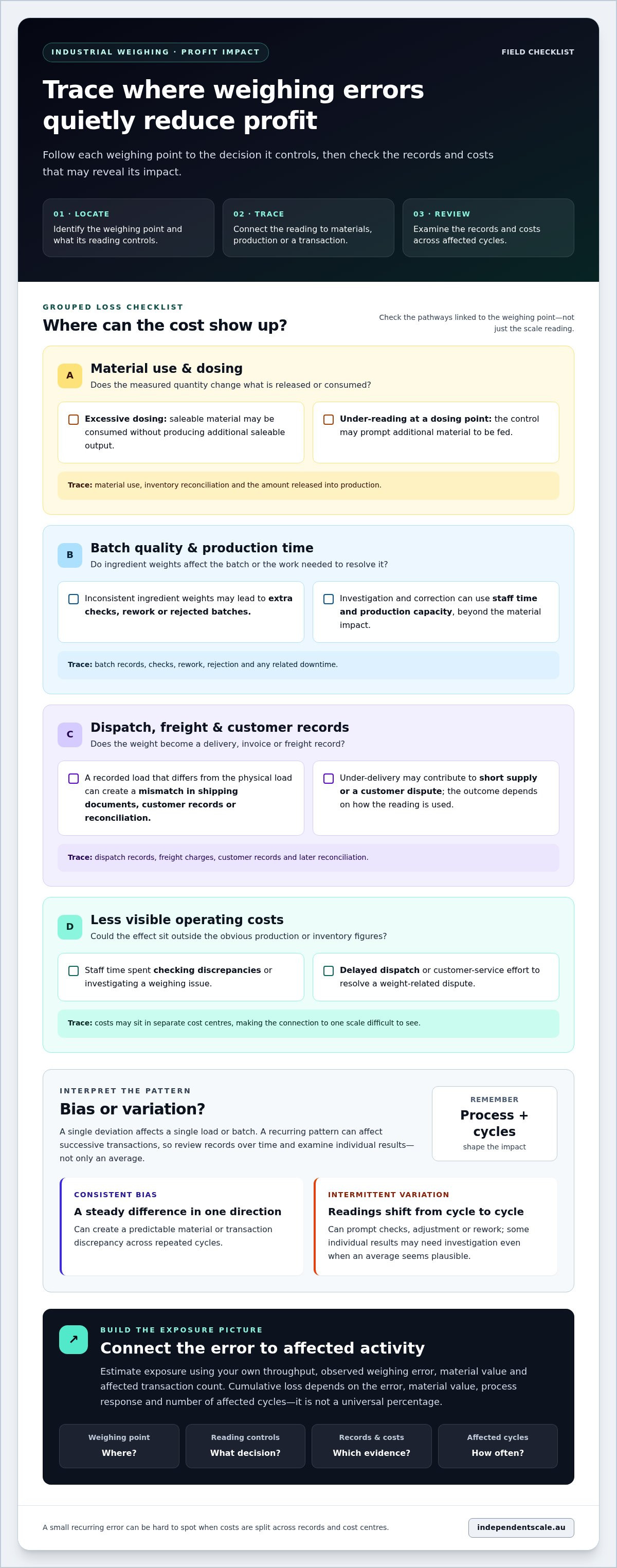
Profit pathways differ by operation. Excessive dosing can consume saleable material without producing additional saleable output, while under-delivery can leave a customer short or lead to a dispute. Neither outcome should be assumed: the direction and consequence depend on the point being weighed and how staff use the result.
Incorrect net weights can also flow into dispatch records and freight charges. If a recorded load differs from the physical load, the business may face a mismatch between shipping documents, customer records and later reconciliation. Inconsistent ingredient weights can produce batches that need extra checks, rework or rejection. Each response uses time and capacity, even before the material impact is calculated.
Some costs appear clearly in production or inventory records. Others are harder to isolate: downtime during an investigation, staff time spent checking a discrepancy, delayed dispatch, or customer-service effort resolving a weight-related dispute. These indirect effects can be recorded in different cost centres, making it difficult to trace one scale error to the final margin.
Why small errors can accumulate across repeated cycles
A one-off deviation may affect a single load or batch. Persistent bias, a consistent difference in one direction, can affect successive transactions. Intermittent variation is less predictable: some readings may be close to the expected value, while others prompt checks, adjustment or rework. Reviewing records over time helps distinguish an isolated event from a recurring pattern.
Cumulative weighing loss is the repeated financial effect of a weighing error across the volume of affected loads, batches or transactions. It isn’t a universal percentage: exposure depends on the observed error, material value, process response and number of affected cycles.
For example, an ingredient weighing point may influence every batch made during a shift, while a dispatch scale may affect only loads processed through that point. A hopper or silo reading may influence both inventory records and the amount released into production. Map each weighing point to its operational use to identify the records and costs to examine. The same reading difference can produce different outcomes across two sites.
How weighing error direction and process position change the financial impact
The direction of an error matters, as does the decision made from the reading. Bias is a consistent deviation from the correct value. Repeatability describes how closely repeated readings agree under the same conditions. A system can produce repeatable readings that are consistently biased, or readings that vary from one cycle to the next.
This distinction helps explain how inaccurate weighing affects profit. A steady bias may create a predictable material or transaction discrepancy; intermittent variation can make the cause harder to isolate. Neither an error percentage nor a tolerance is universally acceptable. The relevant requirement depends on the process, the equipment’s intended use and the consequences of a wrong reading.
Over-reading, under-reading, and inconsistent readings
An over-reading means the displayed weight is higher than the actual weight. In a sale or dispatch record, that could mean the business records or bills for more than it supplied. In a dosing process, the outcome depends on how the control system responds: if it stops feeding when the display reaches a target, a high reading may stop the feed before enough material is present. A low reading can have the opposite effect, prompting additional dosing or recording less material than was delivered.
Under-reading may therefore contribute to short supply, missed revenue or excess material use, depending on where the reading enters the process. Inconsistent readings create a different problem. Individual results may shift in either direction, making a monthly average appear plausible while particular loads or batches still need investigation. Reconciliation should examine individual records and operating conditions, not just an average.
For Australian businesses, measurements used in trade can also have legal measurement implications. The National Measurement Institute (NMI) administers Australia’s trade measurement framework. The operational and financial effect still depends on how each reading is used.
Where errors enter a weighing process
A weighing result follows a chain: force acts on the load cells, the indicator converts and displays a value, and that value is recorded or used to control a decision. A fault or change at one point can affect the result downstream. For more detail on component behaviour, see this guide to industrial load cells.
- Load cells and assemblies: Their response contributes to the weight signal from a platform, hopper or silo.
- Indicators and batching systems: Configuration or signal interpretation can affect what operators see and what a process records or doses.
- Tare, setup and handling: Incorrect tare, unsuitable setup or load placement can produce a wrong result even when the instrument itself is functioning as intended.
- Recording: Transcription or data-entry mistakes can separate the recorded weight from the displayed measurement.
Trace the reading from the weighing point to the final record or control action before deciding what caused the discrepancy. This helps distinguish a measurement-system issue from a setup, handling or recording error, and focuses corrective work on the actual source. An industrial weighing calibration assessment can help evaluate weighing performance and inform the next step.
How to estimate the profit impact using your own weighing data
A useful estimate starts with a defined weighing point and a measured error, not an assumed industry percentage. To assess how inaccurate weighing affects profit at your site, identify what the measurement controls, how much material or product passes through it, and which transactions may have been affected. The result is an exposure estimate based on stated assumptions, not a guaranteed saving or a substitute for investigating the cause.
A practical calculation framework for recurring weighing errors
First, compare observed readings with a suitable reference under conditions relevant to the process. Record the deviation and whether it is consistent or variable. Then match that result to throughput for the same period. Keep units consistent, such as kilograms against kilograms, and use the material’s documented value in A$ per kilogram or tonne.
A basic estimate for direct material exposure is:
Estimated material exposure = quantity deviation per cycle × affected cycles or throughput × relevant material value.
Choose the quantity basis carefully. If the measured deviation is per batch, multiply by the number of affected batches. If it is expressed per tonne, use the tonnes processed. Apply the calculation only to cycles reasonably shown to be affected, and account for whether the error led to excess use, short supply or another process outcome. The same deviation can have different financial effects depending on how the control system responds.
For customer or freight impacts, use the relevant transaction count and the documented billing or freight basis. A weight discrepancy may affect a charge by load, by tonne or under another agreed rate. Use the actual records and rate that applied, not a general market figure.
Keep direct material exposure separate from secondary costs. Record rework, downtime, freight adjustments and customer disputes as distinct categories, using documented quantities, hours or adjustments where available. Don’t count one incident as both wasted material and rework unless each represents a separate cost. Note the measurement period, operating conditions, reference method and uncertainty so another manager can test the assumptions.
Which records make the estimate more defensible?
Bring the operational and financial records together for the same weighing point and period. Useful inputs include batch records, scale tickets, production volumes, material invoices, dispatch data and adjustment records. Link exceptions to specific loads or batches where possible. This makes the estimate traceable and helps distinguish an observed weighing deviation from a separate handling or recording issue.
- Define the scope: Name the scale or process, material, period and affected transactions.
- Check comparability: Compare periods or production lines only when materials, settings and operating conditions are reasonably similar.
- Show the uncertainty: Document missing records, variable readings and assumptions that could change the estimate.
Site-specific weighing data is more useful than a generic error example because it connects an observed deviation to your actual throughput, material value and affected transactions. Use the result to decide which weighing point warrants closer investigation, then refine the estimate as better evidence becomes available.
How to prioritise weighing checks before losses compound
Checking every weighing point with equal frequency may not be practical. Prioritise by the consequences of a wrong reading: how much material passes through, its value, whether the weight affects a customer or freight transaction, and how critical it is to production. This gives teams a documented basis for directing checks where the financial consequences are likely to be greatest.
A high-throughput ingredient hopper may deserve attention because a deviation can influence repeated batches. A dispatch scale may rank highly because its recorded weight informs customer or freight records. A lower-volume point may still warrant priority if an incorrect reading could interrupt a critical process or compromise product consistency.
Build a proportionate weighing-risk review
Start with an equipment register that connects each scale, load cell, hopper or batching system to the decision it controls. Record the material or transaction, throughput, commercial or production consequence, and evidence of recent deviations. Review the register when a process changes, a discrepancy emerges or corrective work affects the weighing system.
- Track the signal: Record the deviation’s direction, recurrence, affected volume and operating conditions.
- Review exceptions: Look for unusual adjustments, batch variation, scale-ticket mismatches and repeated reconciliation differences.
- Escalate unresolved issues: Unexplained variation or suspected equipment faults warrant technical assessment rather than repeated manual correction alone.
Use the evidence to distinguish a recurring pattern from an isolated event. Keep corrective actions and follow-up results with the relevant weighing point. That record helps managers see whether the issue was resolved and whether further checks are justified.
Connect calibration evidence with process requirements
Calibration provides evidence of measurement performance under defined conditions. Consider its results against the weighing point’s intended use and process requirements, rather than treating it as a universal pass for every operating condition. Set verification and calibration plans from applicable requirements, documented risk and equipment history. Avoid assuming one fixed interval or tolerance suits every scale and process.
A formal assessment of scale performance can establish evidence about the instrument’s performance. Independent Scale Service provides NATA accredited calibration to ISO/IEC 17025 and calibration compliant with AS 1379 for concrete batching plants. Set the assessment against the process requirements and the equipment being used.
Calibration evidence is most useful when linked to production records, observed deviations and business exposure. If results show a problem, the next response may involve investigation, adjustment or repair, depending on the findings. If results are acceptable but discrepancies continue, review tare, setup, handling and recording practices as well as the measurement system.
An industrial weighing assessment can help investigate scale performance and identify proportionate calibration or repair actions.
Recover control of weighing accuracy with calibration, repair, and fit-for-purpose equipment
A useful response starts with evidence, not automatic equipment replacement. Quantify the observed deviation and affected throughput, identify the weighing point and decision it controls, then investigate the cause. This sequence turns the question of how inaccurate weighing affects profit into a practical service decision: assess performance, repair a fault where needed, or consider equipment better suited to the process.
Match the response to the weighing-system finding
Calibration assesses measurement performance under defined conditions and provides evidence to compare with applicable process requirements. It can help establish whether the weighing system’s results are suitable for its intended use, but it doesn’t by itself diagnose or correct every fault. Let the findings guide the next action.
- Calibration: Use results to assess scale performance and document relevant deviations against requirements for the application.
- Diagnosis and repair: Investigate the equipment when results or operating behaviour indicate a fault. Depending on the system, this may involve a load cell, indicator, hopper weighing assembly or batching plant.
- Replacement: Consider fit-for-purpose equipment when the existing arrangement can’t meet process requirements or maintain the necessary performance. Base the decision on measured evidence and the demands of the application.
For example, inconsistent hopper readings may call for investigation of the weighing assembly and its operating behaviour, while a repeatable deviation identified during assessment may call for calibration findings to be reviewed against the process requirement. Avoid applying one tolerance or remedy across different weighing points.
Turn the business case into an evidence-led next step
Prepare a concise record before deciding what work to prioritise. Include the observed error and direction, weighing point, affected throughput, estimated material or transaction exposure, relevant records, process consequences and any action already taken. This gives operations and technical teams a common basis for assessing urgency and selecting a proportionate response.
Independent Scale Service supplies, calibrates and repairs industrial weighing equipment, including load cells, industrial scales, hoppers and concrete batching systems. Its calibration services are NATA accredited to ISO/IEC 17025, and its concrete batching plant calibration complies with AS 1379.
Keep the operational requirement central. A calibration result, repair finding or equipment assessment is most useful when interpreted against the actual process and the cost exposure identified from site records. That connection helps avoid spending on a remedy that doesn’t address the source of the discrepancy.
Independent Scale Service provides industrial weighing support for calibration, repair and equipment needs.
Make the next weighing decision evidence-led
Set a clear review point for each weighing system that affects production or commercial records. Compare performance evidence with the process requirement, note any unresolved deviations, and assign an owner to decide the next action. This keeps corrective work tied to operational risk rather than assumption, and gives managers a basis for checking whether the chosen response addressed the cause.
Independent Scale Service supports industrial weighing operations across Sydney, Melbourne and regional Australia. Its calibration services are NATA accredited to ISO/IEC 17025, and its concrete batching plant calibration complies with AS 1379. These credentials apply to the relevant calibration services and help inform decisions about the weighing system under review.
Understanding how inaccurate weighing affects profit is a starting point. A disciplined follow-up can turn measured exposure into better-controlled weighing and more confident operational decisions. Discuss industrial weighing calibration or repair with Independent Scale Service and take the next step with evidence behind it.
Frequently Asked Questions
How can inaccurate weighing reduce profit?
Inaccurate weighing can reduce profit through recurring material giveaway, missed or incorrect revenue, freight discrepancies, rework and customer adjustments. The direction of the error and the role of the weighing point determine the outcome. For example, a reading that affects a delivery record may create a different cost from one controlling ingredient addition. To understand how inaccurate weighing affects profit, trace each affected reading to its operational or commercial consequence.
Can a small weighing error make a significant financial difference?
Yes. A small deviation can have a larger cumulative effect when it recurs across high throughput or frequent transactions. For example, a slight dosing difference repeated through production may affect more material than the same deviation occurring once. An illustrative example can show how repetition works, but it isn’t a forecast for your site. Estimate actual exposure using observed error, affected production volume and relevant material or transaction values.
How do I calculate the cost of weighing errors?
Start with the observed deviation and the number or volume of affected loads, batches or transactions. For material exposure, multiply the affected quantity deviation by throughput and the documented material value. Add secondary costs such as freight adjustments, rework or downtime only where records support them. Keep categories separate: if one incident caused rework that already includes discarded material, don’t count that material again as a separate loss.
Does calibration guarantee that weighing errors will not occur?
No. Calibration assesses measurement performance under defined conditions and provides evidence for comparison with the requirements of the application. It cannot guarantee error-free results in every operating situation. Loading, tare settings, equipment condition, environmental changes and data entry can also affect outcomes. Use calibration alongside suitable operating procedures, routine review of weighing records and investigation of unusual results. The control plan should reflect the process and the consequences of an incorrect reading.
How often should industrial weighing equipment be calibrated?
There isn’t one calibration frequency that suits every industrial weighing system. The appropriate schedule depends on applicable requirements, how the instrument is used, process risk and its performance history. A scale exposed to demanding operating conditions may warrant a different review approach from one used less frequently. Check relevant regulatory or quality-system requirements, then document the rationale for your schedule and review it if performance changes, repairs occur or discrepancies arise.
Can inaccurate weighing affect concrete batch quality and compliance?
Yes. Incorrect ingredient measurements can affect batch consistency, while discrepancies between actual quantities and production records may complicate quality review. The outcome depends on the materials, batching process and scale performance; a weighing error alone doesn’t automatically establish non-compliance. Assess the batch against its specifications and applicable AS 1379 requirements, and retain relevant batching and calibration records to support investigation and operational decisions.
What is the difference between weighing accuracy and repeatability?
Accuracy describes how close a measurement is to an appropriate reference value. Repeatability describes how closely repeated readings agree when measurements are taken under the same conditions. A system can give nearly identical readings each time and still be consistently offset from the reference, meaning it is repeatable but biased. Conversely, readings may vary around the reference. Assessing both characteristics helps distinguish consistent deviation from measurement variability.
