


High Temp Load Cells Australia: The 2026 Buyer’s Guide to Extreme Heat Weighing
Buying a "heat-resistant" sensor is not a solution for extreme industrial heat; it's often the start of a costly cycle of thermal signal drift and premature failure. In Australia's demanding processing environments, achieving stable weighing at 600°C requires a complete engineering approach to high temp load cells australia rather than a simple hardware swap. You've likely dealt with the frustration of batching inaccuracies or the sudden burnout of a sensor that was supposed to handle the heat. We understand that downtime isn't an option when meeting AS 1379 standards for concrete production or maintaining NATA compliance.
This 2026 buyer's guide equips you with the technical specifications needed to select, install, and calibrate equipment that survives the harshest conditions. You'll learn how to navigate the transition to the National Measurement Guidelines 2026, which replaced previous regulations on April 1, 2026, and how ISO/IEC 17025 accredited calibration protects your operational accuracy. We'll examine why system-wide thermal compensation and specialized cabling are essential for extending service life and ensuring your plant remains fully operational, compliant, and efficient.
Key Takeaways
- Identify the engineering differences between strain gauge and hydraulic technologies to ensure weighing stability in environments exceeding 400°C.
- Learn how to select high temp load cells australia that utilize specialized Karma or platinum alloys to prevent thermal signal drift.
- Implement a two-step installation protocol involving radiant heat profiling and specialized mounting hardware to manage structural expansion.
- Maintain mandatory AS 1379 compliance and NATA accreditation through regular calibration intervals tailored to extreme heat stress cycles.
Understanding Thermal Stress in Australian Industrial Weighing
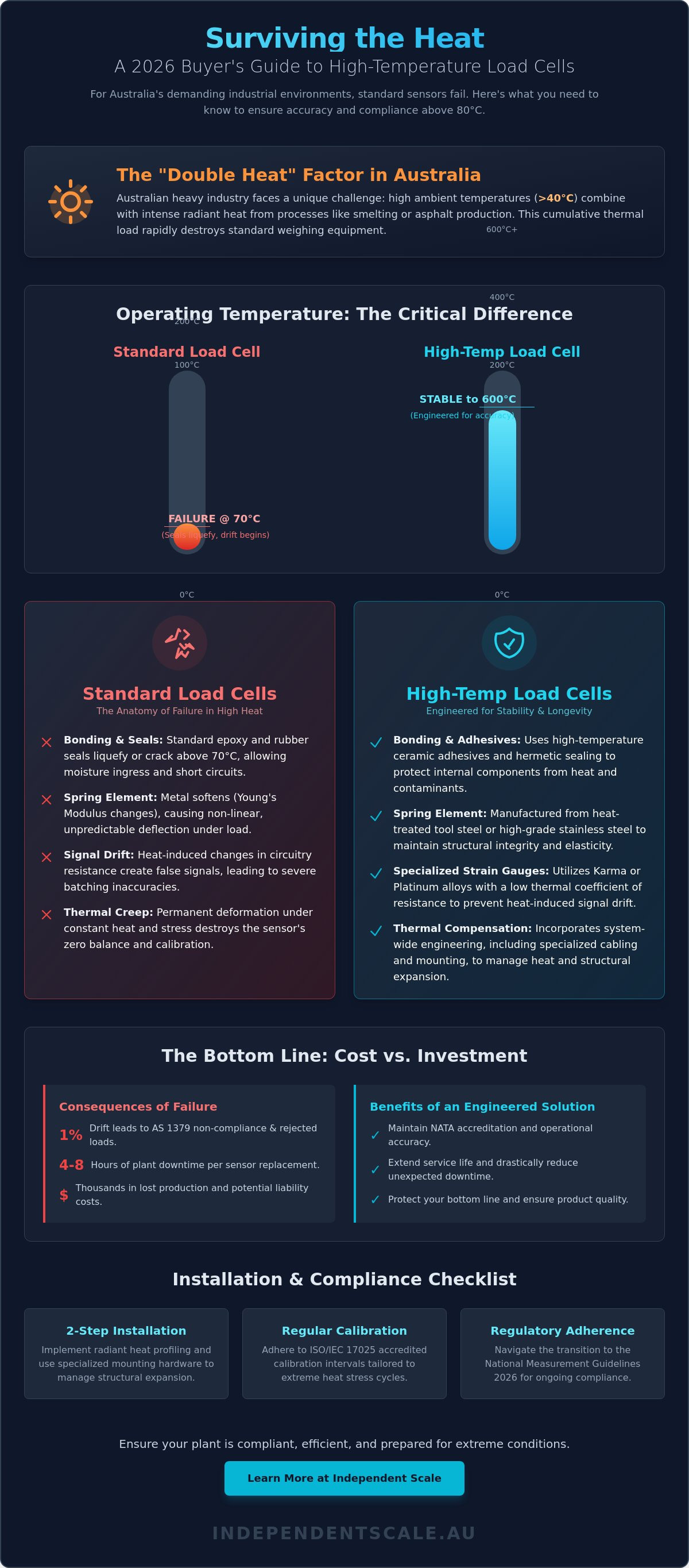
A load cell is a precision transducer that converts mechanical force into a measurable electrical signal. While standard sensors perform reliably in climate-controlled conditions, high temp load cells australia are specifically engineered with specialized strain gauges and heat-treated alloys to maintain accuracy in environments exceeding 80°C. In Australian heavy industry, operators face a "Double Heat" factor. This occurs when extreme ambient temperatures, which frequently exceed 40°C in regional processing hubs, combine with the intense radiant heat of foundries, smelters, or asphalt plants. This cumulative thermal load accelerates component fatigue and can lead to immediate sensor failure if the equipment isn't rated for the specific thermal profile of the site.
Thermal expansion is a significant engineering challenge for high-heat weighing. As the temperature rises, the metal mounting hardware and the load cell body expand at different rates. This differential expansion introduces parasitic forces and side loading, which distorts weight data. Signal drift is the silent killer of batching accuracy in these zones. It manifests as a gradual shift in the sensor's output signal without any change in the actual load. In high-heat zones, this drift occurs because the electrical resistance of the internal circuitry changes in response to temperature fluctuations, leading to inaccurate batching that can compromise an entire production run.
Why Standard Load Cells Fail in Extreme Heat
Standard industrial sensors typically utilize epoxy bonding agents and rubber moisture seals that begin to liquefy or become brittle at 70°C. Once these seals fail, humidity and contaminants penetrate the sensor's internal cavity, causing short circuits. High heat also affects the Young’s Modulus of the spring element, which is the material's inherent stiffness. When the metal softens due to heat, the sensor's deflection under load is no longer predictable or linear. Thermal creep is the gradual increase in plastic deformation of the load cell material under constant stress at high temperatures, which permanently shifts the sensor's zero-balance stability and destroys its calibration profile.
The Cost of Inaccuracy in High-Temp Batching
In the concrete and construction sectors, a 1% drift in batching accuracy can lead to immediate non-compliance with AS 1379. This standard requires strict adherence to mix designs; any deviation can result in rejected loads and significant structural liability. The financial impact of a sensor failure is rarely limited to the cost of the hardware. Replacing a burnt-out load cell in a silo or hopper often requires four to eight hours of plant downtime, costing thousands in lost production. Investing in specialized equipment and regular concrete batching plant calibration and repair ensures that thermal stress doesn't erode your bottom line or your NATA-compliant status.
Anatomy of a High-Temperature Load Cell: Materials and Engineering
High-performance weighing in extreme conditions starts with material science. To manufacture reliable high temp load cells australia, engineers prioritize spring elements made from high-grade stainless steel or heat-treated tool steels. These materials offer superior elastic recovery and maintain their structural integrity even when exposed to constant thermal cycling. Unlike standard sensors that may soften and lose linearity, these specialized alloys are processed to resist the molecular shifts that lead to permanent deformation at temperatures exceeding 150°C.
The internal strain gauges represent the most critical component of the sensor's anatomy. Standard foil gauges fail as temperatures rise, leading to the transition toward specialized Karma or platinum alloys. These materials are essential when designing load cells for high temperatures because they possess a much lower thermal coefficient of resistance. This means the gauge itself is less likely to produce a "false" signal caused by heat-induced expansion of the metal. To ensure long-term reliability, these gauges are bonded using high-temperature ceramic adhesives rather than standard epoxies, which would otherwise delaminate under stress.
Protection against the environment is achieved through hermetic sealing and advanced circuitry. High-temperature sensors often carry IP68 or IP69K ratings, signifying they're laser-welded to prevent the ingress of steam and hot gases. Inside the housing, thermal compensation circuitry uses precision resistors to offset any remaining temperature-induced resistance changes. This ensures the output remains stable across a wide operating range. If you're upgrading an existing system, selecting a professional load cell supply that includes these engineering features is the only way to guarantee NATA-compliant accuracy.
Cabling and Connectivity for Heat Zones
Connectivity is often the weakest link in a high-heat installation. Standard PVC cable jackets melt or become brittle almost immediately when exposed to industrial heat. High-temperature systems utilize PTFE (Teflon) or FEP insulation, which remains flexible and electrically stable up to 200°C. We recommend a 6-wire configuration over the standard 4-wire setup. The additional "sense" wires allow the weighing indicator to measure the actual voltage at the load cell, automatically compensating for any resistance changes in the cable caused by heat fluctuations. You can browse load cell accessories and cables to find specialized wiring solutions for your plant.
Mechanical Shielding and Cooling Options
When radiant heat exceeds the sensor's native rating, mechanical shielding becomes necessary. Heat shields reflect infrared radiation, while water-cooled jackets provide active thermal management for environments reaching 400°C or higher. Thermal isolators, typically made of ceramic or specialized composites, are installed between the vessel and the sensor to block conductive heat transfer. In the context of silos, the Leidenfrost effect can cause liquid to skitter across hot surfaces, creating unpredictable moisture pockets that lead to localized steam pressure against hermetic seals. This phenomenon makes robust sealing even more critical in humid, high-heat Australian processing plants.
Comparing High-Temperature Technologies: Strain Gauge vs. Hydraulic
Choosing the right technology for high temp load cells australia depends on the balance between required precision and the absolute thermal ceiling of the environment. High-temperature strain gauge load cells are the industry standard for precision batching. They offer high resolution and seamless integration with modern digital indicators, but they typically reach their operational limit at 200°C. Beyond this point, the internal compensation components struggle to maintain linearity despite advanced alloy construction.
Hydraulic load cells represent a different engineering philosophy. These sensors are essentially "bulletproof" because they contain no internal electronics within the high-heat zone. They use a high-boiling-point fluid to transmit force to a pressure transducer located in a cooler, remote area. While they can survive temperatures exceeding 400°C, they offer lower resolution than strain gauge models. This makes them ideal for heavy-duty ladle weighing in steel mills but less suitable for high-precision chemical batching where gram-level accuracy is required.
Other niche technologies include vibrating wire sensors and capacitive cells. Vibrating wire technology excels in geotechnical applications where long-term stability in heated boreholes is more important than rapid response times. Capacitive sensors are used in environments with extreme electromagnetic interference (EMI), such as induction furnaces, where heat and electrical noise would saturate a standard bridge circuit.
Operating Ranges and Performance Limits
The 150°C mark is a critical threshold in system design. If your application consistently operates below this temperature, a standard sensor with specialized shielding might suffice for short durations. However, once you cross 150°C, you must transition to dedicated high-temperature hardware to avoid catastrophic failure. Maintaining C3 accuracy grades becomes significantly harder as temperatures rise because thermal noise in the circuit increases and the material's hysteresis properties change. To ensure your system meets legal-for-trade requirements, you can explore specialist load cells designed specifically for these thermal extremes.
Environmental Suitability for Australian Mining and Steel
Australian industrial sites present unique challenges that go beyond pure heat. In coastal steel hubs like Port Kembla and Newcastle, high-temperature sensors must also resist salt-induced corrosion. Stainless steel 17-4 PH or 316 housings are essential for these locations. In arid mining zones like the Pilbara, the combination of 50°C ambient heat and abrasive iron ore dust creates a grinding paste that destroys standard seals. Here, IP69K-rated hermetic sealing is the only viable protection.
Maintenance cycles differ vastly between these technologies. HT strain gauge cells require periodic electrical checks to ensure the insulation resistance hasn't degraded due to heat-induced moisture ingress. Hydraulic systems, conversely, require monitoring for fluid leaks and air entrainment. Regardless of the technology, accreditation by the National Association of Testing Authorities (NATA) is the only way to verify that these sensors remain accurate under the stress of Australian industrial cycles. Regular NATA-accredited calibration identifies drifting sensors before they cause a plant-wide shutdown.
Selection and Installation Guide for Extreme Environments
Installing high temp load cells australia requires a methodical engineering approach that begins long before the sensor is bolted into place. A successful installation must account for the physical expansion of the weighing structure and the degradation of electrical signals over long cable runs. We follow a four-step protocol to ensure system longevity and NATA-compliant accuracy in environments like asphalt plants and smelting facilities.
- Step 1: Thermal Profiling. Use a thermal imaging camera to distinguish between radiant heat from the vessel and conductive heat through the mounting points. This data determines whether a standard HT sensor is sufficient or if thermal isolators are required.
- Step 2: Structural Expansion Management. Steel expands at approximately 12 micrometers per meter for every degree Celsius of temperature rise. Mounting hardware must include rocker pins or sliding plates to allow for this movement without introducing side-load errors.
- Step 3: Strategic Cable Routing. Avoid routing cables through vertical "heat chimneys" or near uninsulated steam pipes where convection currents create localized hotspots. Use stainless steel flexible conduit to protect against both heat and mechanical damage.
- Step 4: Electronic Isolation. Locate all secondary electronics, including weight indicators and junction boxes, in climate-controlled control rooms or ventilated enclosures at least 5 to 10 meters away from the primary heat source.
Signal Integrity and Surge Protection
High-temperature environments are notorious for electrical noise and transient surges. As temperature increases, the thermal noise within the copper circuitry rises, which can mask the small millivolt signals produced by the sensor. To maintain a clean signal, you must use junction boxes and surge arrestors that are specifically rated for high-ambient temperatures. These components prevent lightning strikes or industrial power surges from traveling down the load cell cable and destroying the sensing element. Ensuring these components meet ISO/IEC 17025 standards is essential for maintaining your plant's overall calibration integrity.
Conditioners and Transmitters: The Remote Link
Sending a raw millivolt signal over a long distance from a hot zone is a recipe for inaccuracy. We recommend using signal conditioners and transmitters to convert the load cell output into a robust 4-20mA or digital signal as close to the heat source as safely possible. This conversion minimizes the impact of electromagnetic interference and cable resistance changes caused by the intense heat. Remember that under the National Measurement Guidelines 2026, which took effect on April 1, 2026, the entire signal chain must be verified during your annual calibration. Calibrating the sensor alone is no longer sufficient; the transmitter and indicator must be tested as a single, unified system to ensure true batching accuracy.
If you're facing persistent sensor failures or signal drift, book a NATA-accredited calibration and site audit to identify the specific thermal stressors affecting your equipment.
Compliance and NATA Calibration for High-Temp Systems
Maintaining the accuracy of high temp load cells australia requires more than a standard factory check. In industrial environments where sensors operate at thermal extremes, NATA accreditation to ISO/IEC 17025 is the only recognized benchmark for technical competence. This accreditation ensures that the calibration laboratory has the equipment, training, and traceability to verify sensor performance under stress. While many suppliers claim accuracy levels of 0.05%, these figures are often theoretical. True operational accuracy must be verified through periodic NATA-accredited testing that accounts for the thermal drift and hysteresis common in high-heat zones.
A significant challenge in these environments is the "hot calibration" process. Verifying the accuracy of a weighing system while the vessel or hopper is at an operating temperature of 150°C or higher is technically demanding. Standard weights and procedures may not account for the radiant heat affecting the calibration technician's equipment. Independent Scale Service utilizes specialized gravimetric methods to ensure that the system is calibrated to reflect its actual working state. This approach is essential because a sensor that is accurate at 25°C may exhibit significant non-linearity when the plant reaches its full thermal load.
Traceability is the cornerstone of industrial compliance. Under the National Measurement Guidelines 2026, which were updated on April 1, 2026, all weighing equipment used for legal-for-trade or quality-critical applications must have a clear chain of traceability to national standards. With a 30-year track record in the Australian market, we provide the documentation required to satisfy both internal quality audits and external regulatory inspections.
Meeting AS 1379 Standards in Foundries and Plants
For the concrete and asphalt industries, compliance with AS 1379 is mandatory. This standard dictates strict batching tolerances; even a minor deviation caused by heat-induced signal drift can result in non-compliant material and structural risks. Auditors specifically look for NATA-endorsed calibration certificates that verify the full signal chain, including the junction box and indicator. For a deeper understanding of these requirements, read our Calibration Services: The Authoritative Guide, which outlines the specific certification needs for Australian heavy industry.
Why ISS is the Choice for Australian Industry
Independent Scale Service has established itself as the trusted partner for major industrial players like Boral and Holcim across Sydney, Melbourne, and regional hubs. We understand that sensor failure in a high-heat zone isn't just a maintenance issue; it's a production emergency. That's why we provide 24x7 emergency support to minimize client downtime. Our technicians are experts in diagnosing whether a failure is due to the sensing element, cable degradation, or structural expansion issues. To secure your plant's accuracy and compliance, book a load cell calibration service with our NATA-accredited team today.
Future-Proofing Your High-Temperature Weighing Infrastructure
Achieving long-term accuracy in environments exceeding 150°C requires a shift from reactive repairs to proactive engineering. As discussed, the National Measurement Guidelines 2026 demand rigorous verification of the entire signal chain. Successful operations depend on selecting high temp load cells australia that utilize specialized alloys and 6-wire thermal compensation. Proper installation, which accounts for structural expansion and radiant heat profiling, remains the only way to prevent premature sensor burnout and costly batching inaccuracies.
Independent Scale Service provides over 30 years of Australian industrial experience to every site audit and installation. We're NATA Accredited to ISO/IEC 17025; this ensures your batching plants remain compliant with AS 1379 standards. If you face a critical system failure, our emergency 24/7 breakdown support is available to restore your operations immediately. Consult an ISS expert for your high-temperature weighing requirements to ensure your plant operates with total precision and reliability.
Frequently Asked Questions
Can standard load cells be used with heat shields instead of buying high-temp models?
Standard sensors aren't suitable for high-heat zones because their internal epoxy and moisture seals typically fail at 70°C. While a heat shield reflects radiant heat, it doesn't stop conductive heat from traveling through the mounting hardware. Dedicated high-temperature models use ceramic adhesives and specialized alloys that maintain structural integrity when shields alone are insufficient.
What is the maximum temperature a high-temp load cell can withstand in Australia?
High-temperature strain gauge sensors are generally rated for 200°C. For extreme industrial applications like smelting or foundry work where temperatures reach 400°C to 600°C, hydraulic load cells are the necessary choice. These systems use high-boiling-point fluids to transmit force to remote electronics, allowing the sensing element to survive temperatures that would destroy standard circuitry.
How often should high-temperature load cells be calibrated to maintain NATA compliance?
We recommend a six-month calibration interval for sensors exposed to constant thermal cycling to maintain NATA compliance. Although AS 1379 requires annual checks for concrete plants, heat accelerates signal drift and material fatigue. Regular testing to ISO/IEC 17025 standards identifies accuracy loss before it leads to non-compliant batching or costly structural liability.
What type of cabling is required for load cells operating above 150°C?
Operations exceeding 150°C require cabling with PTFE (Teflon) or FEP insulation. Standard PVC jackets melt or become brittle at these temperatures, which leads to immediate short circuits. When installing high temp load cells australia, we also utilize stainless steel flexible conduit to provide additional mechanical protection against the combined effects of heat and abrasion in mining environments.
Do high-temperature load cells require specialized mounting hardware?
Specialized mounting hardware like rocker pins or sliding plates is essential to manage thermal expansion. Steel expands at approximately 12 micrometers per meter for every degree Celsius increase. Without hardware that allows for this movement, the resulting side loads will distort your weight readings and potentially cause permanent deformation of the load cell's spring element.
Can high-temp load cells handle moisture and steam in cleaning processes?
High-temp sensors can only handle steam if they feature an IP69K rating and hermetic laser welding. Steam cleaning creates intense localized pressure that easily bypasses standard rubber seals. For chemical or food processing plants, it's vital to use 316 stainless steel housings to prevent corrosion caused by the combination of high heat and caustic cleaning agents.
What is the difference between 4-wire and 6-wire load cells in hot environments?
6-wire load cells are the superior choice for hot environments because they include "sense" wires that monitor the actual voltage at the sensor. Heat increases the electrical resistance of the cable itself, which drops the excitation voltage. A 6-wire system automatically compensates for these fluctuations, whereas a 4-wire system will produce significant signal errors as temperatures rise.
How do I prevent signal drift in my weighing system during a summer heatwave?
Prevent signal drift by locating transmitters and summing circuits in climate-controlled enclosures away from the heat source. During an Australian summer where ambient temperatures exceed 40°C, the cumulative thermal load on sensors is extreme. Using 6-wire technology and NATA-compliant surge arrestors ensures the signal remains stable even when ambient and industrial heat combine to stress the system.
