


Getting Buy-In for a Calibration Budget: A Guide for Industrial Managers
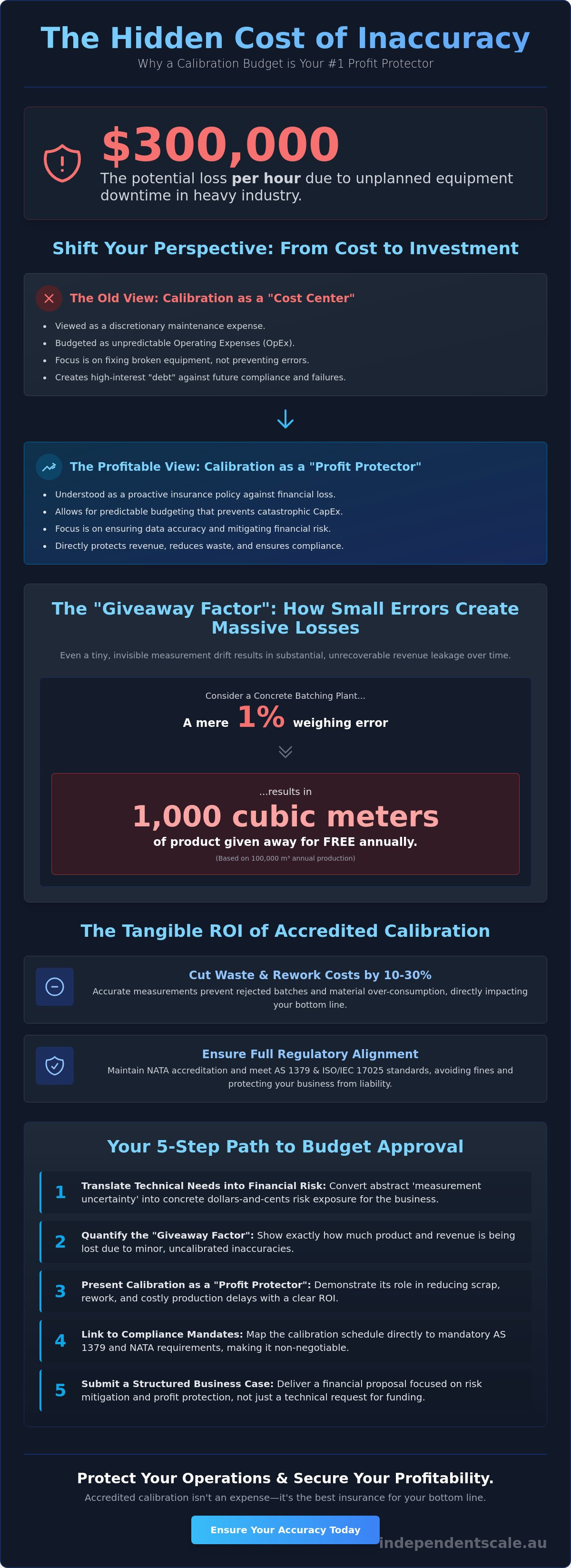
Heavy industry can lose nearly $300,000 per hour due to unplanned equipment downtime; however, many management teams continue to view precision measurement as an avoidable cost center. You likely recognize that maintaining your load cells and weighing systems is critical for operational integrity, but successfully getting buy-in for a calibration budget requires more than just technical justification. It demands a shift from discussing measurement uncertainty to quantifying financial risk.
It's difficult to explain the necessity of NATA compliance when the boardroom only focuses on the bottom line. This article provides the exact framework you need to translate complex data into a compelling business case that secures management approval. You'll learn how to link ISO/IEC 17025 accredited services to a 10% to 30% reduction in waste and rework costs. We'll outline a clear path to maintaining compliance with the latest AS 1379:2026 standard while demonstrating a measurable return on investment that even the most conservative financial officer can't ignore.
Key Takeaways
- Convert technical uncertainty budgets into financial requests to bridge the gap between engineering requirements and management priorities.
- Quantify the "Giveaway Factor" to reveal how minor precision errors in industrial weighing systems result in substantial hidden product loss over a fiscal year.
- Reposition calibration as a "Profit Protector" by demonstrating its role in reducing scrap rates and preventing equipment-related production delays.
- Follow a structured 5-step proposal framework to streamline the process of getting buy-in for a calibration budget from financial stakeholders.
- Ensure full regulatory alignment by mapping equipment maintenance schedules directly to mandatory AS 1379 and NATA accreditation requirements.
What is a Calibration Budget? Bridging Technical and Financial Needs
A calibration budget is not a singular financial figure; it is the intersection of metrological requirements and fiscal allocation. Managers often struggle with getting buy-in for a calibration budget because they present it as a discretionary maintenance cost. However, in an industrial environment, this budget serves two distinct masters: the technical need for measurement accuracy and the financial need for risk mitigation. To understand the technical foundation, one must first define What is calibration? in the context of industrial quality systems. It is the documented comparison of a measurement device against a traceable standard.
There is a critical distinction between maintenance and calibration. Maintenance involves the physical upkeep of equipment to ensure it remains operational; calibration ensures that the data the equipment produces is accurate and legally defensible. Metrological traceability acts as a safeguard for business assets. Without a dedicated budget, you lose the ability to prove that your measurements align with national standards, leaving your operations vulnerable to audit failures and product liability claims.
The Technical Side: Understanding the Uncertainty Budget
The foundation of any financial request is the uncertainty budget. This is a technical document that accounts for all variables affecting a measurement, including sensor drift, repeatability, and environmental factors like temperature or vibration. These variables represent hidden costs. If uncertainty is not quantified through regular load cell calibration, the resulting measurement errors lead to overfilled containers or compromised material ratios. Technical uncertainty directly correlates to financial loss. By documenting these factors, you provide the empirical evidence required to justify the frequency and depth of your calibration schedule.
The Financial Side: Calibration as an Insurance Policy
The primary hurdle to getting buy-in for a calibration budget is the perception of it being a "cost centre." Shifting this narrative requires viewing calibration as a proactive insurance policy. While repairs are often categorized as unpredictable operating expenses (OpEx), a structured calibration program allows for predictable budgeting that prevents catastrophic capital expenditure (CapEx) later. A "zero budget" approach to calibration is essentially high-interest debt against future compliance. You might save on service fees today, but you're accumulating risk that will eventually manifest as a NATA non-conformance or an AS 1379 breach. Quantifying this risk is the first step in moving calibration from a "nice to have" to a "must fund" priority.
The Cost of Inaccuracy: Quantifying the Risk of Inaction
Industrial managers frequently encounter the "if it isn't broken, don't fix it" objection when requesting funds for metrological services. This perspective is dangerous because it assumes that a functional machine is an accurate one. Successfully getting buy-in for a calibration budget requires demonstrating that equipment can be operational while simultaneously eroding company profits. Measurement drift is a cumulative financial leak caused by the gradual loss of sensor precision over time due to environmental stress and mechanical wear. Unlike a total mechanical failure, drift is invisible without testing, but its impact on the bottom line is measurable and severe.
When accuracy is compromised, the business faces two primary financial threats: product giveaway and rejected batches. Out-of-tolerance equipment leads to non-compliance with NATA requirements and can result in significant legal liability if substandard products reach the market. Quantifying these risks transforms a technical request into a business necessity.
Product Giveaway and Revenue Leakage
Small weighing errors often lead to massive product loss over a fiscal year. Consider a concrete batching plant producing 100,000 cubic metres of material annually. If the weighing systems have a 1% positive error, the plant is effectively giving away 1,000 cubic metres of product for free. This "Giveaway Factor" represents direct revenue leakage that cannot be recovered. Regular concrete batching plant calibration serves as a revenue protector by ensuring that material output matches the invoiced amount. Beyond giveaway, inaccurate measurements often lead to rejected batches. If a batch fails quality testing due to incorrect material ratios, the cost includes lost raw materials, wasted labour, and the energy consumed during production. These rejected batches can cost manufacturers up to 2.2% of their yearly revenue.
The High Price of Equipment Downtime
Relying on reactive repairs is a high-risk strategy that compromises operational efficiency. Industry data suggests that reactive repairs cost 3 to 4 times more than scheduled calibration services. In heavy industry, unplanned downtime can cost nearly $300,000 per hour. For facilities integrated into Sydney or Melbourne logistics chains, a single day of unexpected failure can disrupt delivery schedules and trigger contractual penalties. Proactive maintenance is the only way to mitigate these costs. When getting buy-in for a calibration budget, emphasize that scheduled service minimizes the need for emergency load cell supply and keeps the facility running at peak capacity. To protect your operations from these hidden costs, consider scheduling a professional weighing scale calibration to establish a baseline of current accuracy levels.
Building the ROI Case for Calibration Services
Successful managers don't just request funds; they present a strategic plan to protect profit. Shifting the internal narrative from viewing calibration as a "Cost Centre" to a "Profit Protector" is the most effective method for getting buy-in for a calibration budget. While the initial expense is visible on a balance sheet, the return on investment is found in the costs that never occur. By framing calibration as a financial safeguard, you align your technical requirements with the executive team's focus on margin preservation and risk reduction.
Historical data from industrial facilities demonstrates that regular weighing scale calibration can lead to a 10% to 30% reduction in waste and rework costs. These savings are realized by eliminating the material overages typically used to compensate for measurement drift. Beyond direct material savings, precision measurement is a cornerstone of brand reputation. Delivering products that consistently meet or exceed specifications builds client trust and minimizes the risk of costly contract disputes. In high-stakes industries, holding NATA accreditation or proving adherence to ISO/IEC 17025 standards provides a distinct competitive edge during tender processes. Approximately 72% of industrial enterprises now prioritize providers with these specific accreditations, making your calibration budget a tool for business growth.
Efficiency Gains through Precision
Tighter measurement tolerances allow production teams to optimize raw material usage by reducing the "uncertainty buffer." This buffer is the extra material added to batches to ensure compliance when measurement systems are unreliable. Reducing this margin through precise calibration increases total throughput without increasing input costs. Additionally, the integration of high-performance indicators and displays improves operator speed and reduces human error during the weighing process. When operators can trust the data on the screen, cycle times decrease and plant efficiency rises.
Long-Term Asset Protection
A structured calibration schedule is essential for extending the operational lifespan of expensive load cells, silos, and hoppers. By performing regular drift analysis, technicians can identify mechanical fatigue or sensor degradation before it leads to a catastrophic system failure. Maintaining the health of signal processing components, such as conditioners and transmitters, ensures that the entire measurement chain remains robust. This proactive approach ensures that capital assets reach their full depreciable life, maximizing the return on the company's initial equipment investment and preventing the need for emergency capital expenditure. Getting buy-in for a calibration budget today prevents the much higher cost of equipment replacement tomorrow.
Compliance as a Mandate: AS 1379 and NATA Requirements
Regulatory compliance is the most powerful tool for getting buy-in for a calibration budget. In Australia, adhering to specific industry codes is a mandatory requirement for continued operation. Managers must present calibration not as a discretionary service, but as a legal obligation that protects the company from litigation and professional liability. For many industrial sectors, non-compliance is not merely a quality issue; it is a breach of contract that can result in the immediate cessation of site works and the loss of operating licenses.
The weight of NATA accreditation in Australian audits cannot be overstated. National Association of Testing Authorities (NATA) endorsement provides the highest level of assurance that a laboratory is competent to perform specific calibrations. This accreditation aligns with ISO/IEC 17025:2017, the global standard for the competence of testing and calibration laboratories. When a business presents a NATA-endorsed report, it provides a level of legal defensibility that standard certificates of accuracy cannot match. This is particularly critical in courtrooms or during insurance investigations where measurement integrity is questioned.
AS 1379 Compliance for the Concrete Industry
The recently updated Australian Standard, AS 1379:2026, published on May 22, 2026, sets rigorous requirements for the specification and supply of concrete. This standard mandates that all weighing and measuring equipment at a batching plant undergo regular verification to ensure material accuracy. Failing a project audit due to out-of-tolerance equipment can lead to the total rejection of supplied material and the suspension of supply contracts. For a detailed breakdown of these mandatory intervals and technical requirements, refer to our Concrete Batching Plant Calibration Guide.
The Value of NATA Endorsed Reports
A NATA-endorsed report is more than a technical document; it is a prerequisite for high-stakes projects. Tier 1 contractors and government infrastructure bodies often mandate that all weighing systems be calibrated by an accredited provider. Using NATA-accredited calibration services ensures that your data is traceably linked to national standards. This traceability satisfies the most stringent audit requirements and provides a clear competitive advantage during the tender process. Over 72% of industrial enterprises now prioritize ISO/IEC 17025-accredited providers to minimize their operational risk. To ensure your facility meets these mandatory standards, you can book our AS 1379 compliant calibration services today.
5 Steps to Presenting Your Calibration Budget Proposal
- Step 1: Audit your current "Cost of Quality." Document specific instances of waste, rejected batches, and rework over the last 12 months.
- Step 2: Map every piece of equipment to its specific regulatory requirement. Clearly state which assets are governed by AS 1379 or NATA mandates.
- Step 3: Obtain competitive quotes for NATA calibration to ensure your requested figures reflect current market rates for accredited services.
- Step 4: Create a "Risk vs. Cost" matrix. Contrast the price of proactive service against the $300,000 per hour cost of unplanned downtime in heavy industry.
- Step 5: Propose a multi-year calibration schedule. This approach stabilizes cash flow and prevents budget spikes.
Step 1 & 2: Gathering the Evidence
Begin by analyzing your service history to identify patterns of equipment degradation. This data allows you to predict future failures before they disrupt production. Distinguish between "critical" and "non-critical" weighing points to prioritize spending effectively. For instance, linking hopper calibration directly to production uptime provides a tangible link between precision and revenue. When you show that a specific sensor's accuracy dictates the quality of a high-value batch, the budget becomes a necessity rather than a choice. This empirical evidence removes the emotion from the request and replaces it with data.
Step 4 & 5: Closing the Deal
Psychologically, the "Cost of Failure" is your most effective lever. Senior management responds to risk mitigation. Presenting calibration as a fixed, predictable cost allows the finance department to manage OpEx more effectively than dealing with variable, unpredictable repair bills. A structured schedule ensures that getting buy-in for a calibration budget is a one-time hurdle rather than an annual struggle. It transforms a series of emergency fixes into a managed quality program. This shift in perspective ensures the facility remains compliant and operational without fiscal friction. To support your proposal with accurate data, Contact Independent Scale Service for a comprehensive calibration quote that meets your specific regulatory and operational needs.
Secure Your Operational Integrity and Budget Approval
Securing approval for metrological services depends on your ability to frame technical precision as a financial protector. You now have the framework to quantify the giveaway factor, link accuracy to revenue preservation, and leverage mandatory standards like AS 1379:2026 to justify your request. Successfully getting buy-in for a calibration budget is a matter of presenting the executive team with a choice between a managed, predictable expense or the high-interest debt of future non-compliance and unplanned downtime.
Request a Professional Calibration Quote for Your Budget Proposal
Frequently Asked Questions
How do I explain measurement uncertainty to a CFO?
Frame measurement uncertainty as a quantifiable financial liability rather than a technical physics problem. Explain to your CFO that uncertainty represents the statistical probability of overfilling containers or producing substandard material. It is the difference between invoiced weight and actual weight. By reducing uncertainty through regular service, you're effectively tightening the company's profit margins and preventing revenue leakage through direct material loss.
How often should industrial scales be calibrated to maintain a budget?
Calibration frequency is determined by equipment duty cycles and specific environmental conditions. While standards like AS 1379:2026 mandate specific intervals for concrete batching, most industrial scales require service every six to twelve months. High-use systems or those in harsh environments often need quarterly checks to prevent cumulative drift. Establishing a fixed schedule is a reliable method for getting buy-in for a calibration budget by making annual costs predictable.
What are the most common hidden costs of skipping calibration?
The most significant hidden costs are product giveaway and rejected batches. If a weighing system drifts by only 1%, the cumulative loss of raw materials over a fiscal year can exceed the cost of the entire calibration program. Additionally, skipping service increases the likelihood of unplanned downtime. Heavy industry can lose nearly $300,000 per hour during equipment failures, making reactive repairs far more expensive than proactive maintenance.
Is NATA accreditation worth the extra cost in a calibration budget?
NATA accreditation is essential for any facility requiring legal defensibility or compliance with Tier 1 contractor standards. A NATA-endorsed report proves that your measurements are traceably linked to national standards and comply with ISO/IEC 17025. This accreditation acts as a safeguard during audits and insurance investigations. For many Australian infrastructure projects, using a NATA-accredited provider is a mandatory contractual requirement that cannot be bypassed.
Can I use internal checks to reduce the external calibration budget?
Internal intermediate checks are valuable for monitoring equipment stability between professional service intervals. They help identify sudden shifts in accuracy but don't provide the metrological traceability required for compliance with standards like AS 1379. You shouldn't use internal checks to eliminate your external budget. Instead, use them to monitor performance while maintaining a scheduled professional visit to ensure your data remains traceably accurate and legally defensible.
What happens if our equipment fails a NATA audit due to budget cuts?
Failing a NATA or regulatory audit can lead to the immediate suspension of supply contracts and significant financial penalties. If measurements are found to be out of tolerance, you may be forced to recall products or perform expensive rework on completed infrastructure. The cost of rectifying a non-conformance usually dwarfs the original budget request. It also damages your reputation with major corporate clients and government bodies.
How do I include load cell replacement in a calibration budget?
Load cell replacement should be categorized as a lifecycle asset cost within your proposal. Use calibration drift data to predict when a sensor is approaching the end of its reliable service life. By including a provision for proactive replacement in your multi-year plan, you avoid the high costs associated with emergency load cell supply and unplanned system failures. This approach ensures your weighing systems remain operational without budgetary surprises.
What is the difference between an uncertainty budget and a financial budget?
An uncertainty budget is a technical document listing all variables that affect measurement accuracy, such as repeatability and environmental factors. A financial budget is the monetary allocation required to manage those technical risks. You must use the uncertainty budget to justify the financial budget. Showing how technical variables lead to financial loss provides the evidence needed for getting buy-in for a calibration budget from senior management.
