


Expert Weighbridge Repair NSW: Restoring Accuracy and Compliance
A single kilogram of measurement error can be the difference between a profitable load and a devastating Chain of Responsibility penalty under the Heavy Vehicle National Law. For industrial operators in New South Wales, a malfunctioning scale isn't just a technical glitch; it's a legal liability that threatens your bottom line and your National Measurement Institute accreditation. When precision fails, securing professional weighbridge repair NSW becomes an immediate operational priority to prevent cascading financial losses and regulatory scrutiny.
You're likely aware that maintaining weighing accuracy is non-negotiable for trade-certified equipment, yet the complexity of modern load cells and NMI standards makes internal fixes nearly impossible. This guide provides a rigorous technical framework for diagnosing common failures, executing precise repairs, and establishing a maintenance schedule that guarantees compliance. We'll examine how to restore your system's accuracy rapidly, ensuring your diagnostic reports meet the highest industry benchmarks and your facility remains fully operational. By focusing on methodical restoration and proactive maintenance, you'll mitigate the risk of costly downtime and ensure your billing data remains beyond reproach.
Key Takeaways
- Align operations with Chain of Responsibility (CoR) and National Measurement Institute (NMI) standards to mitigate legal and financial liabilities.
- Identify load cell failure and junction box moisture ingress as primary causes of inaccurate billing data and operational errors.
- Execute professional weighbridge repair NSW through a structured approach involving site audits, component isolation, and re-verification.
- Establish a proactive maintenance framework, incorporating daily debris clearance and visual inspections, to prevent major system breakdowns.
- Access NATA-accredited technical support to ensure the reliability and precision of critical industrial weighing infrastructure.
Critical Weighbridge Repair in NSW: Ensuring Compliance and Accuracy
Weighbridge repair is the technical restoration of a system's mechanical and electronic components to their original design specifications. It's a comprehensive process that goes beyond simple parts replacement; it involves verifying the structural integrity of the platform and the precise functionality of the electronic sensor network. For industrial operators, professional weighbridge repair NSW is a mandatory business function that ensures every load is accounted for with absolute precision. When a system fails, the priority is to restore the unit to a state that satisfies both operational requirements and stringent Australian standards.
Under the 2026 Heavy Vehicle National Law (HVNL) updates, weighbridge operators are recognized as key parties in the Chain of Responsibility (CoR). You have a primary duty to ensure transport activities are safe, which includes preventing overloaded vehicles from entering public roads. A faulty weighbridge isn't just a maintenance issue; it's a legal liability. If inaccurate equipment allows an overweight vehicle to pass, the operator faces significant penalties for breaching CoR obligations. Current 2026 standards mandate that critical repairs be executed by NATA-accredited technicians to ensure all work is traceable and legally defensible.
NSW Regulatory Framework and Trade Measurement
The National Measurement Institute (NMI) governs trade measurement across NSW, enforcing the Commonwealth National Measurement Act 1960. Operating a non-compliant weighbridge for commercial transactions is a serious offense that can lead to heavy fines or the loss of your trade license. Accuracy is directly linked to heavy vehicle road safety. Overloaded trucks compromise braking efficiency and cause accelerated damage to NSW road infrastructure. Maintaining a verified, accurate scale is the only way to prove compliance during a regulatory audit or roadside inspection.
Financial Implications of Weighbridge Downtime
When equipment fails, the cost of "guessing" weights is often higher than the repair itself. Under-reading scales result in unbilled product leaving your site, while over-reading scales expose you to litigation for overcharging. This inaccuracy creates massive discrepancies in inventory management and disrupts the efficiency of your entire logistics chain. Downtime forces drivers to seek alternative weighing sites, adding fuel costs and labor hours to every trip. To maintain total site precision, businesses should also invest in regular weighing scale calibration services to catch minor drifts before they require major mechanical intervention.
Reliable data is the foundation of industrial profitability. Without a functional weighbridge, your facility loses its ability to verify incoming raw materials or outgoing finished goods. The resulting data gaps can take months to reconcile, leading to inaccurate financial reporting and lost revenue. Prompt repair isn't just about fixing a machine; it's about protecting your profit margins and ensuring your business remains a trusted partner in the NSW supply chain.
Identifying Common Weighbridge Faults and Failure Points
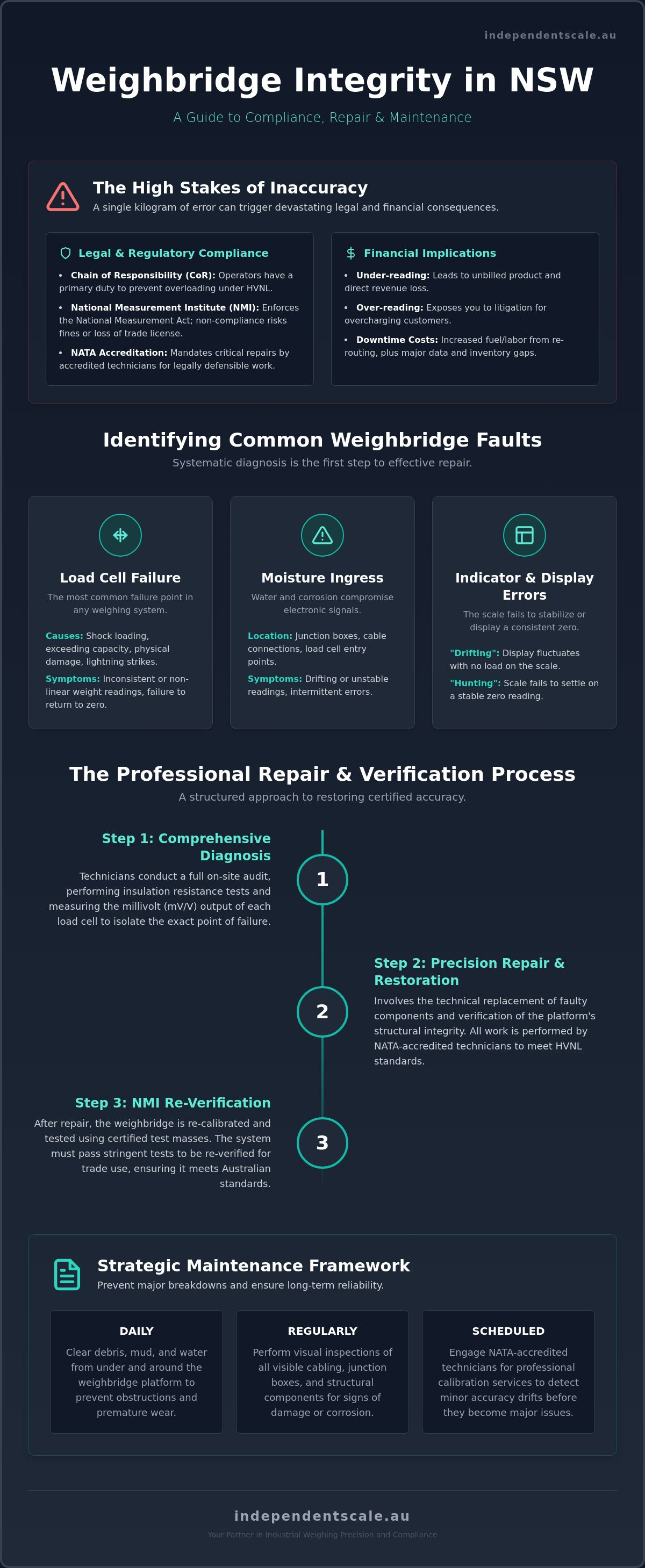
Effective weighbridge repair NSW begins with a systematic identification of failure points. Most operational issues aren't caused by a single catastrophic event but by the gradual degradation of electronic and structural components. Inaccurate readings often manifest as weight "drifting," where the display fluctuates without a load, or "hunting," where the scale fails to settle at zero. These symptoms typically point to failures in the load cell network or the signal processing chain. Understanding these faults allows operators to communicate more effectively with technicians, reducing diagnostic time and operational downtime.
Load Cell Diagnostics and Testing
Load cells are the primary failure point in any weighing system. Physical damage often occurs due to shock loading or exceeding the rated capacity, leading to permanent deformation of the spring element. Technicians diagnose these issues by measuring the millivolt (mV/V) output of each individual cell. A healthy cell should show a consistent output proportional to the applied load; any deviation indicates internal strain gauge failure. We also conduct insulation resistance tests to check for moisture ingress within the load cell cable. If resistance drops below acceptable megohm levels, the cell is compromised. For critical replacements, you can explore our industrial load cells to find NMI-approved components designed for high-capacity applications.
Mechanical issues like deck binding and foundation shifting are equally disruptive. Deck binding happens when debris, such as rocks or compacted soil, fills the gap between the weighbridge platform and the surrounding pit walls. This creates a mechanical bypass where the weight is partially supported by the debris rather than the load cells. In regional NSW, reactive clay soils can cause foundation shifting, leading to uneven load distribution across the sensors. To address these base stability concerns, RiseLock Concrete Lifting provides polyurethane leveling to stabilize the foundation and restore precise platform alignment. Additionally, display malfunctions or flickering indicators often suggest a break in the data transmission line or a failing analog-to-digital converter within the weighing terminal.
Environmental Factors in NSW Industrial Sites
Regional NSW environments present unique challenges to weighing infrastructure. Extreme heat causes thermal expansion of the steel deck, which can lead to binding if the clearance gaps aren't correctly maintained. Dust is another major factor; it accumulates in junction boxes and acts as a bridge for moisture, causing short circuits. To mitigate the risk of lightning strikes, which are common in open industrial plains, we recommend the installation of specialized surge arrestors. These components protect your sensitive electronics from high-voltage transients. Vermin also pose a threat by gnawing through signal cables, leading to intermittent signal loss and erratic readings. If you suspect a failing component, browse our full range of industrial weighing parts to identify the correct replacement for your system.
The Professional Repair Process: From Diagnosis to Re-Verification
A professional weighbridge repair NSW service follows a rigorous, multi-stage technical sequence to ensure the system returns to peak operational performance. The process begins with a comprehensive site audit to establish a baseline through initial zero-point testing and deadload analysis. Technicians use specialized diagnostic tools, such as load cell simulators and high-precision multimeters, to isolate faulty components within the weighing chain. This methodical approach prevents the unnecessary replacement of functional parts, focusing instead on the specific electrical or mechanical failure points identified during the audit.
Fault Diagnosis and Component Replacement
Systematic fault finding distinguishes between mechanical interference and electronic signal degradation. If the platform is physically clear of debris, the focus shifts to the electronic components. Replacing faulty indicators or displays is a critical intervention that requires precise configuration to synchronize with the existing load cell network. Compatibility between new sensors and mounting hardware is essential to maintain the structural integrity of the weighbridge. To ensure signal stability in high-interference industrial environments, technicians utilize high-quality conditioners and transmitters that provide clean, accurate data for the weighing terminal. Each component must be matched to the system's specific millivolt output to prevent calibration drift.
Post-Repair Calibration and Verification
Any mechanical or electronic intervention on a weighbridge necessitates immediate recalibration. It's a regulatory requirement to re-verify the system before it returns to trade-certified service. This involves using certified test masses to perform span and linearity tests, ensuring the scale reads accurately across its entire capacity. Our technicians adhere to AS 1379 and ISO/IEC 17025 standards, providing NATA-accredited calibration that stands up to regulatory scrutiny. For a broader understanding of the technology involved, consult The Complete Guide to Weighbridge Systems.
Final re-verification ensures that the repair has not only fixed the immediate fault but has also restored the system’s compliance with the National Measurement Institute (NMI) requirements. This final step is what transforms a simple mechanical fix into a legally defensible compliance intervention, protecting your business from the Chain of Responsibility penalties discussed earlier. Once the verification is complete, a detailed diagnostic report is issued, documenting the restoration of accuracy and the system's readiness for high-volume industrial use.
Strategic Maintenance: Preventing Major Breakdowns in NSW
Strategic maintenance is the primary defense against unplanned operational failure. While emergency weighbridge repair NSW restores function after a breakdown, a structured maintenance program preserves the system's accuracy between mandatory verifications. Proactive intervention significantly reduces the risk of Chain of Responsibility penalties by ensuring that every vehicle weight recorded remains within the legal tolerance levels. By treating your weighing infrastructure as a precision instrument rather than just a steel platform, you extend the service life of sensitive electronic components and maintain the integrity of your trade-to-weight billing data.
Operator-led inspections are the first line of defense. Daily checks must focus on the physical state of the deck, specifically ensuring that the clearance gaps between the platform and the pit walls remain free of rocks, compacted soil, or spilled material. Weekly visual inspections should include a review of the pit drainage system to prevent water accumulation, which is a leading cause of moisture ingress in junction boxes. Training site personnel to recognize early warning signs, such as erratic zeroing or slow settling times on the indicator, allows for technical intervention before the system enters a non-compliant state.
In facilities where weighbridges are part of an integrated production line, the accuracy of the entire system must be synchronized. Regular hopper and silo calibration ensures that the bulk material data matches the final weighbridge ticket, preventing massive inventory discrepancies. If you suspect your system is drifting, we recommend scheduling a professional site audit to verify your equipment's performance against NMI standards.
Developing a Preventative Maintenance Plan
An effective maintenance schedule is dictated by traffic volume and the local environment. High-traffic industrial sites in NSW, particularly those in dusty or humid regions, require more frequent professional audits than low-volume facilities. Every inspection and calibration event must be documented to maintain audit readiness for NMI or EPA inspections. For a detailed framework on establishing these schedules, consult Calibration Services: The Authoritative Guide. Consistent documentation provides a traceable history of your equipment’s performance, which is essential for proving regulatory compliance during a legal dispute.
Modernizing Legacy Weighbridge Systems
Deciding between a repair and a full system upgrade depends on the frequency of failures. Legacy analog systems are susceptible to signal interference and lightning damage, whereas modern digital load cell technology offers individual sensor diagnostics and superior environmental sealing. Integrating these modern systems with cloud-based logistics software allows for real-time monitoring of weighing data and remote fault detection. Modernizing weighbridge hardware in 2026 yields a high return on investment by eliminating analog signal interference and providing real-time health monitoring of every individual sensor. This transition from reactive repair to data-driven maintenance is the most effective way to minimize long-term operational downtime.
Rapid Response Weighbridge Services Across Sydney and Regional NSW
Industrial operations in Sydney and regional hubs like Newcastle, Wollongong, and Tamworth can't afford prolonged scale failure. When a system goes offline, the priority is securing a technical team that understands the urgency of weighbridge repair NSW. Independent Scale Service provides authoritative support for critical infrastructure, ensuring that electrical and mechanical breakdowns are addressed with surgical precision. For Sydney-based operations requiring specialized Level 2 ASP electrical support for their site's power supply, High Demand Electrical offers the expert assistance needed for complex industrial connections. Our response teams are equipped to handle complex diagnostic challenges on-site, minimizing the time your facility spends in a non-productive state.
We provide comprehensive technical support for high-volume sites, including logistics depots and concrete batching plants. These environments require specialized knowledge of AS 1379 standards to ensure every batch is precisely measured and compliant with structural engineering requirements. Our technicians are trained to restore weighing integrity in the most demanding conditions, whether the failure involves a seized mechanical component or a corrupted electronic signal processor.
Why Industry Leaders Choose Independent Scale Service
Our reputation is built on a relentless commitment to technical excellence and regulatory compliance. We maintain a rigorous adherence to ISO/IEC 17025 and NATA-accredited calibration protocols, providing our clients with legally defensible documentation. Access to our extensive inventory of weighing equipment and accessories means that replacements are executed without the delays associated with third-party sourcing. Our track record includes successful interventions for major NSW industrial players who require absolute reliability from their measurement systems.
- Full compliance with National Measurement Institute (NMI) trade standards.
- Methodical restoration of structural and electronic system integrity.
- Documented verification for Chain of Responsibility (CoR) audit trails.
- NATA-accredited expertise minimizing downtime for critical infrastructure.
Contact Us for Immediate Weighbridge Support
Requesting a priority service call-out is a straightforward process designed for maximum efficiency. Our nationwide technician network ensures that regional NSW sites receive the same level of expert care as metropolitan Sydney facilities. We understand that a malfunctioning weighbridge is a bottleneck for your entire supply chain, and our logistics framework is optimized for rapid deployment. Don't risk penalties or inaccurate billing data by delaying essential maintenance or weighbridge repair NSW. Contact Independent Scale Service for Weighbridge Repair today to restore your system's accuracy and ensure full regulatory compliance across your NSW operations.
Securing Long-Term Measurement Accuracy and Compliance
Maintaining a trade-certified weighbridge requires a methodical approach to both mechanical restoration and electronic precision. By addressing load cell failures promptly and adhering to a strict preventative maintenance schedule, you eliminate the risk of Chain of Responsibility penalties and protect your profit margins from inaccurate billing data. Professional weighbridge repair NSW is the only reliable method to ensure your infrastructure meets the rigorous NATA and NMI standards essential for industrial trade.
Independent Scale Service provides specialized expertise in high-capacity industrial systems, ensuring every repair is NATA Accredited to ISO/IEC 17025 and fully AS 1379 compliant. Our technicians focus on the rapid restoration of accuracy to minimize your operational downtime and restore system integrity. Reliable measurement is the foundation of your logistics and production efficiency. Don't compromise your regulatory standing with unverified equipment; take the necessary steps to secure your facility's operational future and maintain absolute weighing precision.
Request an Urgent Weighbridge Repair Quote
Frequently Asked Questions
How long does a typical weighbridge repair take in NSW?
Repair duration depends on the fault's complexity and part availability. Minor electronic repairs or sensor replacements typically take 4 to 8 hours once a technician is on-site. Structural repairs involving deck alignment or foundation work may extend over several days. Our priority is minimizing downtime through rapid diagnostics and maintaining an extensive local inventory of load cells and indicators to ensure the fastest possible return to service for your facility.
Do I need to recalibrate my weighbridge after a minor repair?
Yes, any mechanical or electronic intervention necessitates immediate recalibration and re-verification. Replacing a single load cell or adjusting mounting hardware changes the system's millivolt output and load distribution. Operating without post-repair calibration invalidates your National Measurement Institute (NMI) compliance. It's a regulatory requirement to ensure the scale is within trade-certified tolerance limits before it returns to commercial service and trade-to-weight billing applications.
What are the most common causes of weighbridge inaccuracy in industrial environments?
Load cell failure and environmental ingress are the leading causes of inaccuracy. Moisture entering junction boxes or electrical surges from lightning strikes often compromise signal integrity. Additionally, debris buildup between the deck and pit walls causes mechanical binding, which prevents the full load from reaching the sensors. Regular weighbridge repair NSW services address these issues by clearing obstructions and replacing damaged electronic components to restore system linearity and measurement precision.
Can Independent Scale Service repair weighbridges from any manufacturer?
Independent Scale Service provides authoritative repair and calibration for all major weighbridge brands and generic industrial systems. Our technicians possess the technical competence to interface with various digital and analog weighing indicators, load cells, and signal transmitters. We use universal diagnostic tools to isolate faults regardless of the original equipment manufacturer. This flexibility ensures that NSW industrial clients receive consistent, high-quality service across their entire fleet of weighing infrastructure.
How often should a weighbridge be professionally inspected for faults?
Professional inspections should occur at least every six to twelve months, depending on traffic volume and environmental conditions. High-usage sites, such as waste facilities liable for the waste levy, are legally required to have their weighbridges verified annually under the Commonwealth National Measurement Act 1960. More frequent quarterly checks are recommended for harsh environments where dust, moisture, or heavy vibrations increase the risk of component fatigue or structural shifting.
What is NATA accreditation, and why is it required for weighbridge repairs?
NATA accreditation to ISO/IEC 17025 confirms that a service provider meets international standards for technical competence and quality management. It's essential for weighbridge repairs because it guarantees that calibration results are traceable and accurate. Using a NATA-accredited technician ensures your compliance documentation is legally defensible during audits or Chain of Responsibility investigations. It provides the technical assurance that all measurement data meets the highest regulatory benchmarks in the industry.
Are there specific NSW regulations for public vs. private weighbridge repairs?
NSW regulations focus on the intended use of the equipment rather than its ownership status. Any weighbridge used for trade, whether public or private, must comply with National Measurement Institute standards and undergo regular verification. Public weighbridges face additional scrutiny regarding accessibility and automated ticketing systems. Regardless of the scale's classification, professional weighbridge repair NSW must be conducted to restore the system to its NMI-certified design specifications and ensure legal operation.
What should I do if my weighbridge fails a compliance audit?
If a weighbridge fails an audit, you must immediately remove it from service to avoid legal penalties and inaccurate billing. Contact a NATA-accredited technician to perform a comprehensive diagnostic audit and identify the root cause of the failure. Once the necessary repairs are completed, the system must undergo full re-verification and calibration. Maintaining a detailed repair history and calibration certificate is essential for demonstrating corrective action to regulatory bodies and restoring your facility's operational status.
