


Expert Weighbridge Calibration Services in Sydney: Compliance & Accuracy Guide
A single inaccurate weighbridge reading isn't just a technical error; it's a legal liability that can trigger NMI penalties and compromise your entire supply chain's profitability. For industrial operators, scheduling weighbridge calibration services Sydney often feels like a trade-off between mandatory regulatory compliance and operational productivity. You likely view these tests as a necessary hurdle, yet you're aware that inaccurate load data leads directly to revenue loss and costly trade measurement disputes.
This guide ensures your equipment meets NATA standards and NMI requirements while protecting your site from unnecessary downtime. We provide a technical roadmap for achieving full compliance, covering the critical requirements of ISO/IEC 17025 and the impact of the legislative overhaul scheduled for April 1, 2026. You'll learn how methodical calibration protocols and precision load cell maintenance extend equipment lifespan and secure your standing under the National Measurement Act 1960. By focusing on technical accuracy and NATA traceability, you can transform a routine maintenance task into a strategic risk management tool.
Key Takeaways
- Identify the critical legal distinctions between NATA calibration and trade verification to ensure full compliance with the National Measurement Act 1960.
- Learn how professional weighbridge calibration services Sydney utilize traceable test masses and incremental load testing to eliminate measurement inaccuracies.
- Implement daily maintenance protocols, including deck inspections and regular zeroing, to mitigate debris buildup and extend the operational life of your equipment.
- Understand the technical requirements of ISO/IEC 17025 accreditation and the specific necessity of AS 1379 compliance for construction and concrete batching applications.
Why Professional Weighbridge Calibration Services in Sydney are Critical
Weighbridge calibration is the methodical comparison of weighing equipment against known, traceable standards. It's the primary mechanism to verify that what a weighbridge is recording remains within legal tolerances. The National Measurement Institute (NMI) administers the regulatory framework for Australian trade, ensuring a level playing field for all commercial entities under the National Measurement Act 1960. Without regular verification, your equipment's accuracy is merely an assumption that can't be legally defended.
Sydney's construction and logistics sectors are currently experiencing unprecedented growth. This surge in activity places immense pressure on weighing infrastructure across the region. Professional weighbridge calibration services Sydney are vital for maintaining the integrity of these high-volume operations. Inaccurate data doesn't just erode profit margins through product giveaway; it exposes your business to significant risks. These include heavy NMI fines and protracted legal disputes over load weights. Rejected loads at major infrastructure projects can stall schedules and damage your reputation with tier-one contractors. For more information on maintaining these standards, consult our Calibration Services Guide.
Compliance with AS 1379 and ISO/IEC 17025
Sydney’s concrete batching plants must adhere to the strict requirements of AS 1379. This standard dictates specific accuracy levels for the measurement of raw materials used in concrete production. General calibration often fails to address the nuances of these specialized industrial environments. ISO/IEC 17025 accreditation provides the necessary assurance that a service provider possesses the technical competence to perform these specialized tests. For high-volume quarries in the Greater Sydney region, these certifications aren't just paperwork. They're proof of reliability. Relying on unaccredited providers can lead to systemic measurement errors that compromise the structural integrity of concrete mixes and lead to costly project delays.
Impact of Sydney’s Climate on Weighbridge Accuracy
Environmental factors in the Sydney basin directly influence weighing performance. Humidity and rapid temperature shifts can cause load cell sensors to expand or contract, altering their electrical output and leading to measurement drift. Coastal locations like Port Botany face additional threats from salt-air corrosion. This can degrade steel components and compromise sensitive electronic junction boxes. Regular weighbridge calibration services Sydney identify these issues early. By monitoring performance trends in these harsh conditions, you can prevent sudden equipment failure and maintain precision throughout the year. Ignoring these local climate impacts eventually leads to expensive mechanical repairs and avoidable operational downtime.
The Technical Process of Weighbridge Calibration
Professional weighbridge calibration services Sydney require more than just a certificate; they demand a rigorous logistical operation. This involves transporting several tonnes of traceable test masses via specialized heavy-vehicle transport to your facility. In Sydney’s congested industrial corridors, this logistical planning is as critical as the technical testing itself. All procedures must strictly align with National Measurement Institute (NMI) requirements for trade verification. Standardized weighbridge calibration services Sydney provide the necessary audit trail to defend your measurements during regulatory inspections.
Step 1: Visual and Mechanical Assessment
The process begins with a comprehensive physical inspection. Technicians check the pit for debris, standing water, or mud buildup that can bind the deck and cause significant weighing errors. We prioritize inspecting load cells for physical damage, cable wear, or corrosion that often occurs in Sydney’s humid coastal environments. Ensuring the weighbridge is level and structurally sound is a prerequisite for any accurate load test. If your equipment shows signs of measurement drift, consulting a specialist for load cell calibration and repair ensures your site remains operational.
Step 2: Incremental and Eccentric Loading
Technicians use certified test masses to perform incremental load testing across the full capacity of the bridge. This identifies linearity errors where the bridge might be accurate at 10 tonnes but fails at 40 tonnes. We also conduct eccentric loading tests to isolate "dead spots" in specific load cell sections. Eccentric loading is the specific test performed to ensure measurement accuracy regardless of where the vehicle is positioned on the weighbridge deck. This step is vital for high-volume sites where drivers may not always center their loads perfectly.
Step 3: Certification and Reporting
Upon completion, we issue NATA-endorsed certificates that satisfy industrial compliance audits. These reports contain "as found" data, showing the error levels before adjustment, and "as left" data, confirming the final accuracy. This documentation is essential for maintaining a transparent audit trail. Final verification involves checking the weight indicators and displays to ensure they correctly interpret and show signals from the load cells. We then establish a mandatory service interval based on your site's specific usage and environmental conditions.
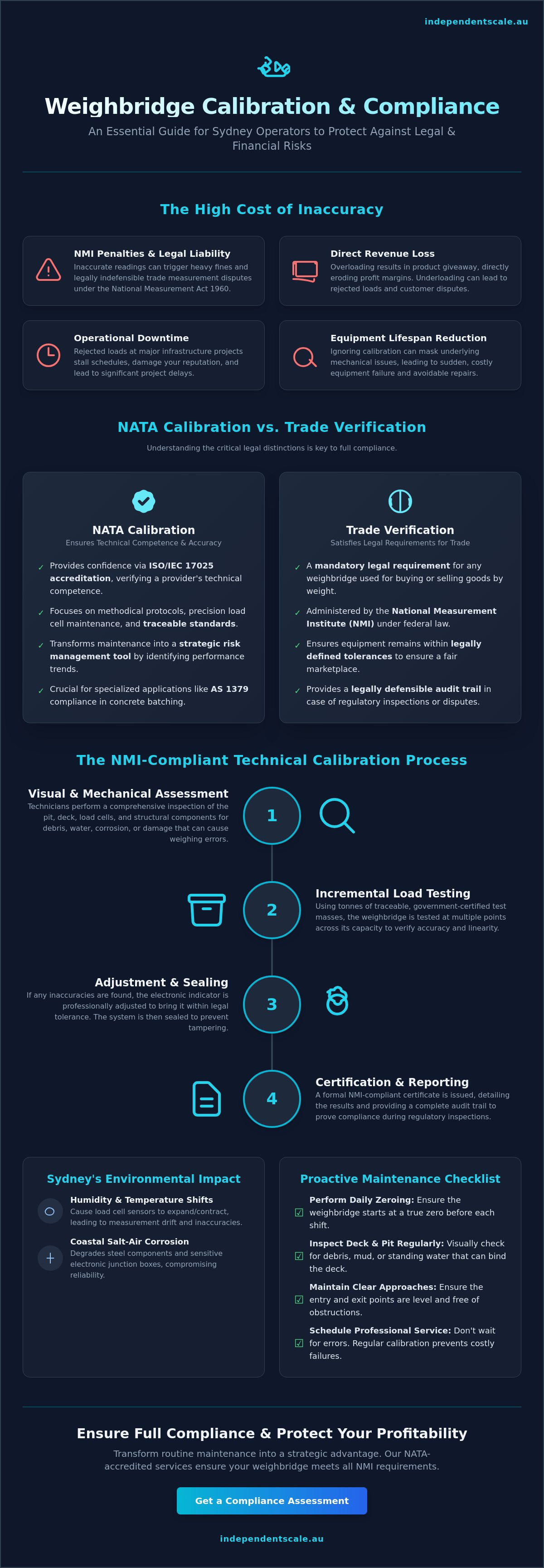
NATA Calibration vs. Trade Verification: Understanding the Difference
In the industrial weighing sector, confusion often exists between NATA calibration and trade verification. While both processes involve testing equipment against known standards, they serve different regulatory and operational purposes. Professional weighbridge calibration services Sydney must be tailored to your specific use case to ensure you remain compliant without over-investing in unnecessary certifications. NATA calibration focuses on the technical competence of the testing laboratory and the traceability of measurements to international ISO/IEC 17025 standards. Trade verification is a legal mandate enforced under the National Measurement Act 1960 for any weighing instrument used to determine a price for a transaction.
A Licensed Scale Verifier holds a specific servicing license from the NMI to perform trade verification. This process confirms the equipment meets the National Instrument Test Procedures (NITP). It results in a "verification mark" or "stamp" on the device. NATA calibration provides a more comprehensive technical report, including an assessment of measurement uncertainty. Many Sydney facilities require both services; trade verification for legal compliance and NATA calibration for high-level quality assurance and technical defensibility during audits. Using weighbridge calibration services Sydney that offer both capabilities ensures no gaps exist in your compliance strategy.
When is Trade Verification Mandatory?
You must have your weighbridge verified for trade if you sell products or services by weight. This includes quarries selling aggregate, waste management facilities charging by the tonne, and freight companies calculating shipping costs. Public weighbridges in New South Wales are also strictly regulated and must maintain current verification. Using an unverified bridge for commercial trade is a serious offense. It exposes your business to NMI investigations, significant financial penalties, and potential litigation from customers who receive inaccurate invoices. For these operators, trade verification is the primary safeguard against measurement disputes.
The Value of NATA Calibration for Internal Metrics
NATA calibration is the preferred choice for businesses that prioritize process control and inventory management over retail trade. If you use your weighbridge to track raw material movement within a site or to manage stock levels, NATA-endorsed reports provide the highest level of confidence. This technical rigor is often required to meet ISO 9001 quality management standards. It ensures that your internal data remains consistent and reliable year-over-year. This level of precision is equally critical for other site components; for example, we provide specialized NATA Calibration for Hoppers to ensure batching accuracy throughout your facility. Relying on NATA-accredited testing helps identify subtle equipment degradation before it impacts your operational efficiency.
Maintaining Your Sydney Weighbridge Between Service Visits
The interval between professional weighbridge calibration services Sydney is when most operational errors develop. While NATA-accredited testing establishes a baseline of accuracy, site conditions change daily. Weighbridge operators must perform visual inspections to ensure the deck remains free-floating and unobstructed. Regularly "zeroing" the indicator is the most basic yet essential task for maintaining consistency. If the bridge fails to return to zero after a load departs, it's a primary indicator of mechanical binding or load cell issues. For a structured maintenance routine, review our Maintaining Vehicle Weigh Scales Checklist.
Housekeeping and Pit Maintenance
Sydney’s intense storm season presents specific challenges for pit-mounted weighing systems. Heavy rainfall often overwhelms drainage systems, leading to submerged components and silt accumulation. Water ingress into junction boxes often results in erratic weight fluctuations or complete system failure. In high-traffic Sydney logistics hubs, dirt, gravel, and road debris frequently lodge in the gaps between the deck and the pit wall. This binding prevents the load from being fully transferred to the load cells, causing the bridge to under-weigh. Establish a weekly cleaning protocol to clear these gaps. Use high-pressure air or water to remove debris, ensuring that electronic components remain shielded from direct moisture.
Operator Training and Best Practices
Operator behavior significantly impacts the longevity of your weighing infrastructure. Trucks must enter and exit the deck at speeds below 5km/h to minimize shock loading. Sudden braking on the weighbridge deck can damage load cell mounts and lead to immediate calibration shift. Operators should also be trained to recognize basic error codes on digital displays and transmitters. If a weight reading fluctuates wildly while a vehicle is stationary, it's typically an electrical fault rather than a mechanical obstruction. Knowing when to call for an emergency repair rather than waiting for your next weighbridge calibration services Sydney visit prevents trade measurement disputes and protects your revenue. Consistent measurement drift is a signal that the system requires professional attention.
If your system shows persistent errors despite regular housekeeping, you may require a technical assessment. Book a professional weighbridge inspection to restore your equipment to NMI-compliant standards.
Why Choose Independent Scale Service for Sydney Calibration?
Selecting a partner for weighbridge calibration services Sydney requires a focus on technical accreditation rather than just operational history. Independent Scale Service maintains NATA accreditation to ISO/IEC 17025, which serves as the global benchmark for laboratory competence and measurement traceability. This accreditation isn't merely a badge; it's a technical guarantee that our testing methodologies, equipment, and technicians meet the most stringent international standards. For industrial clients, this translates to legally defensible data and full compliance with the National Measurement Act. We provide a serious service for serious businesses, ensuring that your weighing infrastructure remains an asset rather than a liability.
Sydney's infrastructure boom demands a level of precision that standard providers often overlook. We maintain deep expertise in AS 1379 compliance, a critical requirement for the concrete and construction industries across the Sydney basin. Our technical team understands that a weighbridge is part of a larger industrial ecosystem. We don't just calibrate; we provide a full lifecycle service including load cell supply, mechanical repair, and system optimization. This integrated approach eliminates the need for multiple contractors and significantly reduces the risk of measurement errors during high-volume production cycles. By focusing exclusively on industrial applications, we ensure our expertise isn't diluted by retail or consumer scale services.
Our Sydney Service Capabilities
Our mobile technicians are strategically positioned to serve industrial hubs across Western Sydney, Port Botany, and regional New South Wales. We understand that every hour of downtime represents a direct hit to your revenue. Our service vehicles are equipped with the specialized tooling required for concrete batching plant calibration and other heavy-duty applications. Whether you require a routine verification or immediate access to our industrial weighing components, our response is structured to prioritize your site's operational continuity. We possess the logistical capability to manage heavy test mass transport even in the most congested Sydney industrial corridors.
Request a Professional Calibration Quote
Precision is a non-negotiable requirement for modern industrial operations. If your site requires weighbridge calibration services Sydney, you need a provider that values technical accuracy over marketing fluff. We offer methodical, data-driven assessments that protect your business from measurement disputes and regulatory fines. Our reporting is clear, authoritative, and ready for any NMI or NATA audit. We don't offer generic advice; we provide technical solutions designed for the rigors of the Sydney industrial landscape. Contact Independent Scale Service for Sydney Weighbridge Calibration to secure a technical quote for your facility. Our experts are ready to ensure your weighing infrastructure remains reliable and compliant.
Secure Your Site's Compliance and Measurement Accuracy
Maintaining a compliant weighing operation requires a commitment to technical precision and a clear understanding of NMI and NATA standards. As outlined in this guide, the distinction between trade verification and technical calibration is a critical factor in effective risk management. By implementing rigorous maintenance protocols and engaging with accredited experts, you protect your business from the financial and legal consequences of measurement drift. Professional weighbridge calibration services Sydney provide the necessary assurance that your equipment remains a reliable asset within your industrial supply chain.
Independent Scale Service delivers the technical competence required for complex industrial environments. We are NATA Accredited to ISO/IEC 17025 and recognized as AS 1379 compliance experts. Our technicians specialize in the unique demands of concrete batching and heavy industrial weighing, ensuring every test mass application and load cell adjustment meets the highest standards of accuracy. Don't leave your regulatory standing to chance or allow inaccurate data to erode your profitability. Book Your NATA-Accredited Sydney Weighbridge Calibration today to ensure your facility operates with absolute precision and full legal compliance. We look forward to supporting your site's long-term operational success.
Frequently Asked Questions
How often should a weighbridge be calibrated in Sydney?
Standard practice dictates that a weighbridge should undergo calibration at least every 12 months. High-traffic sites or those operating in harsh environmental conditions, such as coastal areas near Port Botany, may require more frequent testing to maintain accuracy. Contractual obligations with tier-one infrastructure clients often mandate bi-annual or quarterly inspections to mitigate measurement risk and ensure consistent data.
What is the difference between NATA calibration and NMI verification?
NATA calibration certifies that a weighbridge meets the technical requirements of ISO/IEC 17025 and provides a detailed report on measurement uncertainty. NMI verification is a legal requirement under the National Measurement Act 1960 for any equipment used in trade. While NATA focuses on technical competence and quality assurance, NMI verification ensures the device is legally cleared for commercial transactions.
Can I calibrate my own weighbridge if I have the test weights?
No, self-calibration isn't legally recognized for trade purposes or NATA compliance. Official weighbridge calibration services Sydney must be performed by a licensed technician using certified, traceable test masses. This ensures the results are legally defensible and meet the standards required for regulatory audits, quality management systems, and NMI trade measurement inspections.
What happens if my weighbridge fails its calibration test?
If a weighbridge fails, it must be removed from trade use until the underlying mechanical or electronic faults are rectified. Technicians will perform necessary repairs, such as load cell replacement or deck adjustment, before conducting a follow-up test. You can't legally issue weight-based invoices until the system passes verification and receives a new compliance mark from a licensed verifier.
How long does a typical weighbridge calibration take?
A standard calibration procedure typically requires between two and four hours of on-site time. This duration accounts for the initial visual inspection, the methodical positioning of heavy test masses, and the final adjustment of the weight indicator. Complex sites with significant debris buildup or mechanical binding may require additional time for pre-calibration cleaning and necessary mechanical repairs.
Does Independent Scale Service provide NATA certificates for weighbridges?
Yes, we provide NATA-endorsed calibration certificates that fulfill the requirements of ISO/IEC 17025. These documents provide a comprehensive audit trail, including "as found" and "as left" data points. This level of certification is essential for sites maintaining high-level quality management standards or those involved in government-contracted infrastructure projects across New South Wales.
Are your Sydney technicians licensed to perform trade verification?
Our technicians hold the necessary NMI servicing licenses to perform legal trade verification across the Sydney region. This authorization allows us to verify and "stamp" weighing equipment for commercial use in accordance with the National Trade Measurement Regulations. We ensure your equipment remains fully compliant with Australian law for all weight-based commercial transactions and trade activities.
What industries in Sydney require NATA-accredited weighbridge calibration?
Industries such as concrete batching, waste management, and large-scale logistics rely on weighbridge calibration services Sydney to maintain operational precision. Construction companies adhering to AS 1379 also require accredited testing to ensure material batching accuracy for structural concrete. Any sector where measurement uncertainty must be quantified and minimized will benefit from NATA-accredited calibration services to ensure technical defensibility.
