


Cost to Replace Weighbridge Load Cells: 2026 Australian Pricing Guide
What if the $259.28 you spend on a shear beam load cell is the smallest line item on your final invoice? For Australian industrial operations, the total cost to replace weighbridge load cells isn't just about the hardware. It's about the technical precision required to restore NMI compliance. You're likely dealing with the immediate pressure of operational downtime and the uncertainty of hidden fees like NATA re-calibration. We understand that every hour your weighbridge is offline, your revenue takes a direct hit. This is a high stakes environment where choosing the wrong component or skipping professional verification leads to premature failure and legal liability.
This guide provides a comprehensive breakdown of 2026 Australian pricing, covering hardware kits and the $32 per hour average rate for specialized scale technicians. You'll learn exactly how to budget for NATA accredited calibration, which can start from $50 for new instruments but remains essential for trade use under the National Measurement Act 1960. We'll preview current market trends, including the 6.48% growth in the global weighbridge sector, and explain how to minimize facility downtime through proactive maintenance. This article delivers an accurate roadmap for maintaining a compliant, high capacity weighing system.
Key Takeaways
- Identify the price disparity between analogue and digital hardware kits to select the most cost-effective technology for your facility's specific weighing capacity.
- Accurately budget the total cost to replace weighbridge load cells by accounting for specialized technician labor and the logistical requirements of heavy deck lifting.
- Understand the legal necessity of NATA accredited calibration and NMI verification to maintain trade-to-weight compliance under the National Measurement Act 1960.
- Learn to apply a technical "Repair vs. Replace" framework to determine when a full system upgrade is more economical than individual sensor replacement.
- Discover how modern indicators and integrated surge arrestors can extend component lifespan and reduce future operational downtime through predictive maintenance.
Factors Influencing the Cost of Weighbridge Load Cell Replacement
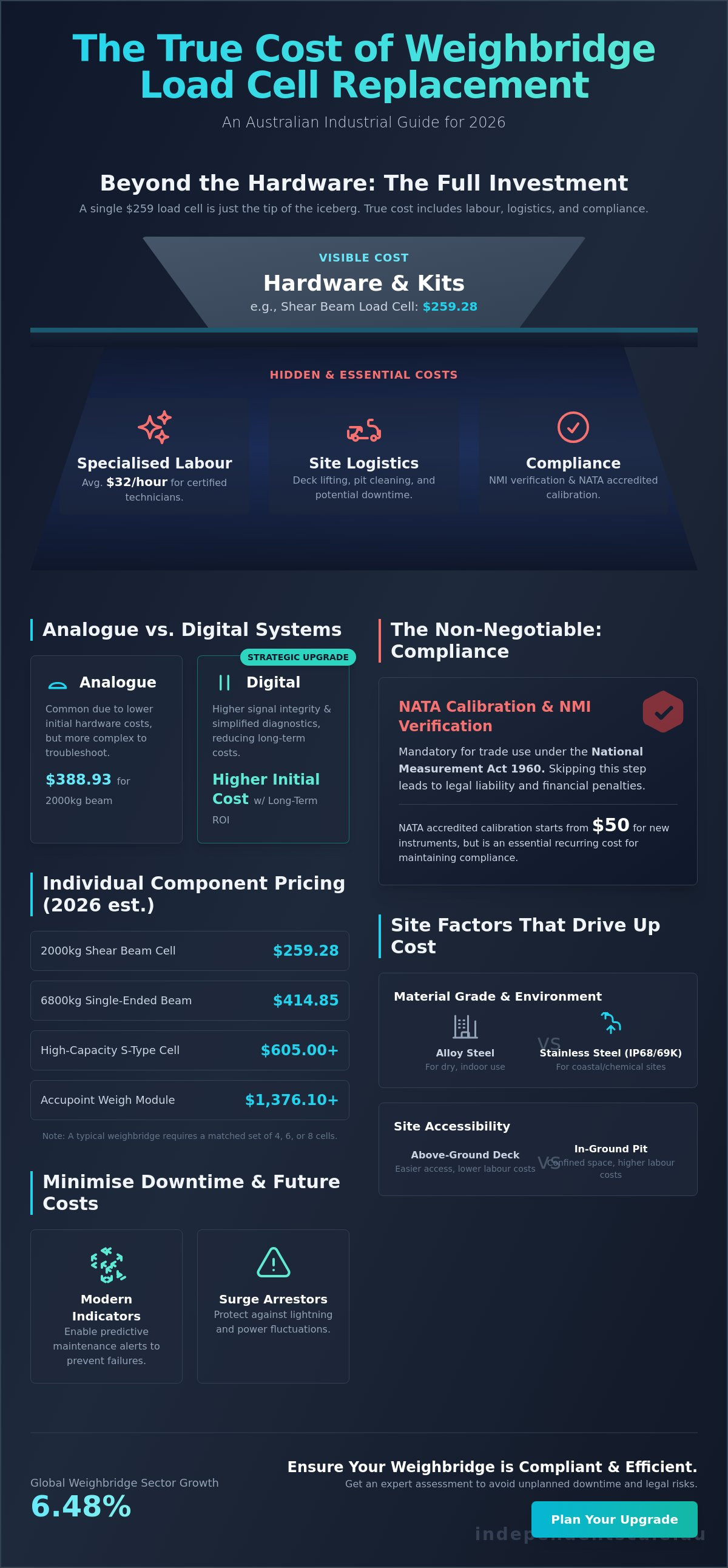
The total cost to replace weighbridge load cells is determined by a complex interplay of hardware selection and site-specific logistics. While a single 2000kg shear beam load cell might be priced at $259.28, the final invoice for a full system overhaul often includes specialized labor and compliance certifications. Industrial facilities must evaluate whether their current infrastructure supports a simple component swap or requires a full technological upgrade to maintain accuracy and NMI compliance.
Capacity is the primary driver of hardware volume. Standard Australian weighbridges typically utilize 4, 6, or 8 cells depending on the deck length and maximum rated capacity. A 100-ton mining weighbridge requires high-capacity compression cells, whereas a standard 60-ton logistics deck might use 30t canister or rocker column variants. Increasing the number of cells doesn't just raise the hardware price; it also adds technical hours for leveling, corner adjustment, and the calibration of summing circuits within the junction box.
Analogue vs. Digital Load Cell Systems
Analogue systems remain common due to lower initial hardware costs, such as the $388.93 price point for a 2000kg single-ended load beam. However, upgrading to digital technology is a strategic investment for high-volume sites. Digital cells offer higher signal integrity and simplified troubleshooting, as each cell communicates directly with the indicator. You should be aware that upgrading from analogue to digital usually requires replacing the entire junction box and indicator to ensure system compatibility. This transition often reduces long-term maintenance costs by identifying specific cell failures before they cause significant weighing errors.
Material Grades and Environmental Protection
Environmental conditions dictate the necessary material grade and IP rating. Alloy steel cells are suitable for dry, indoor applications, but Australian coastal or chemical processing sites require stainless steel construction. Hermetically sealed cells with IP68 or IP69K ratings prevent moisture ingress, which is the leading cause of premature failure. Investing in stainless steel load cells with integrated surge arrestors protects against lightning strikes and power fluctuations. While these features carry a price premium, they are essential for avoiding the revenue loss associated with emergency repairs and unplanned downtime.
Site accessibility significantly impacts the labor component of the quote. Above-ground decks allow for relatively straightforward jacking and replacement. In contrast, in-ground pit installations often require confined space permits and extensive cleaning to remove debris before technicians can access the mounting hardware. These logistical hurdles can extend the time required for a specialized scale technician, currently averaging $32 per hour in Australia, to complete the installation and move to the mandatory NATA-accredited testing phase.
Hardware Cost Breakdown: Load Cells and Kits
Hardware selection represents the most immediate expense when calculating the total cost to replace weighbridge load cells. In 2026, standard industrial components vary significantly based on capacity and material grade. For example, a 1000kg single-ended beam load cell is priced at $726.00, while a 2000kg shear beam model 65023 is available for $259.28. High-capacity steel S-type load cells start from $605.00. While individual unit prices are a useful benchmark, a standard weighbridge requires a synchronized set of 4, 6, or 8 cells. This multiplies the hardware investment and necessitates a matched set to ensure linear output across the entire deck.
Individual Component Pricing
The unit price of a sensor is closely tied to its weight capacity and specialized design. A 6800kg single-ended load beam is currently priced at $414.85, reflecting the increased material strength required for heavier industrial loads. For specialized applications, Accupoint weigh modules start from $1,376.10, providing integrated mounting for tanks and silos. You can view technical specifications and current availability in our load cells collection. It's technically safer to replace all cells in a system simultaneously to prevent mismatching sensitivity levels, which leads to corner errors and calibration drift.
Ancillary Hardware and Accessories
A complete overhaul often necessitates replacing ancillary components that have degraded alongside the sensors. Summing circuits and junction boxes are prone to corrosion and signal interference over time. In harsh Australian environments, using rodent-proof, double-shielded cabling is a technical necessity to prevent erratic weight readings. Standard kits often include 10m cables and an indicator, which ensures the entire signal chain is modernized. If your current summing box shows signs of moisture ingress or terminal oxidation, replacing it during the load cell swap is the only way to guarantee system reliability.
Mounting hardware, including rockers, base plates, and load buttons, is frequently overlooked during budgeting. If these mechanical components are worn, pitted, or rusted, a new load cell won't sit correctly, causing side-loading and inaccurate measurements. Compliance with National Measurement Institute regulations is mandatory for any weighbridge used for trade. Trade-approved hardware undergoes rigorous pattern approval testing to ensure it maintains accuracy over thousands of duty cycles. Opting for non-trade hardware might save upfront costs, but it renders the weighbridge illegal for commercial transactions and will fail a NATA-accredited verification. Facilities looking to audit their current hardware status can browse our full equipment range to identify compatible replacement parts.
Labour, Site Preparation, and Technical Service Fees
The human and mechanical effort required to execute a sensor swap often represents a significant portion of the total cost to replace weighbridge load cells. In Australia, the average hourly rate for a specialized scale technician is approximately $32, based on May 2026 data. However, this base rate does not account for the mobilization of heavy equipment or the specialized nature of field service. A full replacement for an 8-cell weighbridge typically requires a technical team for 1 to 2 full business days, depending on site accessibility and the condition of existing mounting hardware. This timeframe includes the physical installation and the essential load cell calibration required to meet NMI standards.
Lifting a weighbridge deck is a high-precision operation that necessitates heavy-duty hydraulic jacking systems. These jacks must be rated for the full dead-load of the bridge, which can exceed 20 tonnes for a standard 18-metre deck. The cost of mobilizing this machinery, along with safety stands and leveling tools, is a standard inclusion in professional quotes. Attempting to lift a deck without specialized equipment risks warping the structural steel or damaging the new load cells during the "drop" phase. Technicians must ensure the deck is perfectly level to within 1-2mm across all support points to prevent non-linear weighing results.
A critical technical decision involves the "Repair vs. Replace" logic. While replacing a single failed cell might seem cost-effective, it often leads to recurring downtime if the remaining cells are of the same age and duty cycle. If one cell has failed due to environmental ingress or lightning, the others have likely been compromised. Replacing the entire set during a single site visit eliminates redundant travel fees and ensures the system operates with matched sensitivity. This proactive approach is essential for high-volume facilities where unplanned downtime can cost thousands in lost throughput per hour.
Professional Installation Requirements
Precision installation goes beyond mechanical bolting. Technicians must meticulously check the "gap" and "float" of the weighbridge to ensure no binding occurs against the pit walls or approach ramps. Correct load distribution is verified using a test truck or calibrated weights to ensure each cell is carrying its proportional share of the load. Without this technical balancing, specific cells will wear prematurely, leading to early system failure and the need for another expensive replacement cycle.
Site Specific Variables
Pit-mounted weighbridges present unique logistical challenges that can increase labour hours by 25% or more. Debris accumulation and poor drainage often require extensive pit cleaning and remediation before work can commence. If the site is classified as a confined space, additional safety personnel and monitoring equipment are mandatory under Australian OHS regulations. Furthermore, older installations often feature seized mounting bolts that require thermal cutting or specialized extraction, adding unpredictable hours to the service call. For critical operations, utilizing 24/7 emergency service ensures a faster response but carries a premium labour rate to account for after-hours mobilization.
The Hidden Cost: NATA Calibration and Compliance
Hardware installation is technically incomplete without legal verification. Replacing any component in the weighing chain alters the system's millivolt output, necessitating a full recalibration to restore accuracy. This mandatory final step is where the total cost to replace weighbridge load cells often exceeds initial hardware estimates. Under the National Measurement Act 1960, any weighbridge used for trade must be verified by a servicing licensee after a repair. Failing to secure this certification renders the equipment illegal for commercial use and exposes the operator to significant legal liability.
NATA accreditation to ISO/IEC 17025 provides the highest level of confidence in your measurement data. While NATA-endorsed calibration for a single new instrument can start from as little as $50, the logistical requirements for a high-capacity weighbridge are more intensive. You must account for the mobilization of a test truck and several tonnes of certified hire weights. These weights are essential for testing the bridge at its full operating capacity and ensuring linearity across the entire deck. Without this gravimetric proof, there is no technical guarantee that the system is performing within the required tolerances.
The Calibration Process Post-Replacement
Once the new sensors are installed, technicians perform a multi-point calibration using the gravimetric method. This involves placing known masses at specific points on the deck to adjust the summing circuit and indicator settings. Accurate calibration is the only technical defense against "shrinkage"—the incremental loss of revenue caused by under-recording outbound product or over-paying for inbound materials. For high-volume sites, even a 0.5% error can result in tens of thousands of dollars in annual profit loss. You can explore our specialized load cell calibration services to understand the technical requirements for your specific model.
Compliance with AS 1379 and Trade Standards
For industries like concrete production, compliance with AS 1379 is a non-negotiable requirement for quality assurance. We currently service 98% of concrete plants across Sydney, ensuring their weighing systems meet the stringent accuracy levels required for structural material certification. Non-compliance leads to more than just fines; it can result in rejected loads and the loss of major infrastructure contracts. Our calibration services guide details the specific documentation required to satisfy NMI auditors and Chain of Responsibility (CoR) laws. Maintaining these standards is an essential operational cost that protects your business from the catastrophic expenses of legal disputes or site shutdowns.
Legal-for-trade verification is a specialized service that only a licensed technician can provide. If your facility operates within the mining, logistics, or construction sectors, your weighbridge is a critical financial tool. Secure your facility's compliance and accuracy by scheduling a professional NATA-accredited calibration immediately following any sensor replacement.
Strategic Replacement: Minimising Long-Term Operational Costs
Strategic financial planning for industrial weighing equipment requires a shift from viewing sensor failure as an isolated repair to treating it as a system-wide maintenance event. While the immediate cost to replace weighbridge load cells is a primary concern, the long-term ROI is heavily influenced by how you manage component lifecycles. Opting for a single cell replacement might save capital today, but it often ignores the technical reality that load cells in a single deck are typically subject to the same environmental stressors and duty cycles. Instead of a one-off fix, a coordinated replacement strategy prevents the "revolving door" of technician callouts and repeated NATA-accredited verification fees.
Modern digital indicators play a vital role in reducing future operational costs. These systems offer predictive maintenance capabilities by monitoring the millivolt output of individual cells in real-time. If a specific cell begins to drift or shows signs of moisture ingress, the system alerts the operator before the error exceeds trade tolerances. This proactive data allows for scheduled maintenance during planned facility shutdowns, effectively eliminating the revenue loss associated with emergency 24x7 repairs.
The Case for Full Set Replacement
Technicians often recommend a full set replacement to avoid "cascading failure." When one cell fails due to a lightning strike or structural fatigue, the remaining sensors have likely sustained similar internal damage that hasn't yet manifested as a total signal loss. Replacing the entire set offers three distinct advantages:
- Labour Efficiency: You pay for specialized jacking equipment and technician mobilization once rather than multiple times over a 12-month period.
- Matched Sensitivity: New cells from the same production batch ensure perfectly balanced output, making the corner-adjustment process faster and more precise.
- Warranty Protection: Full system overhauls often carry more comprehensive service warranties compared to individual component swaps.
Choosing a NATA-Accredited Partner
The technical competence of your service provider is the final variable in the cost equation. Independent Scale Service (ISS) brings over 30 years of experience to every site, currently servicing 98% of concrete plants across Sydney for major clients like Holcim and Boral. We don't just supply hardware; we provide NATA-accredited calibration to ISO/IEC 17025, ensuring your facility remains compliant with AS 1379 and NMI standards. Our technicians understand the nuances of high-capacity systems and the logistical requirements of heavy industrial environments.
The total cost to replace weighbridge load cells is minimized when technical precision is prioritized over cheap hardware. For a detailed breakdown of how to manage your facility's weighing infrastructure, consult our weighbridge installation and calibration expert services. Contact us today for a comprehensive quote tailored to your specific site requirements and operational duty cycle.
Optimising Your Weighbridge Investment for 2026
Accurate budgeting for the cost to replace weighbridge load cells requires balancing technical hardware specifications with mandatory compliance standards. As established, the 2026 Australian market demands a transition toward digital systems and hermetically sealed stainless steel components to withstand high-volume duty cycles. You must also account for the specialized labor of technicians, currently averaging $32 per hour, and the logistical necessity of heavy lifting equipment for deck manipulation. These factors ensure your facility avoids the revenue loss associated with "shrinkage" and uncertified weighing data.
Reliability is anchored in NATA accreditation to ISO/IEC 17025 and strict adherence to AS 1379 standards for concrete and heavy industry. Independent Scale Service provides 24/7 emergency support across Australia, leveraging over 30 years of expertise to minimize your operational downtime. By choosing a full-system replacement strategy, you eliminate the cascading failure risks associated with aging components and secure your site's legal-for-trade status. Get a Professional Quote for Weighbridge Load Cell Replacement today to ensure your industrial weighing operations remain precise and legally compliant. We're ready to restore your facility's accuracy and productivity.
Frequently Asked Questions
How much does a single weighbridge load cell cost to replace?
Hardware costs for individual sensors vary based on capacity and material grade. As of May 2026, a 2000kg shear beam load cell is priced at $259.28, while a 1000kg single-ended beam model costs $726.00. High-capacity steel S-type sensors start from $605.00. You must also budget for specialized technician labor and mandatory NATA-accredited calibration to ensure the new component integrates correctly with your existing summing circuit.
Do I have to replace all load cells if only one is faulty?
While you can replace a single cell, it's technically recommended to replace the full set. Aging sensors often fail in quick succession due to similar duty cycles and environmental stressors. Replacing the entire set ensures matched sensitivity across the deck and avoids the recurring expense of multiple technician callouts and NMI re-verifications. This proactive approach significantly reduces the total cost to replace weighbridge load cells over a 12-month period.
How long does it take to replace a full set of weighbridge load cells?
A full replacement for an 8-cell weighbridge typically requires 1 to 2 business days. This timeframe includes the physical jacking of the deck, removal of old hardware, and installation of new IP68/IP69K rated sensors. The process concludes with a multi-point gravimetric method calibration. Site-specific challenges, such as confined space entry for pit-mounted systems, can extend this duration by several hours.
Is NATA calibration mandatory after replacing a load cell?
Yes, it's a legal requirement under the National Measurement Act 1960 for any weighbridge used for trade. Any adjustment to the weighing chain necessitates re-verification by an NMI servicing licensee. NATA-accredited calibration to ISO/IEC 17025 ensures your equipment meets the required accuracy tolerances. Failure to verify the system after a repair renders the weighbridge illegal for commercial transactions and exposes you to legal liability.
Can I use generic load cells on my existing weighbridge?
Generic cells are an option, but they must possess NMI pattern approval if the weighbridge is used for trade. Many low-cost alternatives lack the hermetic sealing and surge protection found in premium stainless steel models. Using non-approved or low-quality hardware often results in premature failure and a failed NATA verification, which ultimately increases your long-term maintenance expenditure.
What are the signs that my weighbridge load cells are failing?
Common technical indicators include erratic weight readings, poor repeatability, and "weight drifting" while a vehicle is stationary. You might also notice that the zero point doesn't return correctly after a load is removed. Physical inspections often reveal moisture ingress in the junction box or rodent damage to the cabling. Modern digital indicators can also flag millivolt output errors that signify an internal strain gauge failure.
How often should weighbridge load cells be inspected to avoid replacement?
Quarterly inspections are the industry standard for maintaining high-accuracy industrial systems. Technicians check the "gap" and "float" to ensure the deck isn't binding against pit walls or approach ramps. Regular cleaning to remove debris from around the load cell mounts prevents side-loading and premature fatigue. These proactive measures can extend the operational lifespan of your sensors by 30% or more.
Does the cost of replacement include the disposal of old components?
Professional service quotes from licensed technicians usually include the removal and disposal of old load cells and cabling. This ensures that industrial waste, including potentially hazardous electronic components, is handled according to Australian environmental regulations. It's essential to verify that disposal and site remediation are included in your initial quote to avoid unplanned fees at the end of the project.
