


Concrete Plant Calibration Quote: A Guide to AS 1379 Compliance
A vague concrete plant calibration quote is more than just a procurement oversight; it's a technical liability that can lead to failed NATA audits and costly batching errors. You likely recognize that precision in your weighing systems is non-negotiable for maintaining product quality and site safety across your Australian operations. However, the prospect of hidden fees or significant plant downtime during the testing process often makes the selection of a service provider a complex task. It's a common frustration when a quote seems competitive but fails to account for the full scope of AS 1379 requirements.
This guide provides the technical clarity required to evaluate a concrete plant calibration quote effectively while ensuring full compliance with current Australian standards. You'll learn exactly which hoppers, ad-mix meters, and water meters require gravimetric method calibration to meet rigorous industry benchmarks. We'll also detail how to identify hidden costs in service proposals and how to schedule testing to minimize disruption to your daily batching schedule. By the end of this article, you'll have a clear roadmap for maintaining a NATA-accredited facility that avoids the operational risks and financial penalties associated with non-compliant weighing equipment.
Key Takeaways
- Understand the mandatory requirements of AS 1379 Clause 3.3 to ensure all weighing and measuring equipment meets rigorous Australian regulatory standards.
- Identify the primary cost drivers, including the total number of hoppers and the chosen calibration methodology, to accurately evaluate a concrete plant calibration quote.
- Gain technical insights into the certification of aggregate hoppers and liquid flowmeters to ensure gravimetric accuracy across your entire batching line.
- Learn practical site preparation strategies, such as clearing access for heavy test weights, to minimise technician time and reduce overall service costs.
- Discover why 98% of Sydney’s concrete plants partner with NATA-accredited experts to maintain compliance and operational reliability.
The Importance of AS 1379 Compliance in Your Calibration Quote
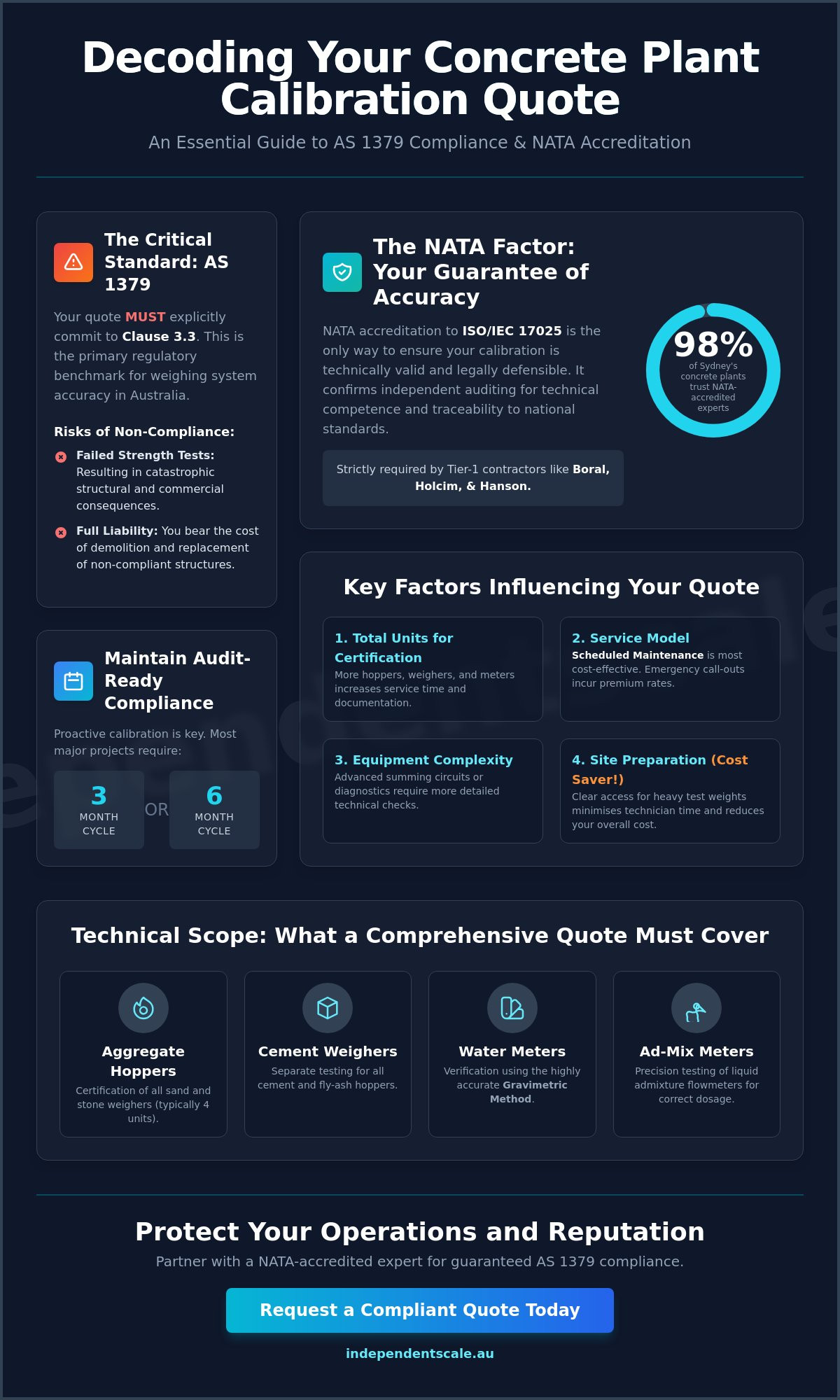
AS 1379-2007 is the Australian Standard for the specification and supply of concrete. It serves as the primary regulatory benchmark for quality control across the national construction industry. When reviewing a concrete plant calibration quote, the most critical element is an explicit commitment to Clause 3.3. This specific clause mandates the accuracy requirements for all weighing and measuring systems within a concrete plant. Without this compliance, the concrete produced may not meet the structural engineering requirements of the project, leading to catastrophic commercial consequences.
Selecting a non-accredited provider to save on initial costs is a high-risk strategy. If a batch of concrete fails a 28-day strength test, the first document an auditor or forensic engineer will request is the calibration certificate for the batching plant. If the service was performed by a provider lacking NATA accreditation to ISO/IEC 17025, that certificate holds no legal weight. The producer then faces the full liability for the cost of demolition and replacement of the non-compliant structures. Professional quotes from Independent Scale Service (ISS) leverage over 30 years of experience to ensure every scale and flowmeter meets these rigorous standards.
Mandatory Audit Intervals for Concrete Plants
AS 1379 requires consistent verification of weighing equipment to maintain batching accuracy. While the standard provides a framework, most Australian plants operating on major infrastructure projects adopt a 3-month or 6-month calibration cycle. Waiting for equipment to fail before calling a technician is an unacceptable risk for professional operators. A compliant concrete plant calibration quote should outline a recurring schedule that keeps your compliance folder audit-ready at all times. After each service, ISS provides detailed documentation that includes:
- Current accuracy readings for all aggregate and cement hoppers.
- Verification of liquid admixture flowmeters using the gravimetric method.
- Signed certificates of compliance for your quality management system.
- A clear record of any adjustments made to summing circuits or load cell mounts.
The Role of NATA in Weighing Accuracy
NATA accreditation to ISO/IEC 17025 is the only way to guarantee that your batching accuracy is technically valid. This accreditation means the calibration laboratory has been independently audited for technical competence. It ensures full traceability, meaning the test weights used on your site are certified against national primary standards. Tier-1 contractors, including Boral, Holcim, and Hanson, strictly require NATA-stamped certificates for all plant equipment. ISS services 98% of concrete plants across Sydney, providing the AS 1379 compliant calibration necessary to satisfy these industry leaders. A professional quote must confirm the use of NATA-endorsed methods to protect your plant's reputation and operational status.
What Factors Influence Your Concrete Plant Calibration Quote?
Requesting a concrete plant calibration quote involves more than just a flat fee for a technician's time. Precise batching requires strict adherence to AS 1379, which dictates specific tolerances for all weighing and measuring devices. Several technical variables determine the final cost of a service visit. A comprehensive quote accounts for the scale of operations and the specific compliance path required by your project contracts.
- Total units for certification: A standard plant often includes four aggregate hoppers, two cement weighers, and multiple liquid meters. Each individual unit requires separate testing and documentation.
- Service Model: Scheduled maintenance is the most cost-effective approach. Emergency call-outs for plant breakdowns or sudden audit failures incur higher rates due to the 24/7 responsiveness required to minimize downtime.
- Equipment complexity: Plants utilizing advanced summing circuits and surge arrestors require more detailed diagnostic checks during the calibration process.
The importance of calibration cannot be overstated for structural concrete providers. Inaccurate measurements lead to compromised batch integrity and potential legal liabilities. This makes the methodology used in your quote a critical factor for compliance.
Dead Weight vs. Pull-Down Methods
The method used to verify accuracy significantly impacts your concrete plant calibration quote. ISS exclusively utilizes the gravimetric (dead weight) method because the pull-down method, which uses hydraulic rams, is not NATA-recognised for AS 1379 certification. Pull-down methods lack the traceable masses required for high-accuracy results. Gravimetric calibration requires specialized crane trucks and 4-tonne certified weight sets. While the equipment requirements for dead weight testing are more intensive, it's the only way to ensure your plant meets the ISO/IEC 17025 standards expected by major tier-one contractors.
Logistics and Site Access Requirements
Geographic location plays a major role in pricing. Transporting 4,000kg of certified test weights to remote Australian sites or regional infrastructure projects involves significant heavy vehicle logistics. Site-specific inductions also influence labour costs. If a technician must complete a four-hour safety induction before starting work, that time is factored into the service agreement. For companies managing multiple assets, we offer multi-plant discounts when AS 1379 compliant services are batched into a single regional circuit. This reduces the per-plant transport cost and streamlines the certification process across your entire fleet.
If your plant is approaching its six-month certification interval, you can view our hopper calibration options to see how we maintain accuracy across different vessel types.
Technical Scope: What a Comprehensive Quote Must Cover
A professional concrete plant calibration quote isn't a single line item. It details the technical methodology required to meet Australian Standard AS 1379. Every component in the batching chain, from the aggregate gates to the admixture dispensers, needs precise verification. ISS ensures your quote includes a full mechanical and electronic audit to prevent batching errors before they occur. This comprehensive approach covers four critical areas of plant operation.
Hoppers and Silo Weighing Assemblies
Accurate weighing starts with the structural integrity of the hopper. We test load cells for linearity and repeatability across the entire weighing range. Binding is a common issue where physical obstructions, build-up, or stiff seals restrict movement; this causes false readings even if the electronics are functional. A comprehensive quote must include a thorough inspection for these mechanical interferences. For facilities upgrading their infrastructure, you can explore our tank and silo weighing assemblies designed for high-capacity industrial use.
Flowmeters and Admixture Systems
Water and chemical admixtures are critical to concrete strength and workability. We calibrate both weighed water systems and flowmeter systems using the gravimetric method. This involves comparing the flowmeter's pulse output against a known weight on a NATA-certified scale to ensure total accuracy. Admixture scales require specific attention; we use chemical-resistant load cells to prevent corrosion from aggressive additives. Our liquid flowmeter calibration services ensure your batching plant maintains the ±3% accuracy required for additives under AS 1379.
Precision isn't limited to the load cell itself. A detailed concrete plant calibration quote should also account for the following technical checks:
- Scale indicators and summing circuits: We examine electronic components for drift, signal noise, or damaged summing boards that can lead to inconsistent batch weights.
- Mechanical inspection: Our technicians inspect knife edges and load cell mountings for wear or corrosion. A mounting misaligned by even a few degrees introduces side-loading errors that compromise the entire batch.
- Electronic fault diagnosis: We check surge arrestors and junction boxes for moisture ingress, which is a leading cause of intermittent scale failure in Australian concrete plants.
- Gravimetric accuracy: We verify aggregate and cement hoppers using certified test weights to ensure the gravimetric system meets the strict ±2% tolerance for cementitious materials.
ISS technicians perform these checks to ensure your plant reflects a complete return to service. We don't just provide a certificate; we provide the technical certainty that your equipment is operating within legal and structural tolerances. This methodical process reduces the risk of rejected loads and protects your NATA accreditation status.
Preparing Your Site to Minimise Calibration Costs
Site readiness is the primary variable within your control when requesting a concrete plant calibration quote. Technical labour is billed by the hour; therefore, any delay caused by restricted access or mechanical failure adds unnecessary expense to the final invoice. Ensure crane trucks carrying heavy test weights have a clear, stable path to the hoppers. Obstructions or soft ground can delay 10-tonne weight deliveries by over 90 minutes, which directly inflates the service cost.
Cleaning hoppers is a mandatory pre-calibration step. Residual build-up of dried concrete or aggregate alters the dead load and can interfere with the gravimetric method of calibration. If a technician must wait for your crew to chip away build-up, the audit takes longer. Verify that plant operators are on-site and ready to assist with the automation software. Modern AS 1379 compliance requires seamless integration between the physical scale reading and the batching computer. Without an operator to navigate the software, the technician cannot verify that the "dash" matches the "scale."
Conduct a pre-check of all mechanical components 24 hours before the scheduled visit. Look for frayed load cell cables, rusted mounting assemblies, or debris jammed in the hopper gaps. Detecting a faulty load cell early allows for a replacement to be sourced before the audit begins, preventing a "failed" result and a costly follow-up visit. Roughly 15% of calibration failures are caused by visible mechanical issues that could've been rectified prior to the technician's arrival.
A Checklist for Plant Managers
Safety compliance is non-negotiable for NATA-accredited technicians. Confirm that all electrical safety and RCD testing is up to date according to Australian standards. Provide a dedicated, stable 240V power supply near the weighing indicators for testing equipment. The plant must be safely isolated to allow for mechanical inspections of summing circuits and load cell mounts. Having the LOTO (Lock Out Tag Out) process ready to go saves approximately 30 minutes of setup time.
Reducing Downtime During the Audit
Strategic scheduling is essential for maintaining production targets. Aim to book calibration during low-production windows, such as a Tuesday or Wednesday, rather than during peak Monday morning pours. Implementing coordinated multi-meter testing across all hoppers can reduce on-site labour hours by 25% compared to testing each unit in isolation. This structured approach is detailed in our guide to preparing for NATA calibration. For plants running 24/7, night audits are available to ensure your concrete plant calibration quote accounts for zero production loss.
Ensure your facility meets AS 1379 standards without excessive downtime. Book an AS 1379 compliance audit today.
Request Your Concrete Batching Plant Calibration Quote
Independent Scale Service (ISS) is the established partner for 98% of concrete plants across the Sydney metropolitan area. This market dominance stems from over 30 years of specialized industrial weighing expertise. We understand that in the concrete industry, accuracy isn't just about quality control; it's a legal requirement for structural integrity. When plant managers request a concrete plant calibration quote, they're seeking a partner that understands the mechanical stresses of high-volume batching environments.
Plant downtime is expensive. ISS mitigates this risk through emergency 24/7 support for breakdown repairs and urgent re-calibration. If a load cell fails or a scale drifts during a critical infrastructure pour, our technicians respond immediately. We prioritize rapid mobilization to ensure your plant remains operational and compliant with state and national regulations. Our team arrives with the necessary heavy-duty test weights and diagnostic tools to solve issues on the first visit.
Obtaining a transparent, no-obligation concrete plant calibration quote is a straightforward process. We provide detailed cost breakdowns that include labor, travel, and certification fees. This transparency allows for accurate budgeting without the risk of hidden surcharges. Our quotes reflect the technical reality of your specific site, whether you're operating a single-bin plant or a complex multi-silo facility.
The ISS NATA Guarantee
ISS provides full compliance with AS 1379 and ISO/IEC 17025 standards. Our NATA accreditation is a benchmark of technical competence that guarantees your results are traceable and legally defensible. Unlike general scale technicians, our experts are specifically trained to repair load cells on-site, often saving plants from the cost of total component replacement. This technical depth ensures your equipment returns to service faster. Request a concrete plant calibration quote to verify your plant's accuracy today.
Beyond Calibration: Repair and Supply
Precision calibration is only effective if the underlying hardware is sound. ISS offers advanced diagnostic services for complex electrical and mechanical faults, such as moisture ingress in junction boxes or structural binding in hopper mounts. We maintain an extensive inventory of high-capacity industrial weighing components to ensure immediate availability. Browse our industrial load cells and indicators designed to withstand the dust, vibration, and chemical exposure typical of Australian concrete production sites.
Secure Your AS 1379 Compliance and Plant Accuracy
Maintaining regulatory compliance is a critical requirement for every Australian concrete producer. A precise concrete plant calibration quote ensures your facility meets the rigorous demands of AS 1379 while protecting your operational output. Independent Scale Service delivers technical expertise backed by over 30 years of industry experience. We're NATA accredited to ISO/IEC 17025, providing the authoritative certification needed to satisfy site audits and quality benchmarks. Our technicians understand the specific challenges of batching plant environments and offer emergency 24/7 support to address critical failures immediately. By prioritising technical accuracy and site preparation, you'll reduce long-term maintenance costs and prevent costly batching errors. Don't risk your plant's reputation or compliance status on substandard weighing equipment or uncertified services.
Request a NATA-Accredited Concrete Plant Calibration Quote
Ensure your business remains a trusted supplier in the Australian construction market by scheduling your next calibration service now.
Frequently Asked Questions
How often does a concrete batching plant need calibration under AS 1379?
AS 1379 requires concrete batching plants to undergo scale calibration at intervals not exceeding 6 months. This biannual schedule ensures that weighing accuracy remains within the prescribed tolerances for cement, aggregates, and water. Plants failing to meet this 182 day cycle risk non-compliance during audits. Regular maintenance prevents the accumulation of material on scales, which accounts for 15% of accuracy drift in older plants.
What is the difference between NATA-accredited and non-accredited calibration?
NATA-accredited calibration adheres to ISO/IEC 17025 standards, providing a globally recognized level of traceability and technical competence. Non-accredited services don't offer the same legal standing or rigorous quality control. Most Tier 1 infrastructure projects in Australia mandate NATA-certified reports for all batching equipment. Choosing a NATA-accredited provider ensures your concrete plant calibration quote includes the documentation required for high-spec government and commercial contracts.
Can you calibrate water meters and admixture scales during the same visit?
Yes, our technicians calibrate water meters, admixture scales, and aggregate hoppers during a single site visit to minimize plant downtime. Consolidating these services reduces the total cost of your concrete plant calibration quote by eliminating multiple call-out fees. We use the gravimetric method for admixture scales to ensure precision. This integrated approach allows a plant to return to full production capacity 25% faster than split-service schedules.
Is the pull-down method acceptable for a concrete plant audit?
The pull-down method is an acceptable alternative for calibrating high-capacity bins where full dead-weight testing is impractical. This technique uses a combination of known test weights and hydraulic force to verify scale accuracy. However, AS 1379 specifies that at least 20% of the scale capacity must be tested using certified weights. Our technicians ensure all pull-down tests meet the strict evidentiary requirements of a formal plant audit.
How long does a typical full-plant calibration take?
A comprehensive calibration of a standard three-bin concrete plant typically takes between 4 and 6 hours. This timeframe includes the testing of cement silos, aggregate hoppers, water meters, and admixture dispensers. Larger plants with 5 or more silos may require a full 8 hour shift. We schedule these works during off-peak periods or scheduled maintenance windows to ensure your production remains unaffected.
What information do I need to provide for an accurate calibration quote?
To provide an accurate concrete plant calibration quote, we require the number of scales, their individual weighing capacities, and the plant's physical location. Details regarding site-specific safety inductions or restricted access hours are also necessary. Providing the make and model of the weighing indicators helps our team prepare the correct technical manuals. This data allows us to allocate the appropriate number of test weights and technicians for the job.
Do you provide calibration services for regional Australian sites?
We service regional Australian sites across New South Wales and beyond, including remote mining and infrastructure projects. Our mobile units are equipped with certified test weights and NATA-traceable equipment to perform on-site calibrations in any location. We currently service 98% of concrete plants across the Sydney basin and maintain a regular rotation for regional clients. Travel logistics are planned 14 days in advance to ensure timely arrival and compliance.
What happens if my plant fails the calibration test?
If a scale fails to meet AS 1379 accuracy requirements, our technicians perform immediate adjustments or repairs to bring it back into tolerance. We carry common spare parts, such as load cells and summing circuits, to fix 90% of issues on the spot. Once the repair is complete, we re-test the system to ensure it passes the compliance check. This immediate response prevents prolonged downtime and ensures your batching remains accurate.
