


Concrete Mix Ratio Mistakes to Avoid: A Guide for Industrial Accuracy in 2026
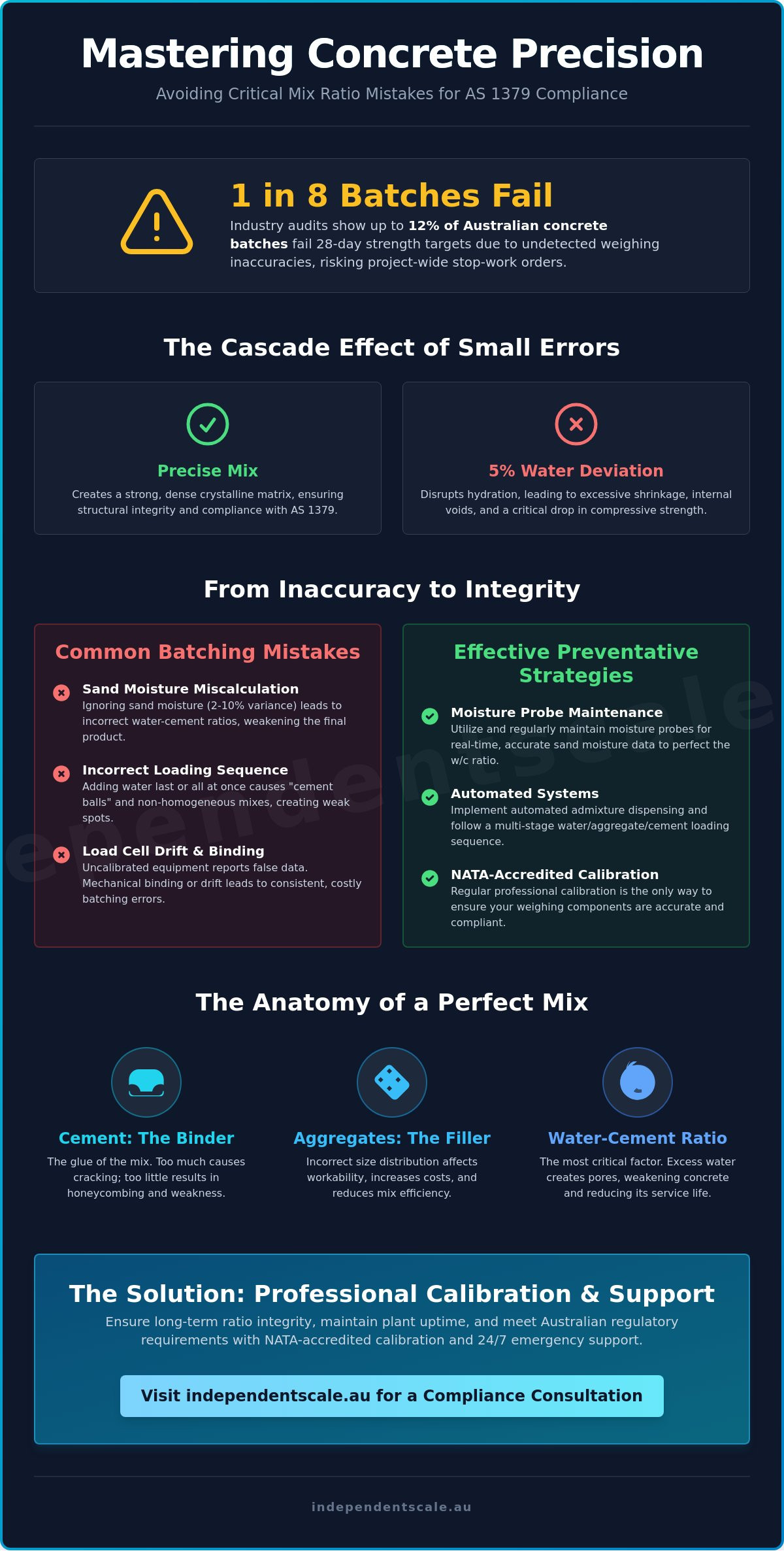
Industry audits from 2024 indicate that up to 12% of industrial concrete batches in Australia fail to meet 28 day compressive strength targets due to undetected weighing inaccuracies. When your automated plant drifts, the resulting structural compromises aren't just technical flaws; they're significant financial liabilities. Understanding the concrete mix ratio mistakes to avoid is essential for any operator responsible for AS 1379 compliance in 2026. You recognize that precision isn't optional when a single out-of-tolerance load can lead to site-wide stop-work orders and expensive core testing.
This guide provides a technical breakdown of how to identify and prevent the critical errors that lead to batch inconsistency. You'll learn the specific calibration protocols and gravimetric methods necessary to achieve zero-fail strength tests while optimising material usage to reduce waste. We'll examine the integration of NATA-accredited weighing standards and the preventative maintenance schedules required to keep your plant operational and fully compliant.
Key Takeaways
- Understand how even a 5% deviation in hydration chemistry can compromise structural integrity and lead to non-compliance with AS 1379 standards.
- Identify the most common concrete mix ratio mistakes to avoid, including miscalculating sand moisture content and using incorrect material loading sequences.
- Learn to detect technical equipment failures, such as load cell drift and mechanical binding, that cause weighing components to report inaccurate batch data.
- Implement preventative strategies like moisture probe maintenance and automated admixture dispensing to eliminate human error and ensure ratio precision.
- Discover the critical role of NATA-accredited calibration and 24/7 emergency support in maintaining plant uptime and meeting Australian regulatory requirements.
The Fundamentals of Concrete Mix Ratios and Why Precision Matters
Concrete mix ratios define the proportional relationship between cement, water, and aggregates. These ratios dictate the final strength, durability, and workability of the product. Identifying concrete mix ratio mistakes to avoid is essential for plant managers who prioritize structural integrity over speed. In an industrial context, these ratios aren't mere suggestions; they're the chemical blueprint for a stable structure.
The chemistry of hydration is a precise science, not a simple drying process. When water contacts cement, it triggers a chemical reaction that forms a crystalline matrix. A deviation of just 5% in the water or cement content can disrupt this matrix. This leads to excessive shrinkage, internal voiding, and a significant drop in MPa ratings. If the mix is off, the chemical bond fails at a molecular level before the first load is even applied.
Inaccurate batching creates a dual financial risk. Over-specifying cement leads to immediate material waste and unnecessary A$ costs. Conversely, under-specifying leads to structural failure. For a 2026 Tier-1 infrastructure project in Australia, the cost of core testing and potential demolition due to a failed batch far outweighs the investment in precise calibration. Accuracy is the only way to protect the bottom line.
Modern industry has moved away from unreliable volume-based mixing in favour of weight-based (gravimetric) batching. Volume varies with material compaction and moisture, but mass remains constant. This shift allows for the level of repeatability required in high-output plants.
The Role of Each Component in the Matrix
- Cement as the binder: It's the glue of the mix. "Cement-rich" mixes are prone to thermal cracking and high shrinkage. Conversely, "lean" mixes lack the paste necessary to coat aggregates, resulting in honeycombing and structural weakness.
- Aggregate grading: Using the wrong size distribution affects workability. Improperly graded stones leave gaps that require more cement paste to fill, which increases costs and reduces the efficiency of the mix.
- Water-cement ratio (w/c): This is the single most critical factor for compressive strength. Excess water creates capillary pores as it evaporates. This weakens the concrete and makes it susceptible to chemical attack over its service life.
How Industrial Standards Define Ratio Accuracy
In Australia, AS 1379 governs the specification and manufacture of concrete. Compliance requires rigorous adherence to batching tolerances to ensure the final product matches the engineer's design. For Tier-1 projects, such as major tunnel or bridge works, detailed batch records are mandatory. These records provide the evidence of consistency needed to pass audits and verify structural safety. The gravimetric method is the Australian industry standard for weighing, utilizing high-precision load cells to provide the mass-based data required for modern compliance.
Common Procedural Mistakes in Concrete Mixing
Procedural failures often occur long before the concrete reaches the formwork. Accuracy in the batching plant is the only way to guarantee structural integrity. One of the most frequent concrete mix ratio mistakes to avoid is guessing the moisture content of sand. In Australian industrial environments, sand moisture can fluctuate between 2% and 10% depending on storage and recent weather. Failure to use moisture probes or gravimetric testing leads to an incorrect water-to-cement (w/c) ratio. If the sand is saturated and the batcher doesn't subtract that weight from the added water, the resulting mix will be too thin, leading to excessive shrinkage and cracking.
The sequence of mixing is equally critical. Adding water last is a recipe for clumping and "cement balls." These are pockets of dry cement encased in a wet outer shell that never fully hydrate. For a professional finish, a portion of the water should enter the mixer first, followed by aggregates and cement, with the remaining water added last to reach the target slump. This ensures the cement paste coats every particle of aggregate evenly.
Timing determines the final performance of the slab. Under-mixing results in a non-homogeneous mass where some areas lack sufficient binder. Conversely, over-mixing is a significant risk during Australian heatwaves. When ambient temperatures exceed 35°C, prolonged mixing increases the heat of hydration. This accelerates the chemical reaction, leading to a "flash set" where the concrete hardens before it can be properly finished. It also breaks down air-entraining agents, reducing the concrete's resistance to freeze-thaw cycles and chemical attacks.
Material Handling and Storage Errors
Contamination of aggregates is a silent killer of concrete strength. Organic matter, such as leaves or soil, interferes with the chemical bond between the cement paste and the stone. Even a 1% increase in silt content can reduce compressive strength by up to 15%. Cement shelf life is another factor plants often overlook. "Stale" cement that has been in a silo for over three months often develops "warehouse set" due to moisture absorption. This alters the effective ratio because the hydrated clumps no longer contribute to the structural bond. Additionally, using recycled water without testing for chloride and sulfate levels can lead to internal corrosion of reinforcing steel.
The Danger of Convenience-Based Adjustments
The "just add a little water" trap on the job site is the most common concrete mix ratio mistake to avoid. Site-side adjustments to improve workability void plant warranties and compromise the design strength. If a mix is too stiff, it usually indicates a failure in the initial batching or moisture calculation. Precise measurement of chemical admixtures is essential; adding even a few extra millilitres of a retarder can delay set times by several hours, stalling the entire project. Ensuring your facility utilises AS 1379 compliant batching systems prevents these errors by automating the measurement of liquids and solids to within strict industrial tolerances. Finally, failing to adjust ratios for specific applications—such as using a footing mix for a high-traffic industrial slab—results in premature surface wear and dusting.
Technical Failures: When the Equipment Lies to You
Even the most advanced batching software fails if the hardware provides inaccurate data. Concrete mix ratio mistakes to avoid often stem from trusting digital readouts without verifying physical sensor integrity. In industrial settings, equipment doesn't always fail catastrophically; it fails subtly through drift and interference.
Load cell drift occurs when environmental factors like humidity or 40-degree Sydney summers cause thermal expansion in sensor bodies. This causes weighing components to report false data, shifting the zero point by several kilograms over a shift. Mechanical binding is another silent killer of precision. When a weigh hopper rubs against a safety stay or a stiff rubber seal, physical friction masks the true material weight. A 2% friction error on a 5000kg batch of aggregate results in 100kg of missing material, immediately compromising the water-cement ratio.
Vibration interference remains a primary cause of inconsistent batching. Concrete plants are high-noise environments where heavy machinery creates constant floor tremors. Poorly shielded scales pick up this mechanical noise as signal jitter. This prevents the batching controller from reaching a stable weight, leading to premature gate closure or overshooting targets. Additionally, the "Phantom Material" effect occurs when hardened concrete or dust builds up on the exterior of weigh hoppers. If the system doesn't account for this cumulative tare weight, you're calculating ratios based on material that isn't actually entering the mixer.
Identifying Load Cell Inaccuracy
Detecting failure before it ruins a pour requires monitoring for non-linearity and poor repeatability. If a scale is accurate at 500kg but shows a 15kg error at 2000kg, the internal strain gauges are likely compromised. Temperature fluctuations significantly impact industrial load cells, causing the resistance bridge to shift. Regular inspections should look for physical signs like corrosion on summing circuits or moisture in junction boxes, which 98% of Sydney plants face during high-humidity months. Maintaining sensor health is critical for preventing concrete mix ratio mistakes to avoid during high-volume production.
Comparing Calibration Methods for Concrete Plants
Static calibration using certified test weights is the baseline for accuracy, but it doesn't account for the dynamic forces of falling material. Dynamic testing simulates real-world flow to ensure the "pre-act" settings in your controller are correct. Many operators mistakenly believe that "zeroing" a scale on the display is the same as a full NATA-accredited calibration. It isn't. Simple zeroing only masks the tare weight; it doesn't verify the span or linearity of the scale. Gravimetric calibration is the only way to ensure AS 1379 compliance. For plants requiring rigorous certification, AS 1379 compliant calibration and repair services provide the documented proof needed for Tier 1 infrastructure projects.
Preventative Strategies: Ensuring Long-Term Ratio Integrity
Maintaining precision in industrial batching requires a shift from reactive repairs to proactive system management. To eliminate common concrete mix ratio mistakes to avoid, plants must focus on the hardware that dictates material flow. Moisture content in fine aggregates can fluctuate by 3% to 7% within a single shift due to weather or stockpile variation. Implementing a weekly moisture probe cleaning and calibration schedule prevents the system from batching blind to water-cement ratios.
Automating admixture dispensers is another critical step for 2026 operations. Manual dosing introduces a high margin for human error, which compromises chemical performance and setting times. Digital dosing units integrated with the batching controller ensure repeatable accuracy within a 1% tolerance. Regular physical inspections are equally vital. You must check tank and silo weighing assemblies for debris build-up or structural binding. Even five kilograms of hardened concrete on a load cell mount can skew a 25,000kg batch, leading to structural non-compliance and rejected loads.
- Establish a rigorous moisture probe maintenance schedule to account for aggregate saturation.
- Replace manual dosing with automated dispensers to remove human error from the ratio.
- Train operators to identify batching patterns that deviate from the standard loading curve.
- Verify load cell health monthly to prevent signal drift and ensure gravimetric accuracy.
The AS 1379 Compliance Framework
The Australian Standard AS 1379 mandates specific calibration frequencies to ensure structural reliability across the supply chain. For most high-volume plants in Australia, this involves 6-monthly scale calibrations performed by a NATA-accredited technician. Maintaining a compliant batching log is non-negotiable for audit purposes. These logs must record the target versus actual weights for every material component. NATA-accredited testing provides the final validation, ensuring that the theoretical mix design translates to actual site performance under ISO/IEC 17025 standards.
Advanced Quality Control Measures
Closing the feedback loop requires comparing slump test results with 28-day compressive strength data. While slump tests provide immediate site-level feedback, they don't always reveal internal ratio imbalances. High-precision monitoring is achieved by using digital transmitters that send real-time data to the control room. You can browse our indicators and displays to find high-resolution hardware that helps operators catch errors before the truck leaves the yard. These systems provide the technical transparency needed to meet 2026 industrial standards and avoid concrete mix ratio mistakes to avoid.
Ensure your plant stays operational and compliant by scheduling a professional AS 1379 calibration service today.
The Solution: Professional Calibration and Equipment Support
Independent Scale Service (ISS) is the primary technical partner for 98% of Sydney’s concrete plants. This market share is the result of over 30 years of technical expertise and a commitment to absolute precision. Eliminating concrete mix ratio mistakes to avoid requires more than just high-quality hardware; it demands rigorous, NATA-accredited oversight to ensure every batch meets Australian standards. Our technicians understand that a single kilogram of variance in a chemical admixture or water feed can compromise an entire project's structural integrity.
Operational uptime is critical for high-volume producers. ISS provides 24/7 emergency support to prevent plant downtime, which can cost thousands of dollars per hour in lost production and transport logistics. Our service teams are equipped to handle immediate mechanical failures, such as ruptured load cell cables or malfunctioning summing circuits, ensuring your facility remains operational under heavy demand. Beyond emergency repairs, our customised maintenance plans include full plant audits and load cell testing to identify wear before it causes a failure.
NATA-accredited calibration is your strongest defence against legal and financial liability. If a structure fails, the first point of investigation is the batching records. Having a calibration certificate that meets ISO/IEC 17025 standards proves your equipment was accurate and compliant at the time of production. This level of technical competence is essential for maintaining contracts with major Tier 1 contractors and government infrastructure bodies.
Our Approach to Concrete Plant Accuracy
Every ISS site visit follows a strict protocol to ensure compliance with AS 1379. Our technicians perform a comprehensive inspection of the weighing system, checking for mechanical binding, debris accumulation, and cable integrity. We then use certified test weights to perform gravimetric method calibrations across the full scale capacity. For a detailed breakdown of our methodology, read Calibration Services: The Authoritative Guide. This process ensures your plant operates with the technical competence required by ISO/IEC 17025 standards.
Ready to Secure Your Mix Integrity?
Precision weighing is an investment in your brand's reputation. The long-term ROI of accurate batching is found in reduced material waste and the total avoidance of costly "out-of-spec" batch rejections. You can book a NATA-accredited concrete batching plant calibration today to ensure your facility is ready for the 2026 construction cycle. For immediate assistance or emergency load cell repairs in Sydney and Melbourne, contact Independent Scale Service directly. We provide the technical certainty needed to eliminate concrete mix ratio mistakes to avoid and keep your production lines moving.
Secure Your Batching Accuracy for 2026
Maintaining industrial-grade precision requires more than just following a recipe. It's about eliminating the technical and procedural inconsistencies that lead to structural failure. You've identified the critical concrete mix ratio mistakes to avoid, from moisture miscalculations to relying on faulty load cells. Now, the focus must shift to maintaining the integrity of your weighing systems through scheduled verification.
Independent Scale Service brings over 30 years of industrial weighing expertise to your facility. We currently service 98% of concrete plants across Sydney, providing the technical competence required for high-volume production. Every calibration we perform is NATA Accredited to ISO/IEC 17025; this ensures your equipment delivers the accuracy your clients demand. Don't let unverified equipment compromise your output or your compliance status.
Ensure your plant meets AS 1379 standards; Book your NATA-accredited calibration today.
Your commitment to precision today protects your operational reputation for years to come.
Frequently Asked Questions
What is the most common concrete mix ratio mistake in industrial batching?
Failing to account for aggregate moisture content is the most frequent error in industrial batching. This mistake leads to incorrect water-cement ratios. In industrial settings, a 1% error in moisture reading can shift the strength by 5MPa. It's a critical concrete mix ratio mistake to avoid to ensure structural integrity and compliance with AS 1379.
How often should a concrete batching plant be calibrated in Australia?
Australian Standard AS 1379 requires calibration at intervals not exceeding 6 months. High-volume plants often increase this frequency to quarterly to maintain 0.5% accuracy for cement and 2% for aggregates. Regular servicing reduces the risk of batch rejection and costly downtime. ISS provides 24x7 emergency support to keep these plants operational and compliant.
Can a faulty load cell cause concrete strength failure?
A faulty load cell provides inaccurate weight data, directly leading to incorrect material proportions and strength failure. If a load cell drifts by 3%, the resulting mix may fall below the specified MPa rating. ISS technicians use the gravimetric method to identify these deviations before they cause structural issues. This precision ensures every batch meets the required engineering specifications.
What is the difference between AS 1379 and ISO 17025 for concrete plants?
AS 1379 is the Australian Standard for the specification and supply of concrete, while ISO/IEC 17025 is the international standard for testing and calibration laboratories. Concrete plants must comply with AS 1379 for product quality. However, the scales used must be calibrated by a NATA accredited facility operating under ISO/IEC 17025 to ensure measurement traceability and legal compliance.
How does moisture content in sand affect the concrete mix ratio?
Moisture in sand increases its weight and volume, which displaces the required water and alters the final density. Sand can hold up to 10% moisture by weight. Failing to adjust for this is a primary concrete mix ratio mistake to avoid because it weakens the cement paste and reduces the concrete's durability. Accurate gravimetric calibration helps mitigate these risks.
What happens if I add too much water to my concrete mix?
Excess water increases the water-cement ratio, which significantly reduces compressive strength and increases permeability. Adding an extra 10 litres of water per cubic metre can reduce concrete strength by 2 to 3 MPa. This also leads to excessive shrinkage, cracking, and a finish that's prone to dusting. Maintaining strict water control is vital for industrial grade results.
Is NATA accreditation necessary for concrete scale calibration?
NATA accreditation to ISO/IEC 17025 is essential for legal and technical compliance in the Australian construction industry. Major contractors like Holcim and Boral require NATA endorsed certificates to verify that scales meet the 0.5% accuracy threshold. Non-accredited calibrations don't provide the same level of legal protection or technical rigor for industrial batching operations.
How do I know if my industrial scales are drifting?
You can identify scale drift by performing regular zero checks and verifying weight consistency against known test weights. If your scales fail to return to zero or show a variance of more than 1% across three consecutive batches, the load cells or summing circuits are likely failing. Immediate technical intervention is required to prevent batch errors and material waste.
