


Concrete Batching Plant Maintenance: 2026 Authority Guide
A single batch of rejected concrete can cost your operation thousands in disposal fees and lost production time, yet many facilities still rely on calibration schedules that ignore the rigorous mandates of AS 1379:2026. In a high-volume production environment, mechanical reliability is only half the battle. If your weighing systems aren't precise, your product isn't legal for Tier 1 or government infrastructure projects. You understand that inconsistent mix quality and the fear of a failed NATA audit are risks your business cannot afford to take. This professional guide to concrete batching plant maintenance provides the technical framework needed to eliminate those vulnerabilities.
This guide demonstrates how to implement a reliable, automated maintenance schedule that ensures maximum uptime and strict compliance with the latest Australian standards. It outlines the specific weighing accuracy mandates, such as the ±0.4% requirement for cement and binders, along with the diagnostic protocols required to extend the service life of your load cells. We detail the essential six-month calibration intervals and technical procedures that guarantee your plant remains a precise, profitable, and fully accredited asset. By following these industry standards, you'll secure the technical competence required for ISO/IEC 17025 compliance and long-term operational success.
Key Takeaways
- Adopt proactive maintenance strategies to secure consistent mix quality and reduce the high cost of emergency plant failure.
- Establish a structured concrete batching plant maintenance schedule involving tiered daily cleaning and weekly mechanical inspections.
- Detect technical faults in weighing components such as load cell cable damage, moisture ingress, and debris-related structural binding.
- Apply AS 1379:2026 precision standards to weighing and metering systems to maintain regulatory compliance and audit readiness.
- Understand the role of NATA-accredited calibration in securing high-tier infrastructure contracts and ensuring technical traceability.
The Strategic Importance of Concrete Batching Plant Maintenance
Effective concrete batching plant maintenance is the primary differentiator between a profitable operation and one plagued by rejected loads. While mechanical components like belts and mixers are prone to physical wear, the electronic weighing systems are subject to drift and environmental interference. Understanding What is a Concrete Batching Plant? and its technical requirements is essential for maintaining production standards. Reactive strategies often lead to catastrophic failure during peak production hours, resulting in site delays and wasted raw materials. Proactive maintenance ensures that every batch meets the engineered mix design without compromise.
Inaccurate measurement of cement or water directly impacts the compressive strength of the concrete, which can lead to structural failures and legal disputes. The Australian market demands high-tier reliability; a single non-compliant batch can jeopardize a supplier's reputation and financial standing. When components are allowed to wear beyond their tolerances, the risk of batch rejection increases, leading to material waste that erodes profit margins. Consistent maintenance isn't just about equipment longevity; it's about product integrity.
Downtime vs. Compliance: A Multi-Tiered Risk
The hourly cost of plant failure in the Australian market is substantial when factoring in idle transit mixers and site labor. Beyond immediate lost revenue, operators face the risk of supplying non-compliant material to major infrastructure projects. AS 1379:2026, published on May 22, 2026, mandates strict tolerances that require precise equipment calibration. Failure to meet these standards can result in the loss of NATA accreditation to ISO/IEC 17025, effectively barring a company from government and high-value commercial contracts. Regular concrete batching plant calibration is the only way to verify that equipment remains within these legal limits and provides the technical traceability required for audit defense.
The Mechanical and Electronic Intersection
Precision measurement doesn't exist in a vacuum; it's highly sensitive to the physical state of the facility. Mechanical vibration from mixers and conveyors is the primary enemy of weighing precision, often causing load cell readings to fluctuate or drift. Over time, physical wear on mixer blades and liners affects the efficiency of the mix, while electronic sensors may experience signal drift due to moisture ingress or structural binding in the mounts. Operators must be trained to identify these symptoms before they result in a rejected batch. A culture of proactive concrete batching plant maintenance involves daily inspections to ensure that mechanical stress doesn't translate into weighing errors. This intersection of mechanical integrity and electronic accuracy is what defines a reliable plant.
Preventive Maintenance Schedule: Daily, Weekly, and Monthly Tiers
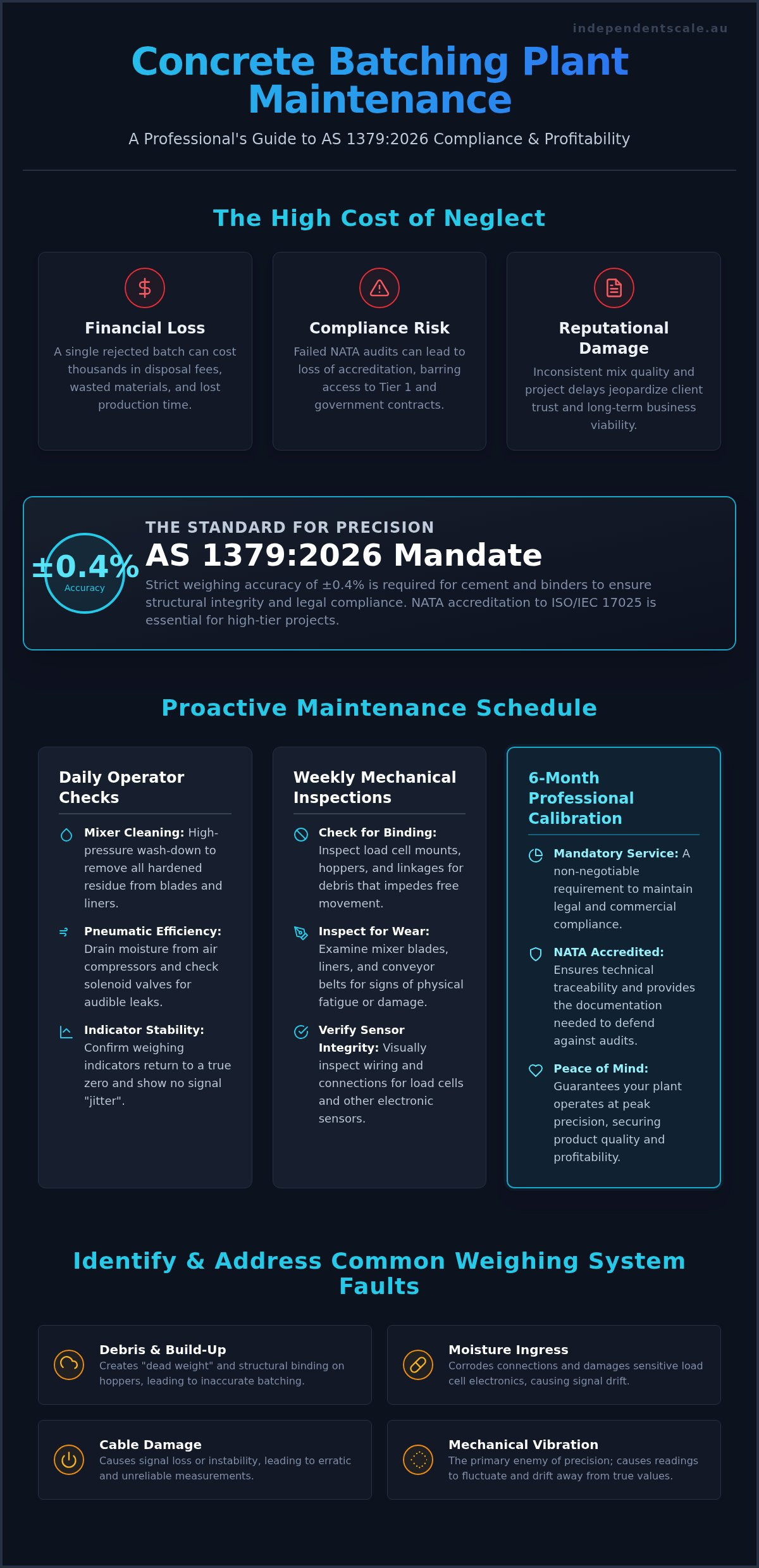
A structured preventive maintenance program is the only way to ensure concrete batching plant maintenance remains effective under high production loads. Relying solely on mandatory six-month calibration intervals is insufficient for high-volume sites where mechanical wear occurs rapidly. Instead, operators must implement a tiered schedule that identifies mechanical fatigue and electronic drift before they trigger a system-wide shutdown. This proactive approach minimizes the risk of batch rejection and ensures your facility remains compliant with the latest industry standards.
Daily Operator Checklist for High-Volume Plants
Daily tasks focus on immediate operational threats that can compromise mix integrity. Hardened concrete build-up in the mixer or on weighing hoppers adds "dead weight" to the scales, leading to inaccurate batching. Operators should perform the following checks every morning:
- Mixer Cleaning: High-pressure wash-down to remove all residue from blades and liners.
- Pneumatic Efficiency: Drain moisture traps in air compressors and check for audible leaks in solenoid valves.
- Indicator Stability: Confirm that all weighing indicators return to a true zero and show no signs of signal "jitter" or instability.
Monthly Technical Inspections
Monthly technical inspections are a critical component of concrete batching plant maintenance, moving beyond surface-level cleaning to evaluate the structural and electrical integrity of the facility. These audits should include:
- Emergency Stop Systems: Functional testing of all E-stops and safety interlocks to ensure site safety.
- Material Conveying: Lubrication of conveyor bearings and an inspection of belt tracking to prevent material spillage.
- Structural Fatigue: Visual inspection of silo supports and weighing hopper mounts for signs of cracking or corrosion.
Weekly mechanical checks must prioritize gate timing and pneumatic pressure. Air leaks in gates often lead to "tailing," where material continues to flow after the discharge command, causing batch overruns. For baseline compliance requirements, refer to the foundational standards in AS 1379-2007 (R2017). It's vital to note that the update published on May 22, 2026 (AS 1379:2026) has introduced more rigorous demands, including a ±0.4% accuracy requirement for cement and other binders.
Professional quarterly verification acts as a bridge between monthly audits and the mandatory six-month NATA calibration. These visits allow for the early detection of load cell fatigue or junction box moisture ingress. If your plant is approaching its six-month compliance deadline or shows signs of measurement drift, scheduling professional concrete batching plant calibration ensures you remain audit-ready and compliant with ISO/IEC 17025 requirements.
Critical Weighing System Maintenance: Load Cells and Hoppers
The precision of your weighing system defines the technical capability of your facility. While general concrete batching plant maintenance often focuses on greasing bearings and adjusting belts, the weighing system requires a specialized diagnostic approach. Any physical interference with a weighing hopper or a shift in load cell output directly compromises mix integrity. To maintain compliance with the ±0.4% accuracy mandate for binders, operators must ensure that the weighing assembly remains a completely isolated system, free from structural binding or electronic interference.
Structural binding is a frequent cause of measurement error. It occurs when aggregate or hardened concrete becomes lodged between the weighing hopper and the plant's main frame. This creates a parallel load path, or a "shunt," which prevents the full weight of the material from reaching the sensors. Regular inspections must verify that all hoppers are free-hanging and that flexible connections, such as dust seals and discharge socks, aren't under tension. A tight connection can support part of the hopper's weight, leading to significant under-reporting of material quantities.
Diagnosing Load Cell Faults Before Failure
Load cell failure rarely happens instantly; it's usually preceded by identifiable performance drift. Signs of fatigue include non-repeatability, where the scale fails to return a consistent reading for the same load, and zero-return issues. Environmental factors in Australia, particularly extreme heat and high humidity, accelerate the degradation of cable insulation and internal strain gauges. Moisture ingress in junction boxes is the most common cause of signal "jitter" and erratic readings. When these symptoms appear, you must decide whether to attempt a technical repair or invest in a new load cell supply to prevent an unscheduled shutdown. Specialized fault diagnosis by NATA-accredited technicians can identify whether the issue is a failed sensor or simple electrical interference in the signal cable.
Maintaining Weighing Hoppers and Silos
Silo and hopper maintenance involves more than just verifying the electronics. You must inspect tank and silo weighing assemblies for correct alignment and structural integrity. Over time, the vibration from aeration systems and vibrators can loosen mounting bolts or cause fatigue cracks in the support brackets. Key maintenance actions include:
- Clearing Material Bridging: Ensure no hardened material has built up inside the hopper cones, which can affect the center of gravity and load distribution.
- Verifying Flexible Connections: Confirm that all inlets and outlets have sufficient slack to allow for full vertical movement of the hopper.
- Cable Protection: Inspect all conduit and cabling for signs of mechanical damage or UV degradation that could expose the shielding.
Maintaining a stable signal requires clean, dry connections within all junction boxes. If an indicator shows drift that cannot be explained by temperature changes, the integrity of the excitation voltage and signal return must be tested. This level of concrete batching plant maintenance ensures that your weighing systems provide the reliable data necessary for AS 1379 compliance and high-tier infrastructure supply.
AS 1379 Compliance and Troubleshooting Common Faults
Adhering to AS 1379:2026 is a mandatory requirement for any producer supplying concrete in the Australian market. This updated standard, published on May 22, 2026, establishes rigorous accuracy mandates for all weighing and liquid-dispensing equipment. Technical compliance requires that cement and other binders be measured within ±0.4% of the maximum scale value. Water measurement requires ±2.0% accuracy, while chemical admixtures must remain within ±5.0% of the indicated value. Failure to maintain these tolerances leads to batch rejection and potential exclusion from high-tier infrastructure projects. Effective concrete batching plant maintenance must prioritize the troubleshooting of faults that threaten these precision markers.
Common Batching Faults and Fixes
Operational interruptions often stem from a mix of mechanical interference and electronic signal degradation. Identifying the root cause requires a methodical diagnostic approach:
- Inconsistent Batch Weights: Often caused by moisture ingress or loose terminals. Inspect all junction boxes for dry, secure connections and verify the excitation voltage.
- Indicator Error Codes: Modern indicators and displays provide specific codes for "over-capacity" or "signal out of range." Check for structural binding on the hopper before recalibrating.
- Slow Material Flow: Usually a mechanical issue involving worn gate seals or low pneumatic pressure. Inspect solenoid valves and air cylinders to ensure responsive gate timing.
The AS 1379 Compliance Framework
The regulatory landscape for concrete batching plant maintenance mandates a maximum interval of six months between formal accuracy checks. This is a non-negotiable requirement for NATA-accredited facilities. During an audit, inspectors review your maintenance log for evidence of these bi-annual calibrations and technical traceability to national standards. Your documentation must include valid NATA Calibration Certificates and a comprehensive log of any unscheduled repairs or component replacements. For a deeper technical breakdown of these requirements, read our Complete Guide to AS 1379 Compliance.
Preparing for a NATA accreditation audit to ISO/IEC 17025 involves more than just verifying scale accuracy. It requires proof of technical competence and rigorous uncertainty calculations. Auditors will examine the history of your weighing systems to ensure that any drift has been identified and corrected. Maintaining a structured record of daily zero-checks and weekly mechanical inspections demonstrates a proactive commitment to quality assurance. If you require NATA-accredited expertise to resolve persistent weighing errors or prepare for an upcoming audit, contact Independent Scale Service for professional concrete batching plant calibration to secure your compliance status.
Professional Maintenance and NATA Calibration Services
Professional concrete batching plant maintenance bridges the gap between daily operator checks and full regulatory compliance. While internal teams can handle greasing and visual inspections, they cannot issue the NATA-accredited certificates required for major infrastructure projects. Independent Scale Service focuses on minimizing client downtime by providing structured on-site visits across Sydney, Melbourne, and regional Australia. Our technicians address both electrical and mechanical faults, ensuring that the entire weighing chain, from the load cell to the indicator, operates within specified tolerances.
For multi-plant operations, custom maintenance contracts provide a standardized approach to reliability. Instead of managing separate schedules for each facility, a single service partner ensures that all weighing systems are calibrated to the same rigorous standards. This consistency is vital for companies operating across different regions, providing a unified defense during national audits or quality disputes. Having a seasoned expert manage your concrete batching plant maintenance schedule reduces the administrative burden and ensures no compliance deadlines are missed.
Why NATA Accreditation Matters for Your Business
The primary differentiator for professional service is NATA accreditation to ISO/IEC 17025. This isn't a simple accuracy check; it's a comprehensive evaluation of technical competence. NATA-accredited calibration provides the traceability and uncertainty calculations necessary to make your weighing data legally defensible. Without this level of verification, you risk failing audits for government contracts or Tier 1 projects. If your facility requires a formal audit or has experienced persistent measurement drift, you should request a professional Concrete Batching Plant Calibration & Repair Service to secure your operational standing.
Complete Weighing Solutions
A comprehensive maintenance strategy extends beyond the batching plant itself. Modern facilities rely on a variety of measurement systems that all require periodic verification. Our services encompass the entire industrial weighing spectrum, including:
- Flowmeter and Liquid Testing: Ensuring chemical admixtures and water are dispensed with the precision required by AS 1379.
- Specialized Calibrations: Professional hopper calibration services and silo weighing audits to prevent material bridging and structural binding.
- Component Sourcing: Providing high-quality conditioners and transmitters for plant upgrades or signal stabilization.
Partnering with a localized expert in Sydney and Melbourne ensures rapid response times for critical failures. This proximity is essential for maintaining production schedules and reducing the impact of unexpected component fatigue. By integrating NATA-accredited calibration into your long-term maintenance strategy, you protect your accreditation status and ensure the continued delivery of high-quality, compliant concrete.
Securing Operational Integrity and Regulatory Compliance
Establishing a rigorous concrete batching plant maintenance program is essential for any operator targeting high-tier infrastructure projects. You've seen that mechanical reliability and electronic precision are codependent; one cannot exist without the other. By implementing tiered preventive schedules and addressing the specific requirements of AS 1379:2026, you eliminate the risks of batch rejection and costly unscheduled downtime. Maintaining your facility as a NATA-accredited asset ensures that your weighing data remains legally defensible and technically sound under the most demanding audit conditions.
Independent Scale Service is NATA accredited to ISO/IEC 17025 and specializes in AS 1379 compliance. We provide expert on-site service across Sydney, Melbourne, and regional Australia to keep your weighing systems precise and your production moving. Don't let calibration drift or structural binding compromise your project eligibility or mix consistency. Request an AS 1379 Compliant Calibration Service today to secure your plant's technical standing and operational future. Proactive precision is your most reliable path to long-term profitability and industry leadership.
Frequently Asked Questions
How often should a concrete batching plant be calibrated according to AS 1379?
AS 1379:2026 requires a maximum interval of six months between formal accuracy checks for all weighing and liquid-dispensing equipment. This is a mandatory requirement for maintaining compliance in the Australian market. High-volume plants may require more frequent internal verifications to ensure they stay within the ±0.4% tolerance for binders. Scheduling professional concrete batching plant maintenance twice a year ensures your facility remains audit-ready and technically sound for major infrastructure contracts.
What are the signs that a load cell in my batching plant is failing?
Load cell failure is typically preceded by identifiable performance drift such as non-repeatability or the inability of the scale to return to a true zero after discharge. You might notice signal jitter or erratic readings on your indicator, often caused by moisture ingress in the junction box or internal strain gauge fatigue. If these symptoms persist despite cleaning, it indicates that the sensor's structural integrity is compromised. Prompt diagnosis is necessary to prevent an unscheduled production shutdown.
Can I perform concrete plant maintenance in-house?
Internal teams can and should perform daily visual inspections, cleaning, and basic mechanical greasing. However, formal calibration to satisfy AS 1379 and ISO/IEC 17025 requires NATA-accredited experts. In-house testing lacks the technical traceability and uncertainty calculations necessary for legally defensible weighing data. While your operators manage the physical upkeep, specialized concrete batching plant maintenance involving load cell diagnosis and precision calibration must be performed by accredited professionals to ensure regulatory compliance and avoid batch rejection.
What is the difference between NATA calibration and regular scale testing?
Regular scale testing is a basic verification that a scale is functioning, whereas NATA-accredited calibration provides a higher level of technical assurance under ISO/IEC 17025. NATA calibration includes rigorous uncertainty calculations and provides a certificate that is recognized by government auditors and Tier 1 contractors. This process ensures that your weighing equipment is traceable to national standards. Regular testing doesn't offer the legal defensibility or the technical depth required for high-tier Australian infrastructure projects.
How does moisture affect concrete batching plant weighing accuracy?
Moisture is a primary cause of electronic signal degradation in industrial weighing systems. Ingress into junction boxes or load cell cables causes signal drift and erratic indicator readings, directly impacting batching accuracy. High humidity or direct water exposure can also lead to corrosion of the load cell mounts, causing structural binding. Maintaining dry connections and using high-quality surge arrestors is essential for preventing these faults and ensuring that your binder measurements remain within the required ±0.4% tolerance.
What should be included in a daily concrete plant maintenance log?
A daily maintenance log must document critical operational checks to ensure plant reliability. Key entries should include:
- Verification that all weighing indicators return to zero after discharge.
- Visual confirmation that the mixer and weighing hoppers are free of hardened concrete build-up.
- An inspection of air compressors and moisture traps to ensure pneumatic efficiency.
- Confirmation that all flexible connections and dust seals are unobstructed and not under tension.
Consistent documentation demonstrates a proactive commitment to quality assurance during regulatory audits.
How do I troubleshoot an electrical fault in my batching control system?
Start by identifying specific error codes on your weighing indicators or control displays. These codes often indicate whether the fault is a signal out of range or a loss of excitation voltage. You should inspect all cables for mechanical damage or UV degradation and check junction box terminals for loose connections. If the fault is intermittent, it's often caused by electrical interference or moisture ingress. Specialized diagnostic tools are required to test load cell health accurately.
Why is hopper binding a common issue in concrete plants?
Hopper binding occurs when material build-up or structural interference creates a parallel load path, preventing the full weight from reaching the load cells. This shunting effect is common in concrete plants due to the high volume of dust and aggregate that can become lodged in tight clearances. Vibration from aeration systems can also shift mounting bolts, causing the hopper to make contact with the main frame. Regular inspections must include clearing these obstructions to ensure hoppers remain free-hanging.
