


Concrete Batching Plant Calibration: The Complete Guide to AS 1379 Compliance
A single rejected load due to batching inaccuracies often costs more than your entire annual maintenance budget. You understand that operating a facility requires a relentless focus on precision, yet the threat of a NATA audit failure or inconsistent mix quality remains a significant operational risk. Achieving reliable concrete batching plant calibration isn't just about ticking a box; it's about protecting your margins and ensuring every cubic metre meets the rigorous demands of Australian infrastructure projects.
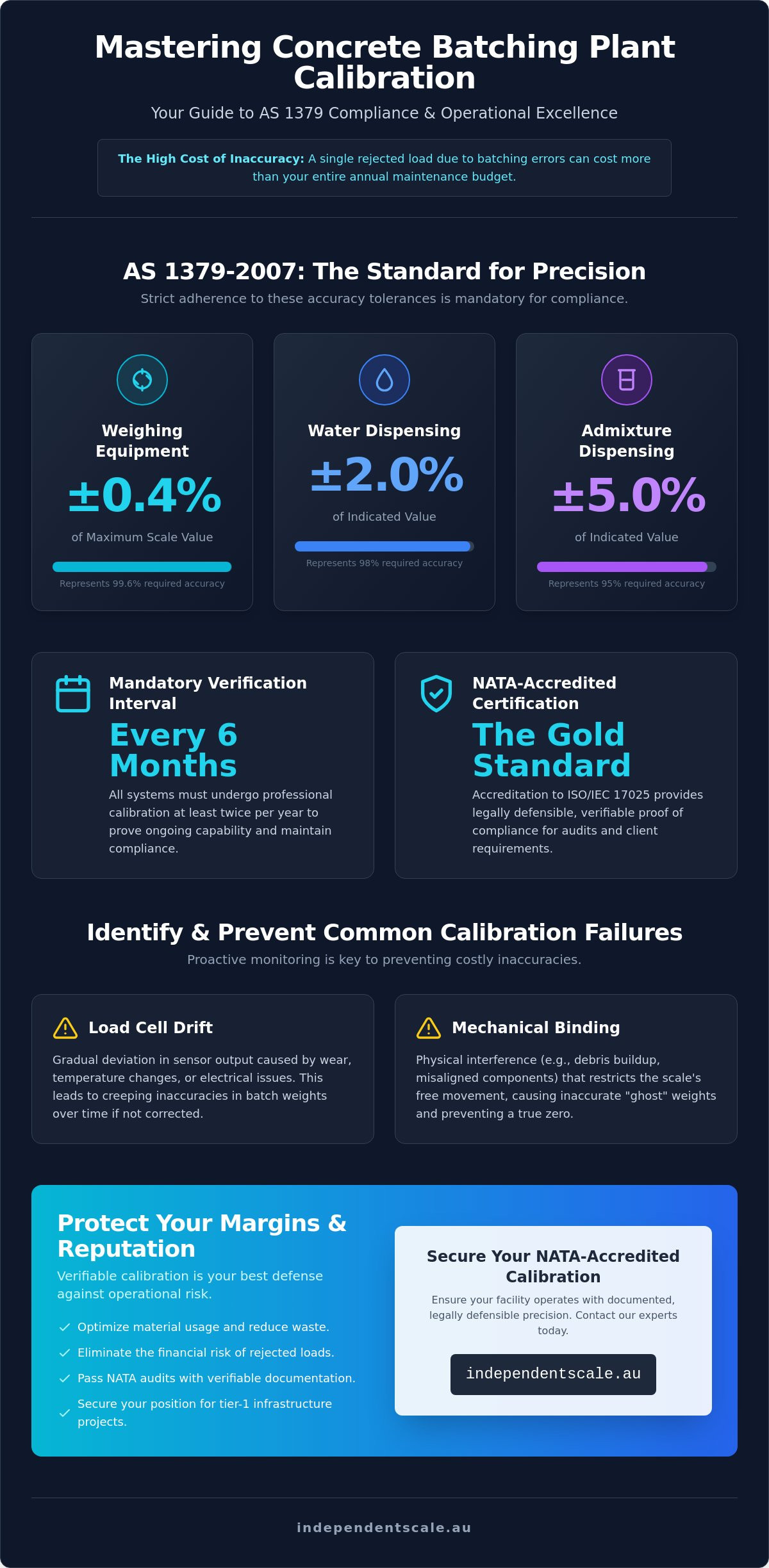
We recognize the frustration of navigating complex regulatory codes while trying to minimize plant downtime. This guide provides the technical expertise and practical steps necessary to achieve full compliance with AS 1379-2007 (R2017). You'll learn how to maintain weighing equipment accuracy within the mandated ±0.4% limit and ensure your liquid-dispensing systems meet strict ±2.0% water and ±5.0% admixture tolerances.
We'll outline the specific six-monthly verification intervals required by law and how to secure the verifiable calibration certificates your clients demand. By following this methodical approach, you can optimize material usage, eliminate the fear of regulatory scrutiny, and maintain the authoritative reputation your business depends on.
Key Takeaways
- Identify the specific accuracy tolerances required by AS 1379-2007 (R2017) for weighing and liquid-dispensing equipment.
- Recognise the technical signs of load cell drift and mechanical binding to prevent inaccurate readouts and "ghost" weights.
- Implement a methodical concrete batching plant calibration procedure using certified test weights to ensure verifiable span adjustments.
- Secure NATA-accredited calibration certificates to provide documented proof of compliance for audits and client requirements.
The Critical Role of Calibration in AS 1379 Compliance
Concrete batching plant calibration is the technical verification that all weighing and dispensing systems within a facility produce measurements within specific, narrow tolerances. In Australia, AS 1379-2007 (R2017) stands as the definitive standard for the specification and supply of concrete. This standard ensures that every cubic metre of concrete delivered to a site possesses the structural integrity required for safety and engineering longevity. Operating a concrete plant without precise, documented calibration creates significant legal and financial exposure for the operator. It isn't merely a maintenance task; it's a fundamental requirement for legal operation in the Australian market.
The risks of non-compliance are severe and immediate. Inaccurate scales lead to inconsistent mix quality, which often results in rejected loads on major infrastructure projects. With the Australian concreting services market valued at $12.9 billion in 2026, the financial impact of material waste and project delays is substantial. Beyond immediate monetary loss, failure to provide verifiable calibration certificates can lead to a breach of contract and exclusion from tier-1 government tenders. NATA accreditation provides the essential traceability and technical assurance that your facility meets these high-stakes requirements. Without this accreditation, your quality records lack the authoritative weight needed to survive a rigorous regulatory audit.
Understanding AS 1379 Requirements for Weighing
Compliance with AS 1379 requires strict adherence to accuracy tolerances that leave no room for error. For weighing equipment, the standard mandates an accuracy of ±0.4% of the maximum scale value. Liquid-dispensing equipment for water must maintain an accuracy of at least ±2.0%, while admixtures require a tighter tolerance of ±5.0% of the indicated value. To remain compliant, all weighing and dispensing systems must undergo professional concrete batching plant calibration at least every six months. Maintaining detailed quality records is essential for NATA audits, as these documents prove your plant's ongoing capability to produce compliant concrete for critical infrastructure.
Why NATA Accreditation and ISO 17025 Matter
A standard scale check doesn't provide the same level of assurance as a NATA-accredited calibration. NATA accreditation signifies that a laboratory has been formally recognized for its technical competence under ISO/IEC 17025. This international standard ensures that the calibration provider uses calibrated master weights and follows rigorous, documented procedures that are repeatable and verifiable. Choosing an accredited provider is the only way to ensure your results are legally defensible. This level of precision is mandatory for projects requiring high-performance concrete where even minor deviations in cement or aggregate ratios can compromise structural performance and safety.
Technical Components of Batching Plant Weighing Systems
The accuracy of any concrete batching plant depends on a seamless chain of technical components, starting from the physical load and ending with a digital readout. This weighing chain is a high-precision circuit where each link must function perfectly to maintain AS 1379 compliance. The process begins when raw materials exert force on load cells, which convert physical pressure into a millivolt signal. This analog data travels through junction boxes to signal conditioners or transmitters, which stabilize the information before it reaches the digital indicator. Any interference or component failure along this path compromises the entire concrete batching plant calibration process, leading to batching errors that can ruin an entire day's production.
High-quality hardware is essential because batching plants are inherently hostile environments. Dust, moisture, and constant vibration from conveyors and mixers create significant electrical noise and mechanical wear. Precise measurement requires components designed to filter this noise while maintaining sensitivity. Professional operators often reference the Caltrans testing and calibration procedure to understand how technical specifications impact real-world plant performance. Reliable data transmission ensures that the batching computer receives a clean, accurate signal, allowing for the precise material cut-offs required for high-strength concrete mixes.
Load Cells and Mounting Assemblies
Load cells are the primary transducers in the system. Depending on the plant configuration, you'll typically find S-type cells for tension applications, or compression and shear beam cells for hoppers and silos. Selecting the correct Load Cell Supply is critical for long-term stability. These sensors must withstand extreme temperature fluctuations and the corrosive effects of cement dust. If a mounting assembly isn't perfectly level or if structural binding occurs, the load cell won't "see" the full weight, causing significant measurement drift. Regular inspection of these assemblies is a prerequisite for successful concrete batching plant calibration.
Digital Indicators and Junction Boxes
The digital indicator is the brain of the weighing system. It's vital to choose robust Indicators and Displays that can integrate with plant automation software. These units translate the summed signal from the Junction Boxes and Surge Arrestors into a readable format. Junction boxes must be moisture-sealed to prevent signal leakage, while surge arrestors protect sensitive electronics from lightning strikes and power spikes common in industrial yards. When troubleshooting signal drift, technicians look for loose terminations or moisture ingress at the junction box before adjusting the indicator span. For plants requiring consistent uptime, maintaining a stock of spare weighing components is a prudent operational strategy.
Step-by-Step Concrete Plant Calibration Procedure
A successful concrete batching plant calibration begins with a thorough mechanical audit. Technicians must first verify structural integrity and check for mechanical binding, such as stiff hoses or accumulated debris that can "ghost" weight. Once the system is mechanically sound, the process moves to zeroing the scales and performing a span adjustment using certified test weights. This ensures the digital readout aligns perfectly with known physical masses across the entire operating range.
Linearity testing follows, where weights are applied incrementally across the full production range. This ensures the system remains accurate whether you're batching a small specialty load or a full-capacity mix. Repeatability tests are equally vital; the system must produce identical readings when the same load is applied multiple times. These steps are non-negotiable for meeting AS 1379 standards. The process concludes with a final verification and the issuance of NATA-endorsed certificates, providing the documented proof required for tier-1 quality audits and regulatory inspections.
Preparing Your Site for Calibration
Preparing your facility for concrete batching plant calibration ensures that the technician can work efficiently, significantly reducing plant downtime. You must provide unobstructed, safe access to hoppers, silos, and weighing bins. It's essential to clean all weighing equipment to remove concrete build-up before the technician arrives. Accumulated material on scales can cause zero-point shift and mask underlying mechanical issues. Logistical planning is also critical; schedule the service during low-production windows to minimize the impact on your delivery schedule.
Calibration Methods for High-Capacity Silos
Standard test weights are often insufficient for high-capacity silos. In these cases, technicians employ the substitution method. This involves applying a known quantity of test weights, recording the reading, and then substituting those weights with a bulk "dead load," such as sand or water, to reach higher capacities. This process repeats until the full scale range is verified. It's a meticulous technique that ensures linearity even at the highest production volumes. Accurate Hopper and Silo Calibration is essential for bulk material management and inventory control. Additionally, technicians must verify flowmeter accuracy for water and admixtures to maintain the specific tolerances defined in AS 1379.
Identifying and Preventing Calibration Failures
Calibration failures often stem from overlooked mechanical or environmental factors rather than internal software errors. Mechanical binding occurs when a weighing vessel isn't fully isolated from its surroundings. Stiff supply hoses, material buildup between the hopper and the frame, or jammed safety bolts can "ghost" weight by supporting part of the load. This physical interference prevents the load cells from registering the true mass. Technicians must ensure that all flexible connections are truly flexible and that the weighing bin has clear clearance from surrounding structures to ensure a successful concrete batching plant calibration.
Load cell drift and creep represent more technical failure modes that require immediate attention. Creep is the change in load cell output occurring over time while under a constant load; drift is a gradual shift in the zero balance. These issues typically signal a failing sensor or moisture ingress into the internal strain gauges. Electrical interference also poses a constant threat in industrial yards. High-voltage cables running near signal wires can induce noise, causing unstable readings. Proper shielding and grounding are essential to protect the integrity of the data. High-wind areas and excessive plant vibration also distort readings, necessitating the use of digital filtering at the indicator level to maintain AS 1379 tolerances.
Diagnostic Checks for Plant Operators
Operators should perform daily zero-checks and simple weight verifications to identify issues before they lead to rejected loads. If the batching computer shows erratic readings or fails to return to zero after a discharge, it's a clear indicator of a technical fault. Recognising these 5 signs you need load cell repair early prevents minor inaccuracies from becoming major compliance failures during an official concrete batching plant calibration audit. Consistent monitoring ensures that the plant remains within the ±0.4% accuracy range required for aggregates and cement.
Preventative Maintenance Strategies
A scheduled maintenance program is the most effective way to maintain long-term AS 1379 compliance. This includes inspecting cable integrity and replacing worn conditioners and transmitters before they fail and cause a total plant shutdown. Keeping a critical spares kit on-site, including a spare load cell and junction box, reduces emergency downtime significantly. If you identify consistent inaccuracies or your six-monthly verification is due, schedule a NATA-accredited calibration to restore plant precision and ensure regulatory compliance.
Independent Scale Service: NATA-Accredited Calibration Experts
Major concrete producers in Sydney and Melbourne rely on Independent Scale Service to maintain operational continuity and regulatory standing. Our firm understands that a single hour of plant downtime represents a significant loss in revenue and project momentum. We provide a comprehensive approach to Concrete Batching Plant Calibration, ensuring every hopper, silo, and flowmeter operates within the strict tolerances defined by AS 1379. Our technical team brings decades of experience to every site, focusing on the precision required for high-strength concrete production.
Beyond routine verification, we specialize in rapid fault diagnosis and emergency repair. When a weighing system fails, our technicians identify whether the issue lies in the load cell hardware, the signal cable, or the digital indicator. We provide full compliance documentation for every accredited service, giving you the verifiable proof points required for NATA audits and tier-1 contractor requirements. Our reports are not just summaries; they're detailed technical records that satisfy the rigorous demands of the National Association of Testing Authorities. This level of detail is a key differentiator for plants serving high-profile corporate clients and government infrastructure works.
Nationwide Support for Industrial Weighing
We operate mobile calibration units across Sydney, Melbourne, and regional Australia to bring technical expertise directly to your facility. Our technicians possess deep expertise in both electrical and mechanical fault diagnosis, allowing us to solve complex weighing issues that generic scale providers often miss. Our mobile units are equipped with high-capacity test weights and specialized diagnostic tools designed specifically for the concrete industry. We maintain immediate access to a full range of Industrial Weighing Components, including junction boxes, surge arrestors, and mounting assemblies, to facilitate on-the-spot repairs and upgrades. This capability allows us to perform linearity and repeatability tests on-site, even for the most complex hopper and silo configurations.
Book Your AS 1379 Compliance Audit
Scheduling a concrete batching plant calibration doesn't have to disrupt your production timeline. We work with plant managers to coordinate services during low-volume periods or scheduled maintenance windows to ensure your facility stays online. Contact our expert team to receive a professional quote for NATA-accredited calibration or to seek technical advice on upgrading your plant's weighing infrastructure. We prioritize responsiveness to ensure that your compliance markers are always up to date. Our commitment to precision ensures your facility remains compliant, efficient, and ready for the most demanding construction projects in the country.
Maintain Operational Precision and Regulatory Standing
Achieving consistent mix quality depends on the absolute accuracy of your weighing and dispensing systems. Maintaining the ±0.4% weighing tolerance required by AS 1379 isn't just a technical goal; it's a legal necessity for operating in the Australian construction sector. By identifying mechanical binding early and implementing a methodical six-monthly concrete batching plant calibration schedule, you eliminate the risk of rejected loads and NATA audit failures. Precise measurement remains your most effective tool for optimizing material usage and protecting project margins. For those seeking to maintain high standards across all their machinery, the Sale and maintenance of concrete pumping equipment is a critical component of a reliable supply chain.
Independent Scale Service has supported the industrial sector in Sydney and Melbourne for over 30 years. Our technicians are NATA Accredited to ISO/IEC 17025, providing the technical competence and verifiable documentation required for full AS 1379 compliance. We ensure your facility meets the highest standards of the National Association of Testing Authorities, giving you the confidence to bid for tier-1 infrastructure projects. Request a NATA-Accredited Batching Plant Calibration Service today to secure your plant's accuracy and reliability. Your commitment to precision today ensures your long-term success in a competitive market.
Frequently Asked Questions
How often does a concrete batching plant need calibration in Australia?
Every six months. AS 1379-2007 (R2017) specifies that weighing and liquid-dispensing equipment must be checked for accuracy at least every six months. Regular concrete batching plant calibration is a mandatory requirement to maintain compliance with Australian standards. This schedule ensures your facility remains capable of delivering high-performance concrete. Failure to adhere to this frequency can result in the invalidation of your quality certificates and potential exclusion from major infrastructure projects.
What is the difference between AS 1379 and ISO 17025 for concrete plants?
AS 1379 is the industry standard for the specification and supply of concrete, while ISO/IEC 17025 is the international standard for the technical competence of calibration laboratories. To meet AS 1379 requirements, the calibration must be performed by a laboratory accredited to ISO 17025. This ensures that the results are traceable, repeatable, and legally defensible. It effectively bridges the gap between production standards and precision measurement science.
Can I calibrate my own batching plant hoppers?
You can't perform your own concrete batching plant calibration if you require a NATA-endorsed certificate for regulatory compliance. While internal maintenance teams should perform daily zero-checks and simple weight verifications, official certification must be conducted by an independent, NATA-accredited technician. This third-party verification provides the necessary impartiality and technical traceability required by tier-1 contractors and government bodies. It's the only way to ensure your documentation survives a rigorous audit.
What happens if my plant fails a NATA calibration audit?
Failing an audit typically results in a non-conformance report and the immediate suspension of your ability to supply compliant concrete to certified projects. You'll be required to identify the root cause, perform necessary repairs, and undergo a successful re-calibration before resuming operations. This process often causes significant plant downtime and can damage your reputation with high-profile corporate clients. It's an expensive risk that regular maintenance avoids.
How long does a typical concrete plant calibration take?
A standard calibration for a single-hopper plant typically takes between four and six hours, though complex facilities with multiple silos and admixture systems may require a full day. Preparation is key to minimizing this window. Ensuring technicians have safe, clean access to all weighing bins and hoppers allows the process to proceed without unnecessary delays. This responsiveness helps you resume production and minimize the impact on your delivery schedule.
Do I need to calibrate liquid flowmeters as part of AS 1379?
Yes, liquid flowmeters are a critical component of the AS 1379 compliance framework. The standard specifies that water dispensing must be accurate to at least ±2.0% of the indicated value. Admixtures require an even tighter tolerance of ±5.0%. These systems are typically calibrated using the weighing method to verify that the volume of liquid dispensed matches the mass recorded. Proper flowmeter precision is vital for maintaining chemical consistency in every batch.
What are the accuracy tolerances for aggregate weighing in Australia?
Aggregate weighing equipment must be accurate to within ±0.4% of the maximum scale value. This strict tolerance ensures that the raw material ratios remain consistent across every batch produced. Maintaining this level of precision is essential for the structural integrity of the final product. Even minor deviations beyond this limit can lead to inconsistent mix performance and potential structural failure in high-performance concrete applications. Compliance is non-negotiable. To ensure your raw materials are processed to the highest standards before they even reach the weighing bins, check out Compass Wire Cloth Corporation for professional aggregate screening solutions.
Why is my batching scale showing different weights for the same load?
Inconsistent readings for the same load usually indicate a repeatability failure caused by mechanical binding or load cell drift. Check for structural interference, such as material buildup or stiff hoses, which can "ghost" weight. If the hardware is clear, the issue may be internal sensor failure or moisture ingress. Professional diagnostic services are necessary to identify the specific fault and restore the system to its required accuracy and reliability.
