


Concrete Batching Accuracy Requirements: The AS 1379 Compliance Guide
A single percentage point of error in your measurement system is the difference between a high-performance pour and a total site rejection. Under AS 1379-2007 (R2017), weighing equipment must maintain a precision of ±0.4% of the maximum scale value, leaving zero margin for mechanical drift or calibration lag. For plant operators, failing to meet these strict concrete batching accuracy requirements doesn't just invite audit non-compliance; it risks structural failure and significant material wastage from over-batching.
We understand that managing these technical tolerances while minimizing downtime is a critical business priority. You're likely already aware of the pressure to maintain consistency across every load, yet the complexity of multi-ingredient mix designs makes this a constant challenge. This guide provides a definitive roadmap for achieving and maintaining AS 1379 compliance through NATA-accredited verification and precise calibration protocols. We'll examine the specific permissible limits for water and admixtures, the mandatory six-month calibration schedule, and how to reduce material variance to ensure your facility remains a trusted authority in the industry.
Key Takeaways
- Identify the legal and technical mandates of AS 1379-2007 (R2017) as the primary standard for ready-mixed concrete production in Australia.
- Master the specific concrete batching accuracy requirements for weighing equipment (±0.4%), water (±2.0%), and liquid admixtures (±5.0%).
- Distinguish between basic scale checks and NATA-accredited calibrations necessary for meeting ISO/IEC 17025 standards and government contract specifications.
- Recognize how mechanical interference, such as hopper binding, and environmental factors like vibration can degrade load cell performance and structural integrity.
- Establish a compliant calibration schedule that adheres to the mandatory six-month professional inspection frequency required for all batching plant equipment.
Understanding AS 1379: The Australian Standard for Concrete Batching Accuracy
AS 1379-2007 (R2017) serves as the definitive benchmark for the specification, manufacture, and supply of concrete across the Australian construction sector. Developed by Standards Australia, this document establishes the technical parameters that ensure concrete delivered to a site possesses the chemical and physical properties required by engineers. In a structural supply chain, the batching plant acts as the point of origin for quality control. Precision at this stage is non-negotiable. Even minor deviations in material proportions can compromise the compressive strength, workability, and long-term durability of the finished structure.
The Legal Framework for Batching Accuracy
Compliance with AS 1379 is a legal requirement enforced through the National Construction Code (NCC). The NCC references AS 1379 as a primary standard, meaning concrete used in compliant buildings must meet these manufacturing tolerances. If a supplier fails to meet concrete batching accuracy requirements, they risk project delays, the demolition of non-compliant pours, and litigation. AS 1379 defines the permissible error margins for every ingredient to ensure the theoretical mix design matches the physical output.
Key Components of a Compliant Batching System
A compliant system relies on weighing hoppers, flowmeters, and admixture dispensers. While manual batching is permitted, automated systems provide the repeatability required for high-volume production. Reliability depends on mechanical integrity and electronic interfaces. Regular concrete batching plant calibration is mandatory to ensure load cells communicate accurate data and haven't drifted due to environmental vibration or mechanical wear.
To maintain compliance, plants must monitor several critical points of measurement:
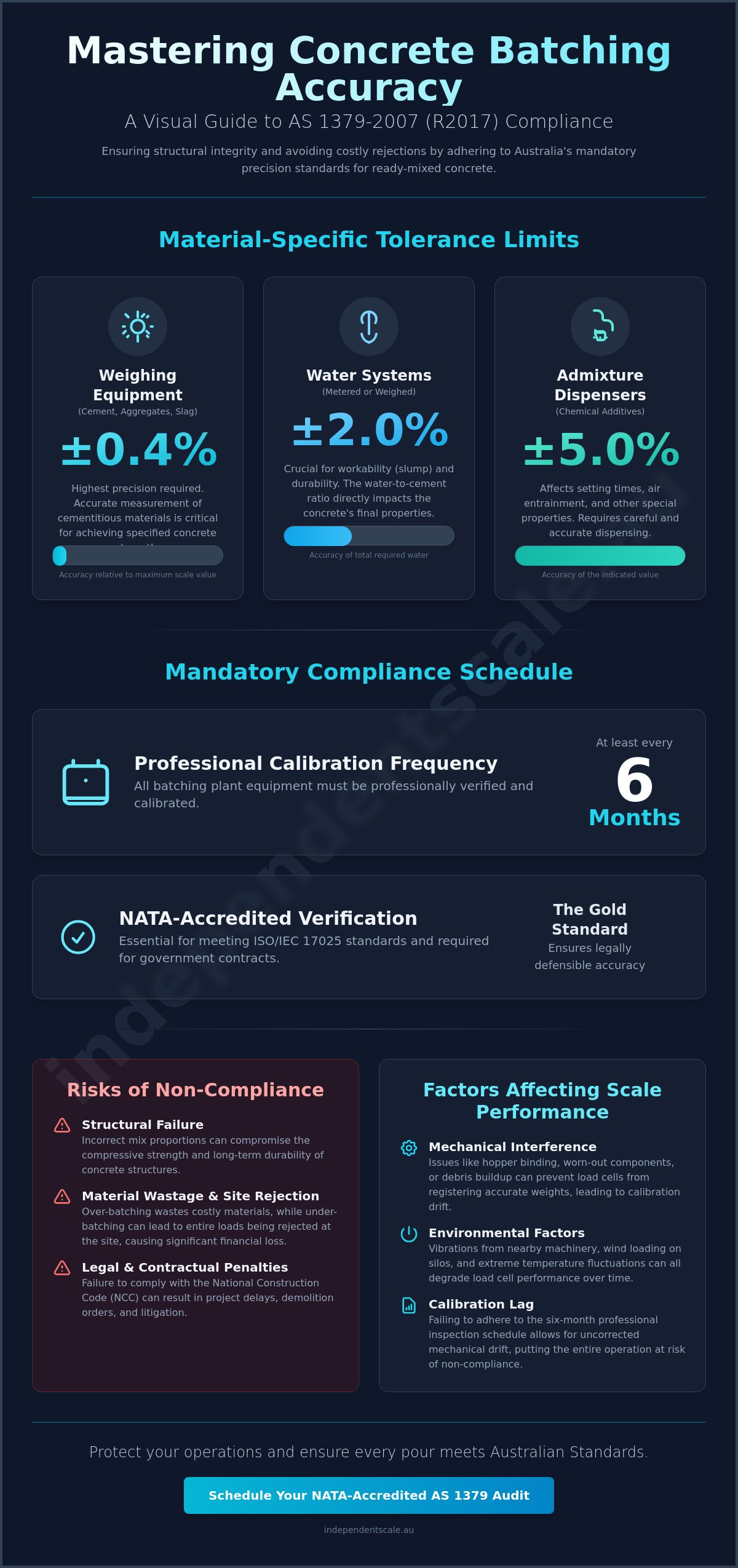
- Weighing Equipment: Scales for cement and aggregates must be accurate to ±0.4% of the maximum scale value.
- Water Systems: Liquid measurement must be metered or weighed to an accuracy of ±2.0%.
- Admixture Dispensers: Chemical additives must be metered to an accuracy of ±5.0% of the indicated value.
These tolerances are vital because cementitious materials require the highest level of precision to achieve the specified strength class. Inaccurate water ratios directly impact the slump and durability of the concrete, while incorrect admixture dosages can lead to unpredictable setting times. By adhering to these standards, plants ensure that every cubic metre of concrete produced is fit for its intended structural purpose.
Material-Specific Tolerance Limits for AS 1379 Compliance
Compliance with Australian standards requires a granular understanding of how individual constituents behave during the batching process. While international standards like ASTM C94 are often cited in general literature, Australian operators must adhere to the specific mandates of AS 1379-2007. These concrete batching accuracy requirements are designed to mitigate the risks associated with chemical imbalances and structural instability. Each material category carries its own permissible error margin, reflecting its relative impact on the final mix performance.
Precision Requirements for Cement and Slag
Cementitious binders are the most critical components in any concrete mix. Accuracy in these materials is the primary determinant of compressive strength and chemical resistance. Under AS 1379, binders including Portland cement, slag, and fly ash require high precision, typically within a ±1% to ±2% tolerance range depending on the batch volume. Binder accuracy is the most critical factor in concrete strength because even a minor deficit in cementitious content can lead to a failure in meeting the specified MPa rating. Managing multiple silos for slag and fly ash increases weighing complexity; each must be metered through dedicated load cells to prevent cross-contamination and cumulative errors.
Aggregates and Water Measurement
Aggregates represent the largest volume of the mix. Their weighing tolerances are generally set at ±2% for batches exceeding 2 cubic metres. Precision here is complicated by moisture content. Plant software must compensate for aggregate moisture by adjusting the dry weight targets in real-time. Failure to calibrate these systems leads to incorrect water-to-cement ratios, which directly compromises the workability and durability of the pour.
Water addition is equally sensitive. AS 1379-2007 requires water to be metered or weighed to an accuracy of ±2.0%. While many plants utilize weighing hoppers, others rely on flowmeters for high-speed production. Regardless of the method, professional verification is necessary to ensure the volume delivered matches the digital readout. For plants utilizing flow-based delivery, liquid flowmeter calibration provides the technical verification required to meet these stringent standards. If your system shows signs of drift, a professional load cell calibration can prevent costly material wastage and ensure your mix designs remain compliant.
- Cementitious Materials: High precision required due to direct impact on MPa.
- Liquid Admixtures: Permissible tolerance of ±5.0% of the indicated value.
- Aggregates: ±2.0% tolerance, requiring active moisture compensation.
The Role of NATA Accreditation in Meeting Accuracy Standards
Accreditation through the National Association of Testing Authorities (NATA) is the only method to verify that a plant’s measurement systems are technically competent and traceable to national standards. While many operators perform internal "scale checks," these informal tests lack the rigorous methodology required for regulatory compliance. A NATA-accredited calibration ensures that your equipment meets concrete batching accuracy requirements by calculating the uncertainty of measurement, a critical factor that raw scale readings ignore. This process creates a documented chain of traceability, linking your plant’s output directly to the SI units of mass and volume.
For industrial clients, a NATA-endorsed certificate is a primary tool for risk mitigation. In the event of a structural failure or a project dispute, these certificates serve as authoritative evidence that the batching plant was operating within the tolerances specified by AS 1379. Without this level of third-party verification, suppliers remain vulnerable to claims of negligence or material non-compliance. It's a standard of proof that basic service reports simply cannot provide.
ISO/IEC 17025: The Technical Foundation
The technical integrity of a calibration service is governed by ISO/IEC 17025. This international standard dictates the requirements for the competence of testing and calibration laboratories. Adhering to ISO 17025 accreditation is mandatory for any technician performing work on high-specification infrastructure projects. This standard ensures that the calibration process accounts for environmental variables, equipment drift, and repeatability. It provides the mathematical certainty that your ±0.4% weighing accuracy is a verified fact rather than an estimate.
Why NATA Certificates are Required for Tier 1 Projects
Government infrastructure bodies and Tier 1 contractors rarely accept non-accredited calibration reports. Major commercial builds and state-funded projects require concrete supplied from plants that undergo regular, accredited testing. This requirement ensures that every m³ of concrete delivered has been batched on equipment verified by a proficient, independent authority. Utilizing a NATA calibration guide helps plant managers align their internal maintenance with the expectations of major project auditors, ensuring the facility remains eligible for high-value contracts.
- Legal Protection: NATA certificates provide a robust defense during audits and legal inquiries.
- Contractual Eligibility: Most government tenders mandate accredited calibration for all batching equipment.
- Verified Proficiency: Accreditation confirms the technician’s ability to perform complex calculations like uncertainty of measurement.
Critical Factors Affecting Batching Plant Scale Performance
Maintaining concrete batching accuracy requirements is a continuous process that extends far beyond the date of your last calibration. Industrial environments are inherently hostile to precision measurement. Environmental variables, mechanical wear, and electrical interference constantly degrade the integrity of your load cell signals. Recognizing these factors early prevents batch rejections and ensures your plant remains within the ±0.4% weighing tolerance mandated by AS 1379. If these factors aren't managed, even the most expensive weighing system will produce non-compliant results.
Wind loading is a primary environmental culprit. On exposed silos, high winds exert lateral pressure that vertical load cells can misinterpret as mass. Similarly, temperature fluctuations cause structural steel to expand and contract, potentially putting "side-load" on the weighing assemblies. Vibration from nearby mixers or heavy transport also introduces signal noise, making it difficult for the controller to determine a stable weight. Regular testing between formal calibration intervals is the only way to detect these drifts before they impact your mix quality.
Load Cell Health and Signal Integrity
Load cell drift often manifests as a scale that won't return to zero or a reading that fluctuates without a load. These issues usually stem from moisture ingress in junction boxes or physical damage to the internal strain gauges. Monitoring your indicators and displays for erratic behavior is the first line of defense. If a load cell has failed due to an electrical surge or mechanical overload, immediate load cell supply and replacement are necessary to restore plant operations. Don't let a faulty signal compromise an entire project's structural integrity.
Hopper and Silo Mechanical Maintenance
Mechanical binding is perhaps the most common cause of measurement error in concrete production. This occurs when a weighing hopper makes physical contact with a fixed structure, such as a maintenance platform or a stray piece of debris. Even a small stone wedged in the gap can shunt the weight, leading to significant under-batching. Regular inspection of tank and silo weighing assemblies ensures that the hopper remains fully suspended and free to move. Material buildup, such as dried concrete on the scale exterior, also adds dead load that can exceed the scale's tare capacity. Implementing scheduled hopper calibration services identifies these mechanical faults before they trigger an audit failure.
If your plant is struggling with inconsistent batch weights or erratic scale readings, contact us for a professional calibration and technical assessment to identify the root cause and restore compliance.
Implementing a Compliant Calibration Schedule
AS 1379-2007 (R2017) mandates that all weighing and liquid-dispensing equipment undergo accuracy verification at least every six months. For high-volume facilities or those operating in harsh environments, this frequency often increases to quarterly to mitigate the risk of cumulative drift. While some industry sources suggest annual checks are sufficient, following such advice invites non-compliance during a NATA audit or a state government project inspection. A robust schedule ensures that concrete batching accuracy requirements are met consistently, protecting the plant from the liability of supplying off-spec material.
Effective management involves a two-tiered approach. Your site team must perform daily zero-balance checks and visual inspections for mechanical binding or material buildup. These internal daily checks are vital for operational health, but they don't replace a professional calibration. A professional, NATA-accredited technician performs a full-scale range test using certified weights, providing the mathematical certainty and legal documentation required for your quality manual. This dual approach minimizes material variance and ensures that any shift in scale performance is caught before it exceeds permissible limits.
Developing Your Plant Quality Manual
Documentation is the backbone of regulatory compliance. An AS 1379 compliant quality manual must include a register of all measuring equipment, its current calibration status, and a comprehensive history of any repairs. It's essential to integrate these calibration results directly into your batching software to ensure the system uses the most current scale factors and correction curves. We provide AS 1379 compliant calibration data in a format that simplifies this integration. This structured data approach ensures that your production records remain audit-ready and that your mix designs are executed with absolute precision.
Emergency Repairs and Minimising Downtime
A single failed load cell can halt production, leading to missed delivery windows and wasted concrete. Minimising downtime requires a proactive approach to spare parts and rapid technical response. We recommend stocking critical components on-site to facilitate immediate repairs. Keeping a supply of junction boxes and surge arrestors protects your system from electrical damage during storms or power surges. When a critical failure occurs, having a service partner who understands the urgency of industrial weighing is the difference between a minor delay and a lost day of production.
Maintaining compliance is a continuous commitment to precision engineering. If your equipment is approaching its six-month verification deadline, contact Independent Scale Service for NATA-accredited calibration to ensure your facility remains fully compliant with Australian standards.
Securing Long-Term Compliance and Structural Integrity
Adhering to AS 1379-2007 (R2017) is a technical necessity that protects your business from legal liability and material waste. We've established that meeting concrete batching accuracy requirements depends on more than just high-quality hardware; it requires a rigorous six-month calibration schedule and a deep understanding of material-specific tolerances. By prioritizing NATA-accredited verification, you ensure that every load of concrete meets the precise engineering standards required for Australia's most critical infrastructure. Maintaining a compliant facility is a serious responsibility for serious industrial operators; it's the only way to guarantee structural dependability and project success.
Independent Scale Service is NATA Accredited to ISO/IEC 17025 and specializes in AS 1379 compliance for concrete plants. Our technicians provide comprehensive service coverage across Sydney, Melbourne, and regional Australia to minimize your downtime and keep your operations running within tolerance. Don't risk your project's reputation or structural safety on unverified measurements. Ensure Your Plant is AS 1379 Compliant with NATA-Accredited Calibration to maintain your standing as a trusted industry supplier. We're ready to help you achieve the precision your clients demand.
Frequently Asked Questions
What is the required accuracy for concrete batching in Australia?
In Australia, weighing equipment for cement and aggregates must maintain an accuracy of ±0.4% of the maximum scale value. Water must be metered or weighed to within ±2.0%, while liquid admixtures require an accuracy of ±5.0% of the indicated value. These concrete batching accuracy requirements are legally mandated by AS 1379-2007 (R2017) to ensure structural reliability across all Normal and Special Class concrete mixes.
How often should a concrete batching plant be calibrated under AS 1379?
AS 1379-2007 requires all weighing and liquid-dispensing equipment to be checked for accuracy at least every six months. High-volume plants or those operating in aggressive environments often require more frequent intervals, such as quarterly, to prevent measurement drift. Regular verification ensures the facility remains compliant with the National Construction Code and avoids the risk of supplying non-conforming material to major infrastructure projects.
What is the difference between AS 1379 and ASTM C94?
AS 1379 is the specific Australian Standard for the specification and manufacture of concrete, whereas ASTM C94 is the equivalent American standard. While both govern ready-mixed concrete, AS 1379 is the only standard recognized by the National Construction Code for Australian projects. It contains specific manufacturing tolerances and testing frequencies tailored to Australian raw materials and environmental conditions, making it the primary compliance benchmark for local suppliers.
Can I calibrate my own concrete batching scales?
You can perform internal daily checks for zero-balance and mechanical integrity, but these don't constitute a formal calibration under AS 1379. Valid compliance requires an external, technically competent technician to perform the verification. For Tier 1 and government contracts, this calibration must be NATA-accredited to ISO/IEC 17025. This ensures that the results are traceable to national standards and include a calculated uncertainty of measurement.
What happens if my concrete plant fails a NATA calibration audit?
Failing a calibration audit results in immediate non-compliance status, which can lead to the suspension of supply to government and commercial projects. If measurements fall outside the ±0.4% tolerance, any concrete produced during the non-compliant period may be deemed structurally unsound. This often necessitates expensive site testing, potential demolition of poured structures, and significant legal liability for the concrete supplier.
How do load cells affect batching accuracy in concrete plants?
Load cells are the primary transducers that convert material weight into electrical signals for the batching controller. Any degradation in load cell health, such as moisture ingress or physical deformation, causes signal drift and measurement errors. Precise concrete batching accuracy requirements cannot be met if load cells are shunted by mechanical binding or if the signal is corrupted by electrical noise from nearby industrial equipment.
What is the permissible error for admixtures in concrete mixing?
Liquid admixtures must be metered to an accuracy of ±5.0% of the indicated value according to AS 1379. Because chemical additives are used in small volumes but have a high impact on setting times and workability, even minor errors can lead to unpredictable concrete behavior. Ensuring admixture dispensers are calibrated every six months is critical for maintaining the consistency of Special Class concrete mixes and performance-based specifications.
Why is NATA accreditation important for concrete supply contracts?
NATA accreditation provides independent verification that the calibration was performed by a technically competent laboratory adhering to ISO/IEC 17025. Most Tier 1 construction contracts and government tenders mandate NATA-endorsed certificates as a prerequisite for supply. It provides the legal weight and traceability required to prove that the concrete was manufactured in strict accordance with Australian Standards, protecting the supplier during project audits.
