


Commercial Weighing Solutions: The Industrial Guide to Accuracy and Compliance
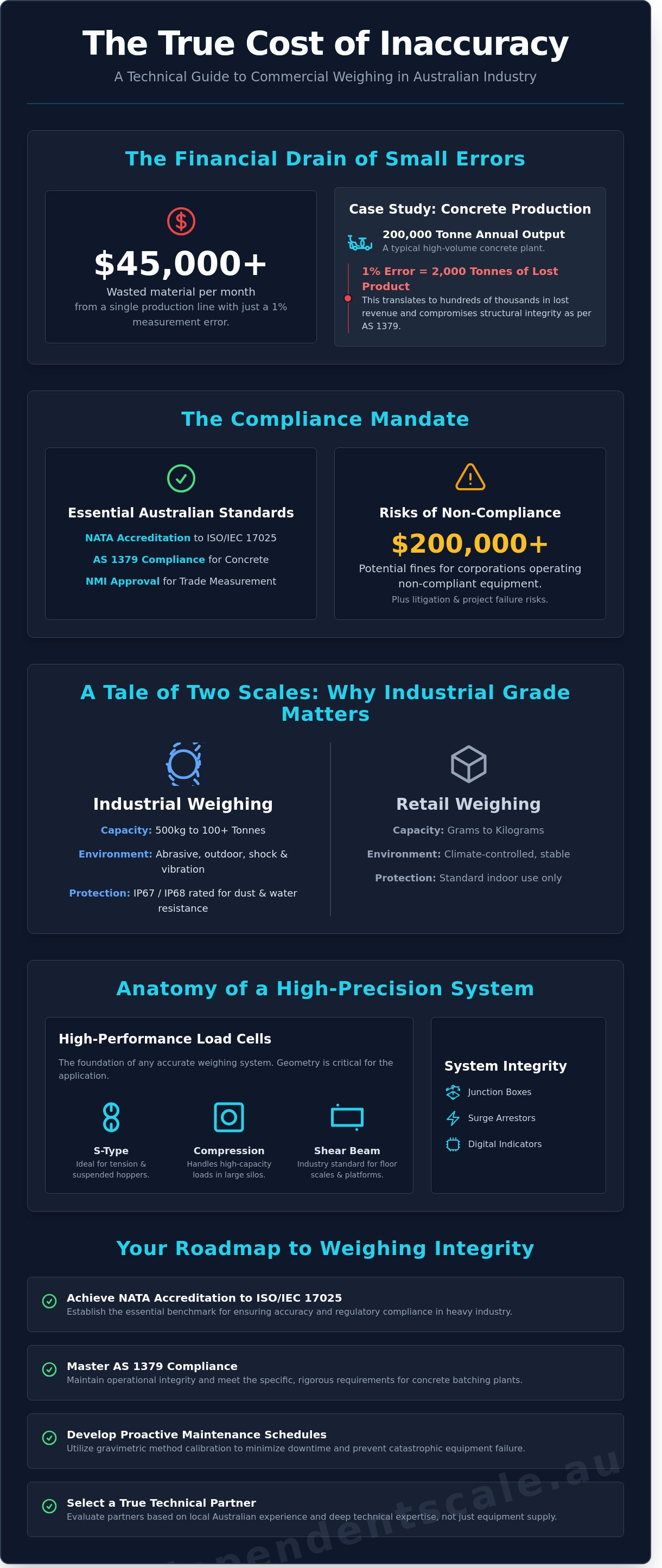
In high-volume industrial batching, a 1% measurement error can result in over $45,000 of wasted material per month for a single production line. Precision isn't a luxury; it's a fundamental requirement for operational viability. You understand that equipment failure or inaccurate batching doesn't just delay production, it compromises your standing with clients and risks non-compliance with Australian Standards. Implementing robust commercial weighing solutions is the only way to safeguard your facility against these costly disruptions and ensure every load meets exact specifications.
This principle of seeking specialised expertise extends to other areas of industrial optimisation. Just as precision weighing prevents material waste, managing the operational environment with advanced air conditioning from a service like Nature Carer Environmental Solutions protects sensitive electronics from heat-related failure. For businesses looking for high-performance hardware, Electro Tech Systems offers a range of commercial weighing solutions built for reliability. Similarly, strategic energy management can significantly reduce operational costs, and for companies in the mining and industrial sectors looking to improve sustainability and efficiency, you can check out Super Smart Energy for expert guidance on decarbonisation.
This guide provides a technical roadmap for implementing high-precision weighing systems that achieve full ISO/IEC 17025 compliance and exceed the rigorous demands of AS 1379. You'll discover how to integrate NATA-accredited calibration and high-accuracy load cell systems to maintain absolute measurement integrity across your entire plant. We'll examine the essential components of industrial accuracy, the necessity of gravimetric method calibration, and how 24/7 technical support protocols eliminate downtime in critical 98% of concrete production environments.
Key Takeaways
- Understand why NATA accreditation to ISO/IEC 17025 is the essential benchmark for ensuring accuracy and regulatory compliance in heavy industry.
- Identify the core hardware components of robust commercial weighing solutions, including the diagnostic advantages of modern digital load cell technology.
- Master the specific requirements of AS 1379 to maintain compliance and operational integrity within concrete batching plant environments.
- Learn to develop proactive maintenance and gravimetric calibration schedules that minimize downtime and prevent catastrophic equipment failure.
- Determine how to select an industrial partner by evaluating technical expertise and local Australian experience over simple equipment supply.
Understanding Commercial Weighing Solutions for Australian Industry
Commercial weighing solutions in heavy industry represent the intersection of mechanical engineering and digital precision. In sectors like mining, bulk logistics, and manufacturing, weighing isn't a secondary task; it's the primary method for inventory control and revenue protection. These systems must maintain accuracy under extreme physical stress while adhering to strict Australian regulatory frameworks. By 2026, the National Measurement Institute (NMI) has projected even tighter oversight on trade-to-measure equipment, making high-specification hardware a baseline requirement for operational legality.
Industrial vs. Retail Weighing: Key Differences
The technical requirements for industrial weighing diverge sharply from retail applications. While a retail scale might measure grams in a climate-controlled shop, industrial commercial weighing solutions must process loads from 500kg to over 100 tonnes in abrasive, outdoor environments. Reliability in these settings depends on specific hardware choices:
- Environmental Protection: Industrial hardware requires IP67 or IP68 ratings to resist dust ingress and high-pressure water jets.
- Capacity and Scale: Heavy industry utilizes high-capacity load cells designed to withstand shock loading and constant vibration.
- Signal Integrity: Large-scale systems often use specialized junction boxes and surge arrestors to protect sensitive electronics from lightning strikes and electrical noise on remote sites.
Durability is the priority. Equipment must function in the Pilbara's heat or the humidity of North Queensland without calibration drift. Standard retail components fail within weeks in these conditions.
The Economic Impact of Weighing Inaccuracy
Inaccuracy in high-volume production creates immediate financial leakage. If a concrete plant with a 200,000-tonne annual output has a 1% positive error, it gives away 2,000 tonnes of product for free. At an average cost of $180 per cubic metre, this equates to hundreds of thousands of dollars in lost revenue. Conversely, under-filling leads to structural failures. In construction, failing to meet the precise mix designs specified in AS 1379 compromises the integrity of the concrete, potentially leading to expensive site remediations or legal action.
Compliance is a legal mandate, not a suggestion. The Australian Trade Measurement Act requires that any scale used for trade must be NMI approved and regularly verified. Operating non-compliant equipment risks fines exceeding $200,000 for corporations. Maintaining AS 1379 compliant systems ensures that every batch meets the exact engineering requirements while protecting the manufacturer from litigation. Accuracy is the only way to guarantee both profitability and safety in modern Australian industry.
Core Hardware: From Load Cells to Tank Weighing Assemblies
Industrial weighing systems are only as reliable as their physical components. In heavy industry, commercial weighing solutions must perform under extreme pressure, vibration, and environmental stress. A robust system integrates high-precision sensors with rugged mounting hardware and sophisticated data processing units to ensure every measurement meets stringent regulatory standards.
High-Performance Load Cells and Mounts
Load cells act as the foundation of any weighing system. Choosing the right geometry is critical for operational accuracy. S-type load cells are ideal for tension applications, such as suspended hoppers. Compression cells handle high-capacity loads in large silos, while shear beam cells are the industry standard for floor scales and medium-capacity platforms. We specify stainless steel construction for 100% of our washdown or corrosive environment installations to prevent premature failure. Explore our full range of industrial load cells designed for heavy-duty applications. Proper mounting kits are equally vital; they protect the cell from side forces and ensure the load is applied vertically for maximum precision.
Digital Indicators and Signal Conditioners
The transition from analogue to digital technology has revolutionised system diagnostics. Modern indicators and displays do more than show weight; they provide real-time feedback on the health of individual cells. This capability allows technicians to identify a failing sensor before it causes a production shutdown. For plants requiring automation, conditioners and transmitters bridge the gap between hardware and PLC systems. These units convert signals into 4-20mA, Modbus, or Ethernet outputs for seamless integration. While wireless data transmission is gaining traction for its flexibility in large-scale plants, hard-wired systems remain the preferred choice for 95% of our clients due to their immunity to RF interference.
Specialised Tank and Silo Assemblies
Weighing a 100-tonne silo requires specialised engineering that accounts for more than just the material weight. High-quality tank and silo weighing assemblies must compensate for thermal expansion and contraction of the vessel. In outdoor Sydney installations, wind loading is a significant factor; assemblies must include uplift protection to prevent the silo from tipping during storms. To protect the sensitive electronics within these systems, we integrate junction boxes and surge arrestors to mitigate the risk of lightning strikes and power surges. This level of hardware protection is why we service 98% of concrete plants across the region, ensuring they stay compliant with AS 1379 standards. If your current system is showing drift, it might be time to schedule a professional hopper calibration service to restore accuracy.
Navigating Australian Compliance: NATA and AS 1379 Standards
In the Australian industrial sector, "close enough" is a liability. For businesses relying on commercial weighing solutions, NATA accreditation represents the absolute peak of measurement integrity. It isn't just a badge; it's a rigorous assessment of technical competence and equipment traceability. While standard calibration might satisfy internal checks, NATA-certified verification provides the legal weight required for high-stakes industries. This distinction is critical when measurement accuracy directly impacts safety, structural integrity, or financial transactions.
NATA accreditation confirms that a laboratory meets the stringent requirements of ISO/IEC 17025. This ensures that every measurement taken in the field is backed by a documented chain of traceability to national standards. For an operator, this means the data produced by your scales is defensible during audits or legal inquiries. Without this level of certification, your weighing data remains vulnerable to challenge.
The Criticality of AS 1379 Compliance
Concrete production demands extreme precision to ensure structural safety. AS 1379:2007, the Australian Standard for the specification and supply of concrete, dictates strict batching accuracy. For cementitious materials and water, the required tolerance is +/- 1% of the total batch weight. For aggregates, the tolerance is +/- 2%. These figures aren't suggestions; they're mandatory requirements for ensuring the compressive strength of the final product.
To maintain compliance, plants must provide a clear audit trail. This includes detailed calibration reports that site inspectors can review at any moment. Failure to meet these standards can lead to project rejections or total plant shutdowns. You can find more detail in our complete guide to concrete batching plant calibration. We currently service 98% of concrete plants across Sydney, ensuring they remain compliant with these rigorous benchmarks.
ISO/IEC 17025 Accreditation Explained
Laboratory accreditation under ISO/IEC 17025 is the global benchmark for testing and calibration laboratories. It's the difference between a simple equipment check and a professional verification of technical proficiency. To issue NATA-endorsed certificates, a provider must demonstrate expertise in complex procedures, including gravimetric method calibration and the management of uncertainty in measurement. This level of commercial weighing solutions expertise ensures that your equipment performs reliably under actual operating conditions.
Adhering to ISO/IEC 17025 significantly reduces the risk of legal disputes. If a structural failure occurs or a contract is contested, the first point of investigation is often the batching and weighing data. A NATA-endorsed certificate proves that your measurements were accurate at the time of production. This protection is essential for Tier 1 contractors and major suppliers like Holcim, Boral, and Hanson, where a single measurement error can result in financial losses exceeding $50,000 in rejected materials and labor costs.
Maximising Uptime: Calibration, Maintenance, and 24/7 Repairs
Industrial operations rely on the sustained accuracy of commercial weighing solutions to maintain profitability and legal compliance. A proactive maintenance schedule prevents catastrophic failure by identifying component wear before it leads to a total system halt. For example, a concrete plant processing 500 cubic metres daily can't afford a sudden scale breakdown. Regular inspections ensure that mechanical components like summing circuits and surge arrestors remain functional under heavy load cycles.
The Calibration Lifecycle
Calibration frequency isn't a guess. It's determined by cycle counts, environmental stressors, and regulatory requirements like AS 1379. High-vibration areas or chemical exposure often require quarterly checks to maintain the required 0.1% accuracy threshold. On-site calibration is the standard for heavy infrastructure, as it accounts for the environmental factors affecting the scale in its working position. For specialized applications, our liquid flowmeter calibration using the weighing method provides unmatched precision by measuring mass rather than volume, eliminating errors caused by fluid density changes.
Managers often claim that calibration takes too much time. This is a costly misconception. A scheduled 2-hour calibration prevents a 48-hour emergency shutdown. Our technicians use NATA-accredited processes to ensure speed without compromising the ISO/IEC 17025 standards. By integrating calibration into planned maintenance windows, you eliminate the risk of product giveaway or batch rejection due to weighing errors.
Fault Diagnosis and Emergency Load Cell Repair
Load cell fatigue manifests in specific ways: drifting readings, non-linearity, or zero-shift. These issues are frequent in heavy-duty assets like a weighbridge, where constant vehicle throughput creates significant mechanical stress. Diagnosing these faults requires a methodical approach. We distinguish between mechanical binding, which is often caused by debris buildup, and electrical issues like moisture ingress in junction boxes or cable damage.
Immediate response is critical for infrastructure that serves as a bottleneck for production. When systems fail, the cost of downtime can exceed $10,000 per hour in high-output facilities. Our 24/7 emergency support team responds immediately to critical failures across Sydney and beyond. We carry a comprehensive range of replacement load cells and digital indicators to ensure repairs happen on the first visit. When selecting commercial weighing solutions, the service agreement is as vital as the hardware itself. Precision is only valuable if it is consistent and supported by expert technical intervention.
Ensure your systems remain accurate and compliant under all conditions. Book a NATA-accredited calibration today.
Selecting a Commercial Weighing Partner in 2026
Selecting a provider for commercial weighing solutions requires looking beyond the price of a load cell or indicator. Technical expertise is the primary differentiator in an industry where downtime costs thousands of dollars per hour. Equipment supply is common, but the ability to diagnose a failing summing circuit or calibrate a complex batching system is rare. You aren't just buying hardware; you're securing a guarantee of operational continuity.
This principle of seeking specialised expertise extends to other areas of industrial optimisation. Just as precision weighing prevents material waste, managing the operational environment with advanced air conditioning from a service like Nature Carer Environmental Solutions protects sensitive electronics from heat-related failure. Similarly, strategic energy management can significantly reduce operational costs, and for companies in the mining and industrial sectors looking to improve sustainability and efficiency, you can check out Super Smart Energy for expert guidance on decarbonisation.
Australia's industrial landscape demands local knowledge. Metro Sydney presents different logistical challenges than regional mining sites. Independent Scale Service (ISS) currently maintains 98% of Sydney's concrete plants. This market dominance isn't accidental. Major players like Holcim, Boral, and Hanson rely on ISS because they require technicians who understand the specific rigours of AS 1379 compliance and high-volume production environments. Local experience ensures that a technician arrives with the correct test weights and spare parts, not just a clipboard.
Modern weighing data must feed directly into your broader business management systems. It's about data integrity. If your weighing partner doesn't understand digital communication protocols, your ERP or SCADA systems will fail to provide accurate inventory reports. Integration ensures that every gram measured on the factory floor is reflected in your financial and compliance documentation. This connectivity is essential for maintaining a competitive edge in 2026.
Checklist for Choosing a Calibration Provider
Don't settle for a provider that lacks the proper credentials. Use this checklist to verify their capability:
- Verify NATA accreditation status for specific equipment types and mass ranges.
- Assess the availability of 24/7 emergency support. ISS provides a dedicated emergency line to minimise client downtime.
- Confirm the provider stocks essential spare parts locally to avoid long shipping delays.
- Review industry-specific experience, particularly for force gauge calibration.
- Ensure compliance with ISO/IEC 17025 standards to guarantee international traceability.
The Independent Scale Service Advantage
ISS offers a no-nonsense approach to industrial weighing. With over 30 years of history servicing Australia’s largest industrial players, the company projects an image of methodical precision. You get direct access to expert technicians who solve problems on-site, not sales representatives reading from a script. ISS provides comprehensive solutions ranging from hopper calibration to complex plant repairs. The focus remains exclusively on solving critical business problems through technical competence and reliability. This established authority makes ISS the trusted choice for serious industrial clients who cannot afford inaccuracies.
Future-Proof Your Industrial Weighing Infrastructure
Achieving sustained precision in industrial environments requires more than high-quality hardware; it demands a rigorous commitment to technical standards. Implementing robust commercial weighing solutions ensures your facility remains compliant with AS 1379 and NATA ISO/IEC 17025 requirements. These benchmarks aren't optional for serious operators. They're the foundation of legal and operational integrity. With over 30 years of experience servicing 98% of concrete plants across Sydney, Independent Scale Service provides the technical expertise needed to eliminate measurement drift and prevent costly downtime.
Maintaining accuracy involves proactive calibration and immediate response when systems fail. Our team delivers 24/7 emergency support across Australia to keep your production lines moving. Whether you're upgrading tank weighing assemblies or seeking gravimetric method calibration, selecting a partner with proven industrial credentials is the most effective way to protect your margins. We've built our reputation on providing no-nonsense, expert service to industry leaders like Boral and Holcim. It's vital to ensure your equipment meets the highest Australian standards.
Request an Expert Consultation for Your Weighing Solution and secure your plant's reliability today.
Frequently Asked Questions
What is the difference between calibration and verification?
Calibration is the comparison of a measurement device against a known standard to determine accuracy, while verification is a formal check to ensure equipment complies with National Measurement Institute (NMI) trade regulations. Calibration provides a detailed report of errors across the scale's range. Verification results in a simple "Pass" or "Fail" for legal trade use. Most industrial sites require ISO/IEC 17025 accredited calibration to maintain internal quality standards.
How often should industrial weighing equipment be calibrated?
Industrial weighing equipment should be calibrated every 6 to 12 months to ensure continued accuracy and compliance. For concrete batching plants, AS 1379 requires a strict 6-month interval for all scales and flowmeters. High-use environments or sites with extreme temperature fluctuations often benefit from quarterly checks. This frequency prevents measurement drift that leads to costly material wastage or non-compliant product batches during heavy production cycles.
Is NATA accreditation mandatory for all commercial weighing solutions?
NATA accreditation to ISO/IEC 17025 isn't mandatory for every business, but it's the gold standard for high-accuracy commercial weighing solutions. Major contractors like Boral, Hanson, and Holcim require NATA-certified reports to satisfy their internal quality audits. Choosing a NATA-accredited provider ensures your equipment's tested using traceable standards. It's the only way to guarantee technical competence and valid results for critical industrial processes that require absolute precision.
What are the main causes of load cell failure in industrial environments?
Moisture ingress and electrical surges from lightning strikes are the primary causes of load cell failure, representing approximately 75% of all service calls. Physical overloading and chemical corrosion also damage sensitive internal strain gauges over time. In harsh environments, using hermetically sealed stainless steel load cells reduces these risks. Proper installation of summing circuits and surge arrestors provides an extra layer of protection against unpredictable environmental damage.
How does AS 1379 impact concrete plant operations?
AS 1379 dictates that concrete production facilities must maintain weighing accuracy within 0.5% for cement and 2% for aggregates. This standard forces plants to undergo mandatory recalibration every 182 days to remain compliant. Failure to comply with AS 1379 can lead to the rejection of concrete batches on major infrastructure projects. It ensures that the final product meets structural integrity requirements through precise, repeatable material measurement.
Can you calibrate weighing systems on-site at remote locations?
On-site calibration is available for remote locations through the use of specialized mobile service vehicles carrying up to 20 tonnes of certified test weights. Technicians travel to mining sites and regional infrastructure projects to perform ISO/IEC 17025 accredited testing without removing equipment. This minimizes downtime by allowing repairs and adjustments to happen immediately. It's an essential service for 98% of concrete plants operating across New South Wales.
What is the "gravimetric method" for flowmeter calibration?
The gravimetric method for flowmeter calibration involves measuring the mass of liquid discharged into a vessel on a NATA-certified scale. This is the most accurate calibration technique because it relies on mass rather than volume, which can change with temperature. By comparing the flowmeter's reading to the actual weight recorded on the scale, technicians can calculate the precise error margin. It's a fundamental process for maintaining batch consistency.
How do surge arrestors protect commercial weighing systems?
Surge arrestors protect commercial weighing solutions by diverting excess electrical energy from lightning or power spikes directly to the ground. These devices are installed between the load cells and the digital indicator to prevent high-voltage transients from frying sensitive electronics. Without this protection, a single lightning strike can cause thousands of dollars in hardware damage and weeks of downtime. They're a low-cost insurance policy for any outdoor weighing installation.
