


Buy Weighbridge Load Cells Australia: Technical Selection & Compliance Guide
A single inaccurate weighbridge reading can result in over A$10,000 in lost revenue or regulatory fines before your next scheduled calibration. When you need to buy weighbridge load cells Australia, the decision impacts your entire supply chain's efficiency and legal standing. You understand that equipment failure isn't just a technical glitch. It's a costly operational bottleneck that halts production and risks your NATA accreditation status.
This guide delivers a professional framework for selecting, purchasing, and installing NMI-approved load cells that adhere to AS 1379 and ISO/IEC 17025 standards. We draw on over 30 years of industrial experience to ensure your system remains accurate under the harshest Australian conditions. You'll learn how to identify durable, high-accuracy sensors and secure the expert installation support necessary to pass every audit. We'll cover technical specifications, surge protection, and the critical role of NATA-accredited verification in minimizing your downtime.
Key Takeaways
- Identify how to select ruggedised load cells that withstand the extreme thermal expansion and dust typical of regional Australian mining and quarry environments.
- Evaluate the mechanical differences between canister, rocker column, and shear beam designs to determine which technology offers the best self-aligning properties for heavy vehicle traffic.
- Navigate the legal requirements for trade-legal weighing by ensuring all hardware carries mandatory NMI approval and integrated lightning protection.
- Follow a professional technical roadmap to buy weighbridge load cells Australia that meet strict industrial compliance standards and minimize operational downtime.
- Understand why hardware replacement must be followed by NATA-accredited calibration to ISO/IEC 17025 to guarantee measurement accuracy and asset longevity.
Selecting Weighbridge Load Cells for the Australian Climate
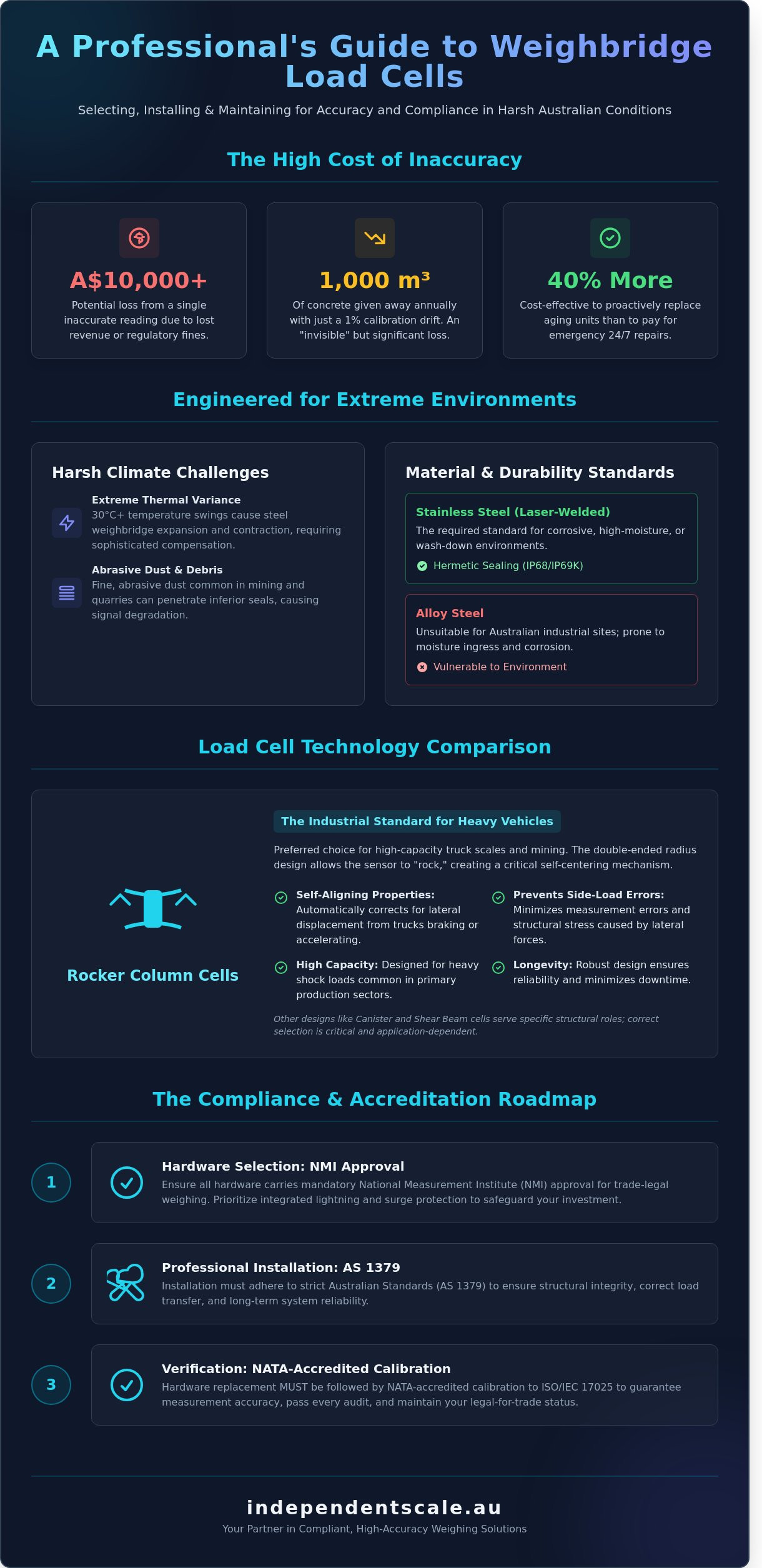
Australian quarries and mines operate under some of the harshest environmental conditions on the planet. In regional NSW and Victoria, temperatures can fluctuate by more than 30°C in a single 24-hour cycle. This extreme thermal variance causes significant expansion and contraction in steel weighbridge structures. If you choose to buy weighbridge load cells Australia based on the lowest price point, you often end up with cheap imports that lack sophisticated temperature compensation. These inferior components fail when subjected to the fine, abrasive dust typical of the Hunter Valley or the Pilbara, leading to immediate signal degradation.
Operational reliability is a requirement for any legal-for-trade application. Load cells are the sensory organs of your weighbridge; if they're compromised, your entire weight data becomes a liability rather than an asset. Maintaining high health standards for these components directly impacts your operational ROI. It mitigates the risk of heavy vehicle overloads and ensures you aren't giving away free product due to calibration drift. For businesses aiming for NATA-accredited precision, the hardware must be capable of surviving the local climate without constant intervention.
The Real Cost of Load Cell Failure
Weighbridge downtime brings high-volume logistics to a standstill. A single hour of equipment failure can prevent the movement of 500 tonnes of material, creating a bottleneck that ripples through the entire supply chain. In the concrete and aggregate industries, inaccurate weighing leads to "invisible" revenue loss that is difficult to track without a forensic audit. If a scale is out of tolerance by just 1%, a plant producing 100,000 cubic metres of concrete annually effectively gives away 1,000 cubic metres of product for free.
Proactive replacement of aging or drifting units is 40% more cost-effective than calling for emergency 24/7 repairs during a peak production window. Independent Scale Service (ISS) services 98% of concrete plants across Sydney, emphasizing that scheduled maintenance prevents the catastrophic failure of summing circuits and surge arrestors. Reliability is about more than just a functional scale; it is about maintaining compliance with AS 1379 and ISO/IEC 17025 standards.
Durability Standards: Stainless Steel vs. Alloy
Material selection is the primary factor in determining a component's lifespan. While alloy steel may be acceptable for controlled indoor environments, it is unsuitable for the corrosive or wash-down conditions found in Australian industrial sites. For these applications, hermetic sealing with an IP68 or IP69K rating is non-negotiable. This level of protection ensures the internal electronics remain dry even when subjected to high-pressure cleaning or temporary submersion.
A technical comparison of load cell types shows that canister and rocker column designs offer different advantages in terms of self-aligning capabilities. Stainless steel hermetic sealing is essential for long-term reliability because it prevents moisture ingress and protects internal strain gauges from the corrosive effects of Australian industrial environments. When you buy weighbridge load cells Australia, prioritize laser-welded stainless steel units. These provide the structural integrity required to withstand the lateral forces and heavy shock loads common in primary production sectors.
Technical Comparison: Canister, Rocker Column, and Shear Beam Cells
Selecting the correct mechanical design is the first step when you buy weighbridge load cells Australia. Mechanical architecture determines how a system handles lateral forces, thermal expansion, and heavy vehicle impact. Rocker columns, canisters, and shear beams aren't interchangeable; each serves a specific structural role in industrial weighing. Independent Scale Service leverages over 30 years of experience to match these technologies to specific site requirements, ensuring compliance with AS 1379 standards.
Rocker Column Load Cells: The Industrial Standard
Rocker column cells are the preferred choice for high-capacity truck scales and mining applications. These cells utilize a double-ended radius design that allows the sensor to "rock" within its mounting hardware. This movement is a critical self-centering mechanism. It automatically corrects for the lateral displacement caused by trucks braking or accelerating on the deck. Without this self-aligning property, side-load forces would cause significant measurement errors and eventual structural fatigue.
- Self-Centering: Gravity naturally returns the rocker column to a vertical position, eliminating the need for complex check rods.
- High Capacity: Typically rated for 30 to 50 tonnes per cell, making them suitable for GVM requirements exceeding 100 tonnes.
- Durability: Stainless steel construction and hermetic sealing protect against the harsh dust and moisture found in Australian mining and concrete sectors.
For operations like concrete batching, where precision is mandatory for AS 1379 compliance, rocker columns provide the stability needed for repeatable results. ISS currently services 98% of concrete plants across Sydney, primarily maintaining these rocker systems to ensure constant uptime.
Canister and Shear Beam Applications
Canister cells represent an older design often found in legacy weighbridge upgrades. While they offer high vertical accuracy, they're sensitive to non-axial loading. If you're retrofitting an older bridge, canister cells may be required to fit existing mounts, but they often require external stay rods to prevent the deck from shifting. In contrast, shear beams are the standard for low-profile or portable weighbridges. Their rectangular shape and low height allow for shallower pits or even surface-mounted designs with minimal ramp inclines.
Selecting the right load cells for specialized industrial weighing involves calculating the total system capacity. A standard 6-cell weighbridge should have a total cell capacity at least 20% higher than the maximum expected GVM to account for uneven weight distribution and shock loading. Once installed, these sensors must be integrated with high-performance indicators and displays to translate millivolt signals into readable data. ISS ensures all integrations meet NATA-accredited standards under ISO/IEC 17025. If your current system is showing drift or inconsistent zeros, it's time to review our full range of industrial weighing solutions to restore accuracy.
Critical Specifications for Compliance and Longevity
Selecting the right hardware is only half the battle. To ensure your investment remains operational and compliant with Australian law, you must focus on specific technical standards. In Australia, any weighbridge used for trade must comply with the National Measurement Act 1960. This means the load cells must carry NMI approval. When you buy weighbridge load cells Australia, verify the certificate of approval number before proceeding. Without this, your scale cannot be verified for trade use, leading to potential fines and legal repercussions.
Longevity depends on how well you protect the electronics from the elements. Regional Australian sites often face extreme temperatures and frequent electrical storms. Unprotected systems are prone to catastrophic failure from lightning strikes. Using junction boxes and surge arrestors is a standard requirement for industrial-grade installations. These components isolate the load cells from voltage spikes, effectively extending the lifespan of your purchase by preventing circuit board damage during storm events.
- NMI Approval: Mandatory for trade-legal weighing in Australia.
- IP68/IP69K Ratings: Essential for protection against dust and high-pressure water ingress.
- Stainless Steel Construction: Necessary for corrosion resistance in coastal or chemical environments.
- Vermin Protection: Use of braided stainless steel cables prevents rodents from disabling your system.
Understanding NMI and OIML Ratings
The National Measurement Institute (NMI) categorises load cells by accuracy classes, typically C3 or C4. A C3 rating provides 3,000 divisions, which is sufficient for most standard weighbridges. C4 ratings offer 4,000 divisions, providing higher precision for specialised applications. Choosing the correct class ensures your equipment meets OIML R60 standards. Buying NMI-approved cells is the only way to ensure legal-for-trade compliance. Always check the NMI database to verify the manufacturer certification before you buy weighbridge load cells Australia.
Environmental Protection and Surge Mitigation
Lightning strikes destroy unprotected weighbridge electronics in milliseconds. A single surge can travel through the steel deck and fry every cell in the circuit. Proper earthing and the installation of conditioners and transmitters play a vital role in signal stability. These devices filter electrical noise and provide a clean signal to the indicator. Australian standards for electrical safety in industrial weighing equipment require robust surge mitigation to prevent downtime. High-quality cable protection is equally critical. Rodents frequently chew through standard polyurethane jackets, leading to signal loss and moisture ingress. ISS recommends stainless steel conduit or rodent-proof cabling for all regional installations.
The Replacement Process: Ensuring NATA Accreditation
When you buy weighbridge load cells Australia, the physical acquisition of hardware is only the first step toward restoring operational accuracy. The replacement process is a high-precision technical undertaking that requires methodical execution to maintain the structural integrity of the weighbridge. Independent Scale Service (ISS) applies over 30 years of industry experience to ensure that every replacement meets the rigorous standards of NATA accreditation and ISO/IEC 17025. A failure to follow correct mechanical and electronic protocols during a swap results in drift, non-linearity, and eventual non-compliance.
Step-by-Step Load Cell Replacement
The technical workflow begins with a comprehensive diagnostic phase. ISS technicians use specialized millivolt meters and load cell simulators to isolate the specific faulty unit within the system. This prevents the unnecessary replacement of functional components. Once the fault is confirmed, the replacement follows a strict sequence:
- Safe Jacking: Using hydraulic jacks with a minimum 50-tonne capacity, the weighbridge deck is lifted. This must be done with extreme care to avoid twisting the steel or concrete structure.
- Hardware Inspection: We replace the mounting hardware, including base plates and rockers, to ensure the new cell sits perfectly vertical. Any tilt of even a few degrees introduces significant weighing errors.
- Circuit Balancing: After the new cell is installed, the summing circuit in the junction box must be re-balanced. This ensures uniform weight distribution across all corners of the bridge, preventing "corner errors" where the same load shows different weights depending on its position.
Calibration and Re-Certification
Hardware installation is never the final step. Any time you break the seal of a weighing system or replace a primary sensing element, a professional load cell calibration is mandatory. We utilize the gravimetric method, using NATA-certified test masses to verify the system across its full capacity range. This isn't a simple "zeroing" of the scale; it's a multi-point verification of repeatability and linearity.
For clients in the construction sector, compliance with AS 1379 is a non-negotiable requirement. This standard dictates the accuracy levels for concrete batching operations. Because ISS services 98% of concrete plants across Sydney, we understand the specific tolerances required for these high-volume environments. For a detailed breakdown of these requirements, refer to our Concrete Batching Plant Calibration Guide to ensure your facility remains compliant with Australian standards.
Operators who buy weighbridge load cells Australia must prioritize this post-installation certification to avoid legal liabilities and commercial disputes. Without a NATA-endorsed report, your weight readings hold no legal standing for trade use or quality assurance audits. Our technicians provide the necessary documentation to prove your equipment performs to the required 0.1% accuracy levels.
Don't risk your site's compliance on uncertified installations. Schedule a NATA-accredited calibration and replacement service to ensure your weighbridge remains accurate and legal.
Why Buy Weighbridge Load Cells from Independent Scale Service?
Independent Scale Service (ISS) provides the technical infrastructure required for high-capacity industrial weighing. When you choose to buy weighbridge load cells Australia from ISS, you're partnering with a team that has over 30 years of field experience. We currently service 98% of concrete plants across the Sydney metropolitan area. This market dominance isn't accidental; it's the result of maintaining NATA accreditation to ISO/IEC 17025 standards. This accreditation is the gold standard for Australian industry, ensuring every measurement and calibration meets strict regulatory requirements.
Industrial operations don't stop at 5:00 PM. We provide 24/7 emergency support to minimize downtime for critical operations. Whether your site is in Melbourne, Sydney, or regional Australia, our technicians provide comprehensive supply and installation services to keep your plant operational. We understand that a failed load cell can halt an entire supply chain; our response times reflect that urgency.
Expertise in Heavy Industrial Weighing
Our technical proficiency is trusted by major industry players like Holcim, Boral, and Hanson. These clients require precision that goes beyond basic scale setup. We specialize in complex hopper calibration and silo systems where accuracy directly impacts product quality. Our technicians are the preferred choice for AS 1379 compliance. This standard is non-negotiable for concrete production, and our methodical approach ensures your equipment remains fully compliant during every audit. We don't guess; we use proven gravimetric methods to verify performance.
Complete Lifecycle Support
We manage the entire equipment lifecycle. This starts with the initial load cell supply and continues through to NATA-certified maintenance. We don't just sell parts; we provide engineering solutions. Our inventory includes a full range of special purpose and shackle pins for unique lifting and weighing applications. By integrating high-quality hardware with scheduled testing, we ensure your weighbridge remains a reliable asset for decades. We focus on long-term stability, not just a quick fix.
Key reasons to choose ISS for your industrial weighing needs include:
- NATA Accreditation: Full compliance with ISO/IEC 17025 for all calibration services.
- 24/7 Response: Immediate technical support to resolve equipment failures and minimize lost revenue.
- Proven Track Record: Three decades of experience with Australia's largest construction material suppliers.
- National Reach: Mobile service units operating in Sydney, Melbourne, and regional hubs across the country.
If you're ready to buy weighbridge load cells Australia, ISS delivers the technical expertise required to maintain accuracy in the harshest environments. We focus on solving critical business problems through precision engineering and responsive service. Our goal is to ensure your weighing systems are the most reliable part of your operation.
Optimise Your Weighbridge Infrastructure
Maintaining a high-performing weighbridge requires more than a simple hardware swap. It demands NMI-approved components that withstand Australia's harsh environmental conditions and rigorous usage cycles. Choosing the correct canister or rocker column cell ensures long-term stability and prevents the measurement drift that leads to non-compliance with AS 1379 standards. When you buy weighbridge load cells Australia, technical specifications must align with NATA-accredited installation practices to guarantee legal-for-trade accuracy.
Independent Scale Service (ISS) currently services 98% of concrete plants across Sydney, providing the technical competence required for complex industrial weighing systems. Our team is NATA Accredited to ISO/IEC 17025, ensuring every calibration meets the highest regulatory benchmarks. We understand that downtime costs money; that's why we offer emergency 24/7 support at 0418 640 439 to keep your operations running without interruption. Don't risk your site's compliance on uncertified equipment or inexperienced technicians.
Request a Quote for NMI-Approved Load Cells & NATA Calibration
Reliable precision is just a phone call away.
Frequently Asked Questions
Do I need NMI-approved load cells for my weighbridge in Australia?
Yes, you must use NMI-approved load cells if your weighbridge is used for trade purposes. The National Measurement Act 1960 requires that any weighing instrument used to determine price must be "legal-for-trade" and verified by a licensed technician. ISS ensures all components meet these strict Australian regulatory standards to keep your business compliant.
Can I replace just one faulty load cell or should I replace the whole set?
You can replace a single cell, but replacing the entire set is often more cost-effective for long-term reliability. When you buy weighbridge load cells Australia from a reputable supplier, you ensure matched sensitivity across all points. Mixing old and new cells can cause balance issues in the summing circuit, leading to 0.5% or higher errors in weight distribution across the platform.
How often should weighbridge load cells be calibrated after purchase?
Calibration should occur every 6 to 12 months depending on your site's volume and environmental conditions. For concrete plants, AS 1379 mandates specific calibration intervals to maintain operational compliance. ISS provides NATA-accredited calibration to ISO/IEC 17025 standards to ensure your equipment remains within the required 0.1% accuracy tolerance.
What is the difference between IP68 and IP69K ratings for load cells?
IP68 signifies protection against continuous immersion in water, while IP69K specifically covers high-pressure, high-temperature washdowns. IP69K cells withstand water jets at 80 degrees Celsius and pressures up to 10 MPa. This rating's essential for Australian sites where heavy mud and debris require aggressive cleaning protocols to maintain equipment hygiene.
How do I know if my weighbridge load cell has been damaged by a lightning strike?
A lightning strike usually causes a permanent shift in the zero-balance or a complete failure of the internal strain gauge bridge. You'll identify this by checking the millivolt output; a deviation of more than 1% from the factory specifications indicates damage. ISS technicians use specialized diagnostic tools to test insulation resistance and bridge integrity on-site.
Does Independent Scale Service provide 24/7 emergency load cell replacement?
Yes, Independent Scale Service operates a 24/7 emergency response team for critical load cell failures. We understand that downtime costs money, especially for the 98% of Sydney concrete plants we service. If you need to buy weighbridge load cells Australia urgently, our technicians arrive with the necessary equipment to restore your operations immediately.
What Australian standards govern weighbridge accuracy for concrete plants?
Weighbridge accuracy for concrete production is primarily governed by AS 1379 and the National Measurement Institute (NMI) requirements. These standards dictate that weighing systems must be verified regularly to ensure batch consistency. Compliance with ISO/IEC 17025 is also critical for maintaining NATA-accredited status in industrial weighing applications.
How long does it typically take to replace and recalibrate a weighbridge cell?
Replacing a single load cell and performing a partial calibration typically takes 2 to 4 hours. A complete system overhaul, including the replacement of a full set of cells and a NATA-accredited recalibration, usually requires 6 to 8 hours. This timeframe ensures the weighbridge is correctly leveled and the summing circuit is balanced for maximum precision.
