


Buy Industrial Scales in Sydney: The 2026 Guide to Compliance & Accuracy
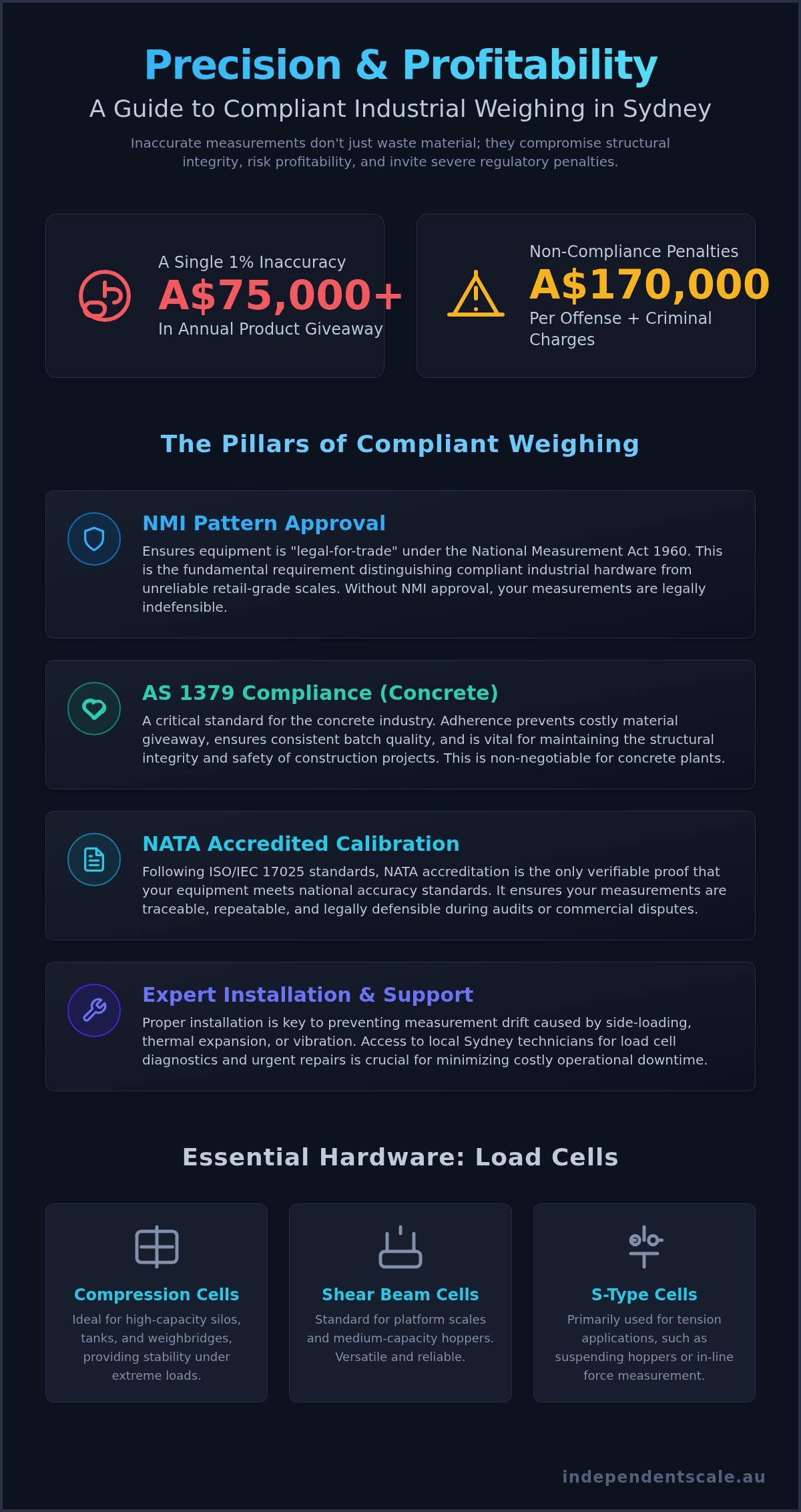
A single 1% margin of error in batching accuracy can result in over A$75,000 in annual product giveaway for a high-volume Australian concrete plant. When you prepare to buy industrial scales Sydney project managers must account for more than just the initial hardware cost. Non-compliance with the National Measurement Act 1960 can lead to criminal penalties and fines reaching A$170,000 per offense. You recognize that inaccurate measurements don't just waste material; they compromise structural integrity and invite avoidable regulatory scrutiny.
This guide provides a technical roadmap to select, install, and calibrate industrial weighing systems that achieve full NATA accreditation and AS 1379 compliance. You'll learn how to navigate the 2026 legislative reforms and the mandatory two-part NMI verification process required for legal-for-trade status. We'll also cover how leveraging local Sydney technicians for urgent repairs and load cell diagnostics minimizes downtime, ensuring your operations remain both precise and profitable.
Key Takeaways
- Identify the specific NMI pattern approval requirements for heavy-duty weighing systems to distinguish compliant hardware from retail-grade alternatives.
- Ensure all concrete batching equipment meets AS 1379 standards to prevent costly material giveaway and structural failures.
- Implement NATA-accredited calibration (ISO/IEC 17025) to maintain the certified accuracy required for legal-for-trade reporting.
- Learn how to buy industrial scales Sydney operators trust by evaluating local support capabilities for load cell repair and silo calibration.
- Mitigate measurement drift by following professional installation protocols for load cell mounting and high-capacity hopper wiring.
Selecting Industrial Scales for Sydney’s Regulatory Environment
Industrial weighing instruments differ fundamentally from commercial retail units. While a standard weighing scale might suffice for a local grocer, Sydney’s heavy industry requires high-capacity systems engineered for precision under extreme load. For businesses looking to buy industrial scales Sydney offers a competitive market, but prioritizing low cost over NMI pattern approval often results in significant financial penalties. You're entering a lifecycle that includes procurement, weighing scale calibration, and technical maintenance. These systems are critical for the construction and manufacturing sectors, where measurements directly impact structural safety and NSW workplace standards.
The Importance of Site-Specific Scale Selection
Selecting equipment based solely on weight capacity is a common error. Sydney workshops often contend with high humidity, abrasive dust, and vibration from heavy machinery. Retail-grade scales lack the ingress protection (IP) ratings and structural rigidity needed to maintain accuracy in these environments. You must match equipment to your specific throughput and environmental stressors. High-volume operations require load cells and weighing assemblies designed for continuous duty cycles. Off-the-shelf solutions fail because they aren't NMI pattern-approved for trade use, leading to immediate non-compliance and equipment degradation. Independent Scale Service manages compliance for 98% of concrete plants across Sydney, providing a level of expertise that generic hardware suppliers cannot match.
Compliance Overview for Sydney Businesses
Regulatory compliance in New South Wales isn't optional. NATA-accredited services (ISO/IEC 17025) provide the only verifiable proof that your equipment meets national standards. This accreditation ensures that your measurements are legally defensible during audits or disputes. The link between equipment selection and NSW safety standards is clear; inaccurate batching or weighing in manufacturing can lead to catastrophic product failure. When you buy industrial scales Sydney operators must ensure the units are verified on-site by a licensed technician. Using non-approved instruments is a criminal offense under the National Measurement Act 1960. Certified scales protect your business from these liabilities and ensure your invoices remain legally enforceable. Our expertise ensures your system remains AS 1379 compliant, focusing on the rigorous testing required for concrete plants and heavy industrial sites across the Sydney basin.
Essential Categories of Industrial Weighing Equipment
Sydney's industrial infrastructure relies on high-capacity weighing systems that go far beyond standard warehouse equipment. If you intend to buy industrial scales Sydney heavy industries like concrete batching, waste management, and chemical manufacturing require specialized hardware. These systems integrate directly into silos, tanks, and hoppers to provide real-time mass data. The accuracy of these setups depends entirely on the quality of internal components and their compliance with standards set by the National Measurement Institute (NMI). Selecting the wrong hardware category doesn't just lead to measurement drift; it can render your entire production line non-compliant with NSW trade regulations.
Load Cells and Weighing Assemblies
Load cells function as the "heart" of any industrial scale. They are the precision transducers responsible for converting mechanical force into a measurable electrical signal. Different applications demand specific cell geometries to handle varied load directions and environmental stressors. S-type cells are typically utilized for tension applications, while shear beam cells are standard for platform scales and small hoppers. For high-capacity vessels, compression cells provide the necessary stability and weight range.
Integrating load cells into existing infrastructure requires precision engineering to avoid side-loading and thermal expansion errors. Using specialized tank and silo weighing assemblies ensures that bulk material is measured accurately while maintaining the structural stability of the vessel. These assemblies often include stay rods and lift-off protection, which are essential for outdoor silos in Sydney that are exposed to high wind loads and environmental vibration.
Indicators, Displays, and Transmitters
The raw signal from a load cell is useless without proper digital processing. Data management in a modern facility relies on the interface between the weighing hardware and the operator. Choosing indicators and displays rated for Sydney’s industrial environments ensures long-term reliability against dust and moisture ingress. These units provide the primary point of interaction for taring, zeroing, and recording weight data for regulatory reporting.
For automated facilities, conditioners and transmitters bridge the gap between the scale hardware and a Programmable Logic Controller (PLC). These components translate the weighing data into standard industrial protocols like 4-20mA or Modbus. A signal conditioner filters and amplifies the raw mV/V output from a load cell to prevent electrical interference from disrupting measurement accuracy. Selecting the right hardware prevents future maintenance bottlenecks and ensures your system remains audit-ready. You can explore our industrial weighing inventory to find components tailored for high-throughput Sydney sites.
The Critical Role of NATA Calibration and AS 1379 Compliance
In Sydney's industrial sectors, a scale's value is defined by its last certified calibration. When you buy industrial scales Sydney suppliers might offer basic verification, but this rarely meets the rigorous requirements of a NATA audit. NATA accreditation provides formal recognition that a facility is competent to perform specific calibrations. This isn't merely a quality "check" performed by an internal technician. It's a comprehensive assessment of measurement traceability, uncertainty, and procedural integrity. Regular calibration is the only method to counteract "drift," where load cells lose precision due to thermal cycling, mechanical fatigue, or environmental moisture common in the Sydney basin.
Concrete Batching Plant Calibration
For the construction industry, concrete batching plant calibration must strictly adhere to AS 1379. This standard dictates the accuracy limits for weighing cement, water, and aggregates. Non-compliance doesn't just risk fines; it leads to inconsistent mix designs that can cause structural failures. Independent Scale Service manages compliance for 98% of concrete plants across Sydney, ensuring that every batch meets the engineering specifications required for NSW infrastructure projects. For a deeper technical breakdown, consult our Calibration Services: The Authoritative Guide.
ISO/IEC 17025 Standards
NATA accreditation to ISO/IEC 17025 represents the global benchmark for calibration laboratories. This standard ensures that your weighing systems produce results that are technically valid and internationally recognized. Maintaining an audit-ready system requires detailed documentation, including calibration certificates that list measurement uncertainty and traceability to national standards. Industry best practices suggest that high-throughput Sydney sites should schedule NATA-certified calibrations every six to twelve months. This frequency mitigates the risk of financial loss from over-filling or legal liability from under-filling. If your facility operates in a compliance-heavy environment, choosing a provider with ISO/IEC 17025 accreditation is the only way to guarantee your measurements stand up to regulatory reporting. When you're ready to buy industrial scales Sydney experts recommend integrating these calibration schedules into your initial procurement plan to ensure long-term accuracy and operational uptime.
Planning Your Installation: Load Cells, Silos, and Hoppers
Installing heavy industrial weighing equipment requires a methodical approach to site preparation. When you buy industrial scales Sydney, the success of the investment depends on the physical environment. Common errors include ignoring structural vibration or failing to provide a level foundation for load cell mounts. These issues cause non-linear measurement errors that calibration alone can't fix. Proper planning ensures that high-capacity systems, such as those used in concrete or chemical processing, remain stable and accurate throughout their service life. Access for maintenance is also paramount; technicians must be able to place certified test weights and access junction points without dismantling major infrastructure.
Hopper and Silo Weighing Setup
Effective vessel weighing starts with balanced load distribution. For silos and hoppers, each support point must carry an equal share of the weight to prevent "binding" or structural twisting. Professionals utilizing hopper calibration services often find that incorrect mounting is the primary cause of measurement drift. You must ensure that piping and conduit connections are flexible; rigid attachments act as "shunts" that carry part of the load, leading to significant under-reporting of material mass.
Electronic protection is the next priority. Sydney industrial sites are prone to electrical noise and transient voltage. Integrating junction boxes and surge arrestors is a non-negotiable requirement for system longevity. These components sum the signals from multiple load cells while protecting sensitive digital indicators from voltage spikes. Without these safeguards, a single electrical event can destroy the entire weighing chain, leading to catastrophic downtime.
Diagnostic and Repair Strategies
Identifying load cell failure before it halts production is a hallmark of a well-managed facility. Symptoms like "wandering" zero points or erratic readings often indicate moisture ingress or mechanical fatigue. Proactive monitoring of mV/V outputs allows for scheduled repairs rather than emergency breakdowns. The role of specialized options and accessories, such as protective covers and high-temp cables, shouldn't be underestimated in extending system life. You can consult our guide to industrial load cells to understand the specific diagnostic markers of component wear. Maintaining a stock of critical spares ensures that local Sydney technicians can restore your accuracy quickly, preventing long-term project delays. If you're managing a complex installation, you should request a technical load cell assessment to verify your system's health before the next audit cycle.
Independent Scale Service: Your Local Sydney Weighing Experts
Independent Scale Service provides the specialized technical support required for Sydney’s most demanding industrial environments. While many suppliers focus exclusively on logistics, we prioritize the entire operational lifecycle. Our team combines local hardware supply with NATA-accredited calibration to ensure your equipment remains legally compliant and technically accurate. When you buy industrial scales Sydney operators require more than a box delivery; you need a partner capable of performing on-site fault diagnosis and load cell repair. We manage compliance for 98% of concrete plants across the region, demonstrating a level of industry-specific competence that generic equipment vendors cannot match. To see how other high-standard Australian enterprises showcase their expertise and professional visibility, you can discover HiLocal.
NATA Accredited Expertise
Our commitment to ISO/IEC 17025 standards defines our service delivery. This accreditation ensures that every calibration we perform is traceable to national standards and supported by rigorous uncertainty analysis. We provide specialized force gauge calibration for laboratories and manufacturing sites that require precision tension and compression data. Additionally, we maintain accuracy in liquid flowmeter calibration by using the gravimetric weighing method. This approach provides the highest level of verification for flow rates in chemical and food processing applications, where volumetric errors can lead to significant batch wastage.
Contact Our Sydney Team
Securing a compliant weighing system starts with a professional consultation. You can request a detailed quote for industrial weighing scales tailored to your facility’s specific throughput requirements. Our Sydney-based technicians are available for responsive repair and maintenance across the metropolitan area, ensuring that your production lines don't stall due to component failure. We don't just sell parts; we provide the technical assurance that your business meets the National Measurement Act 1960 requirements. To explore our inventory and service capabilities, view our complete range of industrial weighing equipment. We're ready to conduct a full site assessment to verify your current systems meet the 2026 standards for accuracy and compliance.
Securing Your 2026 Operational Accuracy and Compliance
Achieving certified measurement accuracy requires more than high-quality hardware; it demands a structured approach to NATA-accredited calibration and site-specific installation. You've seen how AS 1379 compliance protects Sydney concrete plants from the legal and financial risks of batching errors. When you prepare to buy industrial scales Sydney businesses must prioritize systems that offer verifiable traceability to national standards. This ensures your data remains defensible during audits and your production lines stay operational.
Independent Scale Service remains the authoritative choice for heavy-duty applications. As specialists in heavy industrial load cells and NATA accredited to ISO/IEC 17025, we provide the technical expertise needed to eliminate measurement drift and minimize downtime. Our local Sydney team is ready to assist with full site assessments, fault diagnosis, and precise equipment integration. We understand that in high-volume manufacturing, a single hour of downtime is a significant loss. Take the first step toward a fully compliant weighing environment today to safeguard your project timelines and regulatory reporting.
Request a Quote for NATA-Accredited Scale Calibration or Supply. We look forward to ensuring your facility maintains the highest standards of precision.
Frequently Asked Questions
What is the difference between NATA calibration and standard calibration?
NATA calibration is performed by a laboratory accredited to ISO/IEC 17025, providing a certificate that is legally defensible and traceable to national standards. Standard calibration is often a simple check without formal accreditation or documented measurement uncertainty. For high-risk industrial applications in Sydney, NATA certification is necessary to meet the requirements of the National Measurement Act 1960 and ensure audit readiness.
How often do industrial scales in Sydney need to be calibrated?
Most industrial scales require NATA-certified calibration every six to twelve months depending on usage volume and environmental stressors. High-throughput facilities, such as concrete batching plants, often schedule quarterly checks to prevent measurement drift. Regular intervals ensure that you maintain accuracy and avoid the significant criminal penalties associated with using non-approved instruments for commercial transactions under current Australian legislation.
Does my concrete batching plant need to be AS 1379 compliant?
Yes, all concrete batching plants must comply with AS 1379 to ensure the structural integrity of the final product. This standard specifies the accuracy limits for weighing cement, water, and aggregates during the batching process. Maintaining this compliance is critical for NSW infrastructure projects where mix consistency is a primary engineering requirement. Our team specializes in these specific regulatory audits across the Sydney basin.
Can you repair load cells on-site in Sydney?
We provide comprehensive on-site load cell testing and fault diagnosis across the Sydney metropolitan area. Our technicians use specialized diagnostic equipment to identify moisture ingress or mechanical fatigue without requiring you to dismantle major infrastructure. This local support is essential to minimize downtime when you buy industrial scales Sydney projects rely on for continuous production cycles and time-sensitive deliveries.
What should I look for when buying industrial load cells?
You should prioritize NMI pattern approval and the correct IP rating for your specific workshop environment. Ensure the load cell geometry, such as S-type or compression, matches your vessel's structural design and load distribution requirements. High-quality materials like stainless steel are necessary for long-term resistance against Sydney’s humidity and abrasive dust. Always verify that the component is compatible with your existing digital indicators.
Are your calibration services accredited to ISO/IEC 17025?
Independent Scale Service is NATA accredited to ISO/IEC 17025 for a wide range of weighing and force measurement services. This accreditation is the global benchmark for technical competence in calibration laboratories. It guarantees that our processes, equipment, and technicians meet the highest international standards for measurement accuracy and traceability, providing you with the documentation required for any regulatory body or commercial audit.
Do you provide calibration for silos and hoppers in Sydney?
We specialize in the calibration and repair of high-capacity silos, tanks, and hoppers. These systems require specialized test weights and tension kits to verify accuracy across the full weighing range. Our Sydney team manages the entire process, including the integration of junction boxes and surge arrestors to protect your electronics from local electrical interference and transient voltage spikes that occur in heavy industrial zones.
