


5 Critical Signs You Need Load Cell Repair: An Industrial Guide
A single measurement error in a high-volume concrete plant isn't just a technical glitch; it's a compliance emergency that can lead to fines of up to $170,000 per offense under the National Measurement Act. With the National Measurement Guidelines 2026 now in effect, maintaining the integrity of your weighing system is critical for both your bottom line and your legal standing. You understand that unexpected downtime and wasted materials from inaccurate batching are unacceptable risks in a competitive industrial environment. Identifying the early signs you need load cell repair is the only way to prevent a total system failure that halts production.
This guide provides a professional technical framework to help you diagnose faults before they escalate. You'll learn how to distinguish between simple calibration drift and structural fatigue, ensuring your equipment meets the AS 1379 standard and remains NATA-accredited to ISO/IEC 17025. We'll examine five critical indicators that signify your load cells require expert intervention to restore accuracy and minimise downtime.
Key Takeaways
- Learn to identify the specific signs you need load cell repair, such as zero-point instability and non-repeatability, to prevent unplanned plant downtime.
- Understand why technical diagnostics of the Wheatstone bridge circuit are required to uncover internal faults that visual inspections often miss.
- Determine the most cost-effective path between load cell repair and replacement by analysing the structural integrity and compliance needs of your weighing system.
- Maintain strict adherence to AS 1379 by ensuring all repairs are backed by NATA-accredited calibration to ISO/IEC 17025 standards.
Understanding Load Cell Failure in Industrial Environments
Load cells serve as the high-precision heart of industrial weighing systems. These transducers convert mechanical force into measurable electrical signals, providing the data necessary for accurate batching and inventory control. Understanding What is a Load Cell? and its internal Wheatstone bridge circuit is the first step in diagnosing system errors. In high-output environments like concrete batching or food processing, these sensors are essential for maintaining material consistency. Identifying the signs you need load cell repair early prevents the compounding costs of wasted raw materials and unplanned plant downtime. Failure isn't merely a technical inconvenience; it's a direct threat to your operational efficiency and safety protocols.
The Impact of Environment on Load Cell Integrity
Australian industrial sites present some of the harshest operating conditions for sensitive electronics. Concrete plants across Sydney and regional New South Wales deal with constant vibration, abrasive dust, and heavy washdown procedures. While most industrial sensors are designed to handle between 10,000,000 and 12,000,000 load cycles before fatigue becomes a concern, environmental factors often accelerate this timeline. Moisture ingress in humid climates or chemical exposure can corrode internal strain gauges, leading to erratic readings. In regional sites, lightning strikes frequently compromise junction boxes and surge arrestors, causing electrical shifts that mimic mechanical failure. Mechanical fatigue from repeated overloading beyond 110% of rated capacity is another primary cause of non-linear output that necessitates professional diagnostic intervention.
Regulatory Consequences of Inaccurate Weighing
For concrete production and commercial weighing, AS 1379 compliance is non-negotiable. This standard dictates strict accuracy limits that "close enough" measurements cannot satisfy. Using inaccurate equipment for commercial transactions is a direct violation of the National Measurement Act 1960. Under the updated National Measurement Guidelines 2026, the National Measurement Institute (NMI) can issue fines reaching $170,000 per offense for non-compliant scales. To maintain legal-for-trade status, your weighing system requires NATA-accredited calibration to ISO/IEC 17025 standards. This certification serves as quantifiable proof that your load cell and indicator are functioning within the narrow tolerances required for regulatory compliance. Ignoring the technical indicators of failure puts your NATA accreditation and your business's reputation at risk.
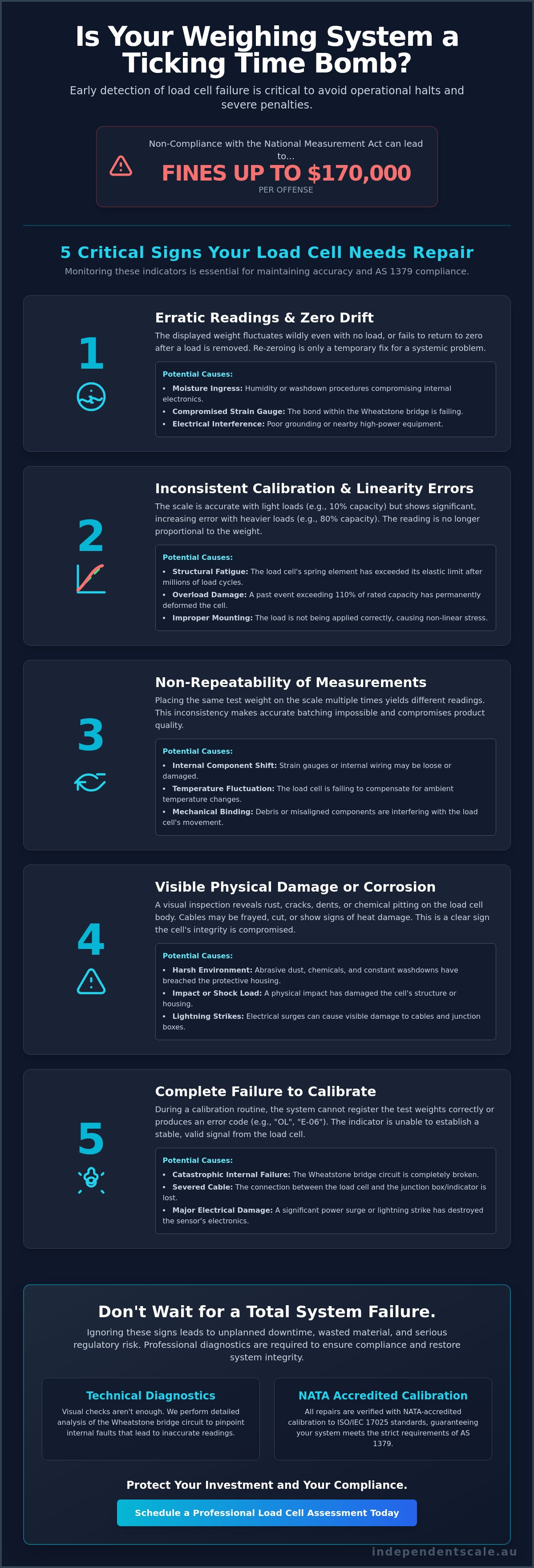
5 Critical Signs Your Load Cell Needs Immediate Repair
Diagnostic accuracy is paramount in high-volume industrial weighing. Most operators notice general scale errors first, but the root cause is often the transducer itself. Identifying the signs you need load cell repair before a total system halt is the difference between a scheduled maintenance window and an emergency shutdown. Relying on visual checks alone is insufficient. You must monitor the electrical and functional performance of the system to catch faults that compromise your AS 1379 compliance. Prioritising these repairs based on the severity of reading drift protects your equipment from catastrophic failure.
Erratic Readings and Zero Drift
If numbers on your digital indicator fluctuate constantly without a load present, you're likely dealing with internal bridge instability. Zero drift occurs when the system fails to return to its tare or zero balance after a load is removed. This often indicates moisture ingress or a compromised strain gauge bond. While some operators attempt to simply re-zero the scale, this is a temporary fix for a deteriorating component. Technical signs that your load cell might require servicing include "hunting" for a stable weight or sudden, large jumps in displayed values that don't correspond to actual material movement.
Calibration Inconsistency and Linearity Errors
A common sign of mechanical failure is a scale that calibrates perfectly at 10% capacity but shows significant error at 80% capacity. This is known as a linearity error. It suggests the load cell's spring element has exceeded its elastic limit or is suffering from internal fatigue. Never attempt to use software offsets to mask these hardware failures. Doing so compromises the integrity of your batching and risks non-compliance with Australian standards. If your system requires frequent recalibration to stay within tolerance, the hardware is likely failing. A professional diagnostic assessment can identify if the cell's output remains proportional to the applied load across the full weighing range.
Physical Deformation and Visual Damage
A visual inspection should be part of every daily maintenance routine, though it cannot replace electrical testing. Look for buckling in the load cell body or cracks in the protective potting material. Corrosion on cable entries or junction boxes can lead to signal degradation and short circuits. Shock loading, often caused by dropping heavy materials into a hopper too quickly, can permanently deform the metal. If you see physical signs of impact, severe rust, or cables with frayed shielding, the internal Wheatstone bridge is almost certainly compromised. These physical indicators are late-stage warnings that often lead to immediate system rejection during a NATA-accredited inspection.
Technical Diagnostics: Identifying Faulty Bridge Circuits
Technical diagnostics move beyond visual inspection to measure the electrical integrity of the internal Wheatstone bridge circuit. While visual checks identify external trauma, they cannot detect internal bond failures or moisture-induced signal degradation. High-precision multimeters are required to perform these tests accurately. By quantifying electrical shifts, you can identify the signs you need load cell repair before the system fails an audit or causes a production halt. Interpreting these results correctly determines whether a component can be refurbished or if a full load cell replacement is mandatory for safety and compliance.
Bridge Resistance and Tap Testing
The first diagnostic step involves measuring input and output resistance. Most standard industrial load cells operate with a resistance of 350 ohms or 700 ohms. You should consult the manufacturer’s datasheet for the specific nominal values of your equipment. If your multimeter shows a deviation of more than 2 ohms from the specification, the internal bridge is likely compromised. Our technicians also employ a "tap test" during live signal monitoring. By gently tapping the load cell with a rubber mallet, we can identify intermittent signal breaks. If the display on your indicator jumps erratically during this test, it confirms a loose internal connection or a debonded strain gauge.
Insulation Resistance and Zero Balance Checks
Insulation resistance testing measures the "leakage" between the bridge circuit and the load cell housing. Using a megohmmeter, a technician checks for resistance values; anything below 5000 MΩ usually indicates moisture ingress or chemical contamination. Another critical metric is the zero balance shift. This is the output of the cell at zero load. If this value has shifted by more than 1% of the rated output, it indicates permanent physical deformation of the spring element. We also monitor for "creep," where the signal gradually changes while a static load is applied. Creep is a definitive sign of failing adhesive bonds within the sensor. When these technical thresholds are exceeded, professional load cell repair or replacement is the only way to restore your system to AS 1379 accuracy levels.
Repair vs. Replacement: Making the Strategic Choice
Choosing between refurbishment and new equipment depends on a rigorous analysis of technical viability and long-term compliance. While professional repair can cost as little as one-fifth of the replacement price when the main structure is intact, this isn't always the most strategic path. You must weigh the immediate savings against the potential for recurring downtime. In an industry where NMI fines reach $170,000 for measurement inaccuracies, the cost of a new sensor is often negligible compared to the risk of non-compliance with AS 1379. The decision is binary: either the component can be certified to ISO/IEC 17025 standards or it cannot.
Downtime is the primary variable in your financial equation. If a custom-engineered load cell has a 12-week lead time, an immediate repair is the only way to maintain production. Conversely, for standard components like a 5000 kg capacity C5 stainless steel cell, which costs approximately $950 AUD, replacement is often more efficient than extensive laboratory repair. Evaluating the age of your weighing system is also critical. If you've identified signs you need load cell repair on a system nearing the end of its 12,000,000 cycle lifespan, replacing the entire set of sensors ensures uniform performance and prevents "cascading" failures where cells fail one after another.
When to Opt for Professional Repair
Repair is the preferred route when the fault is external to the high-precision spring element. Minor cable damage, frayed shielding, or compromised connector pins can be addressed without replacing the transducer. Technicians often find that a suspected load cell fault is actually an issue with a conditioner or transmitter. In these cases, restoring the signal path is faster and more cost-effective than removing heavy mechanical assemblies. Repair is also viable for high-capacity weighbridge cells where the primary structure remains within its elastic limit but requires a new environmental seal or internal moisture removal.
When Replacement is Mandatory
Replacement becomes mandatory when the cell's physical integrity is compromised. If the metal body shows a permanent "set" or deformation, the Wheatstone bridge will never return to a linear output. Hermetic seal failure is another deal-breaker; once moisture causes internal corrosion on the strain gauge grid, the component is technically beyond salvage. As a general rule, if the total cost of diagnostic testing, repair, and NATA-accredited calibration exceeds 60% of a new load cell supply, we recommend a full replacement to guarantee long-term reliability. Request a technical assessment to determine the most compliant path for your facility.
Professional Load Cell Repair and NATA Calibration
Independent Scale Service (ISS) brings over 30 years of technical expertise to every industrial weighing challenge. We currently service 98% of concrete plants across Sydney, providing a level of reliability that only comes from decades of field experience. While previous sections detailed the technical signs you need load cell repair, the ultimate goal is restoring your system to a state of total accuracy and legal compliance. We don't just fix hardware; we provide the certification required to keep your plant operational under the strict National Measurement Guidelines 2026. Our technicians integrate every repair with concrete batching plant calibration to ensure your facility meets AS 1379 standards without exception. This methodical approach is why the largest players in the Australian infrastructure sector trust us with their critical weighing assets.
NATA Accredited Testing and Certification
Accreditation to ISO/IEC 17025 is the benchmark for technical competence in calibration laboratories. A standard repair might restore a reading, but only a NATA-accredited service provides the traceability required for legal-for-trade applications. This documentation is essential for your quality management system and protects your business during regulatory audits. We use the gravimetric method calibration and high-precision test weights to verify that every load cell in your summing circuit is performing within specified tolerances. Our experts examine everything from the junction boxes and surge arrestors to the final digital output. This level of rigor ensures that your "Legal for Trade" certification remains valid, preventing the risk of NMI fines that can reach $170,000 per offense.
Minimising Downtime with Emergency Support
Industrial failure doesn't follow a schedule. That's why ISS maintains a relentless focus on responsiveness through our 24/7 emergency support network. We understand that every hour of plant downtime results in wasted materials and missed delivery windows for major clients like Boral, Hanson, or Holcim. Our technicians provide on-site fault diagnosis across Sydney, Melbourne, and regional Australia, arriving equipped with the diagnostic tools and load cell supply necessary for immediate resolution. We don't just identify the problem; we implement the solution, whether it involves replacing a faulty sensor or recalibrating a hopper. We prioritise rapid intervention to ensure your weighing system returns to service with minimal delay and maximum accuracy. Facing erratic readings or system instability? Contact Independent Scale Service for 24/7 emergency repair to secure your plant's accuracy and compliance.
Securing Long-Term Plant Accuracy and Regulatory Compliance
Maintaining high-precision weighing systems requires more than reactive maintenance. You've learned that identifying technical signs you need load cell repair, such as zero drift or bridge resistance shifts, is the only way to prevent costly batching errors. Professional intervention ensures your facility remains compliant with AS 1379 and the National Measurement Guidelines 2026. Independent Scale Service brings over 30 years of experience servicing 98% of concrete plants across Sydney, providing the technical depth needed to diagnose complex faults and restore system integrity.
Don't let inaccurate measurements put your NATA accreditation at risk. Our team delivers specialized expertise in force measurement and industrial weighing, backed by 24/7 emergency support to minimize your downtime. We ensure every repair meets NATA accreditation to ISO/IEC 17025 standards, providing the documented proof of accuracy your business requires. This methodical approach protects your operations from the $170,000 fines associated with non-compliant measurement equipment.
Get Expert Load Cell Repair & NATA Calibration Services to ensure your weighing systems remain precise and fully compliant.
Frequently Asked Questions
Can a load cell be repaired if it has been overloaded?
A load cell cannot be repaired if the metal spring element has exceeded its elastic limit. Overloading beyond 110% of rated capacity often causes permanent physical deformation. If diagnostic testing shows a permanent zero balance shift or non-linear output, the structural integrity is compromised. In these instances, replacement is the only compliant solution to maintain AS 1379 standards.
How much does it cost to repair an industrial load cell?
Repair costs typically average one-fifth of the price of a new unit, provided the main structure remains intact. For example, replacing a 5000 kg capacity C5 stainless steel load cell costs approximately $950 AUD, making refurbishment a viable option for high-value custom sensors. Precise costs require a technical assessment to identify if the fault lies in the cable, connector, or internal bridge.
What is the average lifespan of a load cell in a concrete plant?
Most industrial load cells are engineered to handle between 10,000,000 and 12,000,000 load cycles. In the high-vibration environment of a concrete plant, abrasive dust and moisture can reduce this effective lifespan. Regular inspections help identify the signs you need load cell repair before the sensor reaches its mechanical fatigue limit.
How do I test a load cell with a multimeter?
You test a load cell by measuring the bridge resistance across the input and output wires using a high-precision multimeter. Standard industrial cells should return values near 350 or 700 ohms, depending on the manufacturer's specification. You must also perform an insulation resistance test with a megohmmeter; values below 5000 MΩ indicate moisture ingress or internal short circuits that require professional intervention.
What causes zero drift in a weighing system?
Zero drift is primarily caused by moisture entering the sensor housing or the strain gauge adhesive bond failing. Environmental factors such as rapid temperature shifts or chemical exposure also contribute to this instability. If your indicator doesn't return to zero after a load is removed, it's one of the primary signs you need load cell repair and indicates internal bridge instability.
Is it better to repair or replace a faulty load cell?
Replacement is usually the more strategic choice if repair costs exceed 60% of the new unit price. For standard components like an S-type tension load cell starting from $605 AUD, the labor involved in laboratory repair often outweighs the cost of a new, warrantied part. However, for specialized or high-capacity units with long lead times, professional repair is essential to minimize plant downtime.
How often should load cells be calibrated to avoid failure?
AS 1379 recommends regular intervals, often every six months, for concrete plants to maintain accuracy. Frequent calibration allows technicians to detect subtle performance shifts early, preventing the sudden system failures that lead to material wastage and regulatory fines. Consistent monitoring ensures your weighing system remains compliant with the National Measurement Act.
Does a repaired load cell need a new NATA certificate?
Yes, any professional repair must be followed by NATA-accredited calibration to ISO/IEC 17025 standards. A repair changes the electrical characteristics of the system, which voids any previous certification. Obtaining a new NATA certificate provides the legal traceability and proof of accuracy required to avoid NMI fines that can reach $170,000 per offense.
