


30MPa Mix Ratio: The Technical Reference for High-Strength Concrete Compliance
Relying on a traditional volume-based "recipe" for high-strength concrete is a gamble that frequently leads to structural failure and failed NATA inspections. Achieving a compliant 30mpa mix ratio requires a shift from approximate buckets to precision weight-based batching. You likely understand that consistency is the biggest hurdle on any industrial site, especially with the introduction of the updated AS 1379:2026 standards and the NCC 2025. Inconsistent batch quality isn't just a technical error; it's a liability that threatens the structural integrity of your project and the reputation of your firm.
This technical reference provides the exact proportions and weighing standards you need to master 30MPa compressive strength. You'll learn how to align your operations with the latest Australian construction regulations to ensure every pour passes inspection without delay. We'll break down the critical relationship between weight precision and concrete performance while outlining the calibration protocols necessary to eliminate batching errors. By the end of this guide, you'll have a clear framework for maintaining compliance and achieving repeatable, high-strength results that stand up to regulatory scrutiny.
Key Takeaways
- Identify the specific performance requirements for 30MPa concrete used in heavy-duty structural slabs and reinforced foundations.
- Learn why the nominal 1:1.5:3 30mpa mix ratio is a baseline that requires weight-based adjustments to meet strict engineering specifications.
- Understand the mandatory sampling and cylinder testing protocols required by the AS 1379:2026 standard to verify compressive strength.
- Recognize how load cell drift and uncalibrated batching equipment lead to lean mixes and compromised structural integrity.
- Master troubleshooting strategies for failed strength tests by addressing ambient temperature variables and precision measurement errors.
What is 30MPa Concrete and Why is the Mix Ratio Critical?
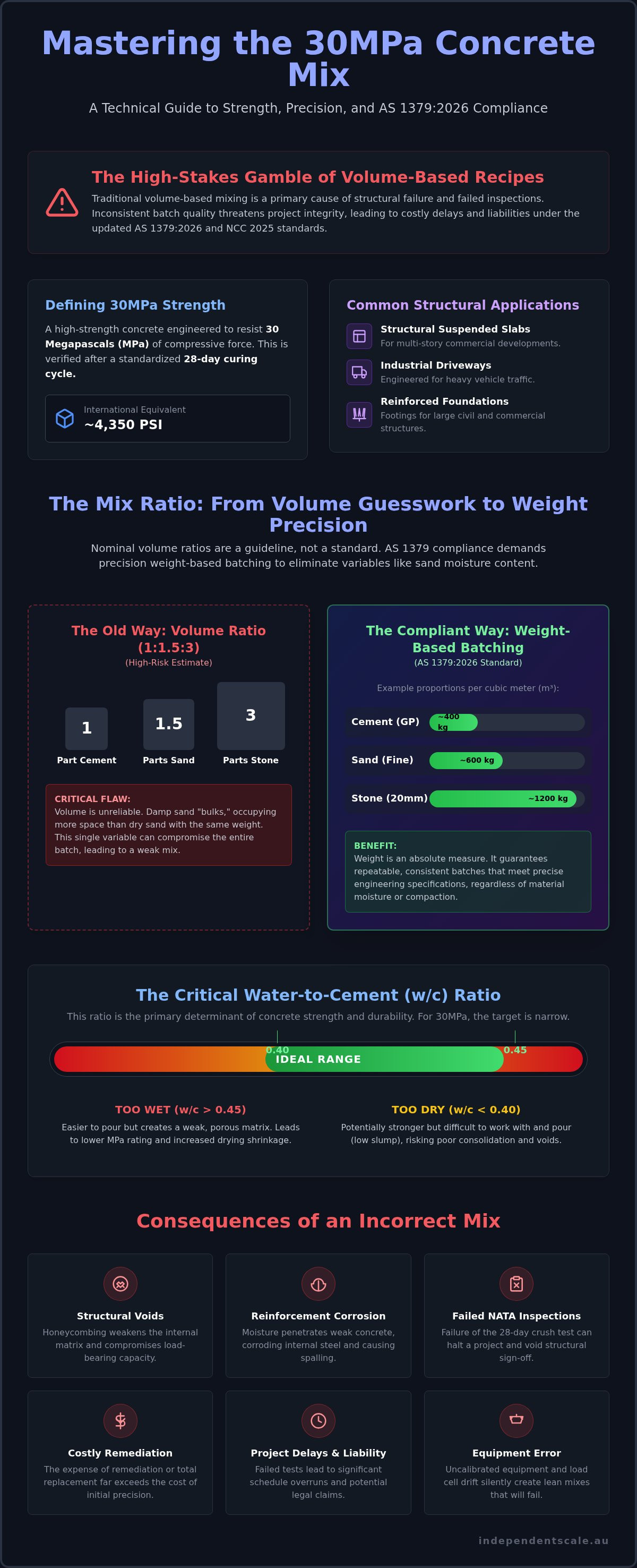
30MPa concrete is a high-strength material engineered to resist 30 Megapascals (MPa) of pressure when subjected to a compressive strength test after a standardized 28-day curing cycle. In the Australian construction sector, achieving the correct 30mpa mix ratio is a non-negotiable requirement for structural integrity. This specific grade provides the necessary durability for demanding applications, representing the "sweet spot" for many engineers because it offers superior load-bearing capacity without the extreme costs of ultra-high-strength mixes. Common applications include:
- Structural suspended slabs in multi-story developments.
- Industrial driveways designed for heavy vehicle traffic and machinery.
- Reinforced foundations and footings for commercial and civil structures.
The strength of this concrete isn't accidental; it relies on the physics of the binder-to-aggregate bond. If the ratio of cement paste to stone and sand is off by even a small percentage, the internal matrix weakens. This leads to a finished product that cannot handle the specified design loads. For serious industrial projects, relying on volume-based estimates is insufficient. Precision is required to ensure the mix meets the performance standards set by the NCC 2025 and AS 1379:2026.
MPa vs. PSI: Understanding the Metrics
Metric standardization is the rule in Australia. While international equipment might display PSI (Pounds per Square Inch), local building codes exclusively use MPa. For reference, 30MPa converts to approximately 4,350 PSI. The 28-day threshold is the industry standard for verification because concrete gains the vast majority of its structural capacity within this first month. Testing earlier can provide indicators, but the 28-day crush test remains the only legal proof of compliance for structural sign-off.
The Consequences of an Incorrect 30MPa Ratio
An incorrect 30mpa mix ratio creates immediate and long-term risks. If the mix is too lean or the aggregate is poorly graded, you'll see honeycombing and internal structural voids. These defects allow moisture to penetrate, leading to carbonation and the eventual corrosion of internal steel reinforcement. Beyond physical failure, there are severe legal and insurance implications. If a slab fails a NATA-accredited strength test, the cost of remediation or total replacement is often compounded by project delays and liability claims. Ensuring your batching plant is calibrated to handle these precise ratios is the only way to mitigate these risks effectively and maintain compliance on-site.
The 30MPa Mix Ratio: Proportions for Cement, Sand, and Stone
In Australian construction, a nominal 30mpa mix ratio is often expressed by volume as 1:1.5:3. This translates to one part cement, one and a half parts fine aggregate (sand), and three parts coarse aggregate. While this serves as a field-ready guideline, it is rarely sufficient for AS 1379:2026 compliance. Reliable high-strength concrete requires a transition to weight-based batching. Volume measurements are susceptible to significant errors due to the "bulking" of sand; damp sand occupies significantly more space than dry sand, even if the actual mass remains identical.
Adjusting for moisture content is a critical step in the batching process. If sand contains 5% moisture by weight, that water must be subtracted from the total design water to maintain the intended water-cement ratio. Aggregate size also dictates performance. A 20mm stone is the standard choice for most structural slabs, providing a robust skeleton for the mix. In contrast, 10mm aggregate is reserved for heavily reinforced sections where flow between tight rebar is necessary. Choosing the wrong aggregate size can lead to segregation or poor consolidation, both of which compromise the 28-day strength result.
The Water-Cement Ratio (w/c) for 30MPa
The ideal water-cement (w/c) ratio for 30MPa concrete typically falls between 0.40 and 0.45. Maintaining this narrow window is essential for balancing workability with ultimate compressive strength. Excess water creates microscopic pores that weaken the concrete matrix. While a higher slump makes the concrete easier to pour, it inevitably leads to a lower MPa rating and increased drying shrinkage. Engineers must specify the target slump to ensure the mix remains pumpable without sacrificing structural integrity.
Admixtures and Enhancements
Modern high-strength mixes frequently incorporate chemical admixtures and supplementary cementitious materials (SCMs). Water-reducing agents or plasticizers allow for a workable slump without compromising the w/c ratio. SCMs like fly ash or ground granulated blast-furnace slag (GGBS) enhance long-term strength and chemical resistance, often proving more durable than pure cement mixes. For precise dosing of these components, industrial facilities rely on tank silo weighing assemblies to monitor storage levels and batching accuracy. Ensuring your batching plant maintains these precise tolerances requires regular NATA-accredited calibration to prevent costly strength failures and ensure compliance with the NCC 2025.
Engineering 30MPa for AS 1379 Compliance
Engineering a compliant 30mpa mix ratio requires strict adherence to AS 1379:2026, the primary Australian Standard governing the specification and supply of concrete. This regulation ensures that structural concrete meets the designer's intent through rigorous manufacturing controls. Under Australian law, batching equipment must maintain precise accuracy tolerances. Typically, cement and aggregates require a mass accuracy of ±2%, while water and chemical admixtures must be within ±1% to ±3% depending on the specific batch volume. If these thresholds aren't met, the structural integrity of the entire project is at risk.
Verification of these proportions occurs through standardized sampling and testing. Field technicians cast concrete cylinders on-site, which are then transported to a laboratory for curing. These cylinders undergo compressive testing at 7 and 28 days to verify they meet the 30MPa requirement. Documentation is equally critical. Every load delivered must be accompanied by a batch docket that records the precise quantities of all ingredients, the time of batching, and any on-site additions. These dockets form the legal evidence required for structural sign-off by engineers and building certifiers.
Slump Testing and Workability
Standard structural pours for 30MPa concrete generally target a slump range of 80mm to 100mm. Achieving this workability while maintaining strength is a delicate balance. In Australia, high ambient temperatures and wind can rapidly accelerate water loss on-site, leading to a loss of slump. However, adding water at the tailboard to regain workability is a common error that dilutes the cement paste and lowers the final MPa result. Reliable slump starts with weighing accuracy at the plant, ensuring the initial water-cement ratio is perfectly calibrated before the truck leaves the yard.
NATA Accreditation in Concrete Production
Government and tier-1 infrastructure projects mandate that all concrete testing and batching plant calibrations are performed by NATA-accredited facilities. This accreditation ensures the laboratory or service provider adheres to ISO/IEC 17025, providing a globally recognized benchmark for technical competence. Utilizing a Concrete Batching Plant Calibration service that understands these regulatory markers is essential for maintaining compliance and passing mandatory site inspections. Choosing a supplier that meets these standards minimizes the risk of non-conformance reports and expensive structural remediation.
The Role of Precision Weighing in 30MPa Production
Achieving a compliant 30mpa mix ratio is impossible using volume-based batching methods like buckets or wheelbarrows. While these methods might suffice for non-structural garden paths, they are unsuitable for industrial 30MPa requirements. Volume measurements fail because they don't account for the variable density of aggregates or the bulking of sand. Precision weighing is the only method that satisfies the mass accuracy requirements of AS 1379. Engineering data indicates that a minor 2% error in weighing cement or water can lead to a disproportionate 10% drop in final compressive strength. This discrepancy frequently results in site-cast cylinders failing their 28-day crush tests, triggering expensive structural audits and project delays.
Consistent batching relies entirely on the integrity of the hopper and silo weighing systems. If a hopper isn't calibrated, the cumulative error across multiple batches leads to significant material wastage or a dangerously lean mix. For high-strength concrete, the 30mpa mix ratio is sensitive to even minor weighing inaccuracies. Precision isn't just about following a recipe; it's about ensuring the structural reliability of the finished slab and maintaining the reputation of the supplier.
Load Cells: The Heart of the Batching Plant
Load cells are the primary sensors responsible for measuring cement, water, and aggregates with high precision. In a batching environment, these components are subjected to constant vibration, dust, and moisture, which leads to load cell fatigue and signal drift. If you notice inconsistent batch weights or "ghosting" on the digital indicator, it's likely time to inspect your Industrial Load Cells for environmental damage or mechanical wear. Replacing compromised sensors is a critical maintenance step to prevent batching errors that compromise the concrete's MPa rating.
Calibration Frequency and Maintenance
AS 1379:2026 specifies strict calibration intervals for all weighing systems used in concrete production. It's a common mistake to confuse "zeroing" a scale with a full NATA-accredited calibration. Zeroing simply clears the tare weight, while a professional Hopper Calibration Service verifies the accuracy and linearity of the scale across its entire operating range using certified test weights. Regular calibration ensures your plant remains compliant with ISO/IEC 17025 standards and provides the documented proof required for structural sign-off.
To avoid non-compliance and ensure every batch meets engineering specifications, schedule your NATA-accredited batching plant calibration today.
Troubleshooting 30MPa Mixes: Why Strengths Fail
When a 28-day cylinder test fails to reach the 30MPa threshold, the investigation must be methodical. While site-based contractors often focus on curing conditions, the root cause is frequently found at the batching plant. A failure to achieve the intended 30mpa mix ratio usually stems from one of three technical oversights:
- Weighing Equipment Drift: Uncalibrated scales produce lean mixes. If the cement scale over-reads, the plant delivers less binder than the design requires, compromising the structural matrix.
- Thermal Acceleration: High ambient temperatures in Australia accelerate hydration. This rapid set prevents the formation of a dense crystalline structure, resulting in lower ultimate strength.
- Poor Aggregate Grading: If the particle size distribution is inconsistent, the concrete's density suffers. This creates internal voids that act as stress concentrators under load.
Rectifying a low-strength result requires a forensic mix analysis. This involves reviewing batch dockets against the engineering specification and conducting core tests on the hardened concrete to determine the actual cement-to-aggregate proportions. If the analysis reveals a 30mpa mix ratio that was technically correct on paper but failed in practice, the focus must shift to the accuracy of the batching equipment itself.
Identifying Weighing Errors on the Batch Floor
Operators must monitor for discrepancies between the theoretical mix design and the actual mass recorded on batch dockets. Even minor deviations in water or cement mass indicate a calibration issue. Utilizing precision indicators and displays allows for the detection of these real-time errors during the batching cycle. It's critical to identify these discrepancies early to prevent the delivery of non-compliant loads. Check load cell mounting for mechanical binding if weights fluctuate.
The Importance of Regular System Audits
Shifting from reactive repair to proactive calibration is essential for maintaining AS 1379 compliance. Independent Scale Service specializes in minimizing downtime during plant audits by identifying drifting sensors and mechanical wear before they lead to structural failure. These audits provide the NATA-accredited documentation required to prove your facility's technical competence and ensure that every batch meets the required structural standards. For a deeper understanding of regulatory requirements and precision measurement, consult Calibration Services: The Authoritative Guide.
Securing Structural Integrity Through Precision Batching
Achieving a compliant 30MPa compressive strength isn't a matter of guesswork; it's a technical requirement dictated by the AS 1379:2026 standard. You've learned that a nominal 30mpa mix ratio is only the baseline for production. True structural reliability depends on the precision of your weighing equipment and the mitigation of environmental variables like moisture and temperature. Moving beyond volume-based estimates to NATA-accredited weight precision is the only way to ensure your project meets the rigorous standards of the NCC 2025.
Independent Scale Service provides the technical expertise required to keep your batching plant operational and compliant. As specialists in AS 1379 standards, we're NATA accredited to ISO/IEC 17025, serving Sydney, Melbourne, and regional Australia. Don't risk structural failure or failed inspections due to uncalibrated equipment. Request a NATA-Accredited Concrete Plant Calibration Service to secure your project's integrity and minimize downtime. With the right technical support, you'll achieve consistent, high-strength results on every pour.
Frequently Asked Questions
What is the 1:2:3 mix ratio for 30MPa?
The 1:2:3 ratio is a traditional volume-based recipe representing one part cement, two parts sand, and three parts stone. While this ratio is often cited for general construction, it typically results in a strength closer to 20 or 25MPa rather than a true 30MPa rating. For structural compliance, a more precise 30mpa mix ratio like 1:1.5:3 by weight is required to ensure the binder-to-aggregate bond meets AS 1379:2026 specifications.
Can I achieve 30MPa strength by mixing concrete by hand?
Achieving a verified 30MPa through hand mixing is extremely difficult and isn't recommended for structural applications. Manual mixing lacks the consistency needed to ensure uniform distribution of cement paste and aggregates throughout the batch. Without the mechanical shear provided by a batching plant or truck mixer, you risk internal voids and inconsistent strength. For projects requiring NATA-accredited verification, machine-mixed concrete from a calibrated plant is a mandatory requirement for sign-off.
How much water is needed for a 30MPa concrete mix per bag of cement?
A standard 30MPa mix requires approximately 18 to 22 litres of water per 40kg bag of cement to maintain the structural integrity. This volume keeps the critical water-cement (w/c) ratio at 0.45 or lower. You must adjust this amount based on the moisture content of your aggregates. Excess water is the primary cause of strength loss; even a few extra litres can drop the final MPa rating below the threshold specified in the NCC 2025.
Why is my 30MPa concrete cracking during the curing process?
Cracking in high-strength concrete is often caused by plastic shrinkage or thermal contraction during the hydration phase. 30MPa mixes have a higher cement content, which generates more heat as the concrete sets. If the surface dries too quickly due to wind or high ambient temperatures, internal stresses cause visible cracks. Proper curing through moisture retention or chemical membranes is essential to manage these thermal effects and maintain the long-term structural integrity of the slab.
How often should a concrete batching plant be calibrated for 30MPa supply?
AS 1379:2026 requires that weighing systems in concrete batching plants undergo calibration every six months to ensure accuracy. You should also perform a full NATA-accredited audit after any major equipment repair or if you notice inconsistencies in batch weights. Frequent calibration is the only way to guarantee that your 30mpa mix ratio remains accurate and compliant with ISO/IEC 17025 standards, preventing costly non-conformance reports and structural failures on-site.
What is the difference between 25MPa and 30MPa concrete mix ratios?
The primary difference lies in the cement content and the specific water-cement ratio used during batching. A 30MPa mix contains more cement per cubic metre than a 25MPa mix, typically requiring a 1:1.5:3 ratio instead of 1:2:4. This increased binder density allows the concrete to withstand higher compressive loads. Additionally, 30MPa mixes require stricter control over aggregate grading and weighing precision to ensure the finished material meets the higher performance specifications.
Does the type of sand used affect the 30MPa strength rating?
Sand quality directly impacts the compressive strength of the concrete matrix and the overall durability of the pour. Using sand with high silt or clay content weakens the bond between the cement paste and the coarse aggregates. For a compliant 30MPa result, you must use well-graded, washed river sand or manufactured sand that meets Australian standards. Poorly graded sand increases the water demand, which inevitably lowers the final strength and increases the risk of shrinkage.
