


24/7 Weighbridge Support Australia: Ensuring Industrial Compliance and Continuity
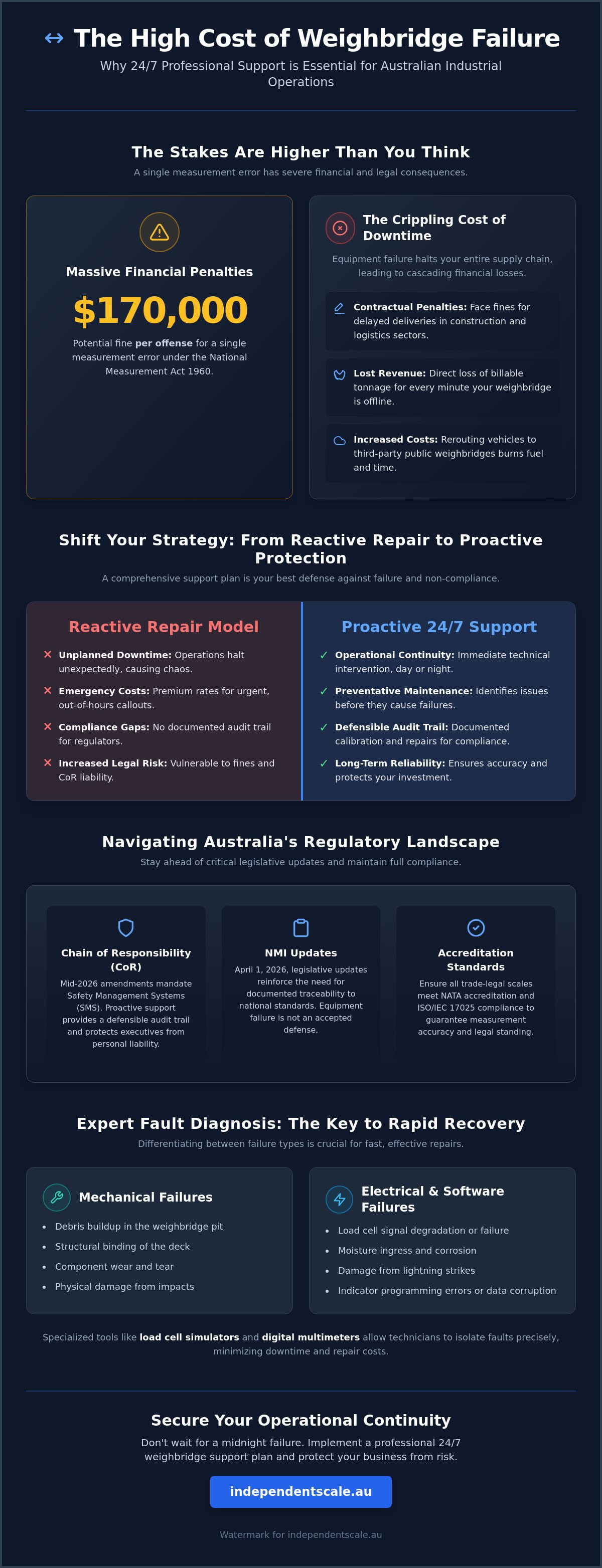
A single measurement error on your weighbridge can result in fines of up to $170,000 per offense under the National Measurement Act 1960. When equipment fails at midnight during a high-priority project, the stakes involve more than just lost time; they involve your entire legal standing. Securing professional 24/7 weighbridge support Australia ensures that your facility doesn't grind to a halt when a load cell malfunctions or a system error occurs outside of standard business hours.
It's clear that you prioritize precision and strict regulatory adherence to protect your business from the mid-2026 Chain of Responsibility amendments. This article outlines how professional support protects your operations from costly downtime and legal compliance risks across the country. We'll preview the technical requirements for rapid restoration of weighing accuracy and the necessity of documented audit trails. You'll discover how to navigate the April 2026 National Measurement Institute updates while ensuring the long-term reliability of your load cell systems, concrete batching plants, and industrial weighing infrastructure.
Key Takeaways
- Understand the financial risks of weighbridge downtime and how immediate technical intervention protects operational continuity in logistics and mining.
- Differentiate between electrical and mechanical system failures using specialized diagnostic tools to accelerate emergency response times and site recovery.
- Ensure equipment meets National Measurement Institute requirements by prioritizing NATA accreditation and ISO/IEC 17025 compliance for all trade-legal scales.
- Learn how to transition from a reactive repair model to a proactive strategy through comprehensive 24/7 weighbridge support Australia and preventative maintenance agreements.
- Identify the technical requirements for maintaining accuracy in specialized environments, including concrete batching plants and high-capacity industrial sites across Sydney and Melbourne.
The Critical Necessity of 24/7 Weighbridge Support in Australia
Industrial facilities operating at high capacity require constant operational availability. 24/7 weighbridge support Australia provides immediate technical intervention for critical weighing infrastructure. In the mining and logistics sectors, a single hour of downtime can stall an entire supply chain. This service ensures that load cell failures or software glitches don't cause terminal bottlenecks. Professional support is not just about repairs; it's about maintaining the technical integrity of systems that facilitate millions of dollars in trade every day.
Just-in-Time (JIT) supply chain models rely on precision timing. If a weighbridge is offline, vehicles cannot be legally dispatched or received. This triggers a cascade of delays affecting turnaround times and inventory management. Site managers must maintain continuous uptime to meet contractual obligations and safety standards. Without round-the-clock technical availability, a minor component failure at midnight can result in a complete site shutdown until the next business day.
The High Cost of Inaccuracy and Downtime
Calculating revenue loss starts with the volume of throughput. High-capacity sites processing hundreds of tonnes daily face massive financial exposure if weighing stops. Inaccurate data is equally dangerous. It leads to vehicle turnaround delays and complicates driver fatigue management. If overloaded vehicles leave a site without accurate measurement, the business faces severe liability. Regular weighing scale calibration and rapid response times are essential to prevent these financial leaks. Key impacts include:
- Direct loss of billable tonnage during equipment outages.
- Contractual penalties for delayed deliveries in the construction and concrete sectors.
- Increased operational costs due to rerouting vehicles to third-party public weighbridges.
Chain of Responsibility (CoR) and Legal Compliance
Under the National Measurement Act 1960, measurement errors can result in fines up to $170,000 per offense. The National Heavy Vehicle Regulator (NHVR) does not accept equipment failure as a valid defense for overloading or non-compliance. Mid-2026 amendments to the Heavy Vehicle National Law (HVNL) mandate the use of Safety Management Systems (SMS) to manage transport risks. Documenting immediate repair efforts and maintaining a strict schedule for load cell calibration provides a defensible audit trail. 24/7 weighbridge support Australia ensures that your facility remains compliant with the April 1, 2026, NMI legislative updates, which reinforce the necessity for documented traceability to national standards. Proactive technical support is a core component of meeting your legal obligations and protecting your executive team from personal liability under CoR laws.
Technical Fault Diagnosis: Beyond Basic Scale Repair
Effective 24/7 weighbridge support Australia requires a methodical approach to differentiating between electrical and mechanical failures. Mechanical issues often involve debris buildup in the pit or structural binding of the deck. Electrical faults are typically more complex, involving signal degradation or component failure within the circuit. Emergency response teams use specialized diagnostic tools, such as load cell simulators and digital multimeters, to isolate faults without unnecessary disassembly. This precision prevents extended downtime and avoids the cost of replacing functional components.
Modern weighing systems rely on sophisticated indicators. Programming errors or corrupted calibration data can render a system useless even if the hardware is intact. Expert technicians must possess deep knowledge of specific indicator protocols to restore functionality quickly. If the system software fails, the entire site's data integrity is compromised, making expert programming knowledge a requirement for any emergency technician.
Harsh Australian conditions present unique challenges that standard maintenance might miss. Lightning strikes can fry sensitive electronics instantly, while moisture ingress is a persistent threat in high-humidity regions. Debris accumulation under the deck can lead to non-linear weighing results that are difficult to diagnose without a physical inspection. These environmental factors necessitate a technical response that looks beyond the obvious symptoms to find the root cause of the error.
Load Cell Failure and Replacement
Identify drifting weights or "err" messages on the display as primary indicators of load cell failure. Drifting occurs when a sensor no longer returns to zero or provides inconsistent readings under the same load. It's critical to use high-quality load cells for replacements to ensure long-term stability and NMI compliance. Technicians test for signal integrity by measuring millivolt output and checking for insulation resistance. Structural damage, such as hairline cracks or corrosion, often necessitates immediate replacement to prevent total system failure and ensure the safety of the weighing platform.
Junction Box and Signal Conditioning Issues
Intermittent faults often trace back to moisture ingress in junction boxes. Even a small amount of condensation can bridge terminals and cause signal fluctuations. For high-precision data relay, the use of conditioners and transmitters is necessary to maintain signal strength over long cable runs. After storm events, troubleshooting surge arrestors is a priority. These components are designed to sacrifice themselves to protect the main indicator, but a failed arrestor will break the circuit. If you encounter persistent signal instability, evaluating your weighbridge accessories for wear and tear is a logical next step to prevent future outages.
Compliance Standards: NATA and Trade-Legal Requirements
Technical repairs are only one half of the recovery process. Professional 24/7 weighbridge support Australia ensures that every intervention meets the rigorous standards set by the National Measurement Institute (NMI). If a technician replaces a load cell or adjusts a calibration setting, the instrument is legally "unverified" until a formal re-verification occurs. Operating a weighbridge for trade without this verification is a direct violation of the National Measurement Act 1960. Compliance requires a systematic approach that combines rapid repair with immediate legal certification to prevent regulatory exposure.
Maintaining a digital audit trail of all support activities is essential for modern Safety Management Systems. This documentation proves that the business took all reasonable steps to maintain measurement accuracy, providing a defense against Chain of Responsibility (CoR) claims. Every calibration, repair, and verification event must be recorded with traceable data back to national standards. This level of transparency is non-negotiable for industrial clients who face regular audits from the NMI or third-party accreditation bodies.
ISO/IEC 17025 Accreditation Explained
ISO/IEC 17025 is the international standard for the competence of testing and calibration laboratories. NATA accreditation to this standard signifies that a service provider has the technical proficiency and equipment to deliver accurate measurement results. This accreditation ensures that calibration certificates are recognized nationally and provide a high level of confidence in the reported measurement uncertainty. For a deeper analysis of these requirements, consult our comprehensive Calibration Services guide. Utilizing NATA-accredited services ensures that your weighing data stands up to legal scrutiny and satisfies the quality management requirements of major corporate contracts.
Trade-Legal Verification (Section 18VV)
A weighbridge used for trade must be re-verified by a licensed technician immediately after any repair, modification, or relocation that could affect its accuracy. Verification is not the same as a standard calibration; it is a legal certification that the device meets the specific requirements of the National Trade Measurement Regulations 2009. Using a non-verified scale for commercial transactions can lead to fines of up to $170,000 per offense. Section 18VV of the National Measurement Act 1960 mandates that a trade-approved weighbridge must be re-verified by a licensed technician after any repair or adjustment before it can be legally returned to service. This requirement ensures that neither the buyer nor the seller is disadvantaged by equipment inaccuracy, maintaining the integrity of the Australian marketplace.
When selecting 24/7 weighbridge support Australia, verify that the technicians hold the appropriate licenses to perform Section 18VV verifications. Without this capability, your site remains legally compromised even after the physical repair is complete. Consistent adherence to these standards protects your revenue and your corporate reputation.
Emergency vs. Preventative: Structuring Your Support Plan
Relying exclusively on a reactive "break-fix" model is a high-risk strategy for industrial facilities. While 24/7 weighbridge support Australia provides a necessary safety net for unexpected failures, the most efficient operations prioritize preventative maintenance. Transitioning to a proactive plan reduces the frequency of emergency call-outs and extends the service life of load cells and structural components. A structured support plan ensures that minor technical drifts are corrected before they escalate into total system shutdowns or legal compliance breaches.
Modern weighbridge support now incorporates remote monitoring capabilities. These systems track performance metrics in real-time, allowing technicians to identify signal fluctuations or zero-point drifting remotely. By analyzing these data trends, service providers can schedule interventions during planned site maintenance windows rather than during peak production hours. This shift from reactive to predictive maintenance is the benchmark for high-throughput logistics and mining sites across the country.
Developing a Maintenance Checklist
A robust preventative maintenance schedule includes frequent visual inspections for structural fatigue and deck clearance. Debris buildup in the pit or around the weighing assemblies can cause significant measurement errors by "binding" the deck. Technicians must also verify the functionality of indicators and displays to ensure data visibility and accuracy for operators. Cleaning protocols should be strictly enforced to prevent corrosive materials from damaging cables and junction boxes. For internal-use equipment, calibration checks are recommended every 6 to 12 months, though high-volume sites often require quarterly inspections to maintain peak performance.
Benefits of a Service Level Agreement (SLA)
A Service Level Agreement (SLA) provides a formal framework for your technical support. This document guarantees response times for emergency 24/7 weighbridge support Australia, ensuring a technician is on-site within a specified window. Beyond speed, an SLA provides priority access to critical spare parts, which is vital given current global supply chain fluctuations. This structured approach allows for predictable budgeting, as routine maintenance costs are fixed, unlike the volatile expenses associated with emergency repairs. Businesses that implement these agreements report higher equipment uptime and a more consistent audit trail for regulatory compliance.
Establishing a professional maintenance framework protects your capital investment and ensures long-term accuracy. To secure your site's operational continuity, you can arrange a comprehensive weighbridge calibration and maintenance audit today.
Industrial Weighbridge Support Across Sydney and Melbourne
Sydney and Melbourne represent the core of Australia's industrial and logistics activity. In these regions, transport networks and construction projects operate on 24-hour cycles, requiring constant infrastructure availability. Professional 24/7 weighbridge support Australia provides the necessary technical coverage to ensure these operations remain functional. With over 30 years of expertise in heavy industrial weighing, our service model understands the specific mechanical stresses placed on equipment in high-throughput environments. This experience allows for faster fault identification and more durable repair solutions compared to generalist scale technicians.
Regional Australian operations, particularly those in mining and large-scale agriculture, require a service partner capable of integrating with site-specific safety and operational protocols. Geographic reach is critical, but technical depth is more important. The focus remains on private infrastructure where accuracy directly impacts the bottom line. Unlike public weighbridge networks that serve individual drivers, industrial support targets the complex systems used by corporate clients to manage mass-volume trade and maintain regulatory compliance. Similarly, for specialized logistical needs such as residential or commercial relocations, you can learn more about Anspach Removals & Storage to ensure a professional and secure transition.
Specialized Concrete Plant Support
Concrete production is governed by strict regulatory frameworks. Maintaining AS 1379 compliance for concrete batching plant weighing is a technical requirement that cannot be overlooked. Inaccurate measurements at the batching stage lead to structural inconsistencies and wasted materials. You can read more in our Concrete Batching Plant Calibration guide to understand the specific verification cycles required. Support services extend beyond the main deck to include:
- Calibrating hoppers and silos to ensure high-volume production accuracy.
- Testing additive scales for precision measurement of chemical components.
- Verifying water meters and flow systems using the weighing method.
- Documenting all calibration events for quality assurance and audit purposes.
Requesting Emergency Support
Efficiency during a breakdown is determined by the quality of information provided during the initial contact. When requesting emergency 24/7 weighbridge support Australia, ensure you have the following details ready for the technical dispatch team:
- The make and model of the weighing indicator or terminal.
- Specific error codes or fault messages displayed on the screen.
- Current site conditions, including any recent storm events or debris buildup.
- Specific site access requirements and safety induction protocols for technicians.
Once the call is logged, NATA-accredited technicians are dispatched to the site with the necessary diagnostic tools and load cell components. This methodical approach minimizes the time between the initial fault and the restoration of trade-legal accuracy. Contact Independent Scale Service for immediate industrial weighing solutions and technical support across all major Australian hubs.
Secure Your Operational Continuity and Compliance
Maintaining measurement accuracy is a legal and financial necessity for heavy industry. We've established that failing to address technical faults immediately exposes your site to massive fines and safety risks under the latest Chain of Responsibility laws. Transitioning to a structured maintenance plan supported by NATA-accredited expertise ensures your infrastructure meets the rigorous requirements of ISO/IEC 17025 and AS 1379 standards. Professional 24/7 weighbridge support Australia is the only way to protect your supply chain from unpredictable equipment failures and the resulting site shutdowns.
Independent Scale Service provides technical proficiency across Sydney, Melbourne, and regional Australia. Our team is methodical and precise, ensuring every repair and calibration event is documented for audit trails. Don't risk your legal standing on unverified equipment or delayed response times. Contact Independent Scale Service for 24/7 Emergency Support to maintain your site's precision and legal standing. Protecting your revenue starts with reliable weighing infrastructure and a partner committed to your operational success.
Frequently Asked Questions
What is the difference between 24/7 support and a standard service call?
24/7 support provides immediate technical intervention outside of standard business hours to prevent total site shutdowns. While a standard service call is scheduled for the next available window during the day, 24/7 weighbridge support Australia guarantees a response time for critical failures at any hour. This ensures that high-capacity logistics and mining operations don't lose billable tonnage due to overnight equipment failure or software errors.
Does my weighbridge need to be NATA accredited for trade use in Australia?
NATA accreditation is not a legal requirement for trade measurement, but National Measurement Institute (NMI) verification is mandatory. NATA accreditation to ISO/IEC 17025 is the industry benchmark for technical proficiency and detailed measurement uncertainty analysis. Many tier-one corporate contracts and large-scale infrastructure projects mandate NATA-accredited calibration to satisfy their internal quality management systems and contractual safety requirements.
How often should a heavy-duty weighbridge be calibrated?
A trade-approved weighbridge must be verified by a licensed technician at least annually or immediately following any repair that could affect its accuracy. For internal-use scales or high-throughput sites, calibration checks are recommended every three to six months. Frequent checks help identify zero-point drifting and structural binding before they lead to significant measurement errors or non-compliance with the National Measurement Act 1960.
Can you repair load cells on-site during an emergency call-out?
Load cells are typically replaced rather than repaired on-site to maintain system accuracy and NMI compliance. Repairing the internal strain gauges of a load cell in a field environment is technically unfeasible and does not guarantee the required precision. Technicians carry a supply of high-quality replacement load cells to swap out failed units immediately, allowing the system to be re-calibrated and returned to service during the same visit.
What are the main causes of weighbridge failure in Australian conditions?
Environmental exposure is the leading cause of system failure in the Australian climate. Moisture ingress into junction boxes and lightning strikes during storm events frequently damage sensitive electronics and conditioners. Additionally, the accumulation of debris and silt in the weighbridge pit can bind the deck, leading to non-linear weighing results that require physical clearing and a structural inspection by a qualified technician.
How does 24/7 support help with Chain of Responsibility (CoR) compliance?
Immediate support ensures that weighing equipment remains accurate, which is a fundamental requirement of the Heavy Vehicle National Law. Under the 2026 Master Code, supply chain parties must implement Safety Management Systems to manage transport risks. 24/7 weighbridge support Australia provides the documented repair history and calibration data necessary to prove a business has taken all reasonable steps to prevent overloaded vehicles from entering public roads.
Are your technicians licensed to perform trade-legal re-verifications?
Licensed technicians must perform a Section 18VV re-verification before a trade-approved weighbridge can be legally returned to service after a repair. Using a non-licensed technician for repairs on trade-legal equipment leaves the business open to fines of up to $170,000 per offense under the National Measurement Act. Always verify that your service provider holds the appropriate NMI servicing license to certify the instrument for trade use on-site.
What industries benefit most from 24/7 weighbridge maintenance plans?
Industries with continuous production cycles, such as mining, logistics, waste management, and concrete batching, benefit most from structured maintenance plans. Concrete plants specifically require adherence to AS 1379 standards for batching accuracy and hopper calibration. Any sector where measurement data is used for commercial transactions or regulatory reporting requires the assurance of a technical safety net to maintain operational continuity and legal standing.
