


What is ISO 17025? A Practical Guide for Australian Industry
In Australian industry, precision is non-negotiable. Yet, navigating the complex landscape of compliance standards presents a significant challenge for many businesses. If you are unsure what ISO 17025 accreditation truly means for your operations, how it differs from a general quality standard like ISO 9001, or the tangible risks of using a non-accredited calibration provider, you are asking the right questions. These uncertainties can directly expose your business to compliance failures, production errors, and substantial financial losses.
This practical guide is engineered to provide the direct, no-nonsense answers you require. We will break down the essential requirements of this critical standard, clarifying its role in proving technical competence and measurement traceability. You will learn precisely why NATA-accredited calibration is the benchmark for quality in Australia, how to verify a supplier's credentials effectively, and how to confidently select a partner that protects your assets, guarantees regulatory compliance, and minimises costly operational downtime.
Key Takeaways
- Understand the core principles of ISO 17025 to verify the technical competence and impartiality of any testing or calibration laboratory.
- Translate technical compliance into a clear business advantage by reducing operational risk, ensuring data accuracy, and enhancing your market reputation.
- Recognise NATA's role as the sole national authority for laboratory accreditation, a critical factor for compliance within the Australian industry.
- Develop a checklist to select the right partner, looking beyond the certificate to assess their scope of accreditation and practical expertise for your specific requirements.
Demystifying ISO 17025: The Global Standard for Laboratory Competence
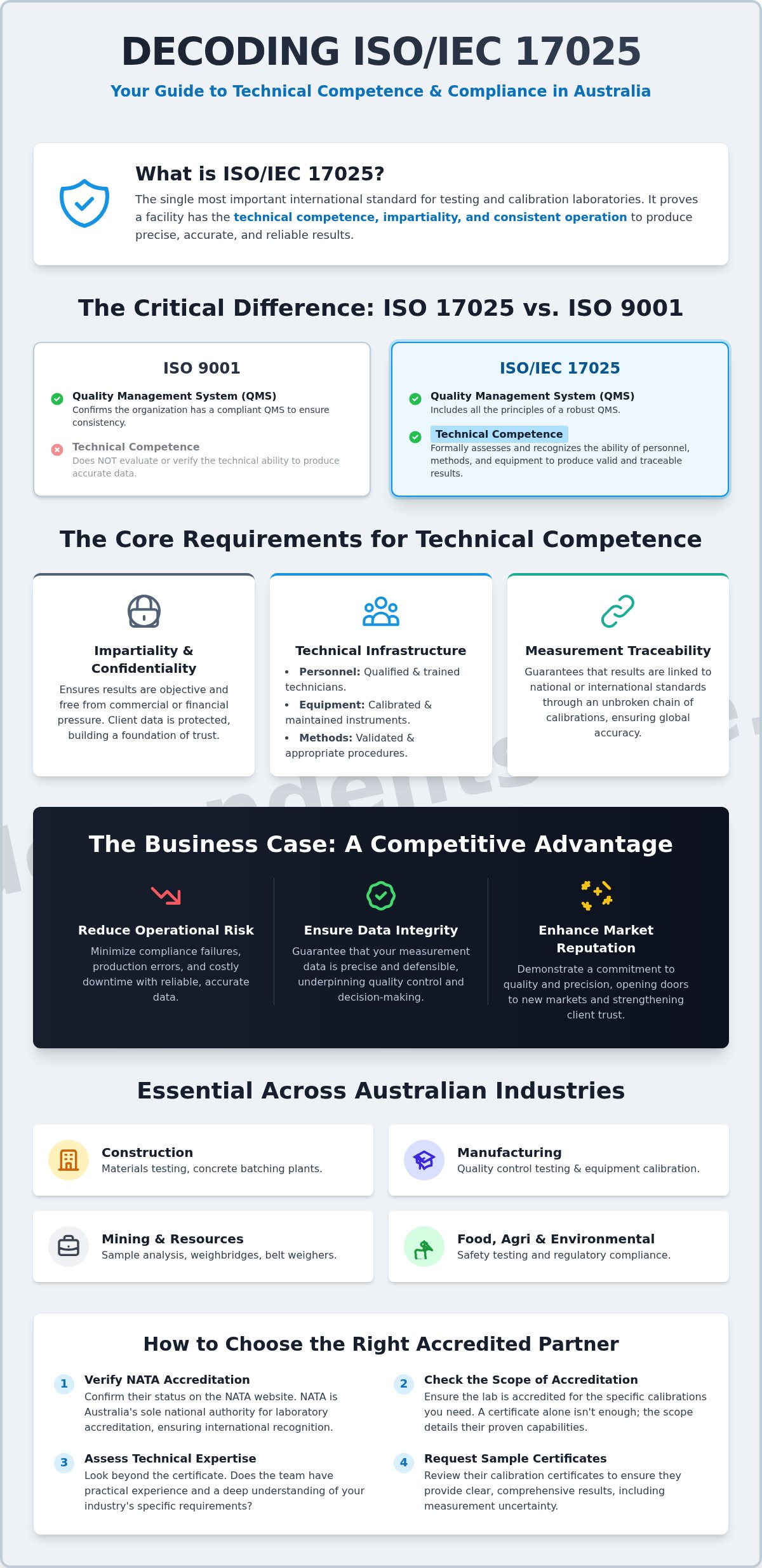
In industrial operations, data integrity is non-negotiable. ISO/IEC 17025 is the single most important international standard for testing and calibration laboratories. It functions as the 'driver's license' for any facility producing test results or calibration certificates, proving they possess the technical competence to perform the work accurately and reliably. The standard has a dual focus, evaluating both a laboratory's quality management system and, critically, its technical proficiency. This global acceptance is underpinned by frameworks like the ILAC Mutual Recognition Arrangement (MRA), ensuring an accredited calibration performed in Australia is recognised internationally.
What is ISO/IEC 17025? A Plain English Definition
At its core, ISO/IEC 17025 specifies the general requirements for the competence, impartiality, and consistent operation of laboratories. Its purpose is to ensure a facility can produce precise, accurate, and reliable results for all testing, calibration, and sampling activities it undertakes. The standard, with its latest version being ISO/IEC 17025:2017, provides a framework covering everything from equipment handling and personnel training to measurement traceability. For a more detailed breakdown, this ISO/IEC 17025 overview provides a comprehensive look at its structure and history.
The Key Difference: ISO 17025 vs. ISO 9001
While often confused, ISO 9001 and ISO 17025 serve different functions. ISO 9001 certification confirms that an organisation has a compliant quality management system (QMS). However, the iso 17025 standard includes these QMS principles and adds a critical layer: the formal assessment and recognition of technical competence. It verifies that the laboratory personnel, methods, and equipment are capable of producing valid and traceable measurements. A laboratory can be ISO 9001 certified but still lack the proven technical skill to generate reliable data.
For businesses focusing on establishing that foundational QMS, professional guidance can be invaluable. Consulting firms like Align Quality specialize in helping companies achieve ISO 9001 certification, providing the essential framework upon which technical competence can later be built.
Which Industries Rely on ISO 17025 Accreditation?
Accreditation is essential across Australian sectors where precision and compliance are paramount. Key industries demand this standard as a prerequisite for doing business:
- Construction: For materials testing labs and the calibration of concrete batching plants, ensuring compliance with standards like AS 1379.
- Manufacturing: For quality control testing of products and the precise calibration of production and measurement equipment.
- Mining and Resources: For the accurate analysis of geological samples and the calibration of critical weighing equipment like weighbridges and belt weighers.
- Food, Agriculture & Environmental: For safety testing, chemical analysis, and regulatory compliance to protect public health and the environment.
The Core Requirements: What Makes a Laboratory Technically Competent?
ISO 17025 accreditation is not a simple pass/fail certificate; it is a comprehensive framework built on verifiable proof of technical competence. The standard moves beyond generic quality management to detail the specific requirements a laboratory must meet to produce consistently accurate and reliable data. These requirements can be understood through three core principles that directly impact the validity of your calibration results.
Impartiality and Confidentiality: The Foundation of Trust
An accredited laboratory must operate with complete impartiality. This requires formal systems to identify and manage any potential conflicts of interest or pressure-whether commercial, financial, or operational-that could influence technical judgment. It ensures the results you receive are based solely on objective measurement data. Furthermore, all client information and results are held under strict confidentiality, building the essential customer confidence required for critical industrial processes.
Technical Competence: People, Equipment, and Methods
The standard mandates a robust technical infrastructure. This is not a single element but a combination of controlled factors that ensure the entire process is sound. A laboratory accredited to iso 17025 must demonstrate competence across:
- Personnel: Technicians must have documented qualifications, ongoing training, and proven experience for the specific calibrations they perform.
- Equipment: All measurement equipment must be properly calibrated, expertly maintained, and verified as fit-for-purpose before use.
- Methods: Calibration procedures must be validated to ensure they are appropriate for the task and capable of producing accurate results consistently.
Measurement Traceability: Ensuring Results are Accurate
This is arguably the most critical technical requirement. Traceability ensures that a laboratory's measurements are linked to a national or international standard through an unbroken chain of calibrations. For example, the test masses used to calibrate your industrial scale are themselves calibrated against more accurate reference standards. This chain continues until it links back to the primary standard of mass maintained by Australia's National Measurement Institute (NMI). This unbroken lineage is what gives your calibration certificate its authority and validity.
The Business Case: Why ISO 17025 is a Competitive Advantage
Beyond the technical specifications, ISO 17025 accreditation is a strategic asset that delivers tangible value. For managers and decision-makers, it answers the critical question: "How does this investment protect my business and improve my bottom line?" The standard translates directly into measurable risk reduction, enhanced market access, and improved operational efficiency. Demanding this level of competence from your service providers is a sound business decision.
Minimising Risk and Ensuring Regulatory Compliance
Engaging a laboratory or calibration service accredited to iso 17025 is a fundamental risk management strategy. It provides objective proof that your measurements are accurate and traceable, which is essential for meeting standards like AS 1379 for concrete manufacturing. This directly mitigates significant business risks:
- Product Failure & Recalls: Accurate measurements prevent out-of-spec production, avoiding costly rework or product recalls.
- Legal & Contractual Disputes: NATA-accredited calibration certificates provide legally defensible data, protecting your business in case of a dispute over quality or quantity.
- Regulatory Penalties: It ensures you remain compliant with industry-specific regulations, avoiding fines and operational shutdowns.
Gaining Market Access and Customer Confidence
In Australia's industrial sector, accreditation is often a prerequisite for business. Major construction, infrastructure, and government tenders frequently require that all testing and calibration in the supply chain be performed by NATA-accredited facilities. This standard acts as a passport to high-value contracts. It demonstrates a verifiable commitment to quality, builds immediate trust with potential clients, and removes the need for customers to conduct their own expensive re-testing, streamlining the acceptance process and saving everyone time and money.
Improving Operational Efficiency and Data Quality
Accurate data is the foundation of an efficient operation. Reliable measurements from properly calibrated equipment-from weighbridges to batching plant hoppers-lead to superior process control. This reduces material waste and rework caused by inaccurate batching or production. Furthermore, it provides a solid, trustworthy baseline for any continuous improvement initiatives. Ultimately, the consistency driven by demanding iso 17025 compliance results in a higher quality end-product, protecting your brand reputation and enhancing long-term profitability.
The Accreditation Process in Australia with NATA
In Australia, the path to gaining and verifying laboratory accreditation is governed by a single, authoritative body. Understanding this process, which is built around the iso 17025 standard, is essential for any business that relies on precise measurement and testing, as it provides a clear framework for ensuring the technical competence of your suppliers.
Who is NATA and What is Their Role?
The National Association of Testing Authorities (NATA) is Australia's sole national accreditation body. Its primary function is to provide independent assurance of technical competence by assessing laboratories and technical facilities against internationally recognised standards. For calibration and testing providers, this means a rigorous evaluation of their systems, procedures, and personnel against the stringent requirements of ISO/IEC 17025. NATA is also a signatory to the ILAC Mutual Recognition Arrangement (MRA), giving its accredited reports global acceptance.
Understanding a Laboratory's 'Scope of Accreditation'
A NATA accreditation certificate is not a blanket approval for all services. The most critical document to review is the laboratory's 'Scope of Accreditation'. This detailed document lists the specific calibrations or tests for which the laboratory has proven its competence. It specifies crucial details, including:
- The type of test or calibration (e.g., calibration of weighing instruments).
- The measurement range and capability.
- The Calibration and Measurement Capability (CMC) or measurement uncertainty.
A laboratory can be NATA accredited, but not for the specific service you require. It is essential to verify their scope covers your precise needs before engaging their services.
How to Verify a Provider's NATA Accreditation
Verifying a supplier's credentials is a straightforward but non-negotiable step in your due diligence. NATA provides a public-facing database for this purpose. To confirm a provider's status, visit the NATA website and use the 'Find an Accredited Facility' search tool. You can search by the company's name or accreditation number.
Crucially, do not stop at viewing the certificate. Always download and review the full Scope of Accreditation to ensure it aligns with your operational requirements. For example, you can verify our NATA accreditation for weighing equipment calibration and see the specific details of our capabilities. This final step ensures you are engaging a truly competent and compliant partner.
How to Choose the Right ISO 17025 Accredited Partner
Verifying a provider's accreditation is the essential first step, but selecting the right calibration partner requires deeper diligence. The goal is to establish a relationship that enhances your quality management system and operational efficiency, not just complete a transaction. A truly competent partner understands that accurate measurement is critical to your productivity and compliance.
Choosing a partner with proven technical competence and industry-specific expertise ensures your equipment is not only compliant but also performs reliably, minimising costly downtime and production errors. This decision directly impacts your operational integrity.
Key Questions to Ask a Potential Calibration Provider
Before engaging a service, demand clear and direct answers to fundamental questions that verify their capability and suitability for your specific needs. A professional provider will have this information readily available.
- Is this specific calibration within your NATA Scope of Accreditation? Ensure the service you require is explicitly listed on their official scope, not just a related capability.
- What is your best measurement capability (BMC) or uncertainty for this task? This technical data proves their level of precision and suitability for calibrating your high-tolerance equipment.
- Can you perform this calibration on-site at our facility? On-site service is critical for minimising disruption and downtime for large or integrated machinery.
- What is your standard turnaround time for certificates and reports? Timely delivery of NATA-endorsed documentation is essential for maintaining your compliance records.
Beyond the Certificate: Industry Experience and Support
An iso 17025 certificate proves technical competence, but it doesn't guarantee an understanding of your operational environment. Look for a provider with a documented history in your specific industry, whether it's concrete production, manufacturing, or logistics. A true partner offers more than just a calibration service; they provide comprehensive support that understands your business pressures.
This includes access to expert technical advice, preventative maintenance programs, and, most critically, emergency breakdown and repair services. The right partner acts as an extension of your team, dedicated to keeping your operations running accurately and efficiently.
Why Independent Scale is Your Trusted Partner
At Independent Scale Service, we deliver more than just compliance; we provide confidence and operational reliability. Our commitment to quality is demonstrated through our comprehensive service capabilities and deep industry knowledge.
- We hold NATA accreditation for an extensive range of weighing equipment calibrations.
- Our technical team possesses over 30 years of hands-on experience in sectors like concrete, manufacturing, and quarrying.
- We provide expert on-site calibration and support services across Sydney, Melbourne, and regional Australia.
- Our services include equipment supply, scheduled maintenance, and 24/7 emergency repair to ensure maximum uptime.
To partner with an expert team committed to the highest standards of calibration and service, contact Independent Scale Service today.
Securing Your Competitive Edge with ISO 17025
Ultimately, ISO 17025 is not merely a compliance requirement; it is a strategic asset for any Australian business reliant on accurate measurement and testing. This global standard provides a robust framework for technical competence, ensures the international acceptance of your results, and builds undeniable trust with clients and regulators. Embracing this standard is a direct investment in quality and operational integrity.
Choosing the right accredited partner is the most critical step in this process. At Independent Scale Service, we provide the expertise and assurance your operations demand. With over 30 years of dedicated industry experience, our NATA accreditation to iso 17025 is your guarantee of precision, traceability, and compliance with key standards like AS 1379. We deliver the accurate and defensible results that protect your business and enhance its reputation.
Secure your compliance and gain a competitive advantage. Request a quote for NATA accredited calibration services and partner with an industry leader in precision measurement.
Frequently Asked Questions About ISO 17025
What is the difference between accreditation and certification?
Accreditation and certification address different aspects of quality assurance. Accreditation, such as ISO/IEC 17025, is a formal recognition by an authoritative body like NATA that a laboratory is technically competent to perform specific tests or calibrations. It focuses on technical capability. Certification, like ISO 9001, confirms that an organisation's management system meets a standard's requirements, focusing on processes and systems rather than the technical validity of results.
How often does equipment need to be calibrated by an ISO 17025 accredited lab?
The ISO 17025 standard itself does not mandate a specific calibration interval. The frequency is determined by factors including manufacturer specifications, the criticality of the measurements, usage frequency, and operational environment. However, for most industrial applications and to maintain compliance, an annual calibration cycle is a widely accepted best practice. A risk-based assessment should ultimately define the required interval for your specific equipment and processes.
Is ISO 17025 accreditation mandatory in Australia?
While not universally mandated by law, NATA accreditation to ISO 17025 is a non-negotiable requirement in many regulated Australian industries. Sectors such as construction materials testing (e.g., concrete batching under AS 1379), environmental analysis, and legal metrology require it. Furthermore, major industrial clients and government tenders frequently specify accreditation as a contractual prerequisite to ensure data integrity, traceability, and risk mitigation for their operations.
What does 'uncertainty of measurement' on a calibration certificate mean?
Uncertainty of measurement quantifies the doubt associated with a measurement result. It is not an error, but a calculated range within which the true value is confidently believed to lie. An accredited calibration certificate must state this value, as it provides a critical indication of the measurement's quality and reliability. A smaller uncertainty value signifies a more precise calibration, which is essential for applications with tight tolerances and for making informed pass/fail decisions.
Can a laboratory be partially ISO 17025 accredited?
Yes. Accreditation is granted for a specific 'scope of accreditation', not for the entire laboratory. This scope meticulously details the specific tests, calibrations, and measurement ranges for which the lab has proven its technical competence. It is essential to verify that the service you require falls within the laboratory’s NATA-endorsed scope. This ensures the competence for your specific task has been independently and rigorously assessed.
What are the costs associated with using an ISO 17025 accredited service?
Engaging an iso 17025 accredited service typically involves a higher cost than non-accredited alternatives. This premium reflects the substantial investment in high-precision reference equipment, continuous staff training, stringent proficiency testing, and the rigorous auditing process by NATA. The higher cost, from A$300 to over A$1,000 per instrument depending on complexity, is an investment in guaranteed accuracy, risk mitigation, and regulatory compliance, preventing far greater costs associated with inaccurate measurements.
