


What Is a Weigh Station? A Guide for Commercial Vehicle Operators
For any commercial vehicle operator, an approaching weigh station can represent a significant operational risk. The potential for heavy fines, extended downtime, and questions about Chain of Responsibility (CoR) compliance can disrupt schedules and impact profitability. This uncertainty is often compounded by concerns that on-site scales may not align with the official readings from enforcement authorities, putting your business and your drivers in a precarious position.
This definitive guide is designed to provide clarity and control. We will deliver a comprehensive overview of Australian weigh station procedures, the technology used for mass measurement, and the specific compliance checks inspectors perform. You will gain a clear understanding of your legal obligations, how to prepare for inspections, and the critical role accurate weighing plays in maintaining safety and efficiency. The objective is to equip your operation with the essential knowledge to pass every inspection, maximise legal payloads, and ensure your fleet remains compliant and productive on the road.
Key Takeaways
- Understand the core functions of an Australian weigh station beyond simple mass checks, including its role in safety enforcement and infrastructure protection.
- Differentiate between fixed, mobile, and Weigh-In-Motion (WIM) systems to better prepare your drivers for the on-road inspection process.
- Assess the operational benefits of an on-site weighbridge for managing fleet compliance and improving logistical efficiency before vehicles enter the public road network.
- Learn why NATA-accredited calibration is essential for ensuring the legal and commercial accuracy of any weighing equipment used in your operations.
The Core Purpose of Weigh Stations in Australian Transport
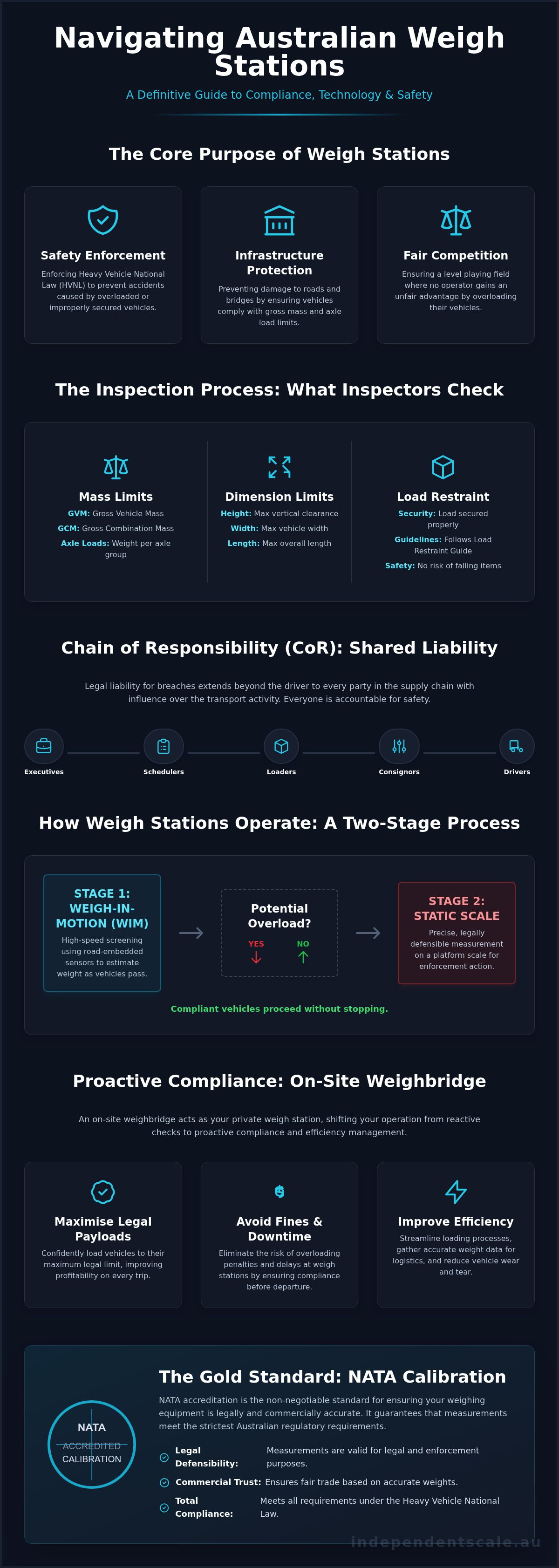
In the Australian transport industry, a weigh station serves a function far more critical than simply measuring a vehicle's mass. These facilities are fundamental checkpoints for enforcing national safety standards, preserving public road infrastructure, and ensuring fair competition. Managed under the authority of bodies like the National Heavy Vehicle Regulator (NHVR), they are essential for maintaining the integrity and safety of the entire heavy vehicle transport network.
The primary role of these checkpoints is to verify compliance with the Heavy Vehicle National Law (HVNL). Non-compliance is not a minor issue; it carries significant consequences, including substantial fines that can reach thousands of Australian Dollars (AUD), demerit points against a driver's licence, and potential court action. These penalties underscore the seriousness of the regulations and the importance of consistent adherence.
Enforcing Mass, Dimension, and Load Restraint Limits
At the core of every inspection is the verification of mass, dimension, and load security. A modern weigh station is equipped to check several key metrics:
- Mass Limits: This includes the Gross Vehicle Mass (GVM) of a single rigid truck and the Gross Combination Mass (GCM) for vehicle combinations. Critically, officials also check axle load limits to prevent concentrated weight from damaging road surfaces and bridges.
- Dimension Limits: Vehicles are checked for compliance with legal limits on height, width, and length to ensure they can safely navigate the road network.
- Load Restraint: Inspectors verify that all loads are secured according to the Load Restraint Guide, preventing items from shifting or falling, which poses a severe public safety risk.
Understanding Chain of Responsibility (CoR)
A crucial legal concept enforced at these checkpoints is the Chain of Responsibility (CoR). Under CoR laws, legal liability for a breach is not limited to the driver. It extends to every party in the supply chain who has influence over the transport activity. This shared responsibility ensures everyone plays an active role in safety.
Parties who can be held liable under CoR include:
- Company executives and operators
- Schedulers and loaders
- Consignors and consignees
- Drivers and packers
For example, if a consignor provides incorrect weight information that leads to a vehicle being overloaded, both the driver and the consignor can be prosecuted. This framework mandates a proactive approach to compliance from all stakeholders.
Given the legal complexities and shared liabilities, many businesses turn to specialist consultants for guidance on their transport planning and compliance strategies. For instance, firms like ML Traffic Engineers Pty Ltd help operators navigate these regulatory requirements effectively.
Weighing Technology: How Weigh Stations Operate
Modern weigh stations in Australia rely on sophisticated technology to enforce mass limits efficiently and accurately, balancing regulatory compliance with the need to maintain traffic flow. Understanding how these systems operate reveals a multi-layered approach, from high-speed screening to precision measurement. Operations are conducted using a combination of fixed, mobile, and sometimes virtual weigh station setups to ensure comprehensive network coverage.
Weigh-In-Motion (WIM) vs. Static Scales
The core of most fixed weigh station facilities is a two-stage process involving Weigh-In-Motion (WIM) and static scale systems. WIM systems use sensors embedded in the roadway to estimate a vehicle's gross and axle weights as it travels at a reduced speed. This technology is designed for high-volume screening, allowing compliant vehicles to proceed without stopping. If the WIM system flags a potential overload, the vehicle is directed to a static axle or platform scale. These static scales provide the precise, legally defensible measurements required for enforcement actions.
The Technology Powering the Scales
The accuracy of any weighing system depends on its core components. The fundamental sensor is the industrial load cell, a robust transducer that converts the mechanical force of a vehicle's weight into a precise electrical signal. In large platform scales, multiple load cells are used, and their individual signals are aggregated through summing circuits to provide a total weight. This raw data is then processed by digital indicators and displays, which translate the signal into a clear, readable weight for enforcement officers. The integrity of this entire process relies on meticulous calibration, often requiring NATA accreditation to ensure measurements meet strict legal and regulatory standards.
Portable and Mobile Weigh Stations
To extend compliance activities beyond fixed locations, transport authorities utilise portable and mobile weighing systems. These typically consist of rugged, portable weigh pads or mats that can be set up quickly at temporary roadside checkpoints. This mobility allows for random inspections and enforcement in remote areas or on routes without permanent facilities. However, the accuracy of these portable systems is highly dependent on a correct setup; they must be placed on a hard, level surface to ensure reliable and repeatable weight readings.
The Inspection Process: What Drivers and Operators Can Expect
Approaching a heavy vehicle inspection or weigh station is a standard operational procedure for transport professionals. Understanding the systematic process ensures efficiency, minimises delays, and maintains compliance. The inspection is a methodical evaluation of the vehicle, its load, and the driver against national safety and transport regulations.
Navigating the Weigh Station
The process begins as you approach the facility. Drivers must obey all road signage, typically an 'All Trucks Must Enter' sign, which directs heavy vehicles into the screening lane. As you proceed at a low, controlled speed, your vehicle will pass over a Weigh-In-Motion (WIM) system. This initial screening measures your vehicle's mass and axle group weights while moving. An electronic sign will then provide an instruction: a green light or arrow indicates you are compliant and can merge back onto the highway, while a red light or arrow directs you to pull into the inspection bay for a static weigh and further checks.
Beyond the Weigh-In: Additional Compliance Checks
If directed into the inspection bay, your vehicle will undergo a more detailed examination. The primary step is a static weigh on a certified weighbridge to obtain a precise, legally enforceable mass reading. However, compliance extends beyond gross vehicle mass. Transport inspectors are authorised to conduct a range of checks to ensure adherence to safety standards and the Australian trade measurement laws that regulate commercial weighing. Operators should be prepared for a comprehensive audit, which may include:
- Driver-Related Checks: Verification of the driver’s license class, inspection of the work diary (logbook) for fatigue management compliance, and assessment of fitness for duty.
- Vehicle-Related Checks: Confirmation of current registration, review of maintenance records, and a physical inspection for roadworthiness, including tyres, brakes, lights, and couplings.
- Load-Related Checks: Scrutiny of permits for any oversize or overmass (OSOM) loads and a critical evaluation of load restraint to ensure the cargo is secured correctly and safely.
Completing these checks successfully allows the driver to receive clearance and continue their journey. Any identified breaches may result in warnings, fines, or grounding of the vehicle until the issue is rectified.
On-Site Weighbridges: Your Private Weigh Station Solution
While public weigh stations are a critical component of road safety and compliance, proactive businesses in sectors like logistics, mining, and agriculture understand the operational necessity of their own on-site weighbridges. Installing an in-house system transforms a mandatory compliance check into a strategic business asset, giving you complete control over your Chain of Responsibility (CoR) obligations, operational efficiency, and commercial accuracy before a single vehicle leaves your premises.
Benefits of an In-House Weighbridge System
An on-site weighbridge is more than just a large scale; it is an integrated solution that delivers quantifiable returns on investment. The primary advantages include:
- CoR Compliance and Fine Avoidance: Ensure every vehicle is within legal mass limits before departure. This proactive approach effectively eliminates the risk of incurring substantial fines and demerit points at a roadside weigh station.
- Improved Operational Efficiency: Manage vehicle flow and optimise loading times without relying on external facilities. An on-site system integrates directly into your workflow, preventing bottlenecks and costly delays.
- Accurate Commercial Data: Generate precise, legally-traceable weight data for invoicing clients, managing raw material stockpiles, and tracking inventory. This ensures you are paid correctly for every kilogram dispatched and maintain accurate stock levels.
The Critical Need for Accurate Calibration
The operational and financial benefits of a private weighbridge are entirely dependent on its accuracy. Over time, factors such as heavy use, environmental conditions, and component wear cause all weighing equipment to "drift" from its correct measurement. An uncalibrated weighbridge provides false data, which carries significant risk.
A scale that reads high can lead directly to overloaded vehicles and severe penalties on the road. Conversely, a scale that reads low results in giving away product for free, leading to direct and often substantial revenue loss. The integrity of your private weigh station is only as reliable as its last verification.
To guarantee the integrity of your weighing data and meet stringent regulatory standards, routine and professional weighing scale calibration is not optional-it is an essential business requirement. NATA-accredited calibration provides auditable proof of accuracy, protecting your business from fines, preserving your revenue, and ensuring your CoR compliance is built on a foundation of verifiable data.
Maintaining Accuracy and Compliance with NATA Calibration
Accurate weight measurement is non-negotiable in logistics and transport. Calibration is the technical process of verifying a scale's accuracy by comparing its readings against a known, traceable standard. For any commercial weighbridge or private weigh station, this process is a critical component of legal and operational integrity. Operating with uncalibrated or inaccurate equipment exposes your business to significant risks, including regulatory fines, loss of revenue from incorrect billing, and safety breaches from overloaded vehicles.
What is NATA Accredited Calibration?
The National Association of Testing Authorities (NATA) is Australia's national accreditation body. NATA accreditation to the ISO/IEC 17025 standard provides independent, third-party assurance that a calibration provider is technically competent and operates a robust quality system. A NATA-endorsed calibration report is a legally defensible document, essential for demonstrating due diligence, maintaining quality management systems, and ensuring compliance with industry regulations.
The Calibration Process for Weighbridges
A professional weighbridge calibration is a meticulous procedure designed to test every aspect of the scale's performance. This systematic approach confirms that your measurements are precise and repeatable. The process typically involves:
- Certified Test Masses: Using government-verified test masses to check the scale's accuracy at critical points across its weighing range.
- Performance Testing: Conducting specific tests to identify common errors, including checks for linearity (accuracy across the full range), repeatability (consistency of measurements), and corner-loading (ensuring accuracy regardless of where the load is placed).
- Formal Certification: Issuing a detailed calibration certificate that provides a formal record of the equipment's performance and its traceability to national standards.
Frequency and Importance of Regular Service
The required frequency for calibration depends on factors like usage intensity, environmental conditions, and specific regulatory or quality assurance requirements. However, a minimum annual calibration is standard practice for most commercial weighing systems. Regular preventative maintenance is equally important, allowing technicians to identify and rectify potential issues like load cell drift or component wear before they cause major inaccuracies at your weigh station. This proactive approach minimises downtime and protects your operational integrity. Ensure your equipment is compliant with our expert calibration services.
Beyond the Public Weigh Station: Securing Your Compliance
Understanding the function of a public weigh station is fundamental for any commercial vehicle operator in Australia. These facilities are critical for upholding road safety standards and ensuring legal mass compliance. While navigating the official inspection process is a non-negotiable part of the job, taking proactive control of your fleet's weight management through on-site solutions is the mark of a professional operation. However, the reliability of your own equipment hinges entirely on its precision and certified accuracy.
To guarantee your on-site weighbridge provides accurate, defensible data, professional calibration is not optional-it is essential. With over 30 years of industry experience, Independent Scale Service provides NATA accredited calibration to ISO/IEC 17025. Our experts ensure your equipment is compliant with standards such as AS 1379, protecting you from costly fines and operational downtime. Ensure your industrial weighing equipment is accurate and compliant. Contact Independent Scale for NATA accredited services.
Stay compliant, stay safe, and keep your operations moving efficiently.
Frequently Asked Questions
What's the difference between a weigh station and a weighbridge?
A weigh station is a roadside checkpoint facility operated by transport authorities to inspect heavy vehicles for compliance with safety and mass regulations. It is the complete site. A weighbridge, conversely, is the specific weighing instrument-the physical scale-used within that facility to measure a vehicle's gross weight and axle loads. While weighbridges are the central component of a weigh station, they are also used in private industrial applications like quarries and logistics depots for commercial purposes.
How often should an industrial weighbridge be professionally calibrated?
For legal-for-trade applications, industrial weighbridges must be certified by a licensed technician at least every 12 months, as mandated by the National Measurement Institute (NMI). However, for high-volume operations or to maintain ISO/IEC 17025 compliance, a more frequent calibration schedule of six months is highly recommended. Regular, NATA-accredited calibration is essential to ensure measurement accuracy, prevent revenue loss, and maintain compliance with Chain of Responsibility (CoR) laws, minimising operational and legal risks.
What are the general heavy vehicle mass and dimension limits in Australia?
In Australia, general access heavy vehicle limits are regulated by the National Heavy Vehicle Regulator (NHVR). A standard 6-axle semi-trailer is typically limited to a gross vehicle mass (GVM) of 42.5 tonnes. General dimension limits include a maximum height of 4.3 metres, a width of 2.5 metres, and a length of 19 metres for a semi-trailer. Exceeding these limits without a specific permit or notice results in non-compliance and potential penalties.
Can commercial vehicles legally bypass a weigh station?
Commercial vehicles are legally required to enter an open weigh station when directed by road signs. Bypassing an operational inspection site is an offence and will result in significant penalties. The only legal exceptions are for vehicles enrolled in specific pre-clearance or accreditation schemes, such as the Intelligent Access Program (IAP), which electronically monitors compliance. For all other heavy vehicles, compliance with weigh station directives is mandatory to ensure road safety and infrastructure preservation.
What is a Weigh-In-Motion (WIM) system and how accurate is it?
A Weigh-In-Motion (WIM) system is a technology designed to measure a vehicle's gross weight and axle loads as it drives over sensor plates at low or highway speeds. Its primary function is for screening, allowing compliant vehicles to proceed without stopping while flagging potentially overloaded vehicles for a static weighbridge inspection. While highly efficient, WIM systems are less accurate than static scales, typically having a tolerance of +/- 2% to 6%, and are therefore generally not used for direct enforcement.
How does Chain of Responsibility (CoR) affect a fleet manager?
Under Australia's Chain of Responsibility (CoR) laws, a fleet manager shares legal liability for on-road breaches, including overloading. This means a manager can be held personally accountable if they fail to take all reasonably practicable steps to prevent a mass breach from occurring. Responsibilities include ensuring vehicles are correctly loaded, maintaining accurate weight records, providing driver training, and ensuring all weighing equipment, such as on-board scales or private weighbridges, is properly calibrated and maintained.
