


What Are The Different Types of Load Cells? An Industrial Guide
In any industrial weighing system-from silos and hoppers to platform scales-operational accuracy and reliability depend on one critical component. Yet, selecting the right one can be a significant challenge, particularly when faced with a range of technical specifications and load cells with different designs. Misinterpreting terms like 'shear beam' or 'single point' can lead to specifying a component that fails under demanding conditions, resulting in costly downtime and inaccurate data. This is a risk that compliant and efficient operations cannot afford to take.
This essential guide provides the technical clarity required for correct specification. We will systematically explore the core types of industrial load cells, including robust compression models, versatile shear beams, and precise single-point designs. You will gain a clear understanding of each type's primary function, ideal application, and key performance characteristics. By the end of this guide, you will be equipped to identify the most suitable load cell for your equipment and confidently discuss your requirements with a supplier, ensuring your weighing system delivers the accuracy your operation demands.
Key Takeaways
- A load cell is a transducer that converts mechanical force into a measurable electrical signal using an internal strain gauge for precise weight calculation.
- Classify tension and load cells primarily by the force they are designed to measure-such as compression, tension, or shear-to match your application's mechanical requirements.
- Specialised load cells are engineered to provide reliable performance in demanding industrial environments, including those with high temperatures or corrosive elements.
- Select the correct load cell by evaluating critical specifications beyond type, including capacity, accuracy class, material construction, and environmental protection (IP) rating.
How a Load Cell Works: The Core Principle of Force Measurement
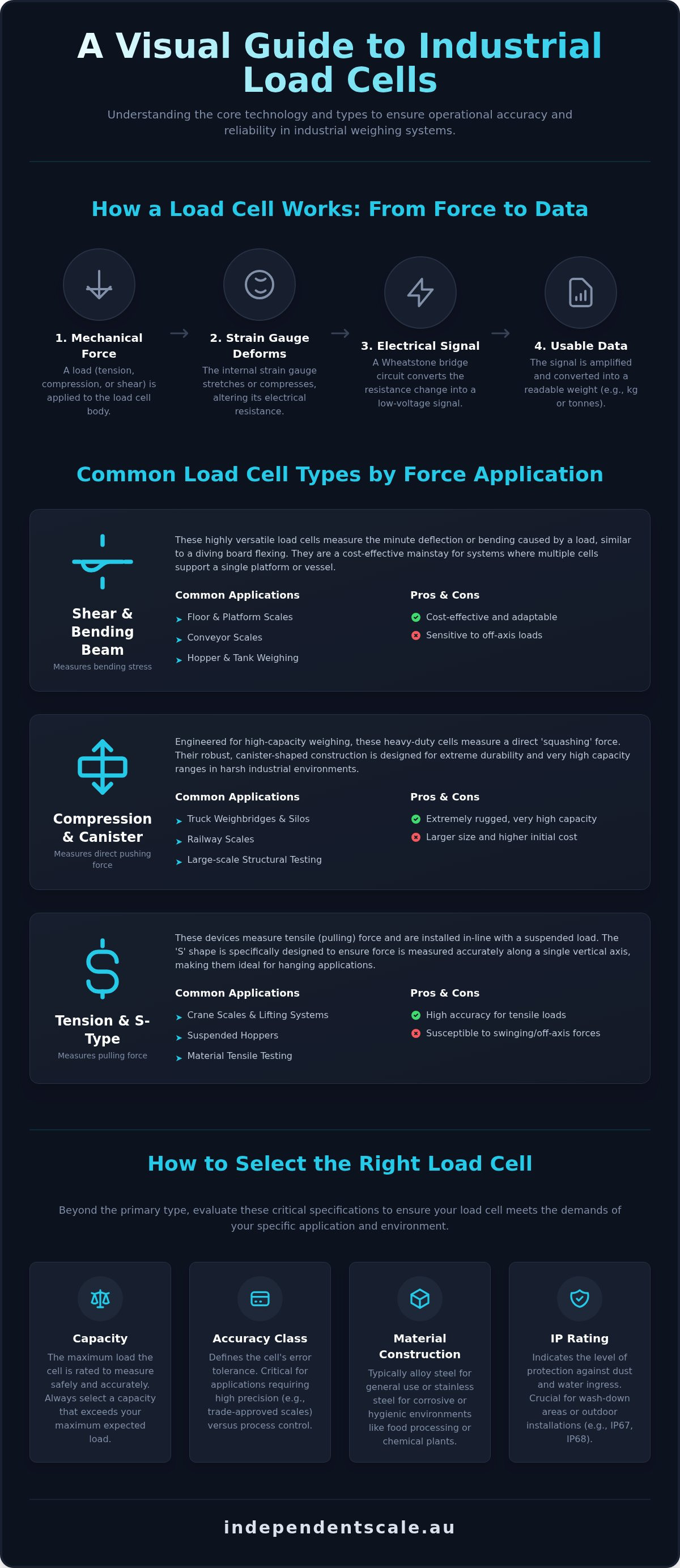
At its core, a load cell is a highly precise transducer designed to convert a mechanical force-such as tension, compression, or shear-into a measurable electrical signal. This fundamental capability is what allows industrial scales, from weighbridges to hopper systems, to determine weight with exceptional accuracy. The internal mechanism responsible for this conversion is the strain gauge, a component that responds physically to applied force.
However, not all load cells are built the same. The physical design of the load cell body is engineered specifically for its intended application. A shear beam load cell used in a platform scale operates under different principles than a tension link used in a crane scale. Selecting the correct type of cell is not merely a matter of capacity; it is critical for ensuring sustained accuracy, system longevity, and operational safety. Using the wrong equipment and load cells can lead to inaccurate measurements, process failures, and significant safety hazards.
The Strain Gauge: The Heart of the Load Cell
The primary sensing element within most modern load cells is the strain gauge. This component is an electrical conductor bonded directly to the load cell's structural body, which is engineered to deform in a predictable way when a load is applied. As the structure flexes, the strain gauge stretches or compresses along with it. This physical deformation alters the gauge's electrical resistance. To maximise sensitivity and compensate for temperature changes, multiple strain gauges are configured into a Wheatstone bridge circuit.
From Electrical Signal to Usable Data
The minute change in electrical resistance from the Wheatstone bridge circuit produces a low-voltage signal. This raw signal is then transmitted to a peripheral device like a digital weighing indicator, transmitter, or a PLC. This instrument performs the critical function of amplifying, conditioning, and translating the electrical signal into a usable, readable weight measurement, typically displayed in kilograms or tonnes. For this data to be reliable, expert calibration is essential. Calibration ensures the entire system is accurate and compliant, verifying that the output reading precisely matches a known mass.
For the entire system to function reliably, the supporting components like terminal blocks, relays, and power supplies must also be of high quality. If you're building or maintaining such a system and need guidance on these parts, you can check out InstroDirect.
Common Load Cell Types by Force Application
The most fundamental way to classify and select a load cell is by the type of force it is engineered to measure. This mechanical principle-whether the force is pushing, pulling, or bending the sensor-dictates its suitability for a specific industrial application. Accurate weighing systems depend entirely on matching the correct force application and load cells to the operational requirement. While there are many specific Types of Load Cells, they are predominantly categorised by how they handle compression, tension, or shear forces.
Shear Beam & Bending Beam Load Cells
These load cells operate by measuring the shear or bending stress induced by a load. Imagine a diving board flexing under weight; the load cell measures this minute deflection. This design makes them highly versatile and a mainstay in Australian industries for multi-cell weighing systems where multiple units support a single platform or vessel.
- Common Applications: Floor scales, platform scales, conveyor scales, and hopper or tank weighing.
- Pros: Highly cost-effective and adaptable for systems requiring multiple load cells.
- Cons: Performance can be compromised by off-axis or side loads if mounting is not precise.
Compression Load Cells & Canister Cells
Engineered to measure a direct pushing or squashing force, compression load cells are the heavy-duty solution for high-capacity weighing. They are placed directly under the object to be weighed, measuring the compressive force exerted upon them. Their robust, often canister-shaped, construction is designed for extreme durability in harsh industrial environments.
- Common Applications: Truck weighbridges, high-capacity silos, railway scales, and structural testing.
- Pros: Extremely rugged with very high capacity ranges, often exceeding 500 tonnes.
- Cons: Typically larger in size and represent a higher initial investment compared to other types.
Tension & S-Type Load Cells
As the name implies, these devices measure tensile, or pulling, force. They are installed in-line with the load, which hangs from the cell. The distinctive 'S' shape of S-Type load cells makes them particularly effective at ensuring the force is measured accurately along a single vertical axis, making them ideal for suspended applications.
- Common Applications: Suspended hoppers, crane scales, mechanical scale conversions, and material tensile strength testing.
- Pros: Excellent for suspended weighing; the compact S-shape is versatile for both tension and compression.
- Cons: Requires careful installation to prevent side-loading, which can introduce measurement errors.
Single Point Load Cells
A single point load cell is specifically designed to be the sole sensor in a small to medium-sized scale, capable of accurately measuring weight regardless of where it is placed on the platform. This off-centre load compensation is crucial for applications where the load position is not consistent, simplifying the overall design.
- Common Applications: Bench scales, retail checkout scales, packaging machinery, and small platform scales.
- Pros: Simplifies and lowers the cost of scale construction for smaller systems.
- Cons: Limited by maximum platform size and lower capacity ranges compared to multi-cell systems.
Specialised Load Cells for Demanding Industrial Environments
While standard load cells form the foundation of most weighing systems, many industrial applications demand more than off-the-shelf solutions. Operations in sectors like Australian construction, mining, and manufacturing often require specialised instrumentation engineered for extreme conditions, high capacities, and unique spatial constraints. These units are not entirely new technologies but are expertly engineered variations of common load cell types, modified to deliver precision and durability in challenging environments.
Understanding these specialised force measurement systems is critical for ensuring operational safety, efficiency, and compliance. Below, we detail several key types of specialised load cells designed for specific, demanding industrial tasks.
Weighbridge Load Cells
Engineered specifically for vehicle scales, weighbridge load cells are high-capacity compression or column-type cells built to endure extreme punishment. Their robust construction, typically from stainless steel with hermetic sealing, allows them to withstand constant, heavy vehicle traffic and exposure to harsh Australian weather conditions. Key features often include integrated surge arrestors for lightning protection and specialised mounting hardware to ensure consistent and accurate weight readings for transport, logistics, and resource management.
Load Pins / Shear Pins
In applications where a conventional load cell cannot be fitted, a load pin provides an elegant and effective solution. These specialised sensors are designed to directly replace a standard pivot, clevis, or axle pin within a mechanical assembly. This allows them to measure the shear force exerted on the pin without altering the equipment's structure. Load pins are essential for force monitoring in:
- Cranes and hoisting equipment
- Winches and mooring lines
- Lifting and rigging gear
- Structural pivots and linkages
Their compact, integrated design makes them indispensable for retrofitting safety and measurement capabilities into existing machinery.
Tank & Silo Weighing Modules
Accurate inventory management and process control in bulk material handling rely on tank and silo weighing systems. These are not just load cells but complete weighing modules, comprising a load cell paired with purpose-built mounting hardware. This hardware is critical; it isolates the load cell from non-vertical forces (like side-loads from wind, vibration, or thermal expansion) that would otherwise compromise accuracy and damage the sensor. The complete assembly ensures reliable, repeatable measurements for batching, mixing, and stock-taking. Need a custom solution for your silo? Our experts can help.
How to Select the Right Load Cell: Key Criteria to Consider
Selecting the correct load cell extends beyond its basic type. For engineers and procurement managers, a detailed specification review is essential to prevent costly measurement errors, equipment failure, and operational downtime. This checklist outlines the critical technical criteria to evaluate before purchase. A mismatch between the component and its application can compromise an entire process.
Capacity, Resolution, and Safety Overload
These three specifications are fundamental to performance and safety. A precise understanding of your operational loads is the first step in specifying weighing systems and load cells that deliver reliable service.
- Maximum Capacity: Calculate the total weight the load cell must support. This includes the "live load" (the material being weighed) and the "dead load" (the weight of the hopper, platform, or structure itself). Always select a capacity that exceeds this total to provide a safety margin.
- Resolution: This refers to the smallest change in weight the load cell can detect and display. For processes requiring high precision, such as batching or chemical dosing, a higher resolution is non-negotiable.
- Ultimate Safety Overload: Expressed as a percentage of the rated capacity (e.g., 300%), this is the maximum load the cell can withstand before catastrophic structural failure. This rating is critical for preventing accidents in environments with potential for shock loading.
Material Construction: Stainless Steel vs. Alloy Steel
The construction material directly impacts the load cell's longevity and suitability for the environment. While alloy steel is a cost-effective and durable choice for dry, controlled industrial settings, stainless steel offers superior corrosion resistance. For food processing facilities, washdown areas, or marine applications around Australia's coastline, stainless steel is the mandatory choice to prevent degradation from moisture and cleaning agents.
Environmental Protection: Understanding IP Ratings
Ingress Protection (IP) ratings define a load cell's sealing effectiveness against dust and moisture. This rating is crucial for ensuring reliability in challenging conditions. An IP67-rated load cell is protected against dust and can withstand temporary immersion in water, making it suitable for wet environments. For applications involving prolonged submersion, such as in-ground weighbridges in flood-prone areas, an IP68 rating is required.
Accuracy Class and Compliance Standards
For applications where goods are sold by weight (trade use), load cells must comply with specific legal standards, typically governed by OIML (International Organization of Legal Metrology) accuracy classes in Australia. This is a legal requirement, not an option. However, achieving this rated accuracy is only possible through precise installation and professional, NATA-accredited calibration.
Ensuring all these specifications align with your application is complex. To guarantee optimal performance and compliance, it is always recommended to consult with an expert. For specialist advice on selecting, installing, and calibrating weighing equipment, contact the technical team at Independent Scale Service.
Expert Guidance for Your Load Cell Requirements
Understanding the operational principles and diverse types of load cells-from shear beam and S-type to specialised high-capacity models-is fundamental to accurate industrial weighing. The selection process is a critical engineering decision. Ensuring your weighing systems and load cells are correctly specified for your application is not just about performance; it is essential for operational integrity and compliance.
With over 30 years of industry experience, Independent Scale Service specialises in these critical selections, particularly for heavy-duty industrial applications. Our NATA accredited calibration services provide the assurance that your equipment meets stringent Australian standards. For expert guidance tailored to your specific operational needs, contact our technical experts for help selecting the right load cell.
Invest in precision to secure the long-term accuracy and reliability your operations demand.
Frequently Asked Questions About Load Cells
What is the most common type of load cell used in industrial scales?
The strain gauge load cell is the most prevalent type used in industrial weighing applications throughout Australia. Specifically, shear beam and double-ended shear beam configurations are standard for their durability and high accuracy. You will find these robust components in platform scales, weighbridges, tank weighing systems, and large hopper scales. Their proven reliability and precision make them the industry benchmark for demanding commercial and industrial environments where consistent performance is critical.
How do I determine the correct load cell capacity for my application?
To determine the correct capacity, you must calculate the total weight the system will support. Sum the weight of the structure itself (dead load) and the maximum weight of the product to be measured (live load). Divide this total by the number of load cells in the system. Finally, apply a safety factor of at least 25-50% to account for shock loading and uneven weight distribution. Selecting the correct capacity is essential for accuracy and preventing premature failure.
What is the difference between a tension and a compression load cell?
The primary difference lies in the direction of the force they are designed to measure. A compression load cell measures a pushing or squeezing force, making it ideal for applications like weighbridges or silo weighing where a structure rests on the cells. In contrast, a tension load cell measures a pulling or stretching force. These are typically used in applications where a load is suspended, such as in crane scales or suspended hoppers and tanks.
Can a load cell be repaired or does it need to be replaced?
Whether a load cell can be repaired depends entirely on the nature of the damage. External issues, such as a damaged cable or faulty connector, can often be professionally repaired. However, if the internal strain gauge or the structural element of the cell has been compromised due to overloading, shock, or lightning strike, a full replacement is almost always necessary. An expert assessment is required to determine viability and ensure continued system accuracy and safety.
Why is stainless steel more expensive and when do I need it?
Stainless steel load cells carry a higher cost due to the material's inherent corrosion resistance and the processes required to manufacture them. This additional investment is essential in harsh operating environments. You require stainless steel in applications exposed to moisture, high humidity, corrosive chemicals, or frequent washdowns, such as in food processing plants, chemical facilities, and marine settings. Using it in these conditions prevents premature failure and ensures long-term measurement accuracy.
Does a new load cell need to be calibrated after installation?
Yes, calibration is a mandatory and critical step after installing any new load cell. The process verifies that the electrical signal from the load cell accurately corresponds to a known weight, ensuring the entire weighing system is precise. This is not just best practice; it is essential for quality control, operational safety, and maintaining compliance with Australian standards. For traceable accuracy, this should be performed by a NATA-accredited technician using certified test masses.
