


Weighbridge Verification Services Melbourne: The 2026 Compliance Guide
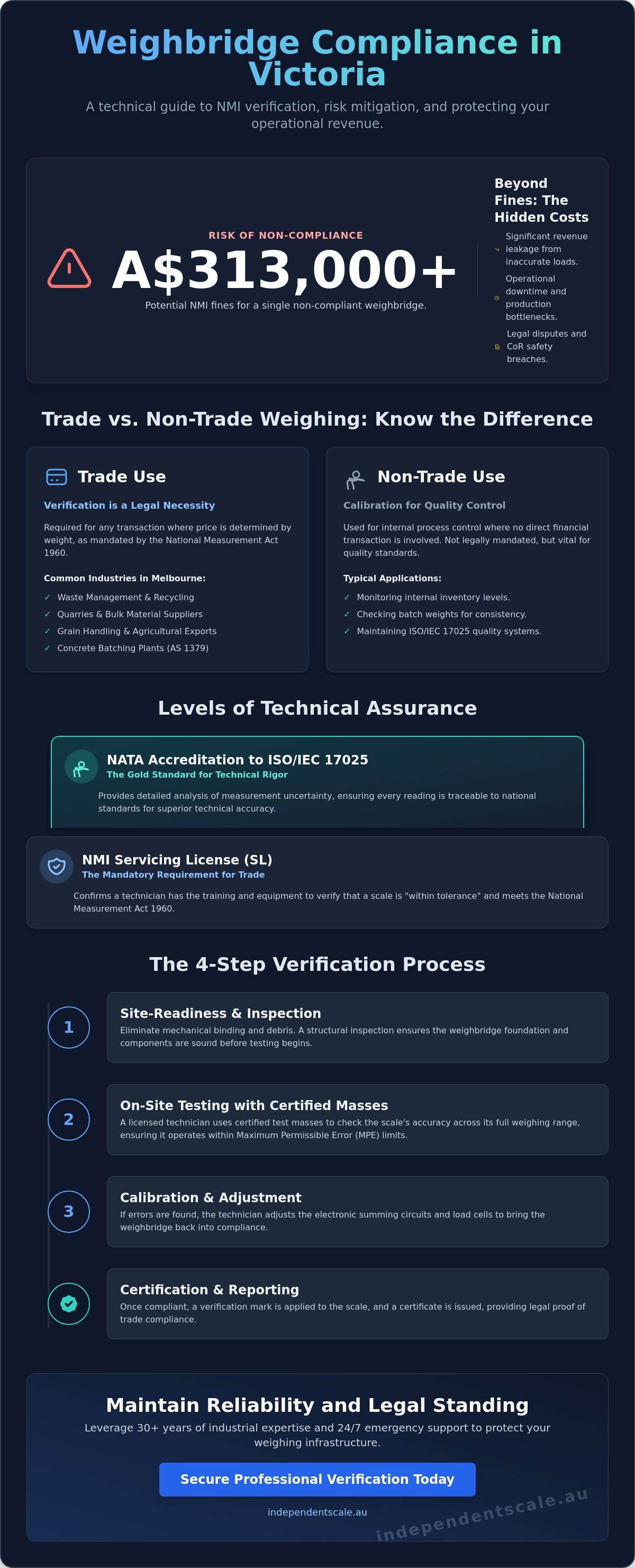
A single non-compliant weighbridge can trigger National Measurement Institute (NMI) fines exceeding A$313,000 under current Australian penalty unit valuations. For Victorian industrial operations, the risk of using unverified equipment extends beyond legal penalties to include significant revenue leakage from inaccurate load data. Securing professional weighbridge verification services Melbourne is the only way to mitigate these risks and ensure your facility remains trade-compliant under the National Measurement Act 1960.
You recognize that operational downtime during testing is a major bottleneck, yet the cost of an inaccurate scale is far higher across a 12 month production cycle. This 2026 compliance guide provides the technical framework you need to master legal requirements and technical standards for NMI certification. You'll learn how to streamline the verification process to protect your margins and maintain total regulatory alignment. We cover everything from the latest NMI audit protocols to the specific technical steps for onsite calibration and fast, professional certification.
Key Takeaways
- Understand the mandatory legal requirements set by the National Measurement Institute (NMI) to ensure your Victoria-based trade operations remain fully compliant.
- Identify the critical differences between standard testing and NATA-accredited calibration to ISO/IEC 17025 standards for superior technical accuracy.
- Master the step-by-step verification process, including structural inspections and the use of certified test masses provided by professional weighbridge verification services Melbourne.
- Implement a site-readiness checklist to eliminate mechanical binding and debris, significantly reducing operational downtime during on-site testing.
- Leverage 30+ years of industrial expertise and 24/7 emergency support to maintain the reliability and legal standing of your weighing infrastructure.
Understanding Weighbridge Verification and Legal Requirements in Victoria
Verification is the mandatory legal testing of weighing equipment used for trade. In Australia, the National Measurement Institute (NMI) regulates these standards to ensure commercial equity between buyers and sellers. If you are unfamiliar with the technical mechanics of these systems, understanding what is a weighbridge is the first step in recognizing why precision is critical for heavy industrial applications. Under the National Measurement Act 1960, using unverified equipment for trade is a federal offence. For corporations, this can result in significant legal consequences, including fines that can exceed A$200,000 per instance of non-compliance.
There's a technical distinction between Verification and In-service Inspection. Verification occurs when a new or recently repaired scale is certified for trade use by a Servicing Licensed technician. In-service Inspection refers to the periodic checks that confirm the device continues to operate within the maximum permissible error (MPE) limits. ISS provides professional weighing scale calibration and verification to ensure your site remains compliant with all NMI requirements. Our technicians focus on technical accuracy to eliminate the risk of legal disputes or financial loss due to weighing errors.
Why Periodic Verification is Mandatory for Melbourne Businesses
The NMI recommends annual testing for high-use industrial weighbridges to maintain accuracy. Melbourne's specific environmental conditions make this 12-month interval critical. Salt air near the Port of Melbourne accelerates corrosion in load cells and structural steel, while seasonal temperature fluctuations from 2°C to over 40°C affect electronic summing circuits and strain gauges. Accuracy is also a fundamental requirement for Chain of Responsibility (CoR) laws in logistics. In 2024, transport authorities have increased the frequency of roadside inspections. Precise weight data is your primary defence against overloading fines and safety breaches.
Trade vs. Non-Trade Weighing: Knowing the Difference
Trade use is defined as any transaction where the final price of a product is determined by its weight. If money changes hands based on the scale reading, verification is a legal necessity. Common Melbourne industries requiring weighbridge verification services Melbourne include:
- Waste management and recycling centres.
- Quarries and bulk construction material suppliers.
- Grain handling and agricultural export facilities.
- Concrete batching plants adhering to AS 1379 standards.
Non-trade calibration is suitable for internal process control where no financial transaction is involved. This might include monitoring internal inventory levels or checking batch weights for consistency. While not legally mandated by the NMI, these checks are vital for maintaining ISO/IEC 17025 quality standards. Professional verification ensures your equipment meets the rigorous demands of the National Measurement Act and protects your business from the risks associated with inaccurate data.
The Regulatory Landscape: NMI Licensing and NATA Accreditation Standards
In Australia, the National Measurement Institute (NMI) oversees the legal metrology framework. To provide weighbridge verification services Melbourne businesses rely on for trade, a provider must hold a Servicing License (SL). This license confirms the technician has the specific training and equipment to verify that a scale meets the National Measurement Act 1960 requirements. Verification isn't optional. If a weighbridge is used to determine a price based on weight, it must carry a current verification mark from an SL holder.
ISO/IEC 17025 is the international standard for testing and calibration laboratories. NATA accreditation represents a higher tier of technical rigor than standard NMI verification. While verification confirms a scale is "within tolerance" for trade, NATA-accredited calibration provides a detailed analysis of measurement uncertainty. It ensures every reading is traceable to national standards. This level of precision's critical for industrial processes where even a 0.1% variance impacts production quality or site safety. Choosing a provider with both NMI and NATA credentials ensures your facility meets both legal and technical benchmarks.
The Role of NATA in Weighbridge Accuracy
NATA accreditation requires labs to undergo regular, stringent peer reviews of their technical competence. This process validates the technician's ability to produce accurate data consistently. For high-capacity equipment, Learn more about our NATA calibration services to understand how traceability is maintained through rigorous documentation and standardized testing protocols. This ensures your equipment remains compliant with global quality management systems. It's about technical depth, not just a pass or fail sticker.
Compliance with Australian Standard AS 1379
Concrete production facilities across Melbourne must adhere to AS 1379, the specification for the specification and supply of concrete. This standard dictates that weighing systems at batching plants undergo regular calibration to ensure batch accuracy. Most plants require a gravimetric method of calibration. This involves using physical test weights to verify accuracy across the full scale range of the hoppers and scales. Failure to meet these standards leads to structural failures or project rejections. We provide AS 1379 compliant concrete plant services to ensure your facility meets these technical requirements without interruption. If you're unsure about your current compliance status, you can review our full range of compliant weighing solutions to find the right hardware for your site.
Step-by-Step Guide to the Weighbridge Verification Process
Professional weighbridge verification services Melbourne follow a rigid technical sequence to ensure your equipment meets the National Measurement Institute (NMI) regulations. The process begins with a comprehensive physical inspection of the site. Technicians examine the weighbridge structure for debris buildup, check the health of digital indicators, and inspect the cabling for environmental damage. This initial audit identifies mechanical issues that might cause a failure during live testing.
The verification involves several high-precision steps:
- Mass Placement: A specialized test truck delivers tonnes of certified test masses to the site. A heavy-duty forklift then positions these weights according to NMI patterns.
- Eccentricity Testing: This confirms the bridge provides identical readings regardless of where the load is positioned on the platform. It's often called a corner test.
- Linearity and Repeatability: Technicians test the system at various intervals up to the maximum capacity. This ensures the bridge maintains accuracy at 10 tonnes just as effectively as it does at 60 tonnes.
- Final Certification: After successful testing, the technician applies a Verification Mark, usually a lead seal or high-destruct sticker, and submits the data to the NMI.
Technical Testing Procedures and Tolerances
Accuracy is measured against the Maximum Permissible Error (MPE). This is the legal limit of deviation allowed for trade-certified equipment. For a standard Class III weighbridge, the MPE varies depending on the load size; it's typically +/- 0.5 scale intervals for the first 500 divisions. Technicians must test individual performance and summing accuracy to ensure the junction box correctly aggregates signals. If your system fails due to hardware fatigue, you can explore our range of industrial load cells to find NMI-approved replacements that restore compliance.
Documentation and Compliance Certificates
A compliant test report is a critical legal document for Victorian businesses. It must include the instrument's serial number, the NMI pattern approval number, and the specific test results for repeatability and eccentricity. You're required to maintain a calibration logbook for regulatory audits to prove a history of compliance. When you receive your Regulation 13 certificate, check that the "Date of Next Verification" aligns with the cycle required for your specific industry. This documentation serves as your primary defense during inspections by trade measurement authorities. It's not just a receipt; it's proof of legal operation.
Minimising Operational Downtime During On-Site Testing
Operational delays during weighbridge testing cost Melbourne businesses thousands in lost productivity. The primary causes of verification lag aren't the tests themselves, but preventable site issues. Debris buildup in the pits, poor drainage leading to Melbourne winter sludge, and mechanical binding of the weighbridge deck often stall technicians for hours. When a weighbridge isn't free-floating, accurate calibration is impossible. Securing weighbridge verification services Melbourne providers who use high-capacity test trucks is the most effective way to reduce this window. These heavy-duty vehicles carry enough certified mass to complete testing in 40% less time compared to smaller units requiring dozens of individual forklift movements.
For 24/7 hubs like the Port of Melbourne, scheduling is critical. Peak traffic hours between 6:00 AM and 10:00 AM should be avoided to prevent site congestion. We recommend booking verification during shoulder periods or night shifts to ensure the technician has unobstructed access. This prevents the bottlenecking of heavy vehicles and keeps your logistics chain moving without interruption.
Site Preparation Checklist for Melbourne Facilities
Preparation is the difference between a two-hour job and a full-day outage. Facility managers should complete these steps before the service vehicle arrives:
- Clear Access: Ensure a 20-tonne+ test truck and support forklift have a clear, 30-metre approach to the site entrance and the weighbridge itself.
- Clean the Deck and Pits: Remove all quarry dust, debris, and sludge. A build-up of just 50kg of mud can throw a high-precision scale out of legal tolerance.
- Power and Indicators: Verify that digital indicators are powered on and showing stable readings. Fluctuating digits often signal moisture ingress in the junction box or faulty summing circuits.
Dealing with Verification Failures
If a weighbridge fails the initial verification test, it's legally "out of service" for trade use until rectified. In these instances, immediate fault diagnosis is required to minimise downtime. Our technicians move straight to load cell testing and indicator programming to identify the source of the error. Common culprits include damaged surge arrestors or mechanical friction in the mounting hardware. Having a specialist onsite means repairs can often happen immediately, followed by a re-test, rather than waiting for a second call-out. For access to essential components and technical support, browse our diagnostic and repair services for industrial scales.
Expert Weighbridge Verification and Maintenance in Melbourne
Independent Scale Service (ISS) brings over 30 years of technical expertise to the Victorian industrial sector. We understand that a non-compliant or malfunctioning weighbridge stops your operations immediately. Our team provides weighbridge verification services Melbourne businesses rely on to maintain NMI compliance and operational uptime. We operate with a "first-time fix" philosophy. This is supported by our massive on-site inventory of load cells and digital indicators. We don't just identify problems; we resolve them during the initial site visit to prevent costly return trips and extended downtime.
Critical infrastructure failures don't follow a 9-to-5 schedule. ISS provides 24/7 emergency support across the metropolitan area. If a load cell fails at 2:00 AM during a peak production cycle, our technicians respond with the necessary hardware to restore accuracy. Our role as a partner extends beyond legal verification. We integrate preventative maintenance into every service call to identify wear in summing circuits or structural fatigue before they cause a total system breakdown. This proactive approach ensures your equipment remains accurate between mandatory verification intervals.
Why Melbourne Industry Trusts Independent Scale
Major Victorian infrastructure players like Holcim and Boral trust ISS for their high-volume weighing requirements. Our service footprint covers every major industrial hub, from the heavy manufacturing zones in Dandenong South to the logistics clusters in Campbellfield and Somerton. We maintain a high standard of technical competence that aligns with ISO/IEC 17025 requirements. For more detailed information on system architecture, read The Essential Guide to Weighbridge Systems.
Comprehensive Weighing Solutions
Accuracy depends on more than just the platform. We supply and install high-performance indicators, remote displays, and specialized junction boxes and surge arrestors for weighbridges. These components protect your investment from lightning strikes and electrical spikes common in Melbourne industrial environments. Our technicians ensure every component meets the strict tolerances required for legal trade. We provide the weighbridge verification services Melbourne needs to ensure 2026 compliance and beyond.
Book your Melbourne weighbridge verification today to secure your site's compliance and operational efficiency.
Secure Your 2026 Operational Compliance
Maintaining legal trade standards in Victoria requires strict adherence to NMI licensing and NATA accreditation. Accuracy isn't just a preference; it's a regulatory mandate under ISO/IEC 17025. Independent Scale Service provides the technical expertise to ensure your equipment meets these rigorous benchmarks. We currently service 98% of concrete plants across major regions in Victoria and New South Wales, proving our capacity to handle large-scale industrial requirements.
Investing in professional weighbridge verification services Melbourne prevents costly legal disputes and equipment failure. Our team prioritizes your uptime, offering 24/7 emergency technical support to address issues before they impact your bottom line. We manage the entire gravimetric method calibration and testing process so your facility remains fully compliant without the administrative burden. This methodical approach ensures your load cells and summing circuits function within specified tolerances. Trust our 30 years of industry experience to keep your operations precise and profitable throughout 2026.
Request a NATA-Accredited Weighbridge Verification in Melbourne
Frequently Asked Questions
How often does a weighbridge need to be verified in Victoria?
In Victoria, any weighbridge used for trade purposes must be verified every 12 months to remain compliant with the National Measurement Act 1960. This annual requirement ensures that the equipment maintains its accuracy within the Maximum Permissible Error (MPE) limits. Failing to meet this schedule puts your business at risk of significant penalties during a National Measurement Institute (NMI) audit.
Can I use a weighbridge for trade if the verification has expired?
It's illegal to use a weighbridge for trade transactions if the verification period has lapsed. Under the National Measurement Act, businesses found using unverified equipment for financial gain face fines of up to A$222,000 for corporations. If your sticker is out of date, you must stop using the bridge for trade immediately and contact a licensed service provider to perform a re-verification.
What is the difference between an NMI license and NATA accreditation?
An NMI license is a legal requirement that allows a technician to verify equipment for trade use under Australian law. NATA accreditation to ISO/IEC 17025 is a voluntary standard that demonstrates a laboratory's high level of technical competence and calibration accuracy. Independent Scale Service maintains both to ensure that weighbridge verification services Melbourne clients receive are both legally compliant and technically superior.
How long does a standard weighbridge verification take onsite?
A standard onsite weighbridge verification typically takes between 3 and 6 hours to complete. This window includes the time needed for the heavy test unit to arrive, the placement of certified test masses, and the execution of repeatability and eccentricity tests. If the bridge requires mechanical adjustments or load cell replacements to meet accuracy standards, the process can extend by another 2 hours.
What industries in Melbourne are most strictly regulated for weighing?
The construction, waste management, and quarrying sectors in Melbourne face the most rigorous oversight due to Chain of Responsibility (CoR) laws and EPA reporting requirements. Companies like Holcim and Boral require 100% compliance to manage high-volume logistics and avoid legal disputes. The waste industry is particularly scrutinized because weighbridge data determines state-mandated landfill levies and gate fees.
What happens if my weighbridge is found to be inaccurate during an NMI audit?
If an NMI inspector finds your weighbridge is inaccurate, they'll issue a non-compliance notice and may apply a "rejected" sticker to the instrument. This prevents the bridge from being used for trade until it's repaired and re-verified by a licensed technician. Fines for non-compliance start at A$1,110 for individuals, while repeat offenders may face prosecution in the Federal Court.
Do you provide verification for portable or axle weighbridges in Melbourne?
We provide full verification for portable and axle weighbridges as long as the specific model has an NMI pattern approval for trade. While many portable units are used only for reference or weight checks, any unit used to determine the price of goods must adhere to the 12-month verification cycle. Our team uses specialized mobile test rigs to service these units at various sites across the Melbourne metropolitan area.
How much does a typical weighbridge verification service cost in Melbourne?
Total costs for a verification service depend on the bridge capacity, its location, and the volume of certified test masses required. The National Measurement Institute (NMI) sets administrative fees for verification marks, which are approximately A$20 to A$50 per sticker in 2024. Most of the expense comes from the mobilization of a heavy test truck carrying 20 tonnes of certified weights and the labor of the licensed technicians.
