


Weighbridge Preventative Maintenance: Practical Guide
A maintenance schedule based on the calendar alone can miss faults that disrupt weighbridge operations. A practical preventative maintenance plan for weighbridges assigns checks according to risk, sets clear responsibilities and defines when to escalate a concern.
Unplanned breakdowns can interrupt vehicle movements, while debris, wear or developing faults may affect weighing consistency. How often should checks happen, and which tasks can operators complete themselves? The answer depends on traffic volume, site conditions and how critical the measurements are.
This guide explains how to build a site-specific routine for inspection and cleaning, recognise warning signs and decide when to arrange specialist diagnosis, repair or calibration. It shows how to coordinate operator checks with technical assessment rather than waiting for a fault to stop operations. With clear responsibilities and a schedule matched to site risk, your team can identify problems earlier and plan follow-up work more effectively.
Key Takeaways
- A stable display alone doesn’t confirm that the entire weighbridge is functioning correctly. Planned inspection, cleaning, testing and documentation help reveal developing issues.
- Use a preventative maintenance plan for weighbridges as a site-specific framework, adjusting checks for traffic, environment, construction and fault history.
- Record repeat-reading inconsistencies, zero shifts, unusual movement and intermittent display faults so your team can identify patterns and escalate concerns.
- Assign each routine check an owner, trigger or frequency, record and escalation action so responsibilities are clear.
- Distinguish maintenance, repair, calibration and regulatory verification. Arrange specialist attention when discrepancies persist or inspection findings remain unresolved.
Why a preventative maintenance plan for weighbridges matters, even when readings seem normal
A stable display doesn’t prove that every part of a weighbridge is functioning correctly. The indicator may show a plausible weight even when debris restricts platform movement, water collects around components or a damaged cable causes an intermittent fault. A weighbridge combines a platform with measurement components, including load cells. What is a weighbridge? offers a basic overview of the equipment and its uses.
A preventative maintenance plan for weighbridges is a documented process for planned inspection, cleaning, testing, recording findings and taking corrective action. It helps identify developing issues before they become operational disruptions. It can’t promise perfect readings or eliminate downtime. Set maintenance frequency according to actual usage, site conditions, equipment design and observed performance.
What can routine maintenance protect against?
Routine checks can help your team identify conditions that may affect equipment or need further investigation, including:
- Debris trapped beside or beneath the platform, potentially restricting movement.
- Standing water or blocked drainage that leaves components exposed to moisture.
- Visible corrosion, cracks or other structural damage.
- Damaged, exposed or poorly routed cables in accessible areas.
Finding and recording these conditions early gives your team a clearer basis for deciding whether cleaning, closer monitoring or specialist assessment is appropriate. A maintenance routine supports, but doesn’t replace, calibration, verification or any legally required inspection that applies to the site.
Does an apparently accurate weighbridge still need a plan?
Yes. Gradual changes and intermittent faults may not be obvious during ordinary transactions. A reading may appear normal for one vehicle and differ during a later test, or a display fault may occur only occasionally. Without a record, it’s harder to tell whether an issue is isolated, recurring or worsening.
Document checks consistently. Record the date, what was inspected, any unusual observation, the action taken and whether the issue returned. Comparing entries over time can reveal patterns, such as repeated debris build-up or recurring display interruptions, and help your team make better-informed service decisions.
These records support fault investigation, but they don’t certify measurement accuracy. Where readings remain inconsistent or a fault persists, specialist diagnosis and appropriate calibration can help determine the next step. Keeping routine maintenance distinct from formal measurement assessment makes clear what each check can establish and where further testing is needed.
What routine checks belong in a weighbridge maintenance plan?
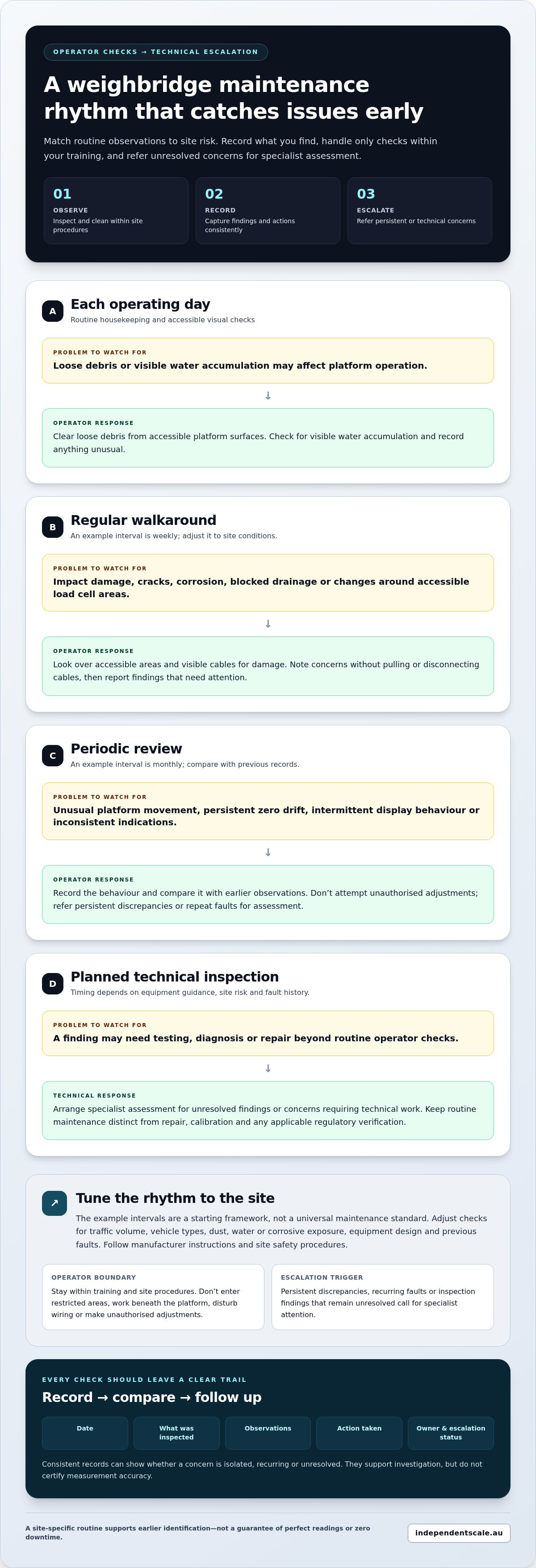
A useful routine gives operators a clear sequence without treating one timetable as suitable for every site. The intervals below are a starting framework. Adjust them for traffic volume, vehicle types, exposure to dust, water or corrosive materials, equipment design and previous faults. Follow manufacturer instructions and site safety procedures before inspecting or cleaning any component.
Which checks can site operators perform?
Operators can complete visual checks and routine housekeeping within their training and site procedures. Don’t enter restricted areas, work beneath a platform or disturb wiring unless authorised and qualified to do so. Record an abnormal reading, sound or movement, and don’t attempt unauthorised adjustments.
- Each operating day: Clear accessible platform surfaces of loose debris and check for visible water accumulation that could affect operation.
- At a regular walkaround interval, such as weekly: Look for impact damage, cracks, corrosion, blocked drainage and changes around accessible load cell areas. Check visible cables for damage without pulling or disconnecting them.
- At a periodic review, such as monthly: Note unusual platform movement, persistent zero drift, intermittent display behaviour or inconsistent indications. Compare observations with previous records.
- At planned technical inspections: Arrange specialist assessment for findings that need testing, diagnosis or repair. Set timing according to equipment instructions, site risk and fault history.
When should maintenance tasks be scheduled?
Use the sample sequence to assign responsibility, not as a universal Australian maintenance standard. A high-traffic site, harsh operating environment or history of recurring faults may need more frequent operator observations. A lower-use site may set different review intervals, subject to equipment guidance and any applicable site requirements.
Separate daily housekeeping from periodic technical inspections and planned specialist work. This helps operators understand what they can safely observe and when an issue needs escalation.
For every check, record the date, observations, action taken, responsible person and escalation status. For example, note whether debris was cleared, a cable concern was reported or a recurring zero shift was referred for assessment. This makes follow-up traceable and helps the next person see whether an issue has been resolved or remains open.
Use persistent discrepancies or repeat faults to inform the next service decision. Where measurement performance needs assessment, planned weighing scale calibration can form part of the broader maintenance programme, alongside inspection and repair as required.
How to recognise weighbridge inaccuracy and investigate likely causes
Suspect a problem when readings or platform behaviour change from the site’s normal pattern. Warning signs include inconsistent repeat readings under comparable conditions, a persistent shift from zero, unusual platform movement and intermittent display faults. Record what happened, when it occurred and any relevant operating conditions. These symptoms can help direct an investigation, but they don’t establish a definitive diagnosis.
Use a structured first check rather than guessing at a cause. In a preventative maintenance plan for weighbridges, operators can note whether an issue appears linked to:
- Platform obstruction: Mud, stones or other debris trapped around the platform may restrict movement.
- Structural or mechanical conditions: Visible damage, corrosion, standing water or contact between components may need assessment.
- Load cells: A fault or abnormal load transfer may contribute to unstable or inconsistent indications.
- Cabling and connections: Damaged cables or connection issues may cause intermittent behaviour.
- Operation: Differences in vehicle positioning or operating procedure can affect comparisons between readings.
What mechanical and environmental issues should teams look for?
From safe, accessible areas, check for accumulated mud, stones, standing water, corrosion and visible points where the platform or nearby components may be contacting each other. Restricted movement or uneven contact can affect how force is transferred through the weighing system. Clear only loose debris that can be reached safely under site procedures. Don’t enter beneath the platform, force moving parts or change clearances without equipment-specific guidance.
Escalate visible damage, recurring obstructions or unexplained changes for assessment. An observation is a useful clue, not proof that a particular component has failed.
How can load cells and indicators affect readings?
Load-cell cable damage or connection problems can produce unstable indications, while an indicator fault may appear as intermittent display behaviour. Operators can record what they see, including when the fault occurs and whether it repeats. Electrical testing, load-cell diagnosis and equipment adjustments require appropriate technical assessment. Visual checks alone can’t establish the source.
Persistent or unexplained discrepancies call for specialist investigation. Load cell calibration provides a technical assessment of measurement response, while maintenance and repair address equipment condition. Calibration, routine maintenance and any applicable regulatory verification serve different purposes. A maintenance inspection doesn’t certify accuracy or replace required assessment.
How to build a site-specific weighbridge maintenance schedule
A useful schedule connects each task to an owner, a trigger, a record and a clear escalation route. Set inspection intensity according to traffic volume, vehicle types, operating environment, weighbridge construction and fault history. For example, a site with frequent heavy vehicle movements or recurring debris may need more frequent observations than a sheltered, lower-use site. Treat intervals as site decisions and check them against equipment guidance.
| Task | Owner | Trigger or frequency | Record required | Escalation action |
|---|---|---|---|---|
| Clear accessible platform debris | Operator | Routine housekeeping, adjusted for build-up | Date, condition and action taken | Report recurring obstruction or restricted movement |
| Inspect visible platform, drainage and cables | Operator or site maintenance team | Scheduled walkaround or after a notable event | Observed damage, water or cable condition | Refer damage or suspected unsafe conditions to the site lead |
| Review repeat readings and zero behaviour | Authorised site team | At the site-defined review interval or when a concern arises | Observed results, conditions and unresolved issues | Escalate persistent or unexplained discrepancies for technical assessment |
| Plan specialist inspection, repair or calibration | Site lead with specialist support | Based on equipment guidance, performance and service history | Findings, work completed and follow-up required | Track recommendations until resolved |
What should a maintenance log record?
Maintain one traceable record for each inspection or service event. Include the date, equipment identifier, observed condition, test results where applicable, corrective actions, responsible person and any unresolved issue. Add relevant load-cell, indicator or previous service details when available. Reviewing these records over time can reveal recurring faults and help refine the schedule, instead of repeating a fixed routine that doesn’t reflect site conditions.
How should findings be prioritised and escalated?
Define site-specific escalation criteria before a fault occurs. A suspected unsafe condition or unreliable weighing result needs prompt review under site procedures. Operators can complete authorised housekeeping, but adjustments, repairs and formal calibration are distinct tasks for appropriately assigned personnel. Calibration assesses measurement performance; it doesn’t replace mechanical maintenance or regulatory verification.
Australian trade measurement and other compliance obligations can depend on the instrument’s use and jurisdiction. Verify applicable requirements with the relevant authority rather than assuming a maintenance log or calibration alone satisfies them. For specialist measurement assessment, arrange weighing scale calibration as part of the site’s planned service programme.
Use your inspection history and equipment performance to shape a preventative maintenance plan for weighbridges. For calibration support that fits your maintenance programme, review the weighing scale calibration service.
When to schedule professional weighbridge maintenance, repair or calibration
A preventative maintenance plan for weighbridges should define when an issue moves beyond routine site checks and needs specialist attention. Escalate persistent weighing discrepancies, recurring display or zero faults, visible damage, unusual platform movement and inspection findings that remain unresolved. Record the symptoms and operating circumstances so the investigation can start with useful site information.
What should happen when a fault or discrepancy persists?
Follow site procedures to secure affected equipment if its condition may be unsafe or weighing results are unreliable. Document the fault, when it occurs, relevant readings and any action already taken. Avoid unauthorised adjustments. They can obscure the original symptom and complicate later diagnosis.
Specialist diagnosis can investigate mechanical and structural conditions, load cells, cabling, connections and indicator behaviour. The findings help determine whether the next step is maintenance, repair, calibration or further investigation. Independent Scale Service provides industrial weighing equipment maintenance, repair, fault diagnosis and calibration across Sydney, Melbourne and regional Australia.
How do maintenance and calibration work together?
These activities have related but distinct purposes:
- Maintenance involves planned care and inspection of equipment condition, including cleaning and identifying developing issues.
- Repair addresses a fault or damaged component identified during inspection or diagnosis.
- Calibration assesses measurement response against appropriate standards. It doesn’t, by itself, repair mechanical faults or confirm legal approval for trade use.
- Regulatory verification is a separate compliance activity where applicable. Requirements depend on the instrument’s use and relevant Australian jurisdiction, so verify obligations with the responsible authority.
Maintenance findings may prompt calibration, repair or additional diagnosis. A recurring discrepancy, for example, should be investigated rather than treated as proof that calibration alone will resolve the issue. Independent Scale Service provides calibration accredited to ISO/IEC 17025 by NATA within its accredited scope. Accreditation does not mean that every weighbridge calibration activity is covered.
Schedule specialist work in response to the equipment’s condition, site records and applicable requirements, rather than assuming one interval suits every installation. For site-specific industrial weighing support, discuss your site requirements.
Put a practical maintenance plan into action
A reliable weighbridge programme depends on more than a calendar reminder. Set routine checks around site conditions and equipment use, record findings consistently, and escalate persistent discrepancies, damage or recurring faults for specialist assessment.
A site-specific preventative maintenance plan for weighbridges helps operators identify concerns early and coordinate maintenance, repair and calibration as distinct parts of equipment care. It also gives specialists useful service history when diagnosing faults or planning further work.
Independent Scale Service provides industrial weighing repair, maintenance and diagnostic support across Sydney, Melbourne and regional Australia. Calibration is accredited to ISO/IEC 17025 by NATA within the relevant accreditation scope.
Discuss industrial weighing support to plan the next step for your site. Clear responsibilities and timely follow-up help your team manage weighbridge maintenance with confidence.
Frequently Asked Questions
How often should a weighbridge be inspected?
Set inspection frequency according to traffic volume, vehicle types, site environment, weighbridge design and fault history. Daily housekeeping may suit sites where debris builds up quickly, while technical inspections should follow equipment guidance and the site’s risk profile. Treat any sample calendar as a starting point, not a universal rule. If the weighbridge is used for trade, verify applicable measurement obligations with the relevant Australian authority.
What should a daily weighbridge maintenance check include?
A daily operator check can cover accessible platform cleanliness, visible damage, water accumulation, drainage and obvious cable damage. Note unusual movement, persistent zero shifts or intermittent display behaviour. Follow site safety procedures and equipment instructions, and don’t enter restricted areas or adjust components without authorisation. Record the date, observations, action taken and any issue referred for follow-up. Escalate damage or abnormal weighing behaviour through the site’s fault process.
Can dirt or debris affect weighbridge accuracy?
Yes. Mud, stones or other debris trapped around a platform may restrict its movement or create unwanted contact with nearby structures. That can affect how the weighing system responds and may contribute to inconsistent indications. Water accumulation and corrosion are also useful inspection findings. Operators should remove only loose debris that’s safe and accessible to clear under site procedures. Persistent or unexplained discrepancies need further investigation, not repeated cleaning alone.
What is an end-middle-end weighbridge test?
An end-middle-end test compares weighbridge indications as a test load is positioned at one end, the middle and the other end of the platform. Differences between positions may help identify uneven response across the weighing structure. The test needs a controlled method, suitable test load and competent interpretation. It isn’t a substitute for every form of calibration or regulatory verification. Follow equipment-specific procedures and have qualified personnel conduct or assess the test.
Does weighbridge maintenance replace calibration?
No. Maintenance focuses on equipment condition through inspection, cleaning and corrective work. Calibration assesses measurement response against appropriate standards. A maintenance finding may prompt calibration, repair or further diagnosis, but completing housekeeping or fixing a mechanical issue doesn’t establish measurement performance. Regulatory verification is separate where applicable. Australian requirements depend on the instrument’s use and jurisdiction, so confirm the relevant obligations with the responsible authority.
What should a weighbridge maintenance log include?
Record the inspection date, equipment identifier, condition observed, test results where available, action taken, responsible person and any unresolved issue. Include relevant load-cell, indicator or service details when known. If a fault recurs, note its circumstances and whether previous corrective action resolved it. Reviewing entries over time can reveal patterns, support fault diagnosis and help the site adjust its maintenance schedule to actual operating conditions.
When should a weighbridge be checked by a specialist?
Arrange specialist attention for persistent discrepancies, recurring faults, visible damage or inspection findings that remain unresolved. Follow site procedures to secure equipment if it may be unsafe or producing unreliable results, and document the symptoms without making unauthorised adjustments. Independent Scale Service provides industrial weighing maintenance, repair and diagnostics across Sydney, Melbourne and regional Australia. Its calibration is accredited to ISO/IEC 17025 by NATA within the relevant accreditation scope.
