


Weighbridge Maintenance Services: 2026 Industrial Guide
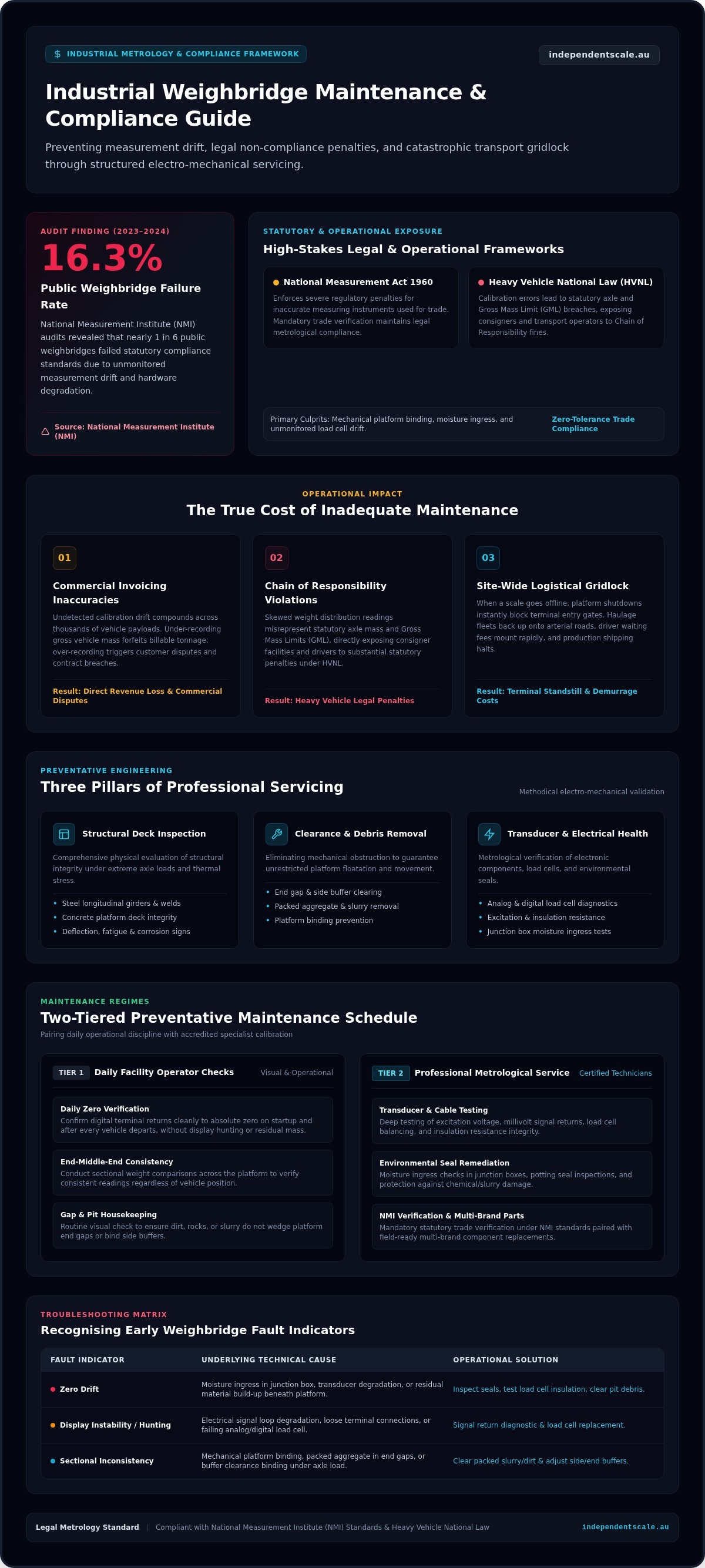
Between 2023 and 2024, the National Measurement Institute (NMI) found that 16.3% of audited public weighbridges failed compliance standards. For industrial facility managers, unmonitored measurement drift doesn't just invite severe regulatory penalties under the National Measurement Act 1960; it halts heavy vehicle traffic, causes commercial invoicing disputes, and exposes transport operators to overloading fines under Heavy Vehicle National Law. Implementing professional weighbridge maintenance services is the only reliable way to prevent sudden load cell failures, moisture ingress, and debris build-up that silently erode measurement precision.
You already know that when a weighbridge goes offline, your entire site's throughput grinds to a halt. Discover how structured weighbridge maintenance services safeguard measurement accuracy, ensure legal trade compliance, and eliminate unplanned downtime across high-tonnage corridors. This 2026 industrial guide outlines the essential mechanical inspections, electrical diagnostics, and statutory verification schedules needed to extend the operating life of your load cells and keep your weighing infrastructure running at peak precision.
Key Takeaways
- Engaging structured weighbridge maintenance services protects heavy industrial operations against deck binding, electrical degradation, and costly transport bottlenecks.
- Establishing a tiered preventative maintenance schedule combining daily operator checks with professional load cell diagnostics maximises equipment longevity.
- Recognising early fault indicators like zero drift and display instability allows technicians to rapidly resolve mechanical binding or moisture ingress before total failure occurs.
- Maintaining strict alignment with National Measurement Institute standards and mandatory annual trade verifications eliminates legal non-compliance risks and commercial billing disputes.
- Selecting a service partner with multi-brand technical capabilities and field-ready component inventory ensures rapid turnaround times and continuous site throughput.
Understanding Industrial Weighbridge Maintenance Services and Operational Risks
Industrial weighbridge maintenance is far more than routine deck washing or zeroing an indicator. It is a rigorous metrological, mechanical, and electrical discipline designed to maintain precise measurement integrity under extreme operating stress. High-throughput facilities across Australian mining, aggregate extraction, and road freight corridors expose measuring assets to heavy axle impacts, thermal cycling, and constant slurry infiltration. Without professional weighbridge maintenance services, severe hardware deterioration can develop unseen beneath the deck.
A heavy-capacity truck scale (weighbridge) depends on the unobstructed mechanical floatation of its platform and the precision of its electronic transducers. Relying on reactive emergency repairs is an expensive operational gamble. Waiting for total hardware breakdown guarantees extended transport downtime, whereas structured preventative maintenance protects revenue streams and preserves equipment longevity.
The Core Elements of Professional Weighbridge Servicing
Professional servicing requires methodical cross-discipline inspections to identify minor mechanical deflections and electrical degradation before scale failure occurs:
- Structural Deck Inspection: Technicians inspect steel longitudinal girders, concrete platform decks, and structural welds for signs of metal fatigue, corrosion, or deck movement.
- Clearance and Environmental Debris Removal: Packed aggregate, dirt, and industrial slurry are cleared from end gaps, side buffers, and pit foundations to eliminate platform binding and guarantee unrestricted movement.
- Transducer and Cabling Diagnostics: Certified technicians test analog or digital load cells, verifying excitation voltage, signal return levels, and insulation resistance while checking junction box seals for moisture ingress.
The True Cost of Inadequate Weighbridge Maintenance
Neglecting scheduled servicing introduces compounding commercial, logistical, and legal risks that directly threaten daily profitability:
- Commercial Invoicing Inaccuracies: Undetected calibration drift compounds across thousands of vehicle payloads. Under-recording gross vehicle mass forfeits billable tonnage, while over-recording damages client trust and triggers contract disputes.
- Heavy Vehicle National Law Non-Compliance: Skewed weight distribution readings can lead to breaches of statutory axle and Gross Mass Limits (GML), exposing consigner facilities and drivers to substantial Chain of Responsibility penalties.
- Site-Wide Logistical Gridlock: A platform shutdown instantly blocks terminal entry gates. Haulage fleets back up onto arterial roads, driver waiting fees mount rapidly, and production shipping ceases entirely.
Essential Preventative Maintenance Protocols and Service Checklists
Maximising weighbridge uptime requires separating daily site housekeeping from specialised electro-mechanical diagnostics. When facility teams try to service electronic transducers without proper metrological training, or conversely leave pit clearing entirely to annual contractor visits, weighing performance quickly degrades. Establishing a structured preventative maintenance schedule ensures that physical deck clearances remain unhindered while electrical loops receive regular, expert verification.
A successful maintenance program pairs frequent operator checks with structured weighbridge maintenance services delivered by accredited technical personnel. This two-tier protocol keeps heavy axle traffic flowing smoothly across Sydney, Melbourne, and regional transport routes.
Routine On-Site Checks for Facility Operators
Facility personnel should conduct straightforward visual and physical inspections to stop minor environmental debris from causing load binding:
- Daily Zero Verification: Observe the digital terminal on startup. The indicator must return to absolute zero cleanly after every vehicle departs, without display hunting or lingering residual mass.
- End-Middle-End Consistency: Drive a loaded site vehicle across the approach, centre, and departure deck sections weekly. Significant readout variations indicate physical binding or localized load cell failure.
- Perimeter and Gap Clearance: Inspect longitudinal and transverse bumper gaps daily. Remove stones, hard-packed dirt, and grain slurry, ensuring T-section rubber seals remain seated correctly in their channels.
- Pit Sump Drainage: Inspect pit-mounted foundations weekly. Confirm automated sump pumps operate correctly and clear drainage channels to prevent standing water from submerging transducers.
Comprehensive Servicing by Accredited Technicians
Specialised technicians focus on structural engineering and electrical signal integrity, delivering adjustments that site operators cannot perform in-house:
- Eccentricity and Linearity Testing: Technicians place certified test masses over each support point, isolating individual load cell outputs to detect corner load discrepancies and signal non-linearities.
- Environmental and Loop Diagnostics: Technicians measure excitation voltages, bridge resistance, and insulation integrity using specialized megohmmeters. They inspect internal seals and desiccant packs within summing junction boxes to stop trace moisture ingress.
- Instrumentation Alignment: Digital weight transmitters and weight displays undergo fine recalibration to bring readings back within required Maximum Permissible Error (MPE) margins.
Implementing systematic asset logs for these service visits establishes an auditable history of mechanical tolerances and electrical health. If your facility requires NATA-traceable accuracy across critical materials processing assets, consider scheduling expert load cell calibration to resolve transducer non-linearities before they lead to trade non-compliance.
Diagnosing Common Weighbridge Faults: Symptoms and Solutions
When weighing errors emerge, identifying the root cause quickly separates minor operational adjustments from critical hardware failures. Operational faults generally display three distinct symptoms: digital display instability (hunting), non-repeatability across consecutive weighments, and progressive zero drift. Diagnosing these anomalies accurately requires isolating mechanical friction, electrical interference, and internal transducer damage.
Experienced field technicians isolate problems systematically. Rather than guessing, they disconnect individual sensors at the summing card to measure output millivolts under dead load. Engaging specialized weighbridge maintenance services ensures that faulty components are pinpointed rapidly using calibrated testing equipment, avoiding prolonged site downtime.
Identifying Mechanical Binding and Foundation Issues
Mechanical binding directly restricts the transfer of vehicle mass to the load cells, producing erratic readings:
- Thermal Steel Expansion: High summer temperatures cause steel bridge decks to expand longitudinally. If bumper stop clearances aren't adjusted for seasonal thermal expansion, the deck binds against abutment walls, absorbing load and under-registering weight.
- Submerged Foundations: Failed sump pumps lead to flooded pits. Standing water corrodes lower mounting assemblies, rusts rocker pins, and creates hydraulic resistance beneath the deck structure.
- Foundation Settlement: Heavy axle impacts can crack concrete approaches or cause civil footings to subside unevenly. When base plates shift out of level, load cells experience severe side-loading forces that destroy measurement linearity.
Troubleshooting Electrical and Load Cell Failures
Electrical faults often mimic mechanical binding but stem from degraded wiring, moisture ingress, or transducer overload:
- Bridge Resistance and Leakage Diagnostics: Technicians use high-precision multimeters to verify input and output bridge resistances against factory baseline specifications. An insulation test between the shield and signal cores that registers under 5,000 megohms confirms moisture contamination within the cable jacket or strain gauge cavity.
- Transient Spikes and Signal Interference: Lightning strikes and nearby variable frequency drives (VFDs) induce severe voltage spikes. Without intact earthing straps and surge suppressors, these transients permanently alter strain gauge zero balances.
- Instrumentation Signal Drift: When the display drifts continuously regardless of platform load, the fault often resides in the signal chain. Technicians evaluate incoming millivolt stability across signal conditioners and transmitters before checking the analog-to-digital converter.
When physical overload or water ingress permanently damages a transducer, immediate replacement is essential. Sourcing premium, hermetically sealed IP68/IP69K stainless steel load cells ensures long-term operational resilience under severe Australian operating conditions.
Australian Standards, NMI Regulations, and Legal Metrology Compliance
Operating a weighbridge for commercial trade in Australia places heavy regulatory obligations on industrial site operators. The National Measurement Institute (NMI) enforces the National Measurement Act 1960 and the National Trade Measurement Regulations 2009, mandating that any instrument determining transactional pricing must remain strictly within Maximum Permissible Error (MPE) margins. When an instrument drifts out of tolerance, statutory penalties can be severe. Under the Act, using an inaccurate measuring instrument for trade carries maximum fines reaching A$313,000, demonstrated on July 17, 2026, when a single non-compliant operator was penalised A$55,000.
Preventative weighbridge maintenance services act as your primary operational safeguard. Regular servicing maintains mechanical alignment and electrical loop integrity, ensuring your weighbridge passes formal verification audits without disruption.
Trade Verification vs. Routine Calibration Service
Many site managers confuse routine calibration with legal trade verification, yet they serve distinctly different metrological functions:
- Legal Trade Verification: Mandatory for all legal-for-trade instruments under NMI R 76-1:2015. Conducted by a licensed Servicing Licensee at least once every 12 months, verification formally applies security seals and certifies the scale for trade transactions. A full re-verification is also mandatory following any major repair, physical relocation, or component adjustment that impacts calibration.
- Routine Preventative Calibration: Scheduled metrological tuning performed between annual verifications. Accredited technicians use certified test masses traceable to national reference standards, identifying gradual signal drift, re-zeroing instrumentation, and making mechanical adjustments before errors breach legal thresholds.
Heavy Vehicle National Law and Chain of Responsibility
Weighbridges serve as critical gatekeepers for compliance with the Heavy Vehicle National Law (HVNL) administered by the National Heavy Vehicle Regulator (NHVR). Major HVNL reforms implemented on August 1, 2026, increased General Mass Limits (GML) to align with previous Concessional Mass Limits (CML) and expanded vehicle combination lengths to 20 metres. Under Chain of Responsibility (CoR) provisions, consignors, loaders, and site operators share direct legal liability for overloaded vehicles departing their gates.
If an uncalibrated platform under-reports axle loads, your business faces substantial court penalties alongside the haulage contractor. Maintaining comprehensive maintenance logs and verified testing records provides auditable proof that your facility took all reasonable steps to prevent overloading breaches.
To ensure your processing and bulk measurement assets satisfy rigorous regulatory audits, partner with Independent Scale Service for NATA-accredited weighing scale calibration aligned with ISO/IEC 17025 standards.
Choosing the Right Maintenance Service Partner in Australia
Selecting an industrial service provider requires evaluating technical capabilities, compliance accreditations, and component availability. A weighbridge isn't an isolated asset; it's the commercial checkpoint of your transport chain. Engaging experienced weighbridge maintenance services ensures that your scale remains reliable, legally compliant, and protected against sudden operational stoppages. Rather than entering restrictive single-brand agreements that limit hardware choices and inflate lead times, facility operators gain greater flexibility by partnering with independent specialists capable of maintaining multi-brand assemblies.
Essential Contractor Capabilities to Verify
When vetting prospective maintenance contractors, site managers should examine specific technical qualifications:
- Formal Accreditation: Confirm the contractor holds formal NATA accreditation to ISO/IEC 17025 calibration standards, guaranteeing that testing procedures, reference standards, and calibration certificates satisfy legal metrology benchmarks.
- Dedicated Testing Resources: Ensure the provider operates dedicated test units carrying sufficient traceable test masses to verify platform linearity across full gross vehicle capacities.
- Multi-Brand Proficiency: Technicians must demonstrate diagnostic experience across diverse transducer technologies, legacy analog platforms, and modern digital indicators and displays.
- Geographic Reach: Verify established service capabilities across key transport routes, including Sydney, Melbourne, and regional Australian industrial centres, ensuring technicians can arrive on site without lengthy travel delays.
Service Level Agreements and Preventative Partnerships
Preventative maintenance agreements must reflect actual site demands. An aggregate quarry processing hundreds of heavy truck combinations daily requires more frequent clearance and calibration intervals than a low-volume regional warehouse. Practical service level agreements establish tailored maintenance schedules matched to site axle volumes and environmental exposure, alongside clear response protocols for emergency fault diagnosis.
Having immediate access to replacement hardware is equally vital. Contractors who maintain extensive local inventories of load cells, summing cards, and cabling can replace compromised components immediately, eliminating days of waiting for overseas freight. Independent Scale Service delivers compliance-first weighing solutions across Sydney, Melbourne, and regional Australia. Backed by NATA accreditation to ISO/IEC 17025 standards and an extensive stock of field-ready components, our technicians deliver rapid fault isolation, precision calibration, and multi-brand servicing to keep your site fully operational.
Protect Your Weighing Infrastructure and Ensure Trade Compliance
Investing in structured weighbridge maintenance services ensures your heavy vehicle operations maintain continuous measurement precision and complete statutory compliance. Proactive clearance routines stop mechanical binding before it corrupts load signals, while routine diagnostic inspections protect sensitive transducers against moisture ingress, foundation movement, and electrical surge damage. Maintaining systematic calibration and testing records insulates your enterprise from commercial billing disputes, haulage delays, and statutory transport liabilities under National Heavy Vehicle Regulator standards.
Independent Scale Service delivers industry-leading, NATA-accredited calibration services meeting ISO/IEC 17025 standards. Our experienced technicians provide comprehensive multi-brand repair capabilities across Sydney, Melbourne, and regional Australia, backed by rapid emergency breakdown response to minimize heavy industrial downtime. Accurate weight data forms the bedrock of an efficient, compliant transport facility. Request an Expert Weighbridge Maintenance Assessment today to safeguard your weighing infrastructure and keep your site logistics moving forward with complete confidence.
Frequently Asked Questions
How often should an industrial weighbridge undergo professional maintenance?
An industrial weighbridge should receive professional preventative servicing every three to six months, depending on daily vehicle tonnage and site conditions. Facilities operating under heavy axle cycles, such as aggregate quarries or waste transfer stations, require quarterly inspections to prevent binding. Engaging structured weighbridge maintenance services ensures load receivers, cables, and junction boxes are tested thoroughly before minor mechanical wear turns into total platform failure.
What is the difference between weighbridge servicing and NMI trade verification?
Routine servicing involves mechanical cleaning, lubricating pivot points, testing excitation voltages, and recalibrating instrumentation to maintain working accuracy. In contrast, legal trade verification is a statutory inspection conducted by an accredited Servicing Licensee under National Measurement Institute standards. Verification formally certifies that the scale satisfies legal metrology margins for commercial billing and applies official security seals to the instrumentation.
What are the most common causes of weighbridge measurement errors?
Measurement errors usually stem from debris accumulation jamming platform ends, water inundation within pit foundations, or thermal expansion binding bumper stops. Electrical issues also degrade performance, particularly moisture ingress inside summing cards, damaged load cell cables, and earth reference loops. Routine preventative weighbridge maintenance services identify these issues early through physical clearance checks and precision insulation resistance testing.
Can weighbridges be repaired and maintained during wet or severe weather conditions?
Technicians can carry out emergency mechanical clearing and basic hardware replacements in wet weather, provided electrical junction boxes remain shielded from open rain. However, high-precision calibration using reference test masses generally requires dry conditions and low wind speeds. Strong gusts and water pooling on the concrete deck introduce artificial forces that skew fine millivolt readings and compromise calibration accuracy.
How does dirt and debris accumulation affect weighbridge reading accuracy?
Accumulated aggregate, soil, and hardened slurry bridge the physical gap between the live scale deck and fixed civil abutments. This mechanical bridging absorbs a portion of the heavy vehicle's downward force rather than transferring it cleanly to the transducers. As a result, the indicator under-registers gross vehicle mass, causing significant product giveaway and commercial revenue loss over time.
What immediate actions should site managers take if a weighbridge displays erratic readings?
Site managers should first conduct a visual inspection around the platform perimeter, clearing trapped stones or packed dirt from end gaps and side buffers. Check that the sump pump is functioning and the pit is free from standing water. If the display continues to drift or fail zero return, remove the scale from service immediately to avoid trade breaches and call an accredited technician.
Are maintenance records required by law under Australian Chain of Responsibility regulations?
While primary metrology laws mandate annual trade verification, Heavy Vehicle National Law requires operators to demonstrate active risk management regarding vehicle mass compliance. Maintaining comprehensive service logs, calibration certificates, and daily zero inspection records provides critical evidence that your facility exercised due diligence. These auditable maintenance documents help protect consignors and site operators against severe Chain of Responsibility penalties during regulatory audits.
