


Weighbridge Installation: A Step-by-Step Guide for Australian Industry
A successful weighbridge installation is a complex, multi-stage project where missteps can lead to significant budget overruns, operational downtime, and compliance failures. Underestimating the required civil works, selecting an unsuitable weighbridge model for your application, or failing to meet National Measurement Institute (NMI) standards for trade use are common and costly errors. The long-term accuracy, durability, and value of your investment are determined not just by the equipment itself, but by the quality and precision of the initial installation process.
This step-by-step guide provides Australian industrial operators with a clear, end-to-end project plan. We will detail every critical phase of the process, from initial site assessment and foundation engineering to the final NMI-compliant calibration and trade certification. By understanding the complete project scope, you can develop a realistic budget, select a competent installation partner, and ensure your new weighing system delivers the compliant, reliable performance your business demands.
Key Takeaways
- A comprehensive site assessment is the essential first step, evaluating key factors like soil stability and power access to prevent costly future issues.
- The weighbridge foundation is the most critical element for accuracy; all civil works must be executed to precise engineering specifications to guarantee performance.
- A successful weighbridge installation follows a structured, four-phase process, ensuring every stage from civil works to component assembly is correctly managed.
- The final phase involves rigorous calibration with certified test masses to validate performance and secure the necessary trade certification for legal operation in Australia.
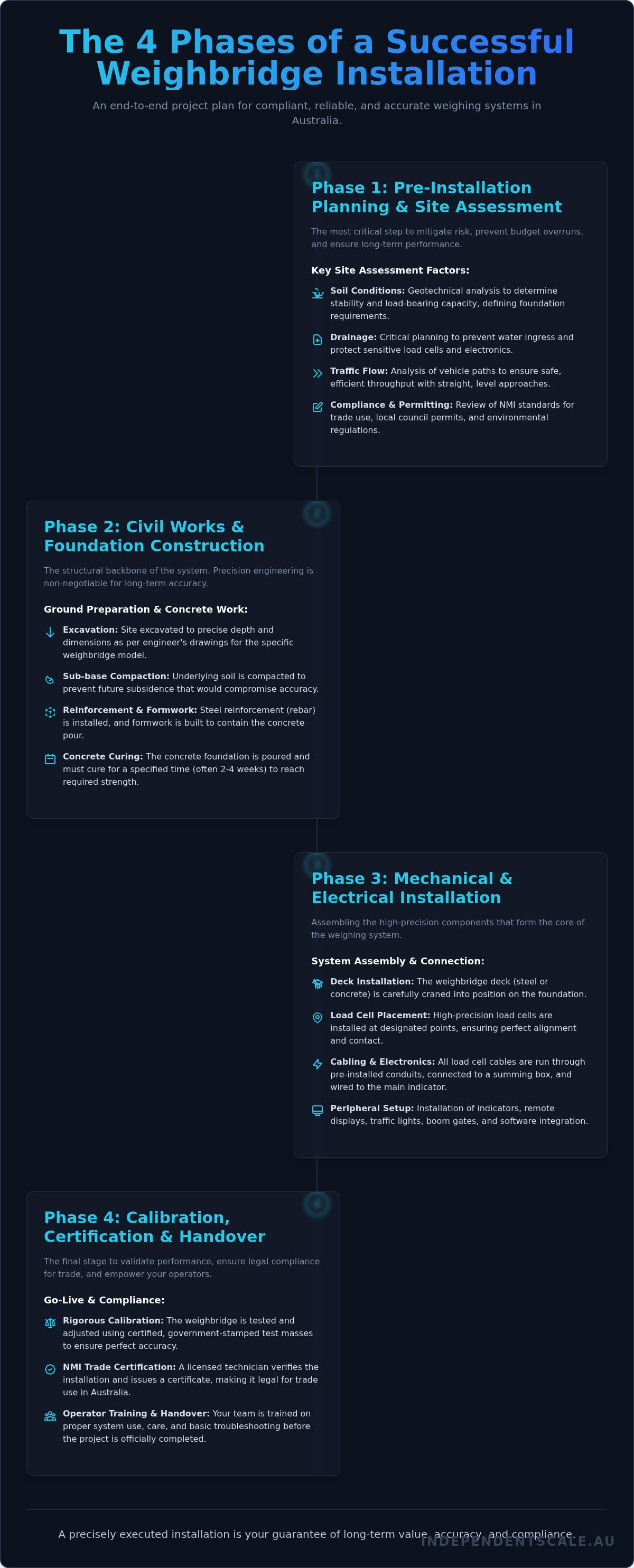
Phase 1: Pre-Installation Planning & Site Assessment
A successful weighbridge installation begins not with excavation, but with a comprehensive site assessment performed by experienced technicians. This critical first step mitigates risk, prevents costly project overruns, and ensures the final system is optimised for performance and longevity. Overlooking this phase is the most common source of long-term operational issues.
Our expert assessment evaluates several key environmental and logistical factors that directly impact the design and structural requirements of the weighbridge foundation. These include:
- Soil Conditions: A geotechnical analysis is essential to determine soil stability and load-bearing capacity, informing the necessary depth and reinforcement of the concrete foundations.
- Drainage: Proper water runoff and drainage planning are critical to prevent water ingress, which can damage sensitive load cells and summing circuits, leading to inaccurate readings and costly repairs.
- Traffic Flow: We analyse vehicle entry and exit paths to ensure safe and efficient throughput, recommending straight, level approaches of sufficient length for accurate weighing.
- Power & Data Access: The location of reliable power sources and data cabling for indicators, remote displays, and software integration is confirmed.
Choosing the Right Weighbridge Type
The site assessment directly informs the selection of the most suitable weighbridge. Each type offers distinct advantages based on available space, operational requirements, and budget. For those new to the topic, a general overview of What is a Weighbridge? can provide foundational context. Key options include:
- Pit Weighbridges: Installed flush with the ground, these are ideal for sites with limited space or where vehicles need to turn or cross over the scale.
- Above-Ground Weighbridges: The most cost-effective option, offering easier access for cleaning and maintenance. They require ramps for vehicle access.
- Semi-Pit & Portable Weighbridges: Specialised solutions offering a compromise for sloped sites or for temporary and mobile weighing needs.
- Deck Material: The choice between a steel or concrete deck depends on traffic volume, vehicle types, and environmental conditions.
Navigating Australian Standards & Legal Requirements
Compliance is non-negotiable. The planning phase must account for all relevant regulations to ensure your weighbridge is legally certified for use. This involves a detailed review of National Measurement Institute (NMI) requirements for any weighbridge used for trade purposes. We also ensure the design and civil works comply with local council permits and environmental regulations. Proper planning includes factoring in essential safety features like guardrails and planning for future needs, such as integration with automation systems or data management software, to ensure your investment remains valuable for years to come.
Phase 2: Civil Works & Foundation Construction
The success of any weighbridge installation hinges on the integrity of its foundation. This is not a stage where shortcuts can be taken. All civil works must be executed to precise engineering specifications, ensuring the structure can withstand immense, repetitive loads without shifting or degrading over time. The quality of this groundwork directly determines the long-term accuracy and reliability of the weighing system and is essential for meeting strict Australian trade measurement regulations.
This phase involves detailed ground preparation, structural reinforcement, and expert concrete work, forming the stable base upon which the entire system will rest.
Excavation and Base Preparation
The first physical step is to prepare the ground according to the engineer’s drawings. This is a methodical process that creates the necessary stable footprint for the foundation. Key actions include:
- Excavation: The site is excavated to the specified depth and dimensions required for the weighbridge model, whether it is a pit or an above-ground design.
- Sub-base Compaction: The underlying soil (sub-base) is compacted to achieve a specified load-bearing capacity. This prevents future subsidence that would compromise weighing accuracy.
- Conduit Installation: Conduits for electrical cables, load cell connections, and drainage pipes are strategically placed and secured before any concrete is poured.
- Levelling: The entire prepared area is precisely levelled to ensure the foundation cures correctly and provides a perfectly flat plane for the weighbridge deck.
Concrete Foundation and Curing
With the site prepared, the structural foundation is constructed. This involves building the formwork to define the shape of the foundation piers and slabs, followed by the placement of steel reinforcing mesh (rebar) to provide tensile strength. High-strength concrete is then poured, ensuring there are no voids or weaknesses.
Crucially, the concrete must be allowed to cure for its full recommended period-typically 21 to 28 days-to reach its designed compressive strength. Attempting to expedite this curing process is a critical error that will compromise the structural integrity of the entire weighbridge installation. Proper drainage systems must also be integrated at this stage to prevent water from pooling around or under the foundation, which can damage load cells and other critical components over time.
Phase 3: Mechanical & Electrical Component Installation
With the concrete foundation fully cured and prepared, the weighbridge installation process moves to its most critical phase: the assembly of the mechanical structure and the integration of its electronic components. This stage demands absolute precision, as the accuracy and long-term reliability of the entire system depend on the correct placement and connection of every part. All work must be performed by qualified technicians to ensure safety and compliance.
Installing the Weighbridge Deck and Load Cells
The process begins with the heavy lifting. Using a crane, technicians carefully lower the weighbridge deck sections onto the foundation. The next step is the precise placement of high-quality load cells, the core components that measure the weight. For a weighbridge to be used for trade, its design and components must be pattern-approved by the National Measurement Institute (NMI). Proper alignment is essential to ensure that a vehicle's load is distributed evenly across each cell. All mounting hardware is then secured and tightened to the manufacturer's specified torque settings to prevent shifting and ensure consistent, accurate performance.
Wiring and Peripheral Equipment Setup
Once the mechanical structure is secure, the focus shifts to the electrical system. Technicians meticulously connect the individual load cell cables to summing cards housed within sealed, IP-rated junction boxes. This protects sensitive electronics from moisture, dust, and electrical surges. A heavy-duty homerun cable is then run, typically through a protective conduit, from the junction box to the main weighbridge terminal or control room.
The final steps of the weighbridge installation involve installing and configuring the primary operator interface, including the digital indicators and displays that show the weight readings. Depending on your operational requirements, this is also when we integrate peripheral equipment, such as:
- Boom gates for traffic control
- Traffic lights (red/green) to guide drivers
- Large remote displays for driver visibility
- Unattended systems with card readers or RFID scanners
Correctly executing this phase ensures your weighbridge is not only functional but also compliant and accurate from day one. For expert installation services across Australia, contact the team at independentscale.au.
Phase 4: Calibration, Certification & System Handover
The final phase of your weighbridge installation transitions the project from a physical structure to a fully operational, legally compliant, and accurate weighing system. This stage is critical for validating the performance of your investment and ensuring it meets all regulatory requirements for commercial use. It culminates in the official handover, equipping your team with the knowledge to operate the system effectively.
The Calibration and Testing Process
Once construction is complete, a certified technician performs a comprehensive weighing scale calibration. This meticulous process involves applying known, certified test masses incrementally across the weighbridge's full capacity. The technician measures the system's response to verify accuracy, linearity, and repeatability. Any necessary electronic adjustments are made to ensure the weighbridge performs precisely to specification. Upon completion, a detailed calibration report is generated, providing a traceable record of the instrument's accuracy for your compliance and quality assurance files.
Achieving Trade Approval (NMI Certification)
For any weighbridge used for commercial transactions-selling or charging by weight-certification for trade use is a mandatory legal requirement in Australia. A verifier licensed by the National Measurement Institute (NMI) will inspect the entire weighbridge installation to ensure it meets the strict standards for accuracy and reliability. Key components are then sealed to prevent unauthorised tampering. Once verified, a Certificate of Approval is issued, officially permitting the weighbridge to be used for legal trade. This certification is essential for industries such as transport, waste management, quarrying, and agriculture.
Operator Training and Final Handover
The final step is the official handover of the completed system to your team. This ensures your staff can operate the equipment safely, correctly, and efficiently from day one. This process includes:
- Operational Training: Demonstrating correct procedures for weighing vehicles, using the digital indicator, and managing data.
- Routine Maintenance: Explaining daily operator checks, cleaning procedures, and identifying potential issues to minimise downtime.
- Documentation: Providing a complete handover package, including operator manuals, technical drawings, the calibration report, and the NMI Certificate of Approval.
- Service Schedule: Discussing an ongoing service and maintenance plan to maintain accuracy and compliance for the life of the asset.
A thorough handover ensures your weighbridge delivers maximum value and remains a reliable component of your operations. For expert calibration and certification services, contact the team at Independent Scale Service.
Ensure Your Weighbridge Project Delivers Lasting Value
As this guide demonstrates, a successful weighbridge is built on a foundation of precision at every stage. From the critical pre-installation site assessment and civil works to the technical component integration and final NATA-certified calibration, meticulous execution is non-negotiable for achieving long-term accuracy and operational compliance.
To guarantee your project adheres to the highest Australian standards, partner with a proven industry leader. Independent Scale Service brings over 30 years of direct experience to every weighbridge installation. As a NATA accredited service provider to ISO/IEC 17025, we deliver unparalleled expertise to clients across Sydney, Melbourne, and regional Australia. Ensure your investment is built for performance, reliability, and longevity.
Request a consultation for your weighbridge installation project.
Take the definitive step towards securing an accurate and fully compliant weighing solution for your business.
Frequently Asked Questions About Weighbridge Installation
How long does a typical weighbridge installation take?
The total timeline is primarily dictated by the civil works, which typically take 2-4 weeks to complete, accounting for excavation, formwork, and concrete curing. The mechanical and electrical installation of the weighbridge itself is significantly faster, usually requiring only 1-3 days. Meticulous planning and site preparation are critical to adhering to this schedule and minimising operational disruption. ISS coordinates all project stages to ensure an efficient and timely completion.
What are the main factors that influence the cost of a weighbridge installation?
The total cost of a weighbridge installation is influenced by several key variables. These include the weighbridge type (pit or above-ground), deck material (steel or concrete), length and capacity requirements, and the complexity of required civil works. Additional factors are the selection of digital versus analogue load cells, software integration, and peripherals like boom gates. A site assessment is essential for an accurate quotation, which can range from A$50,000 to over A$150,000.
Can an existing weighbridge be upgraded or relocated?
Yes, both upgrades and relocations are standard industry procedures. Upgrading an existing system can involve replacing load cells, installing a new digital indicator, or integrating advanced software for superior data management. Relocating a weighbridge is a complex task requiring professional decommissioning, transport, and re-installation on a newly constructed, compliant foundation. ISS provides expert analysis to determine the most cost-effective solution for your existing assets.
What kind of maintenance is required after a new weighbridge is installed?
Ongoing maintenance is essential for ensuring long-term accuracy and operational reliability. This includes routine cleaning of the weighbridge pit or surrounding area to prevent debris from affecting the load cells. We strongly recommend a scheduled preventative maintenance program, which involves professional inspection of all structural and electronic components. Regular calibration is also mandatory to maintain accuracy and compliance with industry or trade regulations.
What is the difference between a standard calibration and a NATA-accredited calibration?
A standard calibration verifies that a scale is weighing accurately against known masses, which is suitable for internal process control. A NATA-accredited calibration is a more rigorous process performed in accordance with ISO/IEC 17025. It provides an official, legally traceable certificate of accuracy that is essential for quality management systems and is a prerequisite for trade-approved scales. This offers the highest level of assurance and compliance.
How do I know if I need a trade-approved weighbridge?
In Australia, a trade-approved weighbridge is a legal requirement if the weight measurement is used to determine the price of a transaction. This is regulated by the National Measurement Institute (NMI). If your business buys or sells bulk goods like grain, scrap metal, or quarry products by weight, or if you use weight for calculating freight charges, you must use a certified, trade-approved system to ensure legal compliance.
