


Weighbridge Calibration Services NSW: NATA-Accredited Accuracy & Compliance
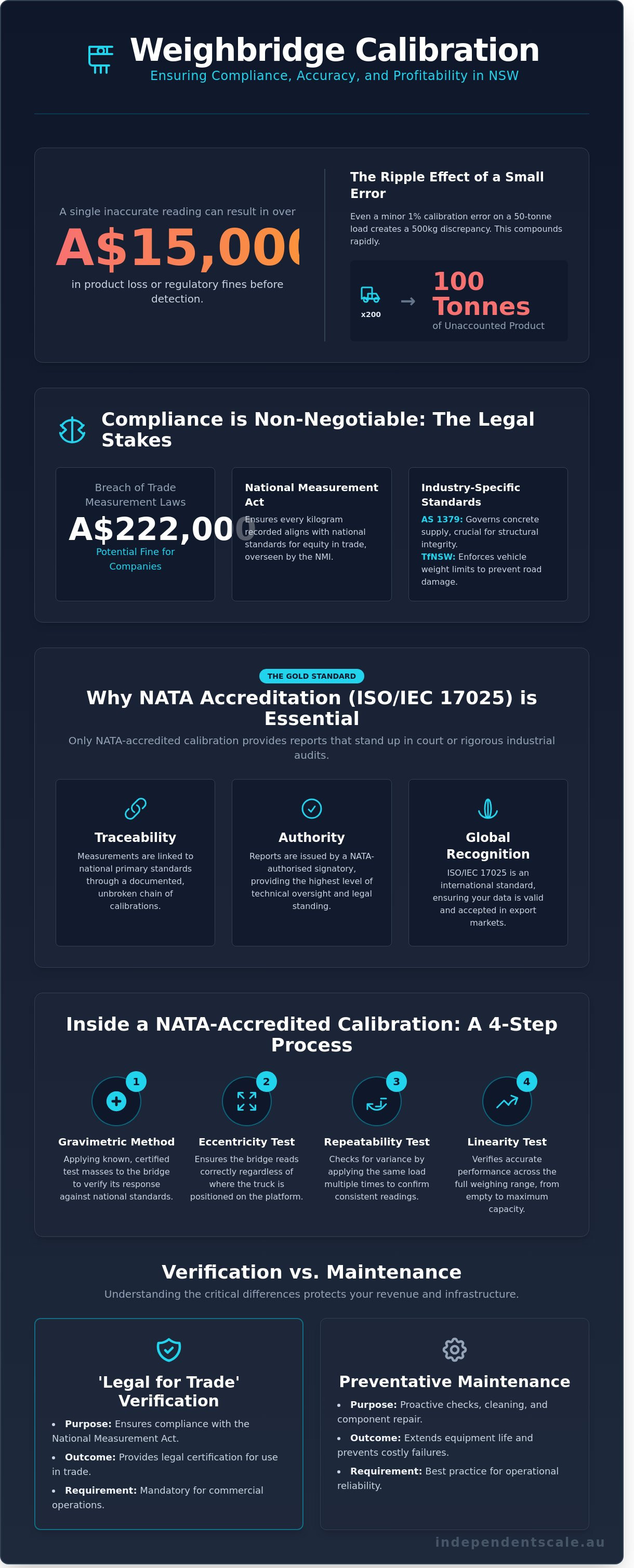
A single inaccurate reading on a high-volume weighbridge often results in over A$15,000 of unaccounted product loss or regulatory fines before the error is even detected. You understand that maintaining precise, trade-legal measurements is the foundation of a profitable industrial operation, yet finding reliable weighbridge calibration services NSW that don't halt your entire truck flow is often a logistical hurdle. Independent Scale Service leverages over 30 years of technical expertise to solve this. We provide NATA-accredited calibration that ensures your equipment remains fully compliant with the National Measurement Act while eliminating the risk of costly legal penalties.
Our team delivers documented, traceable accuracy that stands up to the most rigorous audit trails. You'll learn how our ISO/IEC 17025 accredited procedures minimize downtime and provide consistent service across all regional NSW locations. We'll examine the technical requirements for AS 1379 compliance and the specific gravimetric methods we use to guarantee your weighing systems perform to Australian standards every time.
Key Takeaways
- Understand the mandatory legal requirements under the National Measurement Act to ensure your weighing systems remain fully compliant with Australian standards.
- Learn how NATA-accredited gravimetric methods and precision load cell calibration guarantee the long-term accuracy of heavy-duty industrial scales.
- Identify the critical differences between 'Legal for Trade' verification and preventative maintenance to protect your commercial revenue and infrastructure.
- Discover strategic scheduling and pre-service inspection tips for weighbridge calibration services NSW to eliminate bottlenecks and minimise operational downtime.
- Review why ISO/IEC 17025 accreditation is the industry benchmark for technical competence in high-volume environments like Sydney’s concrete plants.
Understanding Weighbridge Calibration Requirements in NSW
Weighbridge calibration is the technical process of verifying a scale's accuracy using certified test masses. To maintain operational integrity, businesses must first understand what a weighbridge is and how its load cells interact with the weighing terminal. This process ensures that every kilogram recorded aligns with the National Measurement Act 1960. The National Measurement Institute (NMI) oversees these standards to ensure equity in trade across Australia.
Industrial hubs in New South Wales rely on precision. For example, the Port Kembla steel industry and Hunter Valley mining sector process millions of tonnes of material annually. Inaccurate weighing leads to direct revenue loss or severe legal disputes. If a weighbridge is out of tolerance by just 1%, a 50-tonne load results in a 500kg discrepancy. Over 200 loads, this equates to 100 tonnes of unaccounted product. It's a risk most businesses can't afford.
The consequences of non-compliance are significant. Fines for breaching trade measurement laws can reach A$222,000 for companies. Utilizing professional weighbridge calibration services NSW is the only way to mitigate these risks and ensure legal protection during audits.
NSW Regulatory Standards and AS 1379
In the NSW construction sector, AS 1379 governs the specification and supply of concrete. This standard requires strict weighing accuracy to ensure structural integrity of the final product. Transport for NSW also enforces strict vehicle weight limits to prevent road damage. High-volume industrial environments typically require calibration intervals every 6 months to maintain compliance. Regular testing prevents the measurement drift often seen in aging load cells.
The Importance of NATA Accreditation
NATA accreditation to ISO/IEC 17025 is the benchmark for technical competence. While many technicians offer basic testing, only a NATA-accredited laboratory provides a report that stands up in a court of law or a rigorous industrial audit. Key benefits include:
- Traceability: Measurements are linked to national primary standards through a documented chain.
- Authority: Reports are issued by a NATA-authorised signatory, providing a higher level of technical oversight than a standard technician.
- Global Recognition: ISO/IEC 17025 is recognized internationally, ensuring your data is valid for export markets.
For operations requiring weighbridge calibration services NSW, choosing an accredited provider ensures that your equipment meets both NMI and international standards. This level of certification is essential for maintaining an accurate audit trail.
The Technical Process: How NATA-Accredited Calibration Ensures Precision
NATA-accredited weighbridge calibration services NSW follow a rigorous gravimetric method. This process involves applying known, certified test masses to the bridge structure to verify its response. We start with load cell calibration to confirm each individual sensor performs within its specified tolerance. Every millivolt of signal must correlate exactly to the applied mass to maintain ISO/IEC 17025 standards.
Accuracy isn't just about the total weight; it's about consistency across the entire platform. Our technicians perform eccentricity tests to ensure the bridge reads correctly regardless of the truck's position. We follow this with repeatability tests, where the same load is applied multiple times to check for variance. Linearity tests then verify performance across the full scale, from empty to maximum capacity. This level of detail is critical for meeting the legal requirements for trade set by the National Measurement Institute.
Load Cells and Summing Circuits
During the calibration process, we often diagnose faults in industrial load cells that are invisible to the naked eye. NSW's high humidity and coastal salt air can corrode summing box connections, leading to signal drift or total system failure. We inspect the integrity of the summing circuit to ensure balanced output from all corners. To prevent expensive electrical damage from lightning or power spikes, we recommend installing surge arrestors within the weighing electronics.
Digital Indicators and Data Transmission
Precision requires a seamless link between the physical bridge and the control room. We calibrate digital indicators to ensure the visual output matches the physical load without lag. For sites using remote monitoring or PLC systems, signal conditioners must be scaled exactly to prevent data loss or rounding errors during transmission. We also verify that your weighbridge management software correctly interprets the calibration data for seamless record-keeping. If your current system is showing signs of age, you can view our full range of industrial weighing components to ensure your facility remains compliant and efficient.
Trade Verification vs. Preventative Calibration: Choosing the Right Standard
Understanding the distinction between trade verification and preventative maintenance is critical for operational compliance. In New South Wales, "Legal for Trade" status is a mandatory legal requirement whenever a financial transaction is based on the weight of goods. Whether you are selling grain by the tonne or charging for waste disposal, your equipment must be verified by a licensed technician. Operating a weighbridge for commercial use requires adherence to National Measurement Institute (NMI) standards to ensure consumer protection and fair competition.
Preventative maintenance calibration serves a different purpose. It focuses on the mechanical health and long-term accuracy of your infrastructure. Regular testing identifies drifting load cells or structural wear before they cause a total system failure. While standard truck scales often follow NMI patterns, concrete batching plant calibration must comply with AS 1379. This standard involves specific tolerances for additives and aggregates that differ from bulk weighing protocols. Selecting the correct standard for your annual audit depends entirely on your site's specific regulatory environment and output.
When is Verification Mandatory?
- New Installations: Every new weighbridge must undergo initial verification before it's used for trade. This confirms the unit was installed correctly and meets NMI type-approval.
- Post-Repair Requirements: Replacing a single load cell or adjusting the digital indicator triggers a legal requirement for re-verification. You cannot return a scale to trade use after a major repair without a new verification mark.
- The 12-Month Rule: For trade-active weighbridge calibration services NSW, a 12-month verification cycle is the industry benchmark for maintaining legal compliance and mitigating the risk of NMI audits.
Custom Calibration for Non-Trade Applications
Non-trade applications allow for tailored tolerances that match your internal process controls. Many industrial sites use hoppers and silos strictly for inventory management. In these cases, the focus is on repeatability and high-resolution data rather than trade certification. Safety is another primary driver for custom calibration. Axle weighers are essential for transport compliance, ensuring trucks don't exceed GVM limits before hitting public roads. By choosing weighbridge calibration services NSW tailored to your specific industrial tolerance, you balance operational efficiency with technical precision without the overhead of trade-specific documentation where it isn't legally required.
Best Practices for Minimising Downtime During Weighbridge Servicing
Operational downtime in heavy industry is a direct hit to the bottom line. For high-volume sites in the Sydney metro area, a non-functional weighbridge can stall more than 35 truck movements per hour, leading to significant logistical bottlenecks. Securing efficient weighbridge calibration services NSW requires proactive site management before the technician arrives. Efficiency begins with physical clearing. Debris, stones, and packed mud often lodge in the weighbridge pit or around T-section rubbers, causing mechanical binding that skews results. Clearing these areas ensures the technician can begin the gravimetric testing immediately without performing basic site cleaning at an hourly rate. This principle of proactive maintenance extends to the vehicles themselves; keeping a fleet clean is essential for operational readiness, and you can discover Washify to learn about professional mobile washing services for trucks and heavy machinery.
This proactive approach to site management extends beyond just weighing equipment. Ensuring your facility meets all its regulatory duties, including fire safety and emergency management compliance, is crucial for preventing operational disruptions and protecting your team. For businesses looking to streamline these obligations, specialists like ShieldComply offer expert guidance on maintaining a safe and fully compliant worksite in NSW.
- Pre-service inspection: Remove all build-up from the pit and inspect T-section rubbers for wear or displacement.
- Strategic Scheduling: Book calibration during off-peak windows. In Sydney, avoiding the 7:00 AM to 9:00 AM morning rush prevents heavy calibration trucks from being delayed in transit.
- Test Mass Coordination: Ensure a clear, 30-metre approach path for the heavy test unit. Obstructions like parked trailers or raw material stockpiles can add 45 minutes to a standard service.
- Documentation: Have previous NATA reports and the equipment's maintenance log ready. Technicians use this data to identify recurring drift patterns or load cell fatigue.
Site Preparation Checklist
Stability is the foundation of accuracy. Ensure the power supply to the weighing scale and digital indicator is consistent for at least 30 minutes before the service. Perform a visual inspection of the concrete deck for structural cracks or signs of shifting. Finally, alert gatehouse staff and regular drivers of the maintenance window. Clear communication prevents trucks from queuing at the scale while the NATA-accredited weights are being deployed.
Emergency Repairs and Fault Diagnosis
Sudden failures require immediate intervention. Industrial sites in NSW frequently face specific environmental challenges, including lightning strikes in the Hunter Valley or flooding in the Hawkesbury-Nepean region. These events often damage summing circuits or load cells. Accessing 24/7 emergency support is vital for 24-hour operations like concrete batching plants, where 98% of Sydney sites rely on rapid response to maintain AS 1379 compliance. A Preventative Maintenance Program (PMP) remains the most effective way to reduce these emergency calls. Data from over 30 years of servicing shows that sites with a quarterly PMP experience 65% fewer unscheduled outages than those relying on reactive repairs.
Expert Weighbridge Solutions: Why Independent Scale Service Leads in NSW
Independent Scale Service (ISS) delivers over 30 years of specialized experience to the New South Wales industrial sector. We currently maintain 98% of the concrete plants across the Sydney metropolitan area, ensuring precision for the state's largest construction projects. Our facility and field operations hold full NATA accreditation to ISO/IEC 17025. This certification isn't just a badge; it's a guarantee that your weighing equipment meets rigorous international benchmarks for traceability and technical competence. We go beyond simple platform scales, offering expert integration for tank and silo weighing assemblies and high-capacity industrial systems. Our service footprint covers the entire state, providing reliable weighbridge calibration services NSW from Sydney to the Hunter Valley and Illawarra regions.
The ISS Advantage: Authoritative Technical Support
Technical depth defines our service model. We stock a full range of critical components, including special purpose weighing pins and specialized shackle pins to resolve equipment failures immediately. For the concrete and construction industries, we provide specific expertise in AS 1379 compliance. You won't deal with a call center. You get direct access to senior technicians who understand the legal requirements of the National Measurement Act. This level of authoritative support prevents costly compliance breaches and ensures your weighbridge calibration services NSW are legally defensible and technically sound.
Booking Your NSW Weighbridge Calibration
Scheduling your calibration is a streamlined process designed for heavy industry. Whether you require a one-off verification or a multi-site annual program, we provide detailed quotes that account for your specific operational constraints. We know that downtime costs money. Our technicians work to maximize your uptime by coordinating visits with your production cycles. Every calibration includes a comprehensive report and NATA-endorsed certification.
Contact Independent Scale Service for NATA-Accredited Calibration to discuss your site requirements and book a technician. Our team is ready to ensure your facility remains compliant and accurate.
Secure Your Operational Compliance and Accuracy
Maintaining weighbridge precision is essential for legal trade and operational efficiency across New South Wales. Choosing NATA-accredited weighbridge calibration services NSW ensures your equipment meets ISO/IEC 17025 standards and remains compliant with Australian trade regulations. Independent Scale Service provides the technical expertise required to manage these critical assets. We currently service 98% of Sydney's concrete plants, demonstrating our reliability in high-stakes industrial environments. Our team understands that downtime costs money; that's why we offer 24/7 emergency support to keep your scales operational. Whether you need mandatory trade verification or a preventative maintenance schedule, we deliver the accuracy your business demands. Accurate weighing protects your profit margins and ensures your site stays within the law. Don't risk heavy fines or lost revenue due to weighing errors. We're ready to secure your site's compliance today.
Request a NATA-Accredited Weighbridge Calibration Quote
Frequently Asked Questions
How often should a weighbridge be calibrated in NSW?
In NSW, weighbridges used for trade must be verified every 12 months under the National Measurement Act 1960. High-usage industrial sites often opt for 6-month intervals to maintain accuracy and prevent measurement drift. Independent Scale Service provides weighbridge calibration services NSW wide to ensure your equipment remains within the maximum permissible error limits. Regular testing prevents financial losses caused by 1% to 2% inaccuracies in bulk material weighing.
What is the difference between NATA-accredited and traceable calibration?
NATA-accredited calibration is performed under ISO/IEC 17025 standards and provides a higher level of technical competence and legal defensibility. Traceable calibration involves comparing equipment against a known standard but lacks the rigorous external auditing and formal recognition of a NATA laboratory. For civil construction and government contracts, NATA-endorsed reports are frequently mandatory to meet specific quality assurance requirements.
Is weighbridge calibration mandatory for legal trade in Australia?
Yes, it's a legal requirement under the National Measurement Act 1960 for any scale used to determine price based on weight. Trade-certified weighbridges must be verified by a Licensed Repairer to ensure they meet National Measurement Institute standards. Using an unverified weighbridge for commercial transactions can result in fines exceeding A$20,000 per offence for corporations. It's essential to keep your verification current to avoid legal penalties and commercial disputes.
Can you calibrate weighbridges in regional NSW locations like Dubbo or Orange?
We provide comprehensive weighbridge calibration services NSW wide, including regional hubs such as Dubbo, Orange, and Bathurst. Our mobile test units carry up to 20 tonnes of certified test masses to ensure accurate testing in remote locations. We currently service 98% of concrete plants across Sydney and maintain a regular service schedule for regional industrial clients to minimize travel costs and ensure local compliance.
What happens if my weighbridge fails its calibration test?
If your weighbridge fails, our technicians perform immediate diagnostics on components like load cells, summing circuits, or structural mounts. We offer 24x7 emergency repairs to rectify issues and re-test the system on the same day. Our goal is to minimize downtime, as an out-of-tolerance weighbridge can cost a business over A$1,500 in daily lost revenue through inaccurate billing and inventory errors.
How long does a standard weighbridge calibration service take?
A standard weighbridge calibration typically takes between 2 and 4 hours to complete. This timeframe includes the initial inspection, zero-point checks, repeatability tests, and eccentric loading assessments using certified weights. More complex 8-section weighbridges may require up to 6 hours for a full NATA-accredited verification. We schedule these services to align with your site's lowest traffic periods to ensure minimal operational disruption.
Do you provide calibration for concrete batching plant scales as well?
We specialize in the calibration of concrete batching plant scales in accordance with AS 1379 standards. This includes the gravimetric method calibration for water, cement, and aggregate scales. With over 30 years of experience, we ensure your plant meets the strict tolerances required by major contractors like Holcim, Boral, and Hanson. Accurate batching is essential for maintaining concrete strength and structural integrity on civil projects.
What documents will I receive after a NATA calibration service?
You'll receive a formal NATA-endorsed calibration report that complies with ISO/IEC 17025 requirements. This document details the "as found" and "as left" data, measurement uncertainty, and traceability to national standards. These reports are essential for ISO 9001 audits and legal-for-trade compliance. We also provide a certificate of verification for your records to satisfy National Measurement Institute inspectors during routine site visits.
