


Vehicle Scales: A Complete Guide for Australian Industry
In Australian industry, inaccurate vehicle weight data represents a significant financial and legal liability. From steep fines for overloaded vehicles to breaches of Chain of Responsibility (CoR) laws and inaccurate billing for bulk materials, the risks associated with improper weighing are substantial. Selecting and implementing the correct vehicle scales is therefore not an operational choice, but an essential component of risk management, logistical efficiency, and commercial integrity.
This comprehensive guide provides the critical information required to navigate the complexities of vehicle weighing systems. We will detail the operational differences between permanent weighbridges and portable axle weighers, examine their specific applications, and clarify the essential compliance requirements for legal-for-trade use in Australia. The objective is to equip your business with the knowledge to select a durable, accurate, and compliant weighing solution that protects your operations and ensures precise data for all commercial and regulatory purposes.
Key Takeaways
- Understand how vehicle scales ensure you meet Chain of Responsibility (CoR) laws and conduct accurate, legally-approved commercial transactions.
- Differentiate between portable axle weighers and permanent weighbridges to determine which system best matches your operational throughput and site flexibility.
- Develop a clear purchasing framework by evaluating key factors like vehicle volume, site constraints, and required accuracy, moving beyond the initial purchase price.
- Recognise that professional installation and NATA-accredited calibration are essential for ensuring long-term accuracy and legal compliance in Australia.
What Are Vehicle Scales? Understanding Their Role in Industry
Vehicle scales are robust systems engineered to determine the weight of a wide range of vehicles, from light commercial vans to multi-trailer road trains. Commonly known as weighbridges, their primary function in an industrial context is to provide precise weight data for three critical purposes: ensuring legal compliance, enhancing operational safety, and facilitating commercial trade. For a technical overview of their design and function, it is useful to understand What is a Truck Scale (or Weighbridge)? These systems are fundamental for capturing essential metrics such as Gross Vehicle Mass (GVM), tare weight (the vehicle's empty weight), and individual axle loads. In any professional operation, the accuracy of this data is not just a preference-it is a legal and financial necessity.
Why Accurate Vehicle Weighing is Critical for Business
For industries reliant on transport and bulk materials, precise weight measurement is a non-negotiable component of operational integrity. Inaccurate weighing introduces significant risk and inefficiency, impacting everything from legal standing to profitability. Key operational benefits include:
- Compliance with CoR Laws: Meeting Chain of Responsibility (CoR) obligations is mandatory. Accurate weight checks prevent overloading, helping businesses avoid substantial fines and legal penalties.
- Accurate Commercial Transactions: For goods sold by weight, such as aggregates, grain, or waste, certified scales ensure fair and accurate billing, protecting revenue for suppliers and ensuring value for buyers.
- Safety and Asset Protection: Overloaded vehicles are a major safety hazard and cause accelerated wear on tyres, brakes, and suspension. Correct loading reduces maintenance costs and enhances road safety.
- Modern Fleet Maintenance: Just as weight management protects traditional components, specialized diagnostics are vital for modern vehicles. For the growing number of electric and hybrid fleets, independent battery health checks, like those offered by EVdiagnostika.si, are essential for protecting asset value and ensuring performance.
- Logistics Optimisation: Precise tracking of inbound and outbound material flow allows for superior inventory management, load planning, and overall supply chain efficiency.
Industrial vs. Recreational Scales: A Key Distinction
It is crucial to differentiate between professional industrial scales and those designed for recreational use, like caravan scales. Industrial vehicle scales are engineered for high-capacity, high-traffic environments. They are constructed from steel and concrete to withstand extreme loads and harsh conditions. Most importantly, for commercial use, they must be 'trade-approved' (NMI certified in Australia) to ensure their accuracy meets stringent legal standards. In contrast, recreational scales have low capacities, are not built for industrial durability, and lack the legal certification required for commercial transactions. They are unsuitable for any business application where weight is used for billing or compliance.
Types of Industrial Vehicle Scales: Axle Weighers vs. Weighbridges
Selecting the appropriate industrial vehicle scale system involves a critical trade-off between portability, accuracy, and operational throughput. The decision directly impacts efficiency, data reliability, and legal compliance. In Australia, ensuring vehicles are not overloaded is a fundamental requirement under the National Heavy Vehicle Law, with significant legal implications outlined in the Chain of Responsibility (CoR). The two primary categories of vehicle scales are axle weighers and full-length weighbridges, each designed for distinct operational needs.
Portable Axle Weighing Pads
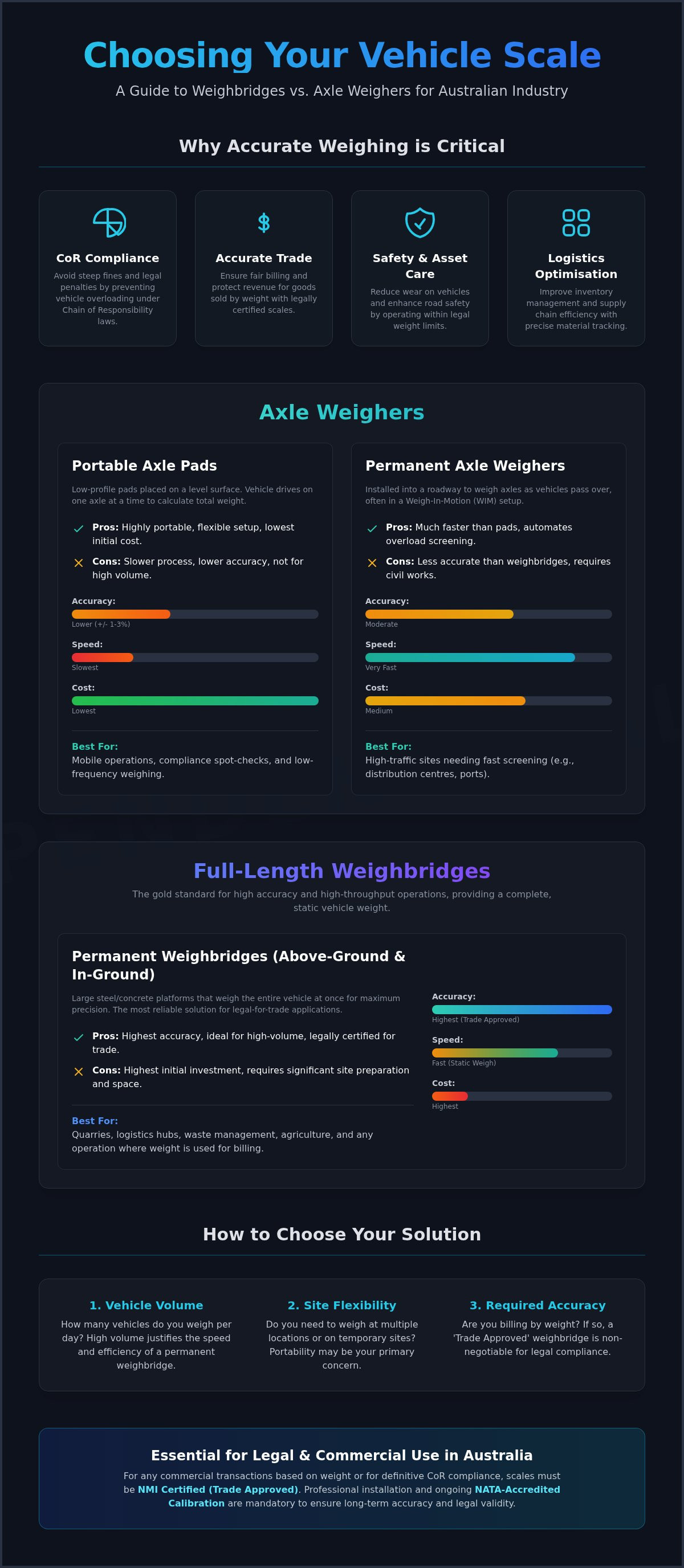
These systems consist of low-profile, high-capacity pads placed on a firm, level surface. A vehicle drives onto the pads one axle at a time to calculate the total gross weight. They are valued for their flexibility and lower entry cost.
- Pros: Highly portable for use across multiple sites, flexible setup, and the lowest initial capital outlay.
- Cons: Slower weighing process, lower accuracy (typically +/- 1-3%) compared to weighbridges, and not suitable for high-volume operations.
- Best for: Mobile operations, compliance spot-checks, and businesses with low-frequency weighing requirements.
Permanent Axle Weighers
Installed directly into a roadway or entrance, these scales weigh each axle as a vehicle drives over them, often without stopping in a Weigh-In-Motion (WIM) configuration. They serve as an effective screening tool.
- Pros: Significantly faster than portable pads and can automate the screening process for overloaded vehicles.
- Cons: Less accurate than a static full-length weighbridge and requires permanent civil works for installation.
- Best for: High-traffic sites needing to screen for potential overloads without creating bottlenecks, such as distribution centres or port entrances.
Full-Length Weighbridges (Truck Scales)
Also known as truck scales, these are large, permanent platforms that weigh the entire vehicle in a single, static measurement. This is the industry standard for high-accuracy and trade-approved weighing.
- Pros: Highest level of accuracy (often to +/- 0.1%), fastest throughput for individual weighments, and can be certified for trade use by NMI Australia.
- Cons: Highest initial cost (often starting from A$50,000+), requires a significant footprint, and involves extensive foundation and civil works.
- Best for: Quarries, waste transfer stations, agricultural depots, and any high-volume facility where billing is based on weight.
At-a-Glance Comparison
| Feature | Axle Scales | Full-Length Weighbridge |
|---|---|---|
| Accuracy | Lower (Screening/Check-Weighing) | Highest (Trade Approved) |
| Throughput | Low to Medium | High |
| Portability | High (Pads) to None (Permanent) | None (Fixed Installation) |
| Initial Cost (AUD) | Low to Moderate | High |
| Installation | Minimal (Pads) to Moderate (Permanent) | Extensive Civil Works Required |
How to Choose the Right Vehicle Scale for Your Operation
Selecting the correct vehicle scale is a critical capital investment that impacts operational efficiency and profitability for years. The decision must extend beyond the initial purchase price to a comprehensive analysis of your specific operational requirements. A thorough assessment of vehicle types, traffic volume, site layout, and data management needs is essential to future-proof your investment and ensure long-term reliability.
Factor 1: Assess Your Traffic and Throughput
Consider the daily volume and type of vehicles requiring weighing. An operation weighing ten rigid trucks per day has vastly different needs from a quarry processing hundreds of B-doubles. For high-throughput environments, the weighing process must be rapid to prevent operational bottlenecks, a factor that heavily influences the choice of scale design and automation features. Key questions to answer include:
- Volume: How many weighing transactions are required per hour or day?
- Vehicle Types: What is the maximum length and gross weight of vehicles (e.g., semi-trailers, road trains)? This dictates the necessary scale length and capacity.
- Process Speed: Is unmanned, 24/7 operation required to maximise efficiency?
Factor 2: Analyse Your Site and Environment
A professional site assessment is non-negotiable. This includes verifying adequate space for the scale deck plus the required straight, level approaches for accurate measurement. The choice between a pit installation (space-efficient but requires drainage) and a pitless design (simpler maintenance but needs ramps) depends on your site. Furthermore, environmental conditions dictate material selection:
This process often involves traffic flow analysis and vehicle maneuvering assessments to ensure the weighbridge placement doesn't create bottlenecks. For this specialized planning, consultancies such as ML Traffic Engineers Pty Ltd can provide expert guidance on site layout and design.
- Steel Deck: Faster to install and suitable for many applications, but requires robust protective coatings in corrosive or wet environments.
- Concrete Deck: Offers superior durability and corrosion resistance, making it ideal for high-volume, heavy-duty use in harsh industrial or agricultural settings.
Factor 3: Determine Your Data and Software Needs
Define your data requirements. Do you need a simple weight ticket, or a sophisticated system that manages data and integrates with your business software? Modern vehicle scales can be equipped with advanced software for detailed reporting, inventory management, and invoicing. Peripherals such as driver-operated terminals, traffic lights, and boom gates can automate the entire weighing cycle, improving accuracy and throughput. For commercial applications, the entire system must be 'legal for trade' and adhere to strict Australian trade weighbridge regulations set by the National Measurement Institute (NMI). Confused by the options? Our experts can help you choose.
Installation, Calibration, and Legal Compliance in Australia
Acquiring a vehicle scale is a significant investment, but it is only the first step. To ensure accuracy, longevity, and legal compliance in Australia, the subsequent processes of professional installation, NATA-accredited calibration, and ongoing maintenance are mission-critical. All weighing instruments used for trade must comply with regulations set by the National Measurement Institute (NMI), the peak body for measurement standards.
The Vehicle Scale Installation Process
A precise installation is the foundation of a reliable weighing system. This multi-stage technical project prevents future inaccuracies and costly repairs, and typically involves:
- Civil Works: An engineered concrete foundation with proper drainage and level approaches is essential to prevent shifting, water damage, and inconsistent readings.
- Mechanical Assembly: The weighbridge deck or axle weigher platforms must be correctly positioned and assembled to distribute weight evenly across the load cells.
- Electronics & Load Cell Integration: Expert technicians install and connect the load cells, summing circuits, and digital indicators, ensuring all components communicate flawlessly for accurate measurement.
Why NATA Calibration is Non-Negotiable for Trade Use
For any commercial transaction based on weight-such as selling scrap metal, grain, or quarry products-your scale must be certified as ‘Legal for Trade’. NATA (National Association of Testing Authorities) accreditation to ISO/IEC 17025 provides independent assurance of a calibration provider's technical competence. Using unverified scales poses significant risks, including NMI-issued fines, commercial disputes, and revenue loss. NATA-certified calibration ensures fairness for both buyer and seller, protecting your business’s reputation and bottom line.
Ongoing Maintenance to Maximise Uptime and Accuracy
High-capacity vehicle scales are precision instruments operating in harsh environments. Proactive maintenance is essential to maximise uptime and preserve accuracy. Regularly remove mud, gravel, and other debris from beneath the weighbridge, as this build-up can impede free movement and cause reading errors. Beyond daily cleaning, a structured schedule of professional inspections is required to check for component wear and drift. To maintain compliance and ensure your measurements are always defensible, periodic recalibration is non-negotiable. Protect your investment and ensure continued compliance. Schedule your NATA-accredited calibration service today.
Secure Your Operational Integrity with Expert Weighing Solutions
Selecting the appropriate vehicle scales-whether an axle weigher for flexibility or a full-length weighbridge for high-volume throughput-is a critical decision that directly impacts operational efficiency and data integrity. Furthermore, professional installation, regular calibration, and strict adherence to Australian legal-for-trade requirements are not just best practices; they are essential for maintaining compliance and avoiding costly disruptions.
Navigating these technical and regulatory complexities requires specialist knowledge. With over 30 years of industry experience, Independent Scale Service provides proven expertise. As specialists in industrial calibration and repair, our NATA Accreditation to ISO/IEC 17025 guarantees that every solution we provide meets the highest standards of accuracy and compliance. Don't leave your operational integrity to chance.
Speak with our industrial weighing experts to find the right solution. Take the definitive step towards optimised weighing and guaranteed compliance for your Australian operation.
Frequently Asked Questions About Vehicle Scales
How much does a weighbridge cost in Australia?
The cost of a weighbridge in Australia varies significantly based on specifications. A standard, full-length weighbridge can range from A$60,000 to over A$120,000. Key factors influencing the final price include the deck material (steel or concrete), length and capacity requirements, installation type (above-ground or in-ground pit), and the sophistication of the associated software. Civil works, such as the concrete slab and approaches, also represent a substantial component of the total project cost.
Are vehicle scales 'Legal for Trade'?
For a vehicle scale to be 'Legal for Trade' in Australia, it must comply with strict regulations set by the National Measurement Institute (NMI). This involves obtaining NMI pattern approval for the design and having the specific installation verified by a licensed technician. This verification ensures the scale's accuracy and reliability for commercial transactions, such as selling goods by weight. Scales used only for internal process control or Chain of Responsibility (CoR) checks may not require this certification.
How often do industrial vehicle scales need to be calibrated?
The required calibration frequency for industrial vehicle scales depends on their use and operating environment. For 'Legal for Trade' applications, the National Measurement Institute (NMI) mandates re-verification at least every 12 months. For high-volume or harsh environments, more frequent calibration-such as quarterly or semi-annually-is essential to maintain accuracy, ensure compliance, and prevent costly errors. Regular servicing by a NATA-accredited technician is the best practice for maintaining optimal performance.
What is the difference between a weighbridge and a truck scale?
In Australia, the terms 'weighbridge' and 'truck scale' are used interchangeably to describe a large set of scales, permanently installed, used for weighing entire road vehicles. There is no technical or functional difference between them in the local industry context. Both terms refer to the same type of heavy-capacity weighing system, whether it is an in-ground pit design or an above-ground installation. The choice of term is typically a matter of regional or company preference.
Can I install a vehicle scale myself?
Self-installation of a vehicle scale is not recommended and is unfeasible for a compliant system. The process requires precise civil engineering for the foundations, specialised lifting equipment for the deck, and expert knowledge for installing and wiring sensitive load cells and electronics. Crucially, a licensed technician must perform the final calibration and verification to ensure the scale meets NMI accuracy standards. Professional installation is essential for safety, accuracy, and regulatory compliance.
What is the lifespan of a typical weighbridge?
A well-maintained weighbridge has a typical operational lifespan of 15 to 25 years. Longevity is heavily influenced by the quality of construction, deck material, traffic volume, and the consistency of the preventative maintenance schedule. Regular cleaning, inspection, and professional calibration are critical to maximising the lifespan of the load cells, structural components, and overall system integrity. A proactive maintenance plan is the most effective way to protect your capital investment.
