


Vehicle Axle Weighing Regulations Australia: The 2026 Compliance Guide
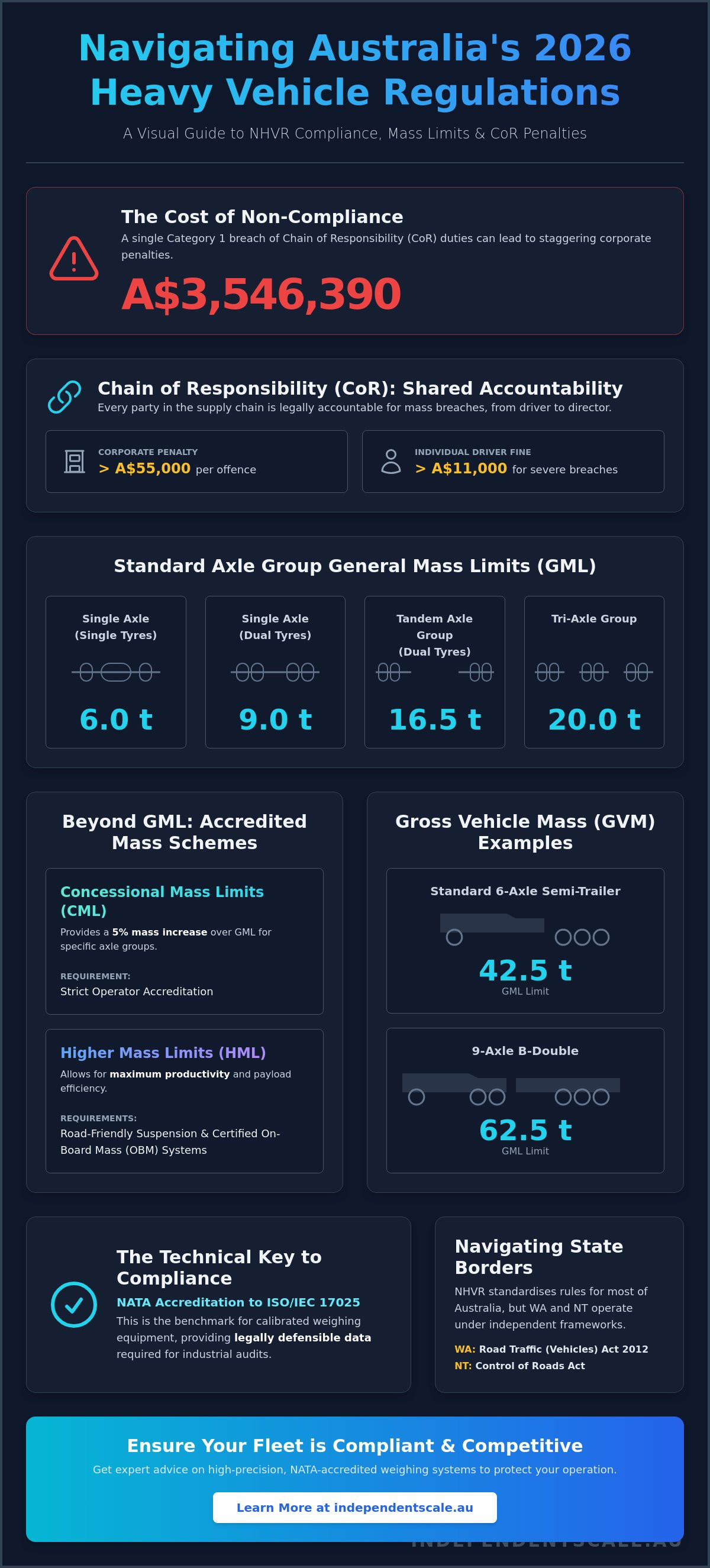
Under the Heavy Vehicle National Law, a single category 1 breach of Chain of Responsibility (CoR) duties can result in corporate penalties of A$3,546,390. Maintaining precise mass limits across every axle is no longer just a safety preference. It's a critical legal requirement for 2026. You understand that regional variations and uncalibrated equipment often lead to unexpected downtime and severe financial risk. This guide simplifies the complex landscape of vehicle axle weighing regulations Australia to ensure your fleet remains fully compliant with National Heavy Vehicle Regulator (NHVR) standards.
You'll gain the technical knowledge to manage mass limits effectively and protect your operation from avoidable audits. We examine the latest NHVR mass requirements, the necessity of NATA-accredited calibration to ISO/IEC 17025, and how to verify weighing accuracy to eliminate road damage and legal liability. This technical breakdown ensures your weighing systems provide the accredited proof of accuracy required for rigorous industrial audits and long term operational reliability.
Key Takeaways
- Understand the updated 2026 NHVR standards and how General Mass Limits (GML) dictate heavy vehicle access to Australian road infrastructure.
- Navigate the specific allowable weights for single, tandem, and tri-axle groups to ensure your vehicle configuration remains within legal GVM tolerances.
- Identify the critical legal obligations under the Chain of Responsibility (CoR) to mitigate shared liability across your entire transport supply chain.
- Learn why NATA accreditation to ISO/IEC 17025 is the technical benchmark for meeting vehicle axle weighing regulations Australia and securing legally defensible data.
- Discover how to select high-precision industrial load cells and indicators that maintain regulatory accuracy in demanding heavy-duty environments.
Understanding Australian Vehicle Axle Weighing Regulations in 2026
The National Heavy Vehicle Regulator (NHVR) oversees more than 1.1 million heavy vehicles across most of Australia. In 2026, the regulator's focus remains on data-driven compliance to protect the nation's A$500 billion road infrastructure. Precise vehicle axle weighing regulations Australia are necessary because axle overloads cause exponential damage to pavement surfaces compared to balanced loads. Accurate vehicle weight and axle ratings ensure that no single point of contact exceeds the road's structural capacity.
While the NHVR standardises rules in most regions, Western Australia and the Northern Territory operate under independent legislative frameworks. WA follows the Road Traffic (Vehicles) Act 2012, while the NT uses the Control of Roads Act. These differences mean a vehicle compliant in Queensland might breach regulations when crossing into WA. Operators must verify axle loads using regularly calibrated weighing equipment to maintain legal standing across all borders. It's a technical requirement that directly impacts operational uptime and safety.
The Role of the National Heavy Vehicle Law (NHVL)
The NHVL serves as the primary legislative instrument for standardising mass, dimension, and loading requirements. By 2026, safety standards have evolved to include stricter digital reporting and verification protocols. The law enforces the Chain of Responsibility (CoR), meaning every party in the supply chain is accountable for mass breaches. Non-compliance results in heavy financial hits. Individual drivers face fines exceeding A$11,000 for severe breaches, while corporate penalties can surpass A$55,000 per offence. These figures reflect the 2025, 2026 penalty adjustments aimed at reducing road trauma and maintenance costs.
General Mass Limits (GML) vs. Accredited Mass Schemes
General Mass Limits (GML) represent the baseline allowable weight for heavy vehicles without specific accreditation. For a standard six-axle semi-trailer, the GML is 42.5 tonnes. To exceed these limits, operators must join the National Heavy Vehicle Accreditation Scheme (NHVAS). There are two primary upgrades to consider:
- Concessional Mass Limits (CML): Provides a 5% increase over GML for specific axle groups, subject to strict operator accreditation.
- Higher Mass Limits (HML): Allows for maximum productivity but requires the vehicle to use road-friendly suspension and certified telematics.
Operating under these schemes isn't a right; it's a privilege based on proven compliance. Operators must demonstrate that their internal weighing processes are robust and their equipment is maintained to industrial standards. Failure to meet these criteria leads to immediate suspension from the scheme and a return to restrictive GML levels. Precise measurement isn't just about avoiding fines; it's about maintaining the certifications that allow your fleet to remain competitive and profitable.
Axle Group Mass Limits and Dimension Requirements
Compliance with 2026 standards requires a granular understanding of how mass is distributed across specific axle groups. The Heavy Vehicle (Mass, Dimension and Loading) National Regulation defines these limits to prevent infrastructure damage and ensure braking efficiency. Failure to adhere to these specifications results in significant penalties and potential vehicle grounding during roadside inspections.
Standard Axle Group Weight Limits
Under General Mass Limits (GML), the maximum allowable weight depends on tyre configuration and axle count. A single axle with dual tyres is capped at 9.0t, while a single axle with single tyres is limited to 6.0t. For tandem axle groups with dual tyres, the standard limit is 16.5t. Tri-axle groups are restricted to a 20.0t cap under GML. Operators must consult the National Heavy Vehicle Regulator mass limits to determine if their vehicle qualifies for Concessional Mass Limits (CML) or Higher Mass Limits (HML), which can increase these thresholds by up to 2.5t for tri-axle groups.
Vehicle configuration dictates the total Gross Vehicle Mass (GVM). A standard 6-axle semi-trailer is typically limited to 42.5t GML, whereas a 9-axle B-double can reach 62.5t. Axle spacing is critical; insufficient distance between groups increases the "point load" on road surfaces, often resulting in a reduced allowable mass for that specific combination. For twin-steer prime movers, 2026 vehicle axle weighing regulations Australia mandate precise monitoring of the steering group. This often requires integrated load cells to maintain the 11.0t limit for twin-steer groups with load-sharing suspension.
Measuring Vehicle Dimensions and Overhangs
Dimension compliance is as critical as mass. The standard legal width for heavy vehicles in Australia remains 2.5 metres. Height is generally capped at 4.3 metres, though 4.6 metres is permitted for specific high-volume configurations like livestock or car carriers. Rear overhang must not exceed 60% of the wheelbase or 3.7 metres, whichever is less. Front load projection is limited to 1.2 metres from the front of the vehicle. If a load exceeds these dimensions, operators must secure an Oversize Overmass (OSOM) permit and may require pilot vehicle escorts for widths exceeding 3.5 metres.
Accurate measurement ensures you avoid the heavy fines associated with vehicle axle weighing regulations Australia. It's essential to verify your on-board monitoring systems against certified ground scales. To ensure your hardware remains within these tight tolerances, professional weighing scale calibration is the only way to guarantee the technical accuracy required for 2026 compliance.
Chain of Responsibility (CoR): Legal Accountability for Weighing
The Heavy Vehicle National Law (HVNL) dictates the Chain of Responsibility (CoR) framework within the Australian transport industry. It's a legal principle ensuring that anyone with control over a transport task shares responsibility for safety and compliance. This means liability for axle weight breaches isn't restricted to the driver. Under vehicle axle weighing regulations Australia, every party that influences the loading process can be prosecuted if a vehicle hits the road over its mass limit. The law recognizes that off-road parties often create the conditions that lead to on-road offences.
To avoid prosecution, businesses rely on the "Reasonable Steps" defense. You must prove you didn't know, and couldn't reasonably have been expected to know, that a breach occurred. Proving this requires a documented Safety Management System (SMS). In 2023, the National Heavy Vehicle Regulator (NHVR) conducted over 4,000 roadside inspections where mass was a primary focus. Companies without verified weighing records faced immediate scrutiny. You need evidence of training, risk assessments, and regular equipment calibration to satisfy investigators.
Penalties for non-compliance are severe. A single Category 1 breach can result in fines exceeding A$3,500,000 for corporations. Individual directors face personal fines of A$350,000 or custodial sentences. A 2022 NSW court case saw a consignor fined A$80,000 for failing to verify the weight of a shipping container. This proves that "I didn't know" is no longer a valid legal excuse in the eyes of Australian regulators.
Who is Responsible Under CoR?
Responsibility extends to every link in the chain. Consignors must ensure loads are accurately described; packers must secure items to prevent weight shifts; and loaders must verify axle distributions. The 2026 regulations increase the burden of proof on executive officers. They must demonstrate active due diligence. Fleet managers are now required to maintain digital records of every weight check. These logs act as the first line of defense during an NHVR audit. Accurate data from calibrated scales is the only way to mitigate these legal risks effectively.
Managing Overload Risks at the Point of Loading
Concrete batching plants represent a high-risk environment for axle overloads. Implementing robust weighing protocols is critical for operational safety. Automated weighbridge systems provide real-time data that eliminates human error. These systems integrate directly with dispatch software to block overloaded vehicles from exiting the site. For operations requiring high precision, Concrete Batching Plant Calibration ensures compliance with AS 1379 standards. Regular NATA-accredited testing prevents the financial and legal fallout of non-compliant loads. Accurate weighing at the source is the most effective way to maintain CoR compliance.
NATA Calibration: The Technical Key to Regulatory Compliance
Adhering to vehicle axle weighing regulations Australia requires more than just owning a scale; it demands proof that equipment remains accurate under load. Standard calibration is often insufficient for legal weighing evidence. While a basic check confirms the scale functions, it doesn't provide the traceability required by the National Heavy Vehicle Regulator (NHVR). Independent Scale Service provides NATA-accredited calibrations that meet the stringent requirements of ISO/IEC 17025. It's the only globally recognised proof of accuracy.
For operators in the concrete production and transport sector, AS 1379 compliance is a mandatory operational requirement. We currently service 98% of concrete plants across Sydney, ensuring their batching and transport weighing systems meet these specific Australian Standards. Calibration intervals typically range from six to twelve months. High-volume sites or those operating in harsh environments often require quarterly certification to mitigate the risk of drift and subsequent non-compliance.
ISO/IEC 17025 Accreditation Explained
A standard test is a simple comparison against a known mass. A NATA-certified calibration is a rigorous technical assessment of the entire weighing system, including uncertainty measurements and traceability to national standards. Without this, your weight data may be dismissed in legal proceedings. You can view our full range of weighing scale calibration services to understand the technical requirements for your specific hardware.
Proving Accuracy During an NHVR Audit
Auditors don't just look for a sticker on the scale. They examine the calibration log and the specific load cell data for every piece of vehicle weighing equipment. Under vehicle axle weighing regulations Australia, a NATA certificate serves as the primary legal defense during weight disputes. Maintaining a clear, dated log of all certifications proves a commitment to the Chain of Responsibility. If a dispute arises over an axle load, the NATA endorsement provides the technical weight needed to challenge a fine.
Protect your business from compliance failures by scheduling NATA-accredited AS 1379 compliance checks with our expert team today.
Industrial Weighing Hardware for Compliance and Accuracy
Adhering to vehicle axle weighing regulations Australia requires more than just a standard platform. It demands a robust ecosystem of high-performance hardware designed to withstand the physical rigours of heavy-duty transport. Precision is the only defence against the strict penalties enforced by the National Heavy Vehicle Regulator (NHVR). For operators in 2026, the focus must shift from basic weight checks to high-frequency, high-accuracy monitoring using NATA-accredited systems.
Core Components of a Compliant Weighing System
The foundation of any reliable weighbridge or axle scale is the sensor technology. Selecting the right Industrial Load Cells is critical for heavy-duty vehicle weighing. Stainless steel, hermetically sealed cells are essential to prevent moisture ingress and corrosion, which are the primary causes of signal degradation. In many Australian industrial sites, environmental factors like dust and heat can cause "load cell drift," where the zero point shifts over time, leading to inaccurate readings and potential legal non-compliance.
Data visibility is equally vital for operational safety. High-precision indicators and displays provide drivers with immediate feedback while they're still in the cab. This real-time visibility allows for load adjustments before the vehicle exits the site. To ensure these systems remain operational during Australia's frequent electrical storms, we integrate junction boxes and surge arrestors. These components act as a shield, protecting the sensitive summing circuits from power spikes that could otherwise lead to total system failure and costly downtime.
Service, Repair, and Emergency Support
Hardware is only as good as its last calibration. Independent Scale Service (ISS) currently ensures 98% of Sydney concrete plants remain compliant with AS 1379 standards through methodical maintenance and gravimetric method calibration. Our data shows that regular servicing reduces the risk of unexpected component failure by approximately 40%. We focus on identifying early signs of wear, such as cable fraying or structural fatigue, before they result in a breach of vehicle axle weighing regulations Australia.
Downtime in a busy transport hub or batching plant is not an option. ISS provides 24/7 emergency repair services to address critical faults immediately. Whether it's a failed load cell or a corrupted indicator, our technicians carry the necessary parts to restore accuracy on-site. Don't risk heavy fines or "grounded" fleet status due to inaccurate equipment. Contact Independent Scale Service for a NATA-accredited calibration quote to ensure your hardware meets ISO/IEC 17025 requirements and maintains peak operational efficiency.
Future-Proof Your Fleet Against 2026 Compliance Standards
Adhering to the updated vehicle axle weighing regulations Australia mandates a shift from reactive maintenance to proactive technical precision. The 2026 standards focus heavily on the Chain of Responsibility (CoR), where every party in the logistics chain is legally accountable for mass limit breaches. This means your industrial weighing hardware must deliver accurate, defensible data to mitigate legal risks and ensure operational safety across every load. It's no longer just about avoiding fines; it's about maintaining a transparent, verifiable record of compliance.
Independent Scale Service provides the technical expertise needed to navigate these regulatory shifts. With over 30 years of industrial weighing expertise, we deliver NATA Accredited services to ISO/IEC 17025 and AS 1379 compliant solutions. Our technicians ensure your equipment meets the highest standards of accuracy, protecting your business from the repercussions of non-compliance. Trust our seasoned team to provide the methodical, precise support your operations require to stay ahead of the curve.
Ensure your fleet is compliant with NATA-accredited calibration from Independent Scale Service.
We look forward to helping you achieve total regulatory certainty.
Frequently Asked Questions
What are the fines for exceeding axle weight limits in Australia in 2026?
Fines for breaching vehicle axle weighing regulations Australia are indexed annually by the National Heavy Vehicle Regulator (NHVR). For the 2024-2025 financial year, a minor risk breach carries an on-the-spot fine of A$711, while a court-imposed penalty for a critical risk breach can exceed A$18,450 for individuals. Corporations face significantly higher exposure, with maximum penalties for severe risk categories reaching A$592,420 under the Heavy Vehicle National Law (HVNL).
Does my vehicle need to be weighed at a public weighbridge to be legal?
You don't need to use a public weighbridge if you have verified on-board scales or a private, calibrated weighbridge on-site. The NHVR requires that any method used to determine weight for compliance must be accurate and defensible. If an enforcement officer stops your vehicle for a roadside inspection, they'll use their own portable scales or a NATA-certified weighbridge to verify your load, so having a reliable internal weighing process is essential for operational certainty.
How often do I need to calibrate my on-board vehicle scales?
On-board vehicle scales should be calibrated every 6 to 12 months to maintain accuracy and ensure compliance with Australian standards. Harsh operating environments or high-vibration conditions often require more frequent testing to prevent sensor drift. For businesses operating under specific quality frameworks like AS 1379, a 182-day calibration cycle is the industry benchmark to ensure load data remains within the required 1% to 2% tolerance levels.
What is the difference between GVM and GCM in axle weighing?
GVM (Gross Vehicle Mass) is the maximum legal weight of your vehicle when fully loaded, including fuel, passengers, and accessories. GCM (Gross Combination Mass) is the total maximum weight allowed for the entire combination, including the prime mover, trailer, and all cargo. Axle weighing ensures that neither the individual axle limits nor the overall GVM and GCM are exceeded, as overloading a single axle can occur even if the total GCM is legal.
Can I be fined if I am under the total weight but over on one axle?
Yes, you'll be fined for an axle overload even if your total GVM is within legal limits. Australian regulations specify maximum weights for single axles, tandem sets, and tri-axle groups to prevent road pavement damage. If a 10-tonne load is positioned too far forward, it can cause the steer axle to exceed its 6.5-tonne limit, resulting in a breach of the vehicle axle weighing regulations Australia regardless of the total gross weight.
What evidence do I need to provide for a "Reasonable Steps" defense?
To provide a "Reasonable Steps" defense under Chain of Responsibility (CoR) laws, you must produce documented evidence of your risk management systems. This includes NATA-accredited calibration certificates, driver training records, and maintenance logs for all weighing equipment. Providing weighbridge dockets or digital logs from on-board scales that show a 100% history of compliance is critical for proving you took all practical measures to prevent a weight breach.
Is NATA calibration required for all commercial weighing equipment?
NATA calibration to ISO/IEC 17025 is required for all weighing equipment used for "Trade" purposes where goods are sold by weight. While not every internal check scale requires NATA certification, any equipment used for official compliance reporting or meeting AS 1379 standards must be calibrated by a NATA-accredited laboratory. Using non-certified equipment increases your legal risk if your vehicle weights are challenged by authorities during a heavy vehicle inspection.
