


Upgrading Load Cells for Better Accuracy: An Industrial Guide
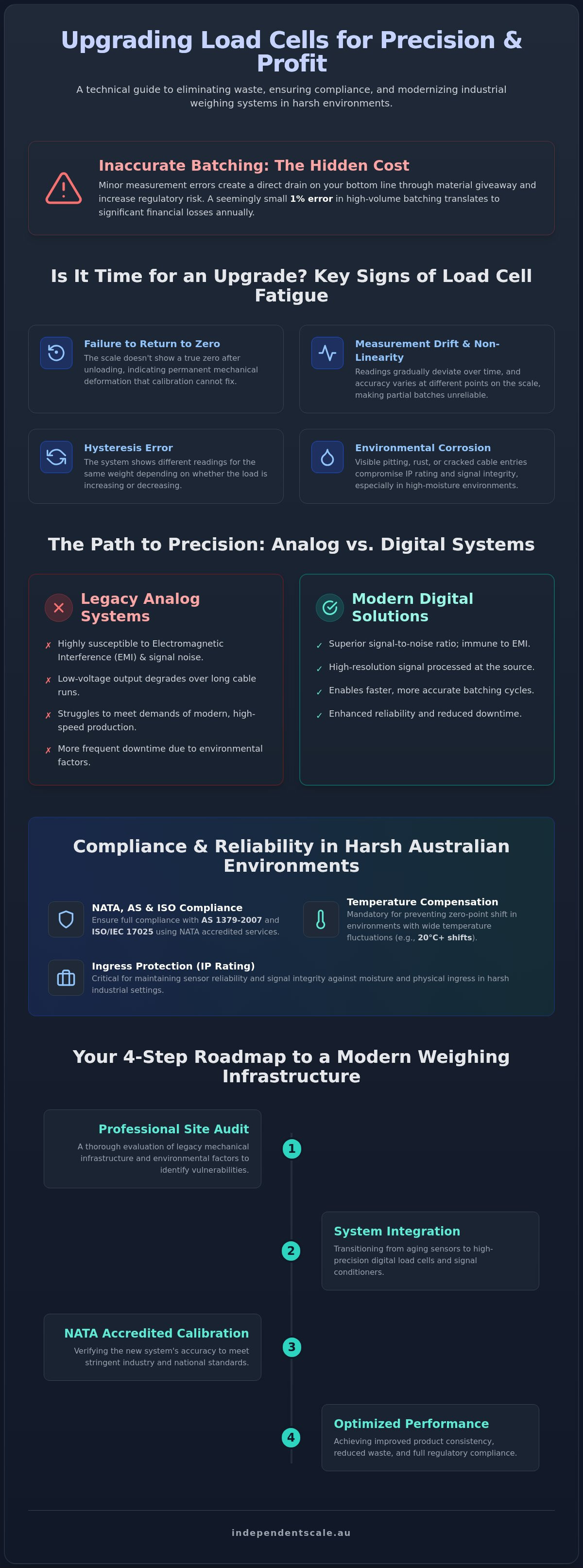
Inaccurate batching isn't just a minor technical glitch; it's a direct drain on your bottom line through material giveaway and regulatory risk. If your facility relies on legacy weighing systems, you're likely battling sensor drift and environmental interference that compromise your output daily. Upgrading load cells for better accuracy is no longer a luxury for high-volume operations. It's a technical necessity to maintain the standards required by AS 1379-2007 and ISO 17025.
You understand that even a minor measurement error can lead to significant waste or a failed audit. This guide explains how to transition from aging analog sensors to high-precision digital solutions, such as the UTILCELL 350iD, to ensure NATA compliance. We'll examine the specific steps required to eliminate measurement drift, reduce downtime, and achieve faster batching cycles. By the end of this article, you'll have a clear roadmap for modernizing your weighing infrastructure to survive harsh Australian industrial environments and improve overall product consistency.
Key Takeaways
- Recognize the physical and financial indicators of load cell fatigue to eliminate costly material giveaway in high-volume operations.
- Analyze the technical advantages of upgrading load cells for better accuracy through the adoption of high-resolution digital signal processing.
- Ensure full compliance with AS 1379-2007 and ISO/IEC 17025 standards by utilizing NATA accredited calibration services.
- Understand the importance of temperature compensation and ingress protection for maintaining sensor reliability in harsh Australian environments.
- Determine the necessary steps for a successful system integration, beginning with a professional site audit of legacy mechanical infrastructure.
Identifying the Need for a Load Cell Upgrade
Industrial facilities often operate under the false assumption that routine calibration is sufficient to maintain system integrity. While calibration corrects minor deviations, it cannot fix structural fatigue or hardware degradation. Upgrading load cells for better accuracy becomes essential when the underlying sensor technology can no longer hold its specifications between scheduled service intervals. Persistent errors in batching usually indicate that the mechanical limits of the sensor have been reached.
Legacy systems, particularly low-resolution analog setups, struggle to meet the demands of modern high-speed production. These older systems are highly susceptible to signal noise and Electromagnetic Interference (EMI). In dense industrial zones across Sydney and Melbourne, where heavy machinery and electrical grids create significant interference, these vulnerabilities lead to frequent downtime. Understanding What is a Load Cell? and its mechanical limitations helps operators identify when a component is failing rather than just drifting.
Signs of Load Cell Fatigue and Measurement Drift
Measurement drift refers to the gradual deviation of a sensor's readings from the actual weight over repeated production cycles, often resulting from thermal instability or structural fatigue. Beyond simple drift, technical teams must monitor for specific hardware failures. If a scale fails to return to a true zero after a load is removed, the internal strain gauge or spring element may be permanently deformed. This mechanical set cannot be calibrated out; it requires a hardware replacement.
- Non-linearity: Accuracy varies significantly at different points on the scale range, making partial batches unreliable.
- Hysteresis: The system provides different readings for the same weight depending on whether the load is increasing or decreasing.
- Environmental Corrosion: Visible pitting on stainless steel elements or cracked cable entry points, common in high-moisture Melbourne facilities, compromises the IP rating and signal integrity.
The Cost of Inaccuracy in Industrial Batching
In high-volume concrete or chemical batching, a 1% error in material measurement translates to significant financial losses over a single fiscal year. This "material giveaway" is a hidden drain on profitability that often goes unnoticed until a full system audit is performed. Upgrading load cells for better accuracy provides a quantifiable ROI by tightening batching tolerances and ensuring every gram of material is accounted for.
Inaccurate mix ratios also pose severe compliance risks. For concrete producers, maintaining the precision required by AS 1379-2007 is a legal and structural necessity. Utilizing high-quality load cells ensures that batching plants remain NATA compliant and avoid the liability associated with structural failure due to incorrect water-to-cement ratios. Precision isn't just about efficiency; it's about maintaining the technical standards your clients expect.
Technical Considerations for High-Accuracy Upgrades
Achieving superior precision in industrial weighing requires a systematic evaluation of the entire signal chain. Upgrading load cells for better accuracy involves more than just selecting a sensor with a higher nominal resolution. It requires an architecture that minimizes signal degradation between the point of measurement and the final data output. In modern industrial environments, the choice of electronics and housing materials determines whether a system maintains its NATA compliance or falls victim to environmental interference.
The signal chain's integrity is often compromised by electrical noise, temperature fluctuations, and physical ingress. Recent advances in load cell technology emphasize the integration of smarter processing units that handle these variables in real-time. For facilities operating in regional Australia, where ambient temperatures can fluctuate by 20 degrees Celsius in a single shift, selecting components with robust thermal compensation is mandatory to prevent zero-point shift.
Digital vs. Analog: Choosing the Right Technology
Traditional analog load cells output a low-voltage millivolt signal that is highly susceptible to Electromagnetic Interference (EMI) from nearby motors or power lines. Transitioning to digital systems or integrating high-quality conditioners and transmitters allows for the signal to be digitized closer to the source. This conversion significantly improves the signal-to-noise ratio and allows for much higher effective resolutions.
- Remote Diagnostics: Digital systems enable individual sensor monitoring, allowing technicians to identify a single failing cell in a multi-cell silo system without disconnecting the entire array.
- Signal Stability: Modern digital transmitters provide faster update rates, which are critical for high-speed batching cycles where every millisecond of latency affects the final weight.
- Simplified Calibration: Digital interfaces often allow for "theoretical calibration" or easier corner adjustment, reducing the hours required for onsite service.
Environmental Protection and IP Ratings
The Australian industrial landscape presents unique challenges, from the fine dust of cement plants to the high-pressure washdowns of food processing facilities. Selecting the correct Ingress Protection (IP) rating is a technical necessity. While IP67 may suffice for dry indoor environments, outdoor silos or washdown areas require IP68 or IP69K ratings. These ratings ensure the internal strain gauges remain hermetically sealed against moisture and corrosive agents.
Material choice is equally critical. While alloy steel is cost-effective, stainless steel provides the necessary corrosion resistance for chemical or coastal applications. For large-scale storage, using specialized tank and silo weighing assemblies ensures the sensors are protected from side loads and thermal expansion. If you're unsure which rating your facility requires, consulting an expert on load cell supply can prevent premature sensor failure and costly replacement cycles.
The Upgrade Process: From Legacy Systems to Modern Precision
Executing a technical transition requires a methodical assessment of the existing infrastructure. Upgrading load cells for better accuracy is not a simple component swap; it's a structural and electrical recalibration of the weighing system. The process begins with a comprehensive site audit to evaluate the mechanical integrity of hoppers, silos, or platforms. Technicians must verify that existing mounting plates are level and that the electrical conduits can support modern shielded cabling without interference. A failing support structure or corroded mount will undermine any new hardware installation.
Minimizing production downtime is a primary objective during any industrial upgrade. This is achieved through meticulous planning of the integration path. By pre-fabricating mounting kits and ensuring all load cells are compatible with the existing mechanical footprint, the physical installation window can be reduced to a single shift. Rapid deployment ensures that NATA compliance is restored and production resumed with minimal impact on the facility's output. Every hour of lost production carries a measurable cost.
Replacing Mechanical Levers with Modern Load Cells
Many legacy facilities still utilize mechanical lever systems that rely on knife-edge pivots. Converting these systems to electronic weighing involves removing the lever assembly and installing load cells directly at the load-bearing points. This transition eliminates the friction and wear associated with moving parts. Alignment is critical. Even a minor misalignment can introduce side-loading errors that negate the benefits of upgrading load cells for better accuracy. Technicians must ensure that the load is applied vertically and that parasitic loads from rigid piping or stiff gaskets are eliminated through the use of flexible couplings.
Integrating Modern Indicators and Controllers
The final stage involves the synchronization of new sensors with high-resolution indicators and displays. Modern controllers provide the necessary processing power to handle digital signals and offer clear data visibility for control room operators. Integration with existing PLC or SCADA networks allows for fully automated batching cycles, reducing the risk of human error. This connectivity enables real-time inventory tracking and immediate notification of system deviations. To safeguard the new investment, the installation should include dedicated junction boxes and surge protection to prevent damage from electrical transients or lightning strikes in exposed outdoor environments.
Ensuring Compliance: NATA Accreditation and AS 1379
Compliance in Australian industry isn't optional. It's a technical framework that ensures structural safety and commercial fairness across all sectors. When upgrading load cells for better accuracy, the objective is often securing or maintaining NATA accreditation. This accreditation acts as a formal recognition that a facility operates under the ISO/IEC 17025 standard. Without this certification, your measurements lack the legal weight required for high-stakes industrial contracts and government tenders. Modernizing your hardware is the first step toward meeting these rigorous technical requirements.
Regular calibration intervals act as your primary defense against quality control disputes and legal liability. If a structural failure occurs or a batch is rejected, investigators will immediately scrutinize the calibration history of the weighing equipment. Independent Scale Service provides the expertise and documentation needed to satisfy these technical inquiries. We issue certified compliance reports that verify your system's performance against national standards, ensuring your operation remains beyond reproach during external audits.
The Role of NATA Accredited Calibration
Standard calibration often involves simple zero and span adjustments performed by internal maintenance staff. While useful for daily checks, this is insufficient for regulatory audits. Professional load cell calibration utilizes NATA-traceable mass standards to verify the sensor's performance across its entire range. These certificates provide the necessary evidentiary trail for quality audits, proving that your equipment meets specific uncertainty budgets. It's a methodical process that identifies non-linearity and hysteresis that simple adjustments can't fix.
Maintaining Compliance with AS 1379 Standards
For the construction sector, AS 1379-2007 dictates the specific accuracy tolerances for concrete production. This standard, which was reconfirmed on December 18, 2017, remains the current benchmark for the specification and supply of concrete in Australia. Achieving these tolerances is significantly easier after upgrading load cells for better accuracy, as modern sensors provide the stability required to stay within the strict margins allowed for various mix components. Comprehensive concrete batching plant calibration ensures every hopper and scale meets these criteria, protecting your plant from the risks of non-compliant output.
Ensure your facility meets all Australian regulatory requirements by scheduling a NATA accredited calibration service today.
Optimising Performance with Independent Scale Service
Installation is only the first phase of maintaining industrial precision. To ensure that upgrading load cells for better accuracy delivers a sustained return on investment, facilities must implement a rigorous technical support framework. Independent Scale Service provides the specialized expertise required to transition from a successful installation to long-term operational reliability. We focus on eliminating the variables that lead to premature sensor failure, such as moisture ingress, vibration fatigue, and electrical surges.
Our service model is built around responsiveness and technical competence. For industries operating in Sydney and Melbourne, we provide rapid response repair services designed to minimize client downtime. When a system deviates from its calibrated state, our technicians arrive equipped with the diagnostic tools necessary to restore NATA compliance immediately. This commitment to urgency ensures that your production cycles remain consistent and your regulatory standing remains secure.
Custom Load Cell Supply and Engineering Support
Effective weighing solutions require more than off-the-shelf hardware. We provide a professional load cell supply tailored to the specific mechanical requirements of Australian industrial plants. This includes engineering custom mounting solutions for non-standard hopper or silo designs where traditional assemblies may fail to provide the necessary stability. Our inventory includes specialized components such as special purpose and shackle pins, which are essential for maintaining accuracy in heavy lifting and tension-based applications.
- Application Matching: We analyze your specific environment to select sensors with the correct capacity, material composition, and IP rating.
- Structural Integration: Our team ensures that new sensors are integrated into existing mechanical footprints without compromising structural integrity.
- Technical Documentation: Every component supplied is backed by comprehensive data sheets and traceability records for your quality management system.
Diagnostic and Preventative Maintenance Programs
Preventative maintenance is a methodical approach to avoiding catastrophic system failures. By utilizing advanced testing equipment, our technicians identify early warning signs such as bridge imbalance or electrical leakage before they manifest as significant measurement errors. Upgrading load cells for better accuracy provides a high-performance baseline, but regular weighing scale calibration is the only way to guarantee that performance over years of heavy use. We also provide basic training for on-site staff, enabling them to recognize visual indicators of wear or debris buildup that could affect scale sensitivity.
A structured maintenance schedule reduces the total cost of ownership by extending the lifespan of your sensors and electronics. We don't just react to failures; we provide the methodical oversight necessary to keep your facility running at peak efficiency. This proactive strategy ensures your batching remains precise, your waste remains low, and your operation remains fully compliant with AS 1379-2007 standards.
Securing Long-Term Precision and Compliance
Transitioning from legacy weighing systems to modern digital architecture is a technical necessity for maintaining industrial profitability. Identifying the physical signs of sensor fatigue and structural drift early prevents the excessive material giveaway that erodes margins. Upgrading load cells for better accuracy ensures your facility remains NATA Accredited to ISO/IEC 17025 and meets the rigorous AS 1379 Compliant Calibration standards required for structural safety.
Maintaining these high-precision standards requires more than just a hardware swap. It demands a methodical approach to preventative maintenance and rapid response repair. Independent Scale Service provides the technical expertise and certified documentation needed to pass any regulatory audit while maximizing plant uptime. We support critical operations across Sydney, Melbourne, and regional Australia with specialized equipment and authoritative reporting.
Protect your production integrity by addressing measurement drift before it impacts your bottom line. Request a professional load cell audit from Independent Scale Service to verify your system's performance and compliance status. Accurate measurement is the foundation of industrial excellence.
Frequently Asked Questions
How often should I upgrade my industrial load cells?
Load cells don't have a fixed expiration date, but you should consider a hardware evaluation when calibration can no longer correct persistent measurement drift. High-cycle applications in harsh environments typically require technology reviews every five to seven years. If your maintenance costs are rising or your batching tolerances are widening, it's a sign that your current sensors have reached their mechanical limits.
What is the difference between a load cell upgrade and a re-calibration?
Re-calibration is a periodic adjustment to ensure existing hardware reads correctly within its current technical limits. Upgrading load cells for better accuracy involves replacing physical sensors or signal processing electronics to achieve higher resolution and thermal stability. While calibration fixes temporary errors, an upgrade improves the system's fundamental capability to handle complex industrial loads.
Can I upgrade my analog system to digital without replacing the whole scale?
You can often modernize an analog system by integrating digital conditioners and transmitters without replacing the entire mechanical scale structure. This allows you to convert the signal to a digital format closer to the source, which significantly reduces electrical noise interference. However, for maximum precision, replacing the analog sensors with native digital load cells is the preferred technical path for most facilities.
Does NATA accreditation matter for all industrial weighing applications?
NATA accreditation is mandatory for any application requiring ISO/IEC 17025 compliance or legal-for-trade certification. While some internal process checks don't strictly require it, having NATA-certified calibration ensures your measurements are traceable to national standards. This formal documentation is vital during quality audits, structural failure investigations, or commercial disputes where measurement accuracy is questioned.
How much downtime should I expect during a load cell upgrade?
A standard load cell upgrade typically requires between four and eight hours of downtime, provided the site audit and component selection are completed in advance. Technicians focus on minimizing client downtime by pre-fabricating mounting kits and wiring assemblies before arriving on-site. Large-scale silo or hopper integrations may require a full shift depending on the mechanical complexity of the existing structure.
What environmental factors in Australia most commonly affect load cell accuracy?
Extreme temperature fluctuations and high humidity levels are the primary factors affecting sensor accuracy across Australia. Significant daily temperature swings cause thermal expansion in mechanical structures and zero-point shift in poorly compensated sensors. Additionally, fine dust ingress in cement plants and salt-air corrosion in coastal industrial zones can compromise the signal integrity of lower-quality hardware.
Is it possible to repair a load cell that has lost its accuracy?
Repairing a load cell that has suffered internal mechanical fatigue or strain gauge deformation is generally not possible. While external issues like cable damage or junction box corrosion can be addressed, a compromised internal element cannot be restored to its original precision. In these cases, replacement is the only reliable method for upgrading load cells for better accuracy and long-term reliability.
How do I know if my load cells are AS 1379 compliant?
Your equipment is compliant if it has a current NATA calibration certificate specifically referencing AS 1379-2007. This standard dictates the accuracy tolerances for concrete batching plants and requires regular verification by an accredited technician. You should review your latest service report to ensure all scales and meters meet the specific percentage-of-load requirements defined in the current Australian standard.
