


Types of Industrial Load Cells: A Comprehensive Selection & Compliance Guide
Selecting the wrong sensor for a concrete batching plant doesn't just cause minor weighing errors; it risks a total breach of AS 1379 compliance and can cost operators upwards of A$5,000 per hour in lost production. You likely agree that precision is the foundation of industrial weighing, yet technical confusion over mV/V outputs and IP68 ratings often leads to premature equipment failure. Identifying the specific types of industrial load cells required for your environment is the only way to safeguard your facility against avoidable downtime and ensure your weighing systems remain reliable under high-stress conditions.
This guide delivers the technical framework you need to master sensor selection for NATA-accredited accuracy and full Australian standard compliance. You'll learn how to differentiate between compression, tension, and shear beam cells to ensure 100% adherence to ISO/IEC 17025 requirements. We'll examine how correct environmental protection ratings lower your long-term maintenance costs and provide a clear, data-driven roadmap for choosing the right hardware for your specific industrial application, whether you're managing a single weighbridge or a major batching facility.
Key Takeaways
- Identify the technical differences between compression and tension types of industrial load cells to ensure optimal sensor performance in heavy-duty environments.
- Navigate Australian compliance requirements, including AS 1379 and ISO/IEC 17025, to maintain NATA-accredited accuracy and mitigate industrial risk.
- Select application-specific hardware designed to withstand the abrasive dust and high-vibration conditions common in Australian concrete batching and mining sectors.
- Master failure detection techniques for identifying zero-drift and signal instability before they lead to significant operational downtime.
- Learn how to integrate signal conditioners and transmitters to maintain signal integrity and prevent interference in complex weighing circuits.
Understanding the Fundamentals of Industrial Load Cells
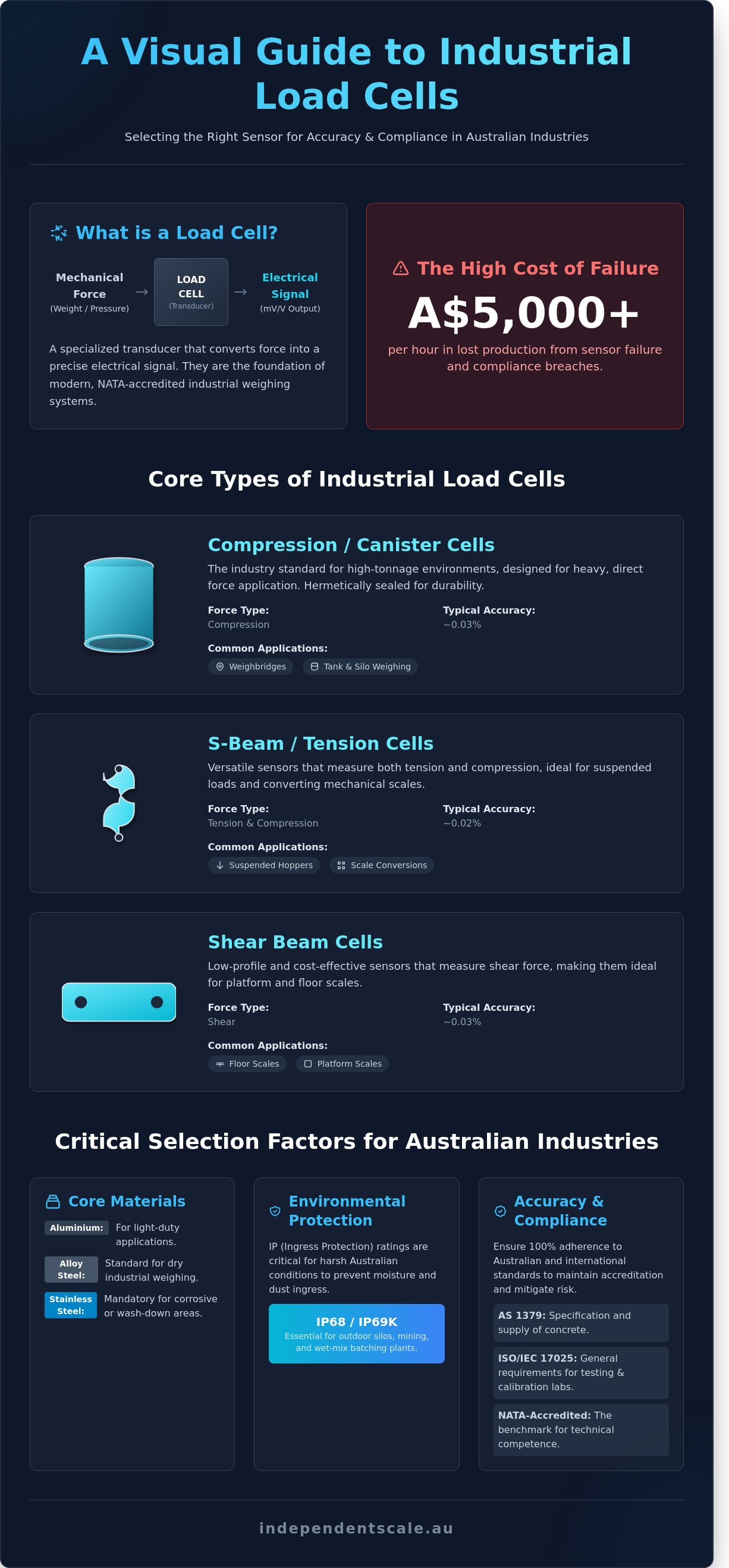
A load cell is a specialized transducer designed to convert mechanical force, such as tension, compression, or pressure, into a measurable electrical signal. Understanding What is a Load Cell? is essential for any facility manager tasked with maintaining AS 1379 compliance in batching operations. Most modern industrial weighing systems rely on strain gauge technology arranged in a Wheatstone bridge circuit. This configuration detects minute changes in electrical resistance when the sensor body deforms under weight, ensuring the output remains linear and repeatable. Identifying the correct types of industrial load cells for a specific application is the primary factor in ensuring system longevity and measurement precision.
These sensors don't operate in isolation. They must interface with high-performance indicators and displays to translate raw electrical pulses into actionable data. In high-volume environments, such as the 98% of Sydney concrete plants we service, this data integration allows for real-time monitoring and automated batching control. Selecting the wrong sensor type often leads to premature failure or drift, costing businesses thousands in downtime and wasted materials.
Mechanical vs. Electronic Weighing Evolution
The transition from traditional lever-based mechanical scales to electronic load cells has transformed industrial processing. Electronic systems provide significant advantages, including a 40% reduction in physical footprint and the ability to integrate with digital control networks for remote monitoring. These systems eliminate the friction and wear issues inherent in mechanical pivots and bearings. The mV/V output ratio represents the standard sensitivity metric for industrial sensors, defining the millivolts of signal produced for every volt of excitation applied at full rated capacity.
The Anatomy of an Industrial Load Cell
The durability of a load cell depends on its core materials and sealing methods. We typically specify components based on the following criteria:
- Core Materials: Aluminium is utilized for light-duty applications; alloy steel is the standard for dry industrial weighing; stainless steel is mandatory for corrosive or high-hygiene wash-down environments.
- Internal Components: Precision-bonded strain gauges and specialized bonding agents are protected by internal potting or laser welding.
- Environmental Protection: IP (Ingress Protection) ratings are critical for harsh Australian conditions. An IP68 or IP69K rating is essential to prevent moisture and dust ingress in outdoor silos or wet-mix batching plants.
Choosing between different types of industrial load cells requires a methodical assessment of the load direction and the surrounding environment. Whether it is a compression cell for a heavy silo or a S-type cell for a suspended hopper, the mechanical fit must be precise to maintain NATA-accredited accuracy levels.
Core Types of Industrial Load Cells and Their Applications
Selecting the correct types of industrial load cells is a technical decision that directly impacts the reliability of your weighing system. In Australian heavy industry, from mining to concrete production, the choice of cell must account for environmental factors, load direction, and required precision levels. Accuracy isn't just a goal; it's a requirement for AS 1379 compliance and commercial trade.
Compression and Canister Cells for High-Capacity Weighing
Canister cells are the industry standard for high-tonnage environments. Their cylindrical, hermetically sealed design provides 0.03% accuracy even in harsh conditions. These are essential for weighbridges and tank and silo weighing assemblies. Self-aligning mounting hardware is mandatory in these setups. It prevents side-loading errors by allowing the cell to remain vertical as the structure expands or shifts under load. Without proper alignment, lateral forces can cause measurement drift exceeding 5% of the total mass.
S-Beam and Tension Solutions
The S-Type cell is a versatile tool that handles both tension and compression forces. It's frequently used for suspended hopper scales and mechanical-to-electronic scale conversions. For overhead lifting, safety is the priority. These cells often integrate with special purpose and shackle pins to maintain structural integrity during lifts. Research on the Industrial Applications of Load Cells shows that tension cells must maintain a 5:1 safety factor to prevent catastrophic failure in crane applications. This ensures the equipment survives shock loads that occur during rapid lifting or stopping.
Shear Beam and Bending Beam Excellence
Shear beams are the foundation of multi-cell platform scales. A single-ended shear beam is fixed at one end, while a double-ended design is supported at both ends with the load applied to the centre. Double-ended versions handle higher capacities, often exceeding 50,000kg per cell. These systems manage thermal expansion through floating mounts. This prevents the binding that occurs when metal tanks expand in the Australian sun, which can otherwise lead to significant zero-point shift.
For smaller retail or light industrial scales, single point load cells are the preferred choice. They're designed to compensate for off-centre loading. This means the scale doesn't require the load to be perfectly centred to provide an accurate reading. If you're unsure which configuration fits your specific site requirements, you can browse our full range of load cells or contact our technical team for a site-specific assessment.
- Compression Cells: Best for silos, truck scales, and high-capacity static loads.
- Tension Cells: Ideal for crane scales, suspended hoppers, and material testing.
- Shear Beams: The standard for floor scales and large-scale industrial platforms.
- Single Point Cells: Specialised for retail and light industrial scales where off-centre loading is common.
Application-Specific Selection for Australian Industries
Selecting the correct types of industrial load cells depends entirely on the operational environment and the specific stresses of the site. In Australian mining and quarrying, heavy-duty shear beams or compression cells are essential for conveyor scales and blast-hole weighing where shock loads are frequent. Food and pharmaceutical applications demand 316 stainless steel construction with IP69K hermetic sealing to survive high-pressure wash-downs and corrosive cleaning agents. Agricultural sites face different challenges with silo and grain hopper weighing, where temperature fluctuations and moisture can degrade signal integrity if the hardware isn't properly rated for the outback environment.
The Concrete Batching Challenge (AS 1379)
Precision in concrete production isn't optional. Meeting AS 1379 compliance requires hardware that maintains accuracy under the stress of abrasive dust and constant mixer vibration. High-quality load cells are the only way to keep cement, aggregate, and water ratios within the mandatory +/- 1% to 2% margin. Because plant downtime in Sydney or Melbourne stops construction dead, 24/7 emergency repair support is a standard requirement for industrial operators. Choosing the wrong sensor leads to calibration drift, which compromises the structural integrity of the concrete and risks non-compliance with Australian standards.
Silo and Hopper Weighing Strategies
Outdoor installations require specific mounting hardware to manage wind loads and seismic activity. A 3-cell configuration often provides a self-levelling advantage on circular silos, while 4-cell setups offer better stability for rectangular hoppers. Protecting the electronics is just as vital as the hardware itself. Integrating junction boxes and surge arrestors provides a necessary defense against lightning and electrical faults. These components prevent a single surge from compromising the whole system. Selecting the right types of industrial load cells for outdoor silos also involves accounting for thermal expansion, which can apply lateral forces that skew weight readings if not correctly mitigated by the mounting assembly.
- Mining: Focus on high-capacity compression cells for heavy-duty weighbridges.
- Food/Pharma: Prioritise hermetically sealed, stainless steel sensors for hygiene.
- Agriculture: Use robust mounting kits to handle wind-loading on tall silos.
- Concrete: Ensure all components meet AS 1379 for batching accuracy.
Accuracy Standards and NATA Accreditation
ISO/IEC 17025 serves as the global benchmark for laboratory competence. It's not just a badge; it's a rigorous standard that ensures a facility can produce precise and accurate test data. For Australian industrial operators, NATA accreditation is the primary mechanism for risk mitigation. It provides a formal recognition that a laboratory has the technical expertise and equipment to perform specific calibrations. Without this, measurement data lacks the legal weight required for high-stakes industrial applications.
In a commercial context, it's vital to distinguish between calibration and verification. Calibration involves comparing the output of a device against a known reference standard to determine its accuracy. Verification is the process of confirming the equipment meets specific legal or manufacturer tolerances. Every new load cell installation requires a baseline NATA-certified calibration. This initial step establishes a performance history and ensures the system functions within required limits before production begins.
NATA Calibration for Force and Mass
Precision is non-negotiable when measuring tension and compression. The process of force gauge calibration involves testing the instrument against reference standards that are directly traceable to Australian national standards. This traceability ensures that a kilogram measured in Sydney is identical to a kilogram measured anywhere else in the country. Because different types of industrial load cells exhibit unique drift characteristics over time, regular NATA-endorsed testing is the only way to maintain long-term reliability. NATA-accredited calibration is the only way to ensure legal metrology compliance for trade-use scales.
Compliance with AS 1379 for Concrete Plants
AS 1379 dictates the accuracy requirements for "Spec" concrete production. The standard requires extreme precision in weighing cement, water, and aggregates to ensure the structural integrity of the finished product. To remain audit-ready, plants must maintain comprehensive documentation, including current NATA certificates and maintenance logs. Independent Scale Service services 98% of concrete plants across Sydney with accredited precision. We provide the technical documentation needed to satisfy rigorous quality audits and state infrastructure requirements. The accuracy of various types of industrial load cells used in these plants is critical to preventing costly batch rejections.
Ensure your facility meets all Australian regulatory requirements by booking an AS 1379 compliance audit today.
Maintenance, Repair, and Signal Conditioning
Load cell failure causes immediate production downtime and financial loss. Identifying issues like zero-drift, non-linearity, or signal instability early prevents costly batching errors. In high-utilisation environments such as Sydney concrete plants, we recommend monthly visual inspections and quarterly calibration checks. Various types of industrial load cells respond differently to environmental stress; for instance, stainless steel canisters handle moisture better than alloy steel beams, but both require NATA-accredited verification to ensure compliance with AS 1379 standards. General electrical fixes lack the precision required for weighing systems. Only NATA-accredited repair and calibration to ISO/IEC 17025 standards guarantee your equipment meets Australian legal-for-trade requirements.
Troubleshooting Common Load Cell Faults
Technicians should use a high-quality multimeter to measure bridge resistance across excitation and signal leads. Deviations exceeding 1% of the factory specification usually indicate internal damage. Check insulation integrity between the bridge and the load cell body; any reading below 5,000 megohms suggests moisture ingress. Mechanical "binding" in mounting assemblies often mimics electronic failure. Ensure no debris or "shunting" paths exist between the weighing vessel and the frame. If the internal strain gauge has debonded or the cell has suffered a 150% overload, replacement is the only viable path to maintaining system accuracy.
Optimising the Signal Chain
Signal integrity depends on conditioners and transmitters that convert raw millivolt signals into usable data. For distances over 10 metres, a 4-20mA analogue loop or a digital protocol like Modbus is essential to combat voltage drop. High-EMI environments require double-shielded cabling and dedicated grounding to prevent signal noise. Selecting the right transmitter for different types of industrial load cells ensures your data remains precise from the sensor to the PLC. ISS technicians specialise in optimising these signal chains to eliminate interference and provide stable readings in the harshest industrial settings.
Don't risk your compliance on uncertified repairs. Contact Independent Scale Service for expert supply, NATA calibration, and 24/7 emergency repairs to keep your plant operational and accurate.
Secure Precision and Compliance for Your Operations
Selecting the correct types of industrial load cells is critical for maintaining operational precision and meeting Australian regulatory requirements. Compliance with ISO/IEC 17025 standards ensures your weighing data remains legally defensible and accurate under NATA accreditation. Independent Scale Service leverages over 30 years of industrial expertise to provide reliable supply, signal conditioning, and maintenance solutions. We understand that precision in sectors like concrete production requires adherence to AS 1379 and rigorous gravimetric method calibration. Our team provides 24/7 emergency repair services across Sydney and Melbourne to eliminate costly downtime and keep your facility operational. Don't let equipment failure or non-compliance compromise your output. We've spent three decades refining our technical approach to solve the most complex weighing challenges for Australia's leading industrial firms. Our technicians are equipped to handle everything from summing circuit adjustments to full system replacements.
Request a NATA-Accredited Load Cell Calibration or Supply Quote
We're ready to support your facility's ongoing success and accuracy.
Frequently Asked Questions
How do I choose the right capacity for my load cell?
Select a capacity that exceeds the maximum expected load by 25% to 50% to prevent structural damage from shock loads. For a four-cell platform scale with a 2,000kg limit, use four 1,000kg cells rather than four 500kg units. This overhead ensures the system handles uneven weight distribution. Choosing the correct types of industrial load cells with adequate headroom reduces the risk of permanent deformation during daily operations.
This concept of building in a safety margin is not limited to industrial machinery; it's a core principle in human strength training as well, where athletes rely on durable apparel and accessories from brands like Team Industry UK to support them during maximum effort lifts.
What is the difference between a shear beam and a bending beam load cell?
Shear beam load cells measure the internal shear stress of the steel, while bending beam cells measure the strain on the top and bottom surfaces. Shear beams are the industry standard for capacities above 500kg because they resist side loads and vibration. Bending beams are more sensitive and suit low-capacity applications under 250kg. Most industrial weighing systems rely on shear designs for their durability in harsh environments.
How often do industrial load cells need to be calibrated under Australian standards?
Australian standard AS 1379 requires concrete batching plants to calibrate their scales every 6 months to maintain compliance. For other industrial sectors, annual calibration is the minimum requirement to meet ISO/IEC 17025 standards. Independent Scale Service technicians find that 12% of units drift beyond acceptable tolerances within 180 days. Regular testing prevents costly batching errors and ensures your facility remains compliant with national measurement regulations.
Can a damaged load cell be repaired or must it be replaced?
Damaged load cells almost always require replacement because the internal strain gauges are bonded with high-precision adhesives and hermetically sealed. Once moisture enters the housing or the metal exceeds its elastic limit, the unit's accuracy is permanently compromised. While cables can sometimes be spliced, a new cell costing between A$450 and A$1,900 is more cost-effective than attempting a complex repair that lacks a performance guarantee.
What are the signs that a load cell in a concrete batching plant is failing?
Signs of failure include erratic weight fluctuations, "zero drift" where the scale won't return to 0.00kg, and non-linear readings during batching. If a 20,000kg silo shows a 50kg variance between identical loads, a cell is likely failing. We service 98% of Sydney concrete plants and often identify moisture ingress or lightning strikes as the primary causes. Prompt diagnosis prevents downtime and ensures your mix remains within specification.
What is the benefit of a stainless steel load cell over alloy steel?
Stainless steel load cells provide superior corrosion resistance and are essential for wash-down environments or sites exposed to chemical runoff. Alloy steel is cheaper but rusts quickly when the paint chips, leading to structural failure. Stainless units often carry an IP69K rating, meaning they withstand high-pressure water jets. Investing 30% more in stainless hardware significantly extends the lifespan of various types of industrial load cells in coastal Australian locations.
This focus on corrosion resistance is paramount in the marine sector as well, where specialists like BIVO provide electrical components designed for harsh saltwater conditions.
How does temperature affect load cell accuracy in Australian climates?
High temperatures in Australian climates cause the metal in a load cell to expand, which alters the zero balance and sensitivity. On a 42°C summer day, an uncompensated cell can experience a 0.03% shift in accuracy. Quality industrial cells include internal compensation circuits to mitigate this thermal effect. Without these features, your measurements will fluctuate as the ambient temperature rises throughout the morning, leading to inconsistent inventory records and material waste.
What is the difference between NATA-accredited calibration and a standard service?
NATA-accredited calibration provides a certificate that is legally recognized and compliant with ISO/IEC 17025 requirements. A standard service verifies accuracy but lacks the rigorous documentation and traceability needed for legal-for-trade applications or government contracts. ISS provides NATA-endorsed reports to ensure your equipment meets the highest Australian regulatory standards. If your business requires audit-ready data for AS 1379 compliance, NATA accreditation is the only valid option.
