


Truck Scales for Australian Industry: A 2026 Guide to Compliance and Accuracy
For Australian industrial operators, the integrity of their weighing systems is non-negotiable. The risk of substantial Chain of Responsibility (CoR) fines for overloading is a constant pressure, while unexpected equipment downtime can halt operations and cripple productivity. In this high-stakes environment, the performance of your industrial truck scales is not just a matter of measurement-it is a critical component of your operational efficiency and legal compliance strategy. Confusion over calibration standards only adds to the complexity, leaving businesses vulnerable.
This definitive 2026 guide provides the expert clarity required to navigate Australia's industrial weighing landscape. We will dissect the crucial differences between NATA-accredited and non-accredited calibration, outline the pathway to full compliance with key standards such as AS 1379, and detail proactive maintenance strategies to ensure maximum uptime. By the end of this guide, you will have a clear framework for achieving accurate payload optimisation and complete confidence in your adherence to CoR obligations.
Key Takeaways
- Understand your legal obligations under Australia's Chain of Responsibility (CoR) framework and how accurate weighing prevents costly breaches.
- Evaluate the operational and financial trade-offs between different truck scales-including weighbridges, onboard, and portable systems-to select the right asset.
- Learn the critical difference between a standard check and a NATA-accredited calibration to ensure your weight data is legally defensible.
- Identify the common causes of load cell failure to implement a proactive maintenance strategy that minimises operational downtime.
The Critical Role of Truck Scales in Australian Logistics and Compliance
In Australia's heavy vehicle industry, precision is not a luxury-it is a legal and operational necessity. As regulations tighten towards 2026, the role of professionally calibrated truck scales has become central to mitigating risk and ensuring operational efficiency. A truck scale (weighbridge) provides the verifiable data required to operate legally and safely, protecting your business from the severe penalties associated with non-compliance.
Understanding Chain of Responsibility (CoR) in 2026
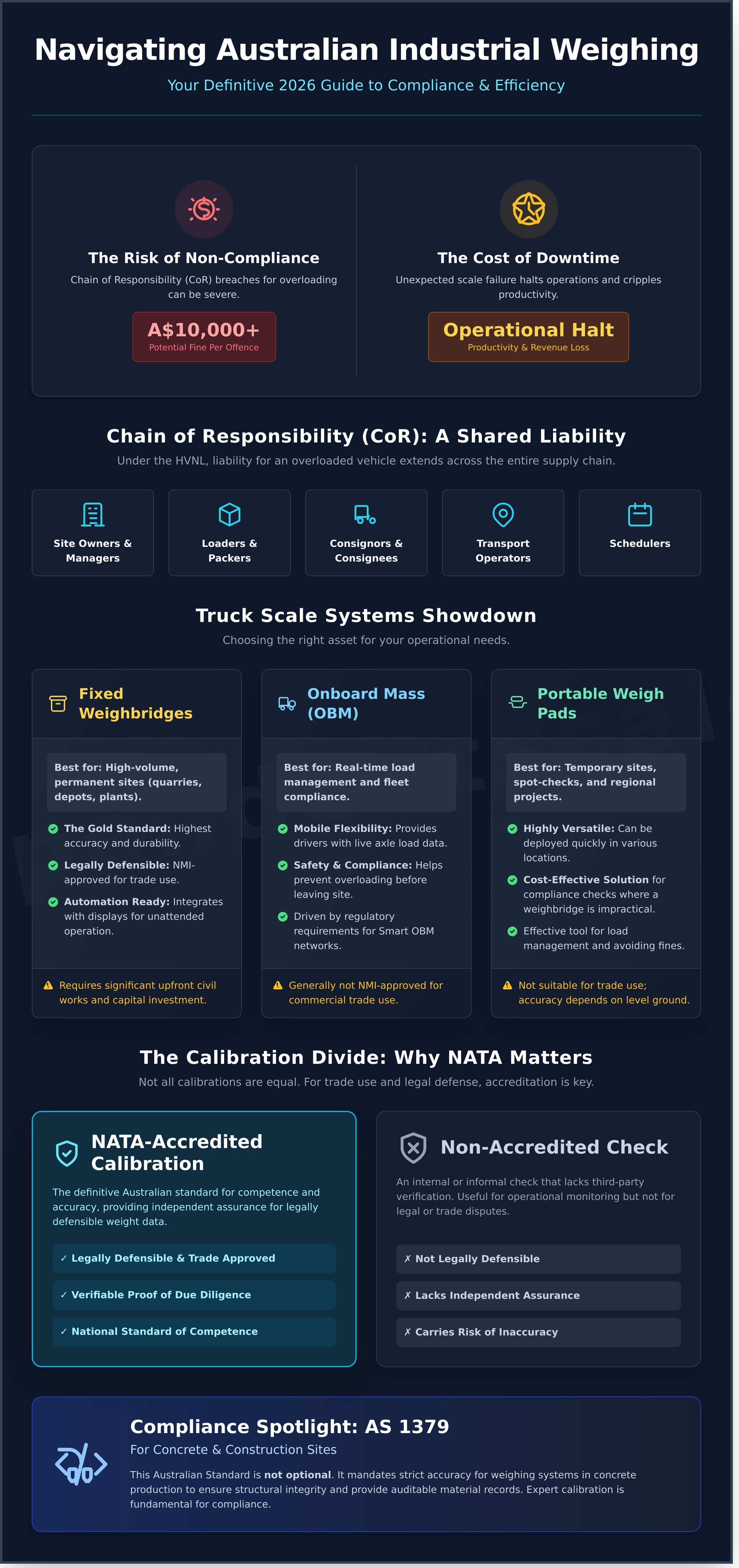
The Heavy Vehicle National Law (HVNL) imposes a shared legal obligation on all parties in the supply chain under its Chain of Responsibility (CoR) provisions. This means liability for an overloaded vehicle is not limited to the driver. Parties held accountable can include:
- Site owners and managers
- Loaders and packers
- Consignors and consignees
- Transport operators and schedulers
In legal-for-trade applications, guesswork is indefensible. In the event of an incident or roadside check, a certified weight docket from a calibrated scale is your primary evidence of due diligence, potentially saving your business from fines that can exceed A$10,000 per offence.
AS 1379 Compliance for Concrete and Construction Sites
For the construction sector, compliance requirements are even more specific. The Australian Standard AS 1379 mandates strict accuracy tolerances for weighing systems used in concrete production. This standard is not optional; it is essential for ensuring the structural integrity of the final product and providing auditable records for material usage. Maintaining this level of precision requires expert concrete batching plant calibration services, which are fundamental for any plant supplying to civil or commercial projects.
Ultimately, integrating a reliable weighing system into your workflow is a strategic investment. It moves beyond simple compliance to become a core part of your site safety protocols and operational efficiency. The upfront cost of a compliant system is minimal compared to the compounding financial and reputational damage of CoR breaches, project delays, and material wastage.
Comparing Truck Scale Systems: Onboard, Weighbridges, and Portable
Selecting the right weighing system requires a critical evaluation of fixed infrastructure versus mobile flexibility. The decision directly impacts initial capital outlay, long-term maintenance costs, and overall operational efficiency. For Australian businesses, environmental factors such as intense heat, pervasive dust, and seasonal moisture demand robust engineering. A system's longevity and accuracy are contingent on its suitability for the specific site conditions.
Fixed Weighbridges: The Gold Standard for High Volume
For high-throughput operations like quarries, logistics depots, and manufacturing plants, a permanent weighbridge is the industry standard. The choice between a concrete or steel deck depends on application and environment; concrete offers superior longevity and corrosion resistance, while steel allows for faster installation. Site preparation is a critical upfront investment, requiring certified civil works to ensure a stable foundation. For maximum efficiency, these permanent truck scales integrate with sophisticated indicators and displays, facilitating automated logging and unattended driver operation.
Onboard Mass (OBM) Systems and Portable Scales
Mobile and vehicle-integrated systems offer flexibility where a permanent weighbridge is impractical. The adoption of Smart OBM is driven by regulatory requirements for heavy vehicle networks, providing drivers and fleet managers with real-time axle load data to ensure compliance and safety. Portable weigh pads are an effective solution for temporary sites, regional projects, or for conducting compliance spot-checks. However, it is essential to understand their limitations; while excellent for load management, most OBM and portable systems are not NMI-approved for trade use. For any commercial transaction based on weight, a certified, permanently installed weighbridge is the legal requirement.
NATA Accreditation: Why Your Truck Scale Calibration Matters
In Australia, not all calibration services are created equal. For industrial weighing equipment, particularly when used for trade, NATA accreditation is the definitive standard of competence and accuracy. NATA (National Association of Testing Authorities) is Australia's national accreditation body, providing independent assurance of technical competence through a proven network of best-practice industry experts.
A 'standard' check might verify that a scale is operational, but a NATA-accredited calibration to ISO/IEC 17025 is a rigorous, legally defensible process. It provides a detailed report with a statement of measurement uncertainty, confirming your equipment meets stringent national and international standards. For any legal-for-trade transaction-where you sell goods by weight-a NATA-endorsed report is essential for compliance, dispute resolution, and maintaining client trust. This is why Independent Scale Service is entrusted to manage NATA compliance for 98% of Sydney's concrete plants, ensuring their truck scales and weighing systems are consistently accurate and compliant with standards like AS 1379.
The Gravimetric Method for Superior Accuracy
The gravimetric method is the cornerstone of high-precision calibration. This technique involves using certified test masses (weights) of a known, traceable value to directly test the scale's performance across its weighing range. This direct comparison provides an indisputable measure of accuracy and linearity. It is the preferred method for industrial applications where precision is non-negotiable, a principle we also apply to our liquid flowmeter calibration using the weighing method for ultimate system accuracy.
Calibration Intervals and Record Keeping
The required frequency for calibrating your truck scales depends on several factors, including usage intensity, environmental conditions (e.g., dust, moisture), and specific industry regulations. A NATA-endorsed Calibration Certificate is a critical document, serving as official proof of compliance during audits and quality control checks. To ensure an efficient service, prepare your site for a weighing scale calibration visit by:
- Ensuring the weighbridge deck is clean and free of debris.
- Providing clear and safe access for our technicians and equipment.
- Having a designated site contact available to authorise the work.
Maintaining the Core: Load Cell Diagnostics and Repair
The load cell is the heart of any industrial weighing system. In both portable axle weighers and large-scale weighbridges, these precision transducers are responsible for converting the physical force of a load into a measurable electrical signal. The accuracy and reliability of your entire operation depend on their performance. When a load cell fails, your business suffers from inaccurate data, operational downtime, and potential compliance issues.
While robustly designed, load cells in demanding industrial environments are susceptible to failure from several key sources:
- Moisture Ingress: Water or condensation penetrating the load cell housing is a leading cause of signal drift and catastrophic failure, particularly in outdoor or wash-down applications.
- Lightning Strikes & Power Surges: The extensive cabling of truck scales can act as an antenna, making load cells vulnerable to damage from nearby lightning strikes or electrical surges.
- Physical Shock & Overload: Sudden impacts from vehicles, incorrect loading, or exceeding the scale's capacity can cause permanent damage to the internal strain gauges.
Replacing a high-quality, hermetically sealed load cell with a cheaper, inferior alternative is a false economy. Expert repair of a premium load cell often provides a more reliable and cost-effective long-term solution, restoring the component to its original factory specifications and ensuring system integrity.
Diagnosing Load Cell Faults
Identifying a failing load cell requires expert analysis. Our NATA-accredited technicians use specialised equipment to perform millivolt (mV) output testing and insulation resistance checks to pinpoint the exact point of failure within a multi-cell system. Common symptoms of a fault include 'drifting' weights where the reading slowly creeps up or down, or a failure for the scale to return to a perfect zero. We can diagnose, repair, or supply a wide range of replacement load cells to suit any industrial system.
The Critical Role of Conditioners and Transmitters
Load cells do not operate in isolation. Signal conditioners are essential for amplifying and stabilising the low-level signal from the load cell, ensuring clean, accurate data is sent to the weight indicator. To protect this sensitive equipment, properly installed junction boxes and surge arrestors are non-negotiable. These components shield the entire system from damaging electrical transients. Upgrading an older scale with modern conditioners and transmitters can significantly improve its performance and extend its operational life.
Optimizing Your Weighing Infrastructure with Independent Scale Service
Selecting the right weighbridge or truck scale is only the first step. Ensuring its long-term accuracy, compliance, and operational uptime is essential for business continuity. With over 30 years of specialized experience in Australian industrial weighing, Independent Scale Service (ISS) provides the expert support necessary to maintain your critical infrastructure. Our 24/7 emergency repair services are structured to minimize costly downtime and keep your operations moving.
A comprehensive weighing strategy extends beyond a single point of measurement. True operational efficiency and inventory control depend on the accuracy of every weighing system across your site. We provide integrated solutions that ensure precision from material intake to final dispatch.
Beyond Truck Scales: Integrated Weighing Solutions
To achieve complete process control, your weighing infrastructure must be calibrated and maintained as a cohesive system. ISS offers expert services and components for every stage of your production environment:
- Material Storage and Batching: We provide NATA-accredited calibration for hopper and silo systems, ensuring your batching processes meet stringent quality and compliance standards like AS 1379.
- Inventory Control: Utilize our industrial-grade tank and silo weighing assemblies to gain precise, real-time data on your raw material stock levels, preventing shortages and improving procurement accuracy.
- Custom Applications: For unique or challenging industrial environments, our team delivers custom-engineered solutions, including high-capacity special purpose and shackle pins for specialised lifting and load measurement.
Next Steps: Getting Your Site Compliant
The most effective path to operational integrity begins with a comprehensive site-wide weighing audit. Our technicians will assess all weighing equipment-from your primary truck scales to your batching plant hoppers-to identify compliance gaps and create a clear action plan. This audit forms the foundation of a robust maintenance strategy.
The onboarding process for new industrial maintenance contracts is direct and efficient. We work with you to establish a preventative service schedule designed to secure and maintain NATA accreditation to ISO/IEC 17025, significantly reducing the risk of unexpected equipment failure.
Don't wait for a breakdown to disrupt your operations. For expert 24/7 support and to ensure your weighing systems are accurate, compliant, and reliable, Contact Independent Scale Service today.
Your Partner in Weighing Compliance and Operational Efficiency
As we've explored, the accuracy of your weighing systems is not merely a technical detail; it is foundational to your operational success and regulatory standing in Australia. From selecting the right system to implementing a rigorous maintenance schedule for core components like load cells, every decision impacts your bottom line. The single most critical factor remains consistent: NATA-accredited calibration, which transforms your truck scales from simple equipment into a guaranteed asset for profitability and compliance.
For over 30 years, Independent Scale Service has been the trusted authority in industrial weighing, servicing 98% of Sydney's concrete plants. Our expertise is backed by our NATA Accreditation to ISO/IEC 17025, ensuring every calibration meets the highest possible standard. Don't leave your compliance to chance. Secure Your Compliance with NATA-Accredited Scale Calibration with our expert team today.
Partner with the experts to ensure your weighing infrastructure is an asset, not a liability.
Frequently Asked Questions About Truck Scales
What is the difference between a weighbridge and an onboard truck scale?
A weighbridge is a large, static scale installed in the ground that a vehicle drives onto for a certified gross weight measurement. It is the standard for legal-for-trade transactions. In contrast, an onboard truck scale is an integrated system of sensors on the vehicle's suspension that provides real-time weight estimates. Onboard systems are primarily for load management and avoiding overloads, not for certified trade use, as they lack the accuracy of a fixed weighbridge.
How often should I calibrate my truck scales to remain compliant in Australia?
For legal-for-trade applications, Australian regulations mandate verification by a licensed technician at least every 12 months. However, for high-volume operations or sites with a quality management system (e.g., ISO 9001), more frequent calibration, such as biannually or quarterly, is essential. This practice ensures sustained accuracy, prevents costly errors, and demonstrates due diligence under Chain of Responsibility (CoR) laws. Regular servicing is a critical component of operational integrity.
Is NATA accreditation mandatory for all industrial truck scales?
NATA accreditation is not a universal legal requirement for all scales. However, it is often a contractual obligation for suppliers in industries like construction, mining, and waste management. NATA accreditation to ISO/IEC 17025 provides independent, technical validation of a calibration provider's competence and the traceability of their measurements. This is a critical assurance for businesses where precise weight data is integral to quality control and high-value transactions.
Can a damaged load cell in a truck scale be repaired, or must it be replaced?
In the vast majority of cases, a faulty or damaged load cell must be replaced. The internal strain gauges are hermetically sealed and attempting a repair is impractical and would void any trade certification. While associated issues like damaged cabling can sometimes be repaired, the load cell itself is a core component whose integrity cannot be compromised. An expert technician will diagnose the fault and install a replacement to restore certified performance.
What is Chain of Responsibility (CoR) and how do scales help?
Chain of Responsibility (CoR) is Australian transport law that extends legal liability for overloading beyond the driver to all parties in the supply chain. This includes loaders, schedulers, and executives. Accurately calibrated truck scales or weighbridges are your primary defence. They provide objective, documented evidence that every vehicle has been loaded within legal mass limits before leaving your site, mitigating the risk of heavy fines and prosecution for all responsible parties.
The principle of supply chain accountability is universal. Whether a business is moving industrial materials within Australia or is a fresh produce supplier like Singapore's Tigercane, accurate weight data is fundamental to commercial trust and legal compliance.
This responsibility also extends to general vehicle maintenance and roadworthiness, which is another crucial pillar of CoR compliance. For operators needing reliable support, specialist workshops like Diego's Shop provide the expert service and warrantied repairs necessary to keep a diesel fleet in safe, roadworthy condition.
What happens during a NATA ISO/IEC 17025 calibration visit?
A NATA-accredited calibration is a highly structured process. A qualified technician uses certified test masses, traceable to national standards, to conduct a series of tests across the scale's capacity. They perform "as found" tests, make necessary adjustments, and then conduct "as left" tests to confirm compliance. The entire procedure is meticulously documented, and a formal NATA-endorsed certificate detailing the results, including measurement uncertainty, is issued upon completion.
Are portable weigh pads accurate enough for legal-for-trade use?
No, portable weigh pads are generally not approved for legal-for-trade use in Australia. Their primary function is for screening and compliance checks, such as verifying axle loads to prevent overloading under CoR legislation. For commercial transactions where goods are sold by weight, a trade-approved instrument, such as a full-length weighbridge verified by a licensed technician under National Measurement Institute (NMI) regulations, is legally required to ensure accuracy and fairness.
How do I protect my truck scale from lightning and electrical surges?
Effective protection requires a systematic approach. The primary defence is a properly designed grounding (earthing) system for the weighbridge deck and foundation, which provides a path for electrical energy to dissipate. Additionally, dedicated surge protection devices must be installed on both the main power supply and the low-voltage load cell signal lines within the junction box. This combination safeguards sensitive electronics like load cells and digital indicators from damaging power fluctuations.
