


The Ultimate Guide to Australian Weighing Equipment and Industrial Compliance
Operational downtime from a faulty load cell. The constant risk of non-compliance with AS 1379. Inaccurate batching that costs thousands in wasted materials. These are not minor inconveniences; they are critical threats to your productivity and regulatory standing. For any serious industrial operation, the precision and reliability of your australian weighing equipment are non-negotiable. When your entire process depends on accurate measurement, there is zero margin for error.
This guide is engineered to master these complexities. We will provide the essential technical knowledge required to navigate Australian industrial weighing standards, select the right systems for your application, and maintain NATA-accredited accuracy. By reading, you will gain a clear pathway to achieving full regulatory compliance, significantly reducing material loss through precision, and understanding the critical importance of 24/7 emergency support for your most essential systems. Secure your operations and protect your bottom line by ensuring your weighing equipment is accurate, compliant, and reliable.
Key Takeaways
- Learn why NATA accreditation to ISO/IEC 17025 and compliance with standards like AS 1379 are non-negotiable for legal trade and major industrial projects in Australia.
- Gain a foundational understanding of core australian weighing equipment, from the function of high-precision load cells to the requirements of concrete batching plant systems.
- Discover how to select the correct equipment for your operational environment by properly assessing load capacity requirements and material suitability.
- Understand the critical link between measurement accuracy and profit protection, and how compliant systems safeguard your business against costly errors.
Understanding the Landscape of Australian Weighing Equipment
In Australia's demanding manufacturing, construction, and logistics sectors, industrial weighing equipment is not merely a tool but a critical operational asset. Unlike consumer products, this equipment is engineered to perform reliably under constant, heavy-duty use, exposure to harsh elements, and the strict requirements of Australian law. The precision of this equipment directly impacts profitability, operational efficiency, and legal compliance for trade measurement. While the basic concept of a weighing scale is simple, industrial systems are far more complex.
The governance of australian weighing equipment used for trade falls primarily under the National Measurement Institute (NMI), which ensures that all measurements are accurate, fair, and legally defensible. Attempting to use "off-the-shelf" consumer scales in these environments inevitably leads to premature failure, inaccurate readings, and significant legal and financial risk. These systems lack the durability, capacity, and NMI-approved certification essential for industrial applications.
The Scope of Industrial Weighing in 2026
The industry is rapidly evolving beyond simple mass measurement. Key trends shaping the landscape include the integration of automation and IoT (Internet of Things) for real-time data logging and remote monitoring, reducing manual intervention and error. In sectors like mining and major infrastructure, there is a distinct shift toward integrated, high-capacity systems such as weighbridges and silo scales. Industrial weighing equipment is a system of integrated sensors and indicators designed for measuring mass under demanding operational conditions.
Economic Impact of Measurement Accuracy
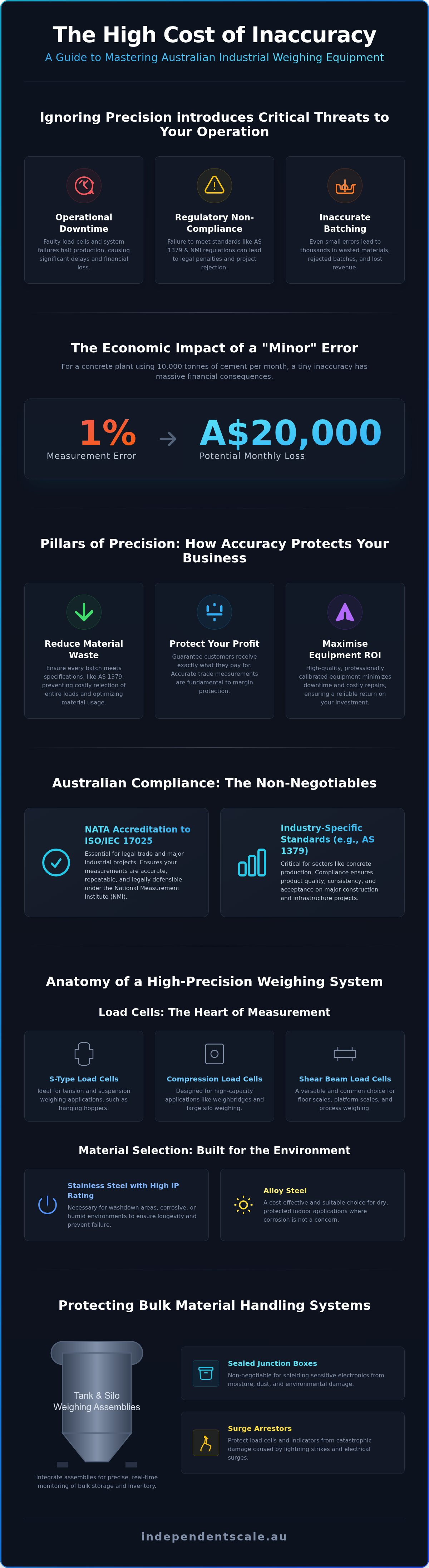
Even minor inaccuracies have substantial financial consequences. For a concrete plant using 10,000 tonnes of cement per month at A$200 per tonne, a mere 1% measurement error translates to a potential loss of A$20,000 every month from material over-supply or under-delivery. Precise weighing is essential for:
- Reducing Waste: Accurate batching in processes like concrete production ensures product specifications (e.g., AS 1379) are met, preventing costly rejection of entire loads.
- Protecting Profit: Ensuring customers receive exactly what they pay for-and that you are not giving away product for free-is fundamental to margin protection.
- Maximising ROI: Investing in high-quality, professionally calibrated australian weighing equipment minimises downtime, reduces the frequency of costly repairs, and delivers a reliable return on investment over its service life.
Core Categories of Industrial Weighing Systems
Understanding the core components of industrial weighing systems is essential for ensuring accuracy, compliance, and operational efficiency. While applications vary, most high-precision australian weighing equipment is built upon a foundation of robust sensing technology, sophisticated data management, and durable hardware designed for demanding environments.
Load Cells and Sensing Technology
At the heart of any modern weighing system is the load cell, a transducer that converts force into a measurable electrical signal. The selection of the correct load cell is critical for system accuracy and longevity. Common types include:
- S-Type Load Cells: Ideal for tension and suspension weighing applications.
- Compression Load Cells: Designed for high-capacity weighing, such as in weighbridges and large silos.
- Shear Beam Load Cells: A versatile option used in floor scales and process weighing.
Environmental factors dictate material choice. Stainless steel load cells with high IP (Ingress Protection) ratings are necessary for washdown areas or corrosive environments, whereas alloy steel is suitable for dry, protected applications. For specialised industrial applications, a comprehensive range of load cells is available to meet specific operational demands.
Bulk Material Handling Solutions
For industries managing high-volume materials, accurate measurement is fundamental to inventory control and batching consistency. Integrating tank and silo weighing assemblies into existing infrastructure allows for precise, real-time monitoring of bulk storage. In exposed outdoor installations, protecting sensitive electronics is paramount. The use of sealed junction boxes and surge arrestors is non-negotiable to shield against moisture, dust, and electrical surges from lightning strikes, ensuring system reliability.
Indicators and Data Management
Raw data from a load cell is useless without a system to process and display it. Modern indicators and displays provide operators with real-time weight readouts and control functions. For integration into automated plant control systems, conditioners and transmitters convert the load cell's analog signal into a stable, standardised output (e.g., 4-20mA or 0-10V) compatible with PLCs. This digital signal processing is far more resistant to electrical noise than analog signals, a crucial advantage in industrial settings with heavy machinery.
This reliance on digital readouts highlights the importance of the human element; operators must be able to see these displays clearly to ensure accuracy. Just as precision engineering is vital for equipment, clear vision is essential for the personnel who manage it. For professionals who value Australian-made quality in all their tools, from industrial hardware to personal equipment, options like Australian Made Vision offer that same commitment to precision.
This emphasis on digital data management and integration is a key trend across heavy industries. In parallel fields like structural fabrication, for example, specialized software from providers like SOCWeld is used to automate and manage critical welding documentation, ensuring similar levels of compliance and traceability.
This emphasis on digital data management and integration is a key trend across heavy industries. In parallel fields like structural fabrication, for example, specialized software from providers like SOCWeld is used to automate and manage critical welding documentation, ensuring similar levels of compliance and traceability.
Australian Compliance Standards: AS 1379 and ISO/IEC 17025
In Australian industrial sectors, particularly construction and manufacturing, compliance with national standards is a non-negotiable requirement for safety, quality, and legal accountability. The two primary standards governing the accuracy of weighing equipment are AS 1379, for the specification and supply of concrete, and ISO/IEC 17025, the international benchmark for the competence of testing and calibration laboratories. Adherence is enforced through NATA (National Association of Testing Authorities) accreditation.
Using non-calibrated or improperly certified australian weighing equipment introduces significant risk. The legal implications range from breach of contract and project penalties to severe liability in the event of material or structural failure. For any serious industrial project, NATA-accredited calibration is an essential risk management protocol, not an optional expense.
The NATA Accreditation Framework
The NATA seal on a calibration certificate is the definitive mark of technical competence in Australia. It signifies that the provider has been rigorously assessed and proven to operate in accordance with ISO/IEC 17025. This guarantees that the procedures, equipment, and personnel meet the highest standards for producing precise and reliable results. For high-accuracy systems, we employ the gravimetric method, a meticulous process using certified test masses to verify instrument performance. This is a core component of our NATA-accredited load cell calibration services.
Compliance for Concrete and Construction
AS 1379 mandates strict accuracy for weighing systems in concrete production to ensure structural integrity and product consistency. Inaccurate batching of cement, aggregates, or admixtures can compromise the entire project. To meet this standard, operations require expert concrete batching plant calibration that delivers verifiable, audit-ready documentation.
- Audit-Ready Documentation: NATA-endorsed certificates must be provided for every calibration, creating an official and traceable record of compliance for project auditors and regulatory bodies.
- Frequency of Calibration: For high-use facilities producing specification concrete, calibration is recommended every six months. The maximum allowable interval under AS 1379 is 12 months.
Selection Guide: Matching Equipment to Your Environment
Selecting the correct Australian weighing equipment requires a technical assessment of its intended operational environment. Failure to match the system to site conditions compromises accuracy, longevity, and regulatory compliance. Key selection criteria include capacity, material composition, physical installation constraints, and data integration requirements.
Capacity needs can range from grams in laboratory settings to hundreds of tonnes for industrial weighbridges and silos. Material selection is equally critical; stainless steel is essential for corrosive, chemical, or wash-down environments, whereas mild steel is suitable for dry, protected applications. Physical constraints, such as the need for low-profile weighbridge assemblies in space-restricted sites, must also be factored into the design.
These weighbridges are crucial for the logistics and transport sectors, where the safety and roadworthiness of the vehicle fleet are just as important as load compliance. For operators in this space, maintaining their fleet with quality components is key, and reputable suppliers like Superior Trailer Parts are an essential resource for trailer and caravan parts.
Furthermore, modern industrial processes demand seamless data integration. Your weighing system must be capable of communicating with existing PLCs and control systems. Standard output options include:
- Modbus
- Profibus
- 4-20mA analogue outputs
- Ethernet/IP
Environmental Risk Assessment
A thorough risk assessment is non-negotiable. For facilities with frequent high-pressure wash-downs or chemical exposure, IP-rated (Ingress Protection) load cells and enclosures are mandatory to prevent moisture and contaminant ingress. In lifting and crane applications, using certified special purpose and shackle pins is essential for safety and accuracy. For sites in regional Australia, robust protection for sensitive electronics against lightning and power surges is a critical investment to prevent catastrophic failure.
Maintenance and Repair Strategies
Operational continuity depends on a clear maintenance plan. A preventative maintenance schedule is superior to reactive repairs, minimising unplanned downtime. For critical infrastructure, access to 24/7 emergency support is vital to achieving 98% uptime or greater. In cases of diminished accuracy, a targeted service like hopper calibration can restore performance and compliance, offering a cost-effective alternative to a complete system replacement. Correctly specified and maintained equipment ensures long-term operational integrity.
For expert guidance on selecting compliant and reliable weighing equipment for your specific application, contact the technical team at independentscale.au.
Partnering with Independent Scale Service for Total Precision
Navigating the complex standards for Australian weighing equipment requires a partner with proven expertise and an unwavering commitment to accuracy. For over 30 years, Independent Scale Service (ISS) has been the trusted authority for industrial weighing solutions, providing NATA-accredited excellence for businesses across Sydney, Melbourne, and regional Australia. Our core mission is to ensure your operations are not only compliant but also optimised for maximum efficiency and precision.
We specialise in developing custom engineering solutions for the most demanding industrial weighing challenges. From heavy-duty weighbridges to intricate batching systems, our team has the technical competence to design, install, and maintain equipment that performs under pressure. Understanding that any operational interruption is costly, our expert repair services are structured to minimise downtime, keeping your production on schedule and within specification.
Our Full-Service Approach
Our commitment to clients extends far beyond initial supply. We provide a complete lifecycle service, from system design and installation to ongoing maintenance and NATA-accredited calibration. This includes specialised services such as high-precision force gauge calibration for critical engineering and manufacturing applications. Our industry leadership is demonstrated by the fact that we service and maintain the weighing systems for 98% of concrete plants across the Sydney basin, a testament to our reliability and expertise.
Getting Started with Your Weighing Audit
Ensuring your equipment meets all relevant standards begins with a comprehensive assessment. We can schedule a thorough site visit to verify compliance and identify potential areas for improvement. Based on this audit and your specific production volume, we will develop a customised maintenance schedule designed to guarantee sustained accuracy and prevent costly failures. Take the first step towards total weighing precision and compliance for your business.
Contact Independent Scale Service for an expert consultation on your Australian weighing equipment needs.
Your Partner in Compliant and Accurate Weighing Solutions
Navigating the industrial measurement landscape requires a strategic approach. The key takeaways are clear: selecting the correct equipment for your specific application is paramount, and strict adherence to Australian compliance standards like AS 1379 and ISO/IEC 17025 is non-negotiable for operational integrity. Ultimately, the performance of your australian weighing equipment directly impacts your productivity, safety, and profitability.
Do not leave precision to chance. Independent Scale Service provides the expertise and certified solutions necessary to ensure your operations are both accurate and fully compliant. With services that are NATA Accredited to ISO/IEC 17025, AS 1379 compliant, and backed by 24/7 emergency industrial support, we are your dedicated partner in operational excellence and risk mitigation.
Take the definitive step towards securing your industrial compliance. Explore our NATA-accredited solutions today and ensure your measurements are always accurate and defensible.
Frequently Asked Questions About Australian Weighing Equipment
What is the difference between a standard calibration and a NATA-accredited one?
A NATA-accredited calibration is performed by a laboratory certified to ISO/IEC 17025, providing a formal report with measurement uncertainty and international traceability. This is essential for strict quality systems and regulatory compliance. A standard (or traceable) calibration verifies instrument accuracy against certified test masses but lacks the formal NATA endorsement and the rigorous procedural oversight mandated by the accreditation, making it suitable for less critical applications.
How often does a concrete batching plant need to be calibrated under AS 1379?
Australian Standard AS 1379, "Specification and supply of concrete," mandates specific calibration frequencies. Weighing systems for cement, aggregates, and admixtures must be calibrated at least every six months. Water metering systems require calibration at a minimum of every twelve months. Immediate recalibration is also required following any repair or adjustment that could affect the system’s measurement accuracy, ensuring consistent product quality and compliance.
Can you repair load cells from other Australian weighing equipment brands?
Yes. Our expert technicians possess the diagnostic skill and equipment to service and repair load cells from a wide range of manufacturers. We focus on restoring the operational integrity and accuracy of your existing australian weighing equipment, regardless of the original brand. Our comprehensive service includes fault-finding in summing circuits and junction boxes to ensure the entire system performs reliably, minimising your operational downtime and protecting your investment.
What are the benefits of using stainless steel load cells in Australian industries?
Stainless steel load cells offer superior durability and corrosion resistance, which is critical in many demanding Australian industrial environments. They are ideal for washdown applications in food processing, coastal areas with salt spray, and facilities using harsh chemicals. This material resilience ensures long-term measurement stability and reliability, reducing replacement costs and protecting the integrity of your weighing processes from environmental degradation.
How do surge arrestors protect my weighing equipment during storms?
Surge arrestors are essential for protecting sensitive electronic weighing components from voltage spikes caused by lightning or power grid fluctuations. The device instantly diverts excessive electrical energy safely to the ground, shielding critical parts like digital indicators and load cells from permanent damage. This preventative measure is a crucial defence against catastrophic equipment failure, saving significant costs in repairs and unscheduled operational downtime.
Do you provide on-site calibration services for large-scale silos and hoppers?
Yes, we provide comprehensive on-site calibration services for large-scale industrial equipment, including silos, tanks, and hoppers. Our technicians arrive with certified, traceable test masses and the specialised jacking equipment required to safely and accurately conduct calibrations. This service ensures your high-capacity weighing systems remain compliant and accurate with minimal disruption to your site operations, maintaining the integrity of your inventory and production processes.
What documentation do I receive after a successful equipment calibration?
Following a calibration, you will receive a formal Calibration Report or Certificate. For a NATA-accredited service, this is a NATA-endorsed certificate that includes detailed 'as found' and 'as left' readings, a statement of measurement uncertainty, and clear traceability to national standards. This comprehensive documentation is essential for passing quality audits and demonstrates full compliance with industry regulations and standards.
How does the gravimetric method improve liquid flowmeter accuracy?
The gravimetric method provides the highest level of accuracy for liquid flowmeter calibration. The process involves precisely measuring the mass of a liquid that passes through the meter into a vessel on a calibrated scale. By comparing the highly accurate weight reading to the flowmeter's registered volume, we calculate a precise calibration factor. This direct measurement against a primary standard (mass) is fundamentally more accurate than less direct volumetric methods.
