


The Grave Consequences of Inaccurate Batching in Industrial Weighing
A single 1% measurement error in your plant is not a minor variance; it's a compounding liability that can lead to a 100% project failure. In an industry where ready-mix concrete prices have risen 6.5% year-over-year as of April 2026, the financial consequences of inaccurate batching are immediate and severe. You understand that precision is the foundation of your operations. Even slight deviations in load cell performance result in costly material wastage, audit failures, and site rejections by Tier 1 contractors.
These errors extend beyond your balance sheet to threaten legal compliance and long-term structural safety. You'll discover the specific financial, regulatory, and safety risks associated with measurement drift in industrial weighing systems. This guide provides the technical insights needed to justify NATA-accredited calibration to stakeholders and ensure equipment meets the strict ±0.4% accuracy requirements mandated by AS 1379-2007. We will examine the latest standards from NIST Handbook 44-2026 and outline how to mitigate risk through rigorous hopper and silo calibration.
Key Takeaways
- Quantify the "giveaway" effect to understand how even minor over-batching of cement directly erodes your annual profit margins.
- Assess the severe consequences of inaccurate batching on structural integrity, including the risks of honeycombing and compromised design life.
- Ensure legal compliance with AS 1379-2007 by implementing a mandatory six-month NATA-accredited calibration schedule for all weighing equipment.
- Protect your commercial reputation and avoid being blacklisted by Tier 1 contractors through the prevention of site rejections and project delays.
- Develop a robust mitigation strategy that combines professional hopper and silo calibration with routine mechanical inspections for binding and build-up.
The Financial Impact: Material Wastage and Profit Margin Erosion
Inaccurate batching occurs when weighing systems fail to maintain specified tolerance limits during the batch production process. In concrete manufacturing, AS 1379-2007 requires weighing equipment for cement and aggregates to maintain an accuracy of ±0.4% of the maximum scale value. When systems drift beyond these parameters, the financial consequences of inaccurate batching manifest through two primary channels: material giveaway and project rejections. While a 1% error might seem negligible on a single load, it represents a systemic failure that erodes profit margins across the entire production cycle.
The "Silent Killer" of Industrial Profitability
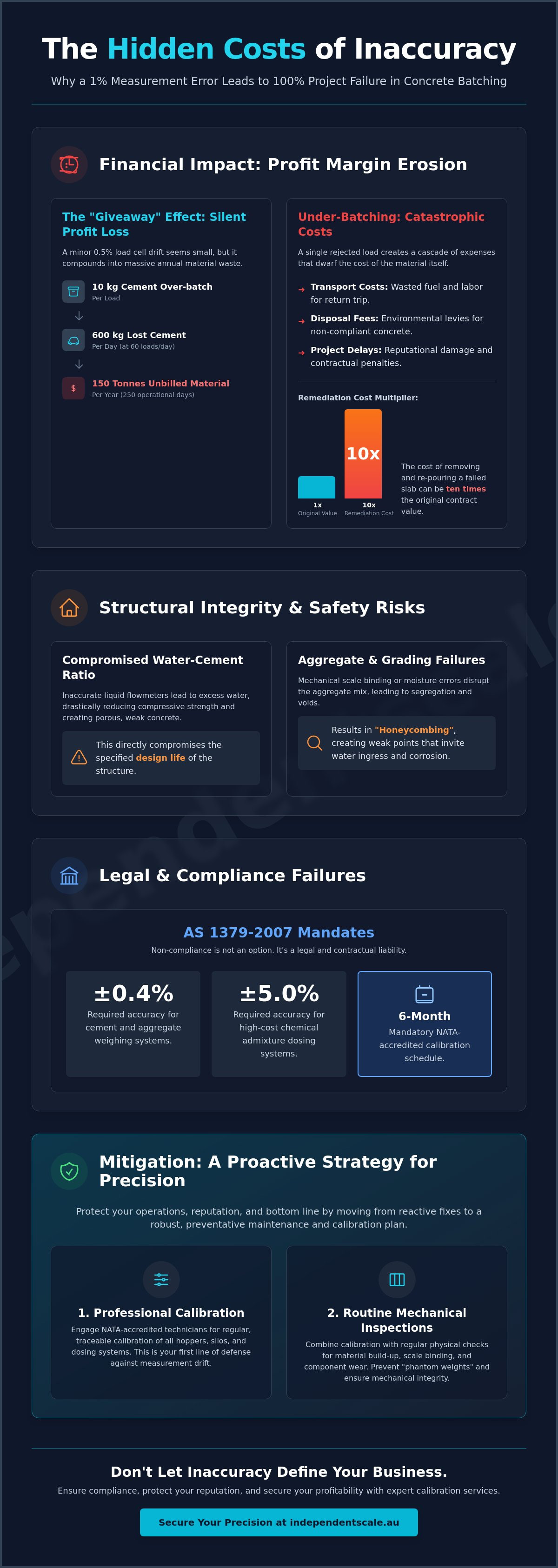
Precision measurement is the only barrier against material giveaway. A minor 0.5% drift in your load cells accumulates rapidly over thousands of cycles. Consider a plant over-batching cement by just 10kg per load. At a production rate of 60 loads per day, the facility loses 600kg of cement daily. Over a standard 250-day operational year, this equates to 150 tonnes of unbilled material. With ready-mix concrete prices reaching $195+ per cubic yard in May 2026, this "silent" loss directly subtracts from the bottom line. The impact is even more pronounced with chemical admixtures, where dosing systems must maintain ±5.0% accuracy. Because these chemicals are high-cost inputs, even slight over-calibration leads to significant annual waste.
Project Rejections and Disposal Liabilities
Under-batching presents an even higher risk profile. Attempting to save on material costs by operating at the lower end of tolerances often leads to batches that fail slump or strength tests. Tier 1 contractors and government infrastructure projects don't accept non-compliant material. The consequences of inaccurate batching in these scenarios include the immediate rejection of the entire load. The financial burden of a rejected load includes several layers of wasted capital.
- Transport Costs: Fuel and labor for the return trip to the batching plant.
- Disposal Fees: Environmental levies and tipping fees for hardened, non-compliant concrete.
- Remediation: If the material is already poured, the cost of jackhammering out a slab and re-pouring can be ten times the original contract value.
These hidden costs transform a small measurement error into a catastrophic operational expense. It's not just about the cost of the cement; it's about the total loss of the production window and the liability of the waste produced.
Structural Integrity Risks and Engineering Failures
While the financial drain of material waste is immediate, the physical consequences of inaccurate batching represent a much higher risk profile for the asset owner. Engineering specifications rely on precise chemical and physical proportions to meet design life requirements. When a batching plant fails to deliver these proportions, the resulting structure is fundamentally compromised. These failures often remain invisible during the pour, only manifesting weeks or years later as structural deficiencies or premature degradation.
Compromising the Water-Cement Ratio
The relationship between water content and concrete strength is logarithmic. A minor increase in water volume beyond the design mix leads to a disproportionate reduction in compressive strength. Inaccurate liquid flowmeters are frequently responsible for these variances. When water measurement is non-compliant, the concrete becomes overly porous. This porosity weakens the internal matrix and reduces the material's ability to resist load. For high-performance or special-class mixes, the precision of chemical admixtures is non-negotiable as even gram-level errors can drastically alter setting times and hydration heat.
Aggregate Grading and Consistency Issues
Aggregates provide the structural skeleton of the mix. Inaccurate measurement of sand and stone, often caused by uncorrected moisture content or mechanical scale binding, disrupts the grading curve. Scale binding is particularly dangerous because it creates "phantom weights." The indicator might display a target weight, but physical obstructions in the hopper prevent the actual material from being measured correctly. This results in segregation or "honeycombing," where the coarse aggregate is not properly suspended in the paste. The cost of inaccuracy in aggregate batching is a loss of workability and inconsistent slump, making the concrete difficult to pump and place correctly.
The most severe consequences of inaccurate batching often stay hidden until the 28-day compressive strength testing phase. If these tests fail, the project faces catastrophic delays and the potential requirement for total demolition of the affected elements. Beyond immediate strength, poor batching compromises long-term durability. Structures with inaccurate proportions are susceptible to carbonation and chloride ingress. These processes accelerate the corrosion of reinforcement steel, leading to spalling and "concrete cancer" which shortens the structure's design life by decades. Ensuring your equipment is verified through professional concrete batching plant calibration is the primary defense against these engineering failures.
Legal Consequences and AS 1379 Compliance Failures
Compliance with AS 1379-2007 (reconfirmed in 2017) is a non-negotiable legal requirement for batching plants operating in Australia. This standard is enforced through the National Construction Code (NCC), making any deviation from its technical requirements a breach of statutory law. The legal consequences of inaccurate batching are most severe when a plant fails to meet the mandatory ±0.4% accuracy threshold for cement and aggregate weighing. When these inaccuracies lead to structural non-compliance, the plant operator and management face significant exposure to litigation and contractual penalties.
Breaching the Australian Standard for Concrete
AS 1379 requires that all weighing and liquid-dispensing equipment undergo professional calibration at least every six months. Relying on a basic "scale check" or an unaccredited technician is legally insufficient. Without a NATA-accredited certificate, a plant cannot prove its equipment was operating within the required tolerances during a specific production window. Failing an audit or being found in breach of these standards often results in immediate suspension from government infrastructure tenders. For plants supplying major projects, the loss of certification can lead to the termination of supply agreements worth millions of dollars.
Litigation and Professional Indemnity
In the event of a structural failure or a failed 28-day strength test, batching records become critical evidence in legal proceedings. Investigators scrutinize these logs to determine if the mix delivered matched the design specification. Integrating precision tank and silo weighing assemblies ensures that every component is accounted for with a high degree of traceability. A NATA-accredited calibration report serves as a primary legal defense, providing documented proof that the plant operated within statutory accuracy limits at the time of production. Without this documentation, professional indemnity insurance may not cover the resulting claims, leaving the business and its managers personally liable for damages.
The consequences of inaccurate batching also manifest as "Liquidated Damages" in Tier 1 construction contracts. These clauses allow contractors to claim specific financial compensation for every day a project is delayed due to non-compliant material supply. If a batching error forces a site shutdown or requires the removal of poured concrete, the supplier is often held responsible for the total cost of the delay. Plant managers must also recognize their vicarious liability; they are legally responsible for ensuring that all measurement systems are verified by accredited professionals to prevent negligence claims during a structural investigation.
Operational Downtime and Brand Reputational Damage
The "Blacklist" effect is a reality for plants that fail to maintain precision. One bad batch delivered to a high-profile infrastructure project can lose a multi-million dollar client instantly. Tier 1 contractors in Sydney and Melbourne maintain strict internal compliance registers. They prioritize suppliers who provide a documented history of NATA-accredited accuracy. The consequences of inaccurate batching extend to total operational paralysis. When an operator or site inspector suspects a measurement fault, production must stop immediately. This downtime isn't limited to the plant itself. It ripples through the entire supply chain, affecting truck fleets, pump operators, and site crews waiting for delivery.
The Cost of Unscheduled Repairs
Proactive maintenance is significantly more cost-effective than emergency intervention. Proactive hopper calibration identifies measurement drift before it triggers a site rejection or a structural failure. In contrast, an emergency breakdown forces an immediate halt to all revenue-generating activities. Faulty indicators and displays often exacerbate these issues. They lead to operator error and force technicians to spend hours on diagnostic time that could've been avoided with routine service. The ripple effect of plant downtime is extensive. If a batching plant stops during a major pour, the site crew remains on the payroll while standing idle. You're paying for logistics and labor that aren't producing value. Unpredictable equipment also degrades employee morale and safety. Operators shouldn't have to "guess" if the load cell is reading correctly. This uncertainty creates a high-stress environment that increases the likelihood of safety incidents and further human error during critical production windows.
Earning and Losing "Preferred Supplier" Status
Major infrastructure projects demand reliability. A reputation for "dead-on" accuracy is a significant competitive advantage when bidding for government tenders. Conversely, consistent inaccuracy leads to increased audit frequency and regulatory scrutiny. Regulators and contractors will scrutinize every batch record if they lose trust in your plant's precision. Maintaining "Preferred Supplier" status requires more than just meeting the minimum requirements; it requires a commitment to documented excellence. Once a supplier is blacklisted for quality issues, the road to reinstatement is long and expensive. If you're looking to protect your reputation and minimize downtime, you should schedule a professional batching plant audit today. This ensures your operations remain compliant with AS 1379 and your brand remains synonymous with reliability.
Mitigation: Strategies for Ensuring Batching Precision
To avoid the severe consequences of inaccurate batching, plant operators must move from reactive repairs to a proactive metrology framework. Precision isn't a static state; it's a condition maintained through rigorous technical standards and high-quality hardware. Implementing a systemic approach to measurement integrity ensures your plant remains compliant with AS 1379-2007 and protects your commercial interests from the risks of material giveaway or structural failure.
The NATA Accreditation Advantage
The six-month calibration cycle mandated by AS 1379 is the minimum requirement for legal operation. However, the quality of that calibration is determined by the accreditation of the provider. ISO/IEC 17025 standards represent the global benchmark for testing and calibration laboratories. Using NATA-accredited Concrete Batching Plant Calibration Services provides a level of traceability that unaccredited "scale checks" cannot match. You should analyze your calibration reports to identify "out-of-tolerance" trends. If a hopper scale consistently drifts in the same direction over three cycles, it indicates an underlying mechanical issue, such as progressive load cell fatigue or structural deflection, that requires immediate intervention before a total failure occurs.
Addressing the Technical Roots of Scale Drift
Load cell drift is often the technical catalyst for inaccurate batches. Signal degradation occurs when moisture enters non-hermetically sealed sensors or when temperature fluctuations affect the internal strain gauge bridge. This results in "creep," where the weight reading changes under a static load. You can mitigate this by investing in hermetically sealed stainless steel load cells designed for harsh industrial environments. Daily and weekly mechanical inspections are equally vital. Operators must check for hopper binding, where physical contact between the weighing vessel and the surrounding structure creates friction, leading to significant measurement errors. Removing material build-up from the interior of the hopper ensures the "zero" point of your scale remains stable throughout the production shift.
Hardware Upgrades for Long-Term Stability
The electronic environment of a batching plant is often prone to signal interference. Selecting high-performance conditioners and transmitters is essential for reducing signal noise and ensuring the raw data from the load cells reaches the control system without distortion. Protecting these sensitive components is critical. Integrating industrial-grade surge arrestors prevents voltage spikes from damaging weighing electronics during storms or power surges. Well-trained operators act as the final line of defense; they should be taught to recognize early warning signs like slow return-to-zero or inconsistent slump readings. Professional calibration and hardware optimization transform your weighing systems from a potential liability into a verified competitive asset.
Prioritize Precision to Secure Long-Term Structural Integrity
Inaccurate batching is a systemic risk that compromises your financial margins and the safety of your infrastructure. We've examined how material giveaway erodes profitability and how non-compliant water-to-cement ratios lead to structural failures. The legal consequences of inaccurate batching under AS 1379-2007 include the loss of government tenders and exposure to liquidated damages. These risks make professional oversight a necessity rather than an option.
Maintaining a rigorous calibration schedule is the only method to ensure your plant operates within the required ±0.4% tolerance. Our team are AS 1379 compliance specialists, NATA accredited to ISO/IEC 17025. We provide professional calibration services across Sydney, Melbourne, and regional Australia to help you maintain traceable records and protect your reputation with Tier 1 contractors. Precision measurement transforms your weighing systems from a liability into a verified operational asset.
Protect your project with NATA-accredited Concrete Batching Plant Calibration.
Frequently Asked Questions
How does inaccurate batching affect the compressive strength of concrete?
Inaccurate batching directly compromises compressive strength by altering the specified water-cement ratio. Excessive water increases the porosity of the hardened paste, which reduces the material's ability to resist compressive loads. These deviations often result in failed 28-day strength tests, forcing the removal of non-compliant structural elements. Precise aggregate grading is also necessary to ensure the concrete matrix remains dense and durable.
What is the permissible tolerance for concrete batching under AS 1379?
AS 1379-2007 mandates strict tolerance limits for all batching components. Weighing equipment for cement and aggregates must maintain an accuracy of ±0.4% of the maximum scale value. Liquid measurement systems for water require ±2.0% accuracy, while chemical admixture dispensers must operate within ±5.0% of the indicated value. Maintaining these technical standards is essential to avoid the legal and structural consequences of inaccurate batching.
Can inaccurate batching lead to legal action against a plant manager?
Plant managers can face legal action under vicarious liability if a structural failure is traced back to non-compliant production. If batching records show that tolerances were exceeded, it provides evidence of negligence in a court of law. Professional indemnity insurance often requires proof of regular calibration. Without NATA-accredited documentation, managers lack a primary defense against litigation following an engineering failure.
How often should a concrete batching plant be calibrated in Australia?
Concrete batching plants in Australia must be calibrated at least every six months to comply with AS 1379-2007. This frequency ensures that measurement drift is identified before it exceeds permissible limits. High-volume plants or those working on sensitive infrastructure projects often choose more frequent intervals. Regular servicing minimizes the risk of unscheduled downtime and ensures continued eligibility for government tenders.
What are the most common causes of weighing errors in batching plants?
Weighing errors are frequently caused by mechanical binding or material build-up inside the hopper. Physical obstructions prevent the load cell from sensing the true weight of the material. Electrical signal noise and load cell drift due to moisture ingress are also common technical factors. Routine inspections for "phantom weights" and the use of hermetically sealed sensors help maintain long-term measurement stability.
Is a standard scale calibration the same as a NATA-accredited calibration?
A standard scale calibration is not legally equivalent to a NATA-accredited calibration. NATA-accredited services adhere to ISO/IEC 17025 standards, providing a high level of technical competence and traceable results. This accreditation is a mandatory requirement for many Tier 1 and government contracts. Standard checks lack the rigorous documentation needed to defend against audits or legal investigations.
What happens if a batching plant fails a NATA audit?
Failing a NATA audit results in the immediate loss of compliance certification. This status change prevents a plant from supplying concrete to any project governed by the National Construction Code or government infrastructure frameworks. Regaining accreditation requires a full technical audit and proof of rectification. The resulting loss of revenue and reputational damage can be catastrophic for industrial suppliers.
How do environmental factors like wind or vibration affect batching accuracy?
Environmental factors like high winds or heavy machinery vibration introduce signal interference into weighing electronics. These forces apply external pressure to the load cells, causing unstable readings and consequences of inaccurate batching such as over-filling. You can mitigate these effects by installing wind shielding and using advanced signal conditioners. High-quality transmitters filter out mechanical noise to ensure that only the actual material weight is recorded.
