


The Critical Benefits of NATA Accredited Calibration for Australian Industry
An inaccurate load cell in an Australian concrete batching plant isn't just a technical glitch; it's a legal liability that can lead to immediate project shutdowns and regulatory penalties. You already know that maintaining precision is the only way to avoid the high costs of wasted materials and the stress of a failed ISO audit. Understanding the specific benefits of NATA accredited calibration is essential for any facility manager who prioritises operational integrity over guesswork. With over 30 years of industry experience, we've seen how non-accredited testing leaves businesses vulnerable to inconsistent batching quality that compromises structural safety and project timelines.
This article explains why NATA accreditation is the definitive gold standard for weighing accuracy and how it protects your business from severe compliance risks. We detail the technical requirements for achieving full compliance with AS 1379 and ISO/IEC 17025 standards. The following sections examine how these rigorous protocols reduce operational risk, eliminate legal exposure from inaccurate records, and ensure the long-term reliability of your weighing equipment in demanding industrial environments.
Key Takeaways
- Understand how ISO/IEC 17025 standards define the technical competence of a laboratory and eliminate measurement errors in industrial weighing equipment.
- Discover the core benefits of NATA accredited calibration for mitigating compliance risks and meeting the rigorous demands of Australian insurers and regulatory auditors.
- Identify the critical differences in audit trail depth between NATA-endorsed certificates and standard traceable calibration to ensure your business remains fully compliant.
- Learn how precision calibration supports adherence to AS 1379 standards for concrete production and enhances accuracy in bulk material handling and logistics.
- Gain actionable insights on verifying a provider’s scope of accreditation and the importance of on-site calibration capabilities for heavy industrial machinery.
What is NATA Accredited Calibration?
NATA calibration isn't just a certificate. It's a rigorous validation of a laboratory's technical competence. In Australia, the National Association of Testing Authorities (NATA) operates as the sole national accreditation body. They assess laboratories against international standards to ensure every measurement is accurate, repeatable, and legally defensible. Understanding the benefits of NATA accredited calibration starts with recognizing the difference between a simple equipment check and a formally audited process. While a significant portion of non-accredited providers offer "traceable" services, only NATA-accredited facilities have undergone the intensive peer-review process required to prove their results hold up under industrial scrutiny.
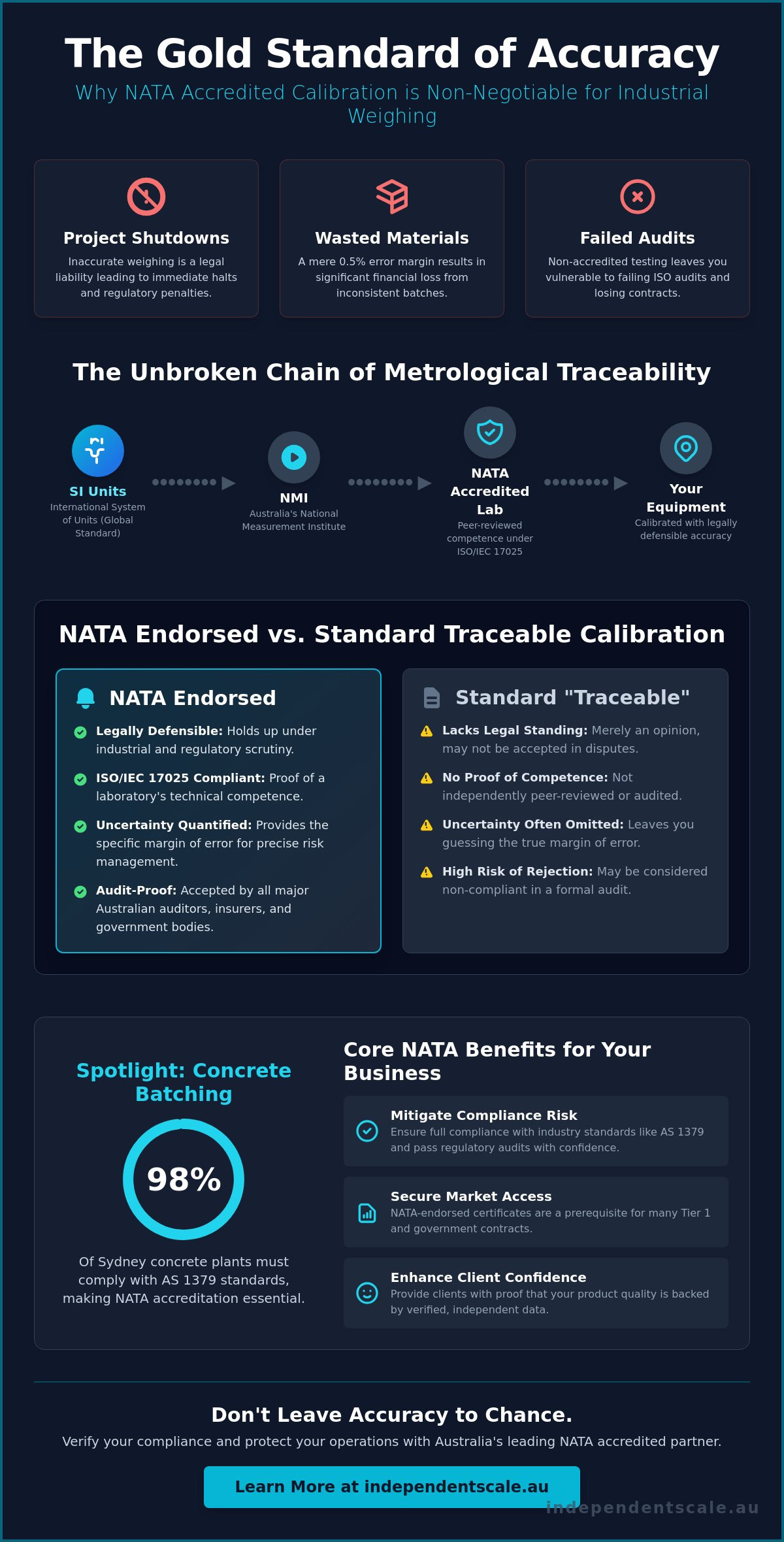
The relationship between NATA and the National Measurement Institute (NMI) is foundational to Australian industry. NMI maintains the nation's primary measurement standards. NATA then accredits commercial laboratories to ensure their secondary standards and procedures align perfectly with these national benchmarks. For sectors like civil construction, where AS 1379 compliance is mandatory for 98% of concrete plants across Sydney, this hierarchy ensures that a scale in one facility measures a tonne exactly the same as any other. ISS has maintained this level of precision for over 30 years, focusing on high-stakes industrial environments.
The ISO/IEC 17025 Standard
ISO/IEC 17025:2017 is the global benchmark for testing and calibration laboratories. It's more than a management system; it's a technical requirement. This standard mandates strict controls over environmental factors like temperature and vibration, which can skew sensitive measurements by 0.5% or more if left unmonitored. It requires documented proof of staff proficiency and regular equipment maintenance. By adhering to this standard, a lab ensures total impartiality. Results aren't influenced by external commercial pressures or poor internal habits. This creates a baseline of trust for every measurement result produced.
Metrological Traceability Explained
Traceability is an unbroken chain of comparisons back to the International System of Units (SI). NATA accreditation validates that this chain isn't just claimed, but scientifically sound. A critical component of a NATA report is the "uncertainty of measurement." This value quantifies the margin of error, giving engineers the specific data needed to manage operational risk. Without this, a calibration is merely an opinion. One of the primary benefits of NATA accredited calibration is this transparency. It allows for precise weighing scale calibration that meets both regulatory demands and internal quality control thresholds. When accuracy is non-negotiable, an accredited report is the only acceptable proof of performance.
Core Benefits of NATA Accreditation for Weighing Equipment
NATA accreditation represents the highest tier of technical competence for Australian weighing services. It isn't merely a badge of quality; it's a rigorous assessment of a laboratory's ability to produce accurate, reliable data. One of the primary benefits of NATA accredited calibration is the elimination of technical errors through peer-reviewed procedures. These protocols ensure that every measurement is traceable to national standards maintained by Australia's National Measurement Institute (NMI). This traceability is essential for industries where a margin of error of even 0.5% can lead to significant financial loss or safety compromises.
Securing NATA-endorsed calibration provides several strategic advantages for industrial operators:
- Peer-Reviewed Accuracy: Calibration procedures are audited by technical experts to ensure they meet ISO/IEC 17025 standards.
- Market Access: Many government and Tier 1 commercial contracts require NATA-endorsed certificates as a prerequisite for tendering.
- Client Confidence: Providing clients with accredited reports proves that your product quality is backed by verified, independent data.
- Proactive Risk Management: Regular testing identifies equipment drift early, allowing for adjustments before a total system failure occurs.
Risk Mitigation and Legal Standing
In the Australian legal system, a NATA-endorsed report serves as objective evidence of "due diligence." If a business faces a product liability claim or a dispute over weight readings, these certificates demonstrate that the company adhered to the highest possible calibration standards. This protection is critical for companies complying with AS 1379 for concrete production, where precise batching is a legal requirement. By using accredited services, you minimise the financial impact of batching errors. These errors often lead to rejected loads or structural integrity issues that cost tens of thousands of dollars to rectify. It's a necessary safeguard for your balance sheet and your reputation.
Operational Efficiency and Reliability
Operational reliability depends on the consistency of your equipment across multiple sites or production lines. NATA-accredited calibration schedules allow for predictive maintenance, which reduces the need for emergency repairs and minimises rework. When your measurements are consistent, your output remains uniform. For instance, NATA-calibrated load cells ensure that weight readings remain precise over time, preventing costly plant shutdowns caused by undetected component degradation. This precision extends the lifespan of your hardware and ensures that your plant operates at peak efficiency. To maintain your site's compliance, you can book a professional weighing scale calibration to ensure all equipment meets current Australian standards.
NATA vs. Traceable Calibration: Why the Difference Matters
Traceable calibration implies that a technician used weights that were once calibrated by a higher authority. It doesn't guarantee the technician's competence, the environmental conditions during testing, or the mathematical validity of the results. One of the primary benefits of NATA accredited calibration is the rigorous audit trail that validates every variable in the measurement process. Unlike standard services, NATA-accredited providers are audited to ISO/IEC 17025 standards, ensuring that the equipment, methods, and personnel meet strict international benchmarks.
Insurance providers and external auditors frequently mandate NATA-endorsed certificates because they provide legally defensible proof of accuracy. A "sticker-only" service might seem cost-effective, but it offers zero technical backing if a measurement is challenged in court or during a contract dispute. If a weighing system fails on a major infrastructure site like WestConnex, a non-accredited certificate won't satisfy the compliance requirements of Tier 1 contractors. It's a risk that can lead to immediate site shutdowns and heavy financial penalties.
Evaluating the Total Cost of Ownership (TCO) for weighing equipment requires looking beyond the initial service fee. A non-accredited calibration might save A$200 today, but a single batching error can cost tens of thousands in wasted materials, labor, and project delays. High-precision industries don't view NATA accreditation as an expense; they see it as a critical risk mitigation strategy.
What is Missing in a Standard Report?
The most critical omission in standard reports is calculated measurement uncertainty. Without this value, you don't know the true reliability of your scale's readings. Standard reports also lack independent oversight and external proficiency testing for the technician. During an ISO 9001 or AS 1379 audit, these omissions often lead to immediate non-conformance reports. Another of the benefits of NATA accredited calibration is that it includes this data as standard, providing the transparency required for high-level quality assurance.
When is NATA Calibration Mandatory?
For concrete batching plants, AS 1379 compliance is a regulatory necessity, not an option. This standard demands that all weighing equipment is calibrated by a NATA-accredited laboratory. High-stakes infrastructure projects, such as the Sydney Metro, enforce strict contractual obligations for NATA-endorsed testing to ensure structural integrity. Internal quality management systems that prioritize risk management also require the highest level of assurance to prevent product recalls or catastrophic structural failures in the field.
Industry Applications: From Concrete to Logistics
The benefits of NATA accredited calibration extend beyond simple paperwork; they safeguard the structural integrity of Australian infrastructure and the profitability of logistics networks. Precision weighing is a functional necessity for any sector handling bulk materials or safety-critical components. Without traceable accuracy, businesses risk regulatory intervention, financial loss, and equipment failure. ISS provides the technical expertise required to maintain these standards across diverse industrial environments.
AS 1379 Compliance for Concrete Plants
In the construction sector, adherence to AS 1379 is the baseline for quality and safety. This Australian Standard mandates gravimetric method calibration for cement and aggregate weighers to ensure every batch meets specified strength requirements. Compliance isn't a one-time event. Plants must perform these calibrations every six months to satisfy industry audits and maintain their certification. Independent Scale Service currently manages the NATA reporting for 98% of concrete plants across Sydney, providing the technical assurance required by major contractors. See our guide to concrete batching plant calibration for a detailed breakdown of these requirements.
Weighbridge and Heavy Industrial Scales
Logistics operators face strict penalties for mass limit breaches on Australian roads. Accurate weighbridges are the only defense against heavy overload fines and the potential loss of heavy vehicle accreditation. One of the key benefits of NATA accredited calibration in this sector is the legal protection it offers through Trade Measurement compliance. This level of precision is also vital for tank and silo weighing assemblies where inventory management and batching rely on exact data. For safety-critical testing, ISS ensures the reliability of force gauges, which are used to verify the load-bearing capacity of industrial equipment and lifting gear.
Laboratory and Scientific Weighing
Scientific and medical laboratories require the highest level of measurement certainty to ensure repeatable results. NATA-endorsed calibration provides a clear chain of traceability back to national standards, which is essential for maintaining ISO/IEC 17025 accreditation. Whether it's weighing chemical precursors or performing material stress tests, the accuracy of the equipment dictates the validity of the final data. ISS technicians use NATA-calibrated masses to verify that laboratory balances operate within strict tolerances, preventing costly research errors or manufacturing batch failures. This methodical approach ensures that every gram measured is accounted for with absolute confidence.
Choosing a NATA Accredited Partner in Australia
Selecting a calibration provider requires a methodical approach to verify technical competence. You must first access the NATA website to confirm a provider's specific scope of accreditation. This ensures the laboratory is authorized to calibrate your specific equipment within the required measurement ranges. A general accreditation is insufficient; it must align precisely with your facility's technical requirements. Checking the scope prevents the risk of receiving a report that fails to meet regulatory or audit standards.
For heavy machinery and fixed installations, on-site calibration capabilities are essential. Transporting large-scale equipment to a laboratory is often impossible and risks damaging sensitive components during transit. Mobile calibration units allow technicians to assess equipment under real-world operating conditions. To realize the full benefits of NATA accredited calibration, the process should account for site-specific variables like vibration, airflow, and structural integrity that a lab environment cannot replicate.
Reliability in high-stakes industrial environments is built on longevity. Providers with 30+ years of experience bring a level of expertise that newer firms lack, particularly when dealing with legacy mechanical systems and modern digital interfaces. This experience is critical when diagnosing complex faults that simpler tests might miss. You should also prioritize partners offering 24/7 emergency support. Industrial downtime is expensive. Having a technician available at any hour minimizes production losses and keeps your facility compliant without lengthy delays.
The Independent Scale Service Advantage
Independent Scale Service (ISS) holds NATA accreditation to ISO/IEC 17025 and maintains a strict commitment to AS 1379 standards. We don't just record numbers; our technicians provide comprehensive expertise in both electrical and mechanical fault diagnosis. If a load cell or summing circuit fails during calibration, we identify and resolve the issue immediately. This rigorous approach is why major Australian industry leaders like Holcim, Boral, and Hanson trust ISS for their precision weighing needs. We understand the benefits of NATA accredited calibration extend beyond a certificate; they include operational safety and long-term asset protection.
Next Steps for Your Facility
The first step toward full compliance is a comprehensive site audit. This allows our technicians to evaluate the condition of your weighing equipment and identify any potential risks to accuracy. To prepare for a NATA calibration visit, ensure your industrial scales are clean and easily accessible. Clear any debris from under the scale platform and ensure power supplies are stable. This preparation streamlines the process and ensures an efficient, accurate result for your operations.
Ready to secure your facility's accuracy and compliance? Contact Independent Scale Service for a NATA-accredited calibration quote today.
Secure Your Industrial Compliance and Measurement Accuracy
Maintaining precision in industrial weighing isn't just about day-to-day accuracy; it's about regulatory certainty and long-term risk mitigation. By choosing NATA Accredited to ISO/IEC 17025 services, your facility ensures every measurement meets the highest international standards. The benefits of NATA accredited calibration extend beyond simple verification, providing the legal defensibility and technical rigour required for AS 1379 compliant services in sectors like concrete production and heavy logistics. Traceable calibration often falls short for high-stakes Australian industries where precision is non-negotiable. Independent Scale Service provides the specific expertise needed to keep your equipment operational. With over 30 years of experience, we offer 24/7 emergency support for industrial clients to minimise downtime, ensuring your production lines never stall due to equipment failure or audit non-compliance. Our team focuses on delivering methodical, data-driven results that protect your bottom line and your operational reputation. Accurate weighing is the backbone of your production quality. Trust a seasoned expert to maintain the standards your business depends on every day.
Get a NATA-Accredited Calibration Quote Today
Frequently Asked Questions
What is the difference between NATA and ISO 17025?
ISO/IEC 17025 is the international standard that specifies the general requirements for the competence of testing and calibration laboratories. NATA is the Australian authority that assesses and grants accreditation to laboratories against this specific standard. When a laboratory is NATA accredited, it means they've proven their technical competence and adherence to ISO/IEC 17025 through rigorous third party audits.
Is NATA calibration legally required for all businesses in Australia?
NATA calibration isn't legally required for every business, but it's mandatory for those operating under strict regulatory frameworks or industry standards like AS 1379 for concrete production. Many government contracts and major infrastructure projects require NATA endorsed reports to ensure measurement traceability. Understanding the benefits of NATA accredited calibration helps businesses meet these specific contractual and legal obligations without risking project delays.
How often should I have my industrial scales NATA calibrated?
Industrial scales should undergo NATA calibration every 6 to 12 months depending on the frequency of use and the criticality of the measurements. High volume facilities, like the 98% of concrete plants ISS services across Sydney, typically follow a 6 month schedule to maintain compliance. Frequent testing prevents measurement drift that leads to material waste or non compliance with Australian trade measurement laws.
Can a standard electrician perform a NATA calibration?
No, a standard electrician can't perform a NATA calibration because they lack the specific accreditation and audited technical procedures required by ISO/IEC 17025. Only technicians working for a NATA accredited laboratory can issue NATA endorsed reports. These specialists use certified reference masses traceable to national standards, providing a level of precision and legal standing that exceeds the scope of general electrical work.
What happens if my equipment fails a NATA calibration test?
If equipment fails a NATA calibration test, the technician issues a report documenting the non conformance and the scale must be taken out of service or adjusted immediately. The unit requires professional repair or recalibration to bring it back within the specified tolerances of the relevant Australian standard. Continuing to use failed equipment risks product quality and can void insurance coverage in industrial settings.
How long does a NATA calibration report remain valid?
A NATA calibration report remains valid until the next scheduled calibration interval, which is usually defined by your site quality management system or standards like AS 1379. While the report is a point in time record, most Australian industrial sectors recognise a 12 month maximum validity period. Harsh environments or 24/7 operations often necessitate shorter 3 month or 6 month intervals to ensure ongoing accuracy.
Does NATA accreditation apply to the equipment or the laboratory?
NATA accreditation applies to the laboratory and its specific scope of testing, not the individual pieces of weighing equipment. The laboratory undergoes regular audits to prove its staff, equipment, and methods comply with ISO/IEC 17025 requirements. When you seek the benefits of NATA accredited calibration, you're relying on the laboratory's proven technical competence to verify your equipment's accuracy and provide a traceable result.
Why does NATA calibration cost more than standard calibration?
NATA calibration costs more than standard calibration because it involves higher overheads for rigorous auditing, specialised staff training, and the maintenance of high precision reference standards. The laboratory must pay annual accreditation fees and participate in regular proficiency testing to maintain its status. This investment ensures a level of traceability and technical certainty that standard, non accredited checks can't provide for critical industrial applications.
