


The Comprehensive Weighbridge Installation Guide: Compliance, Engineering, and NATA Standards (2026)
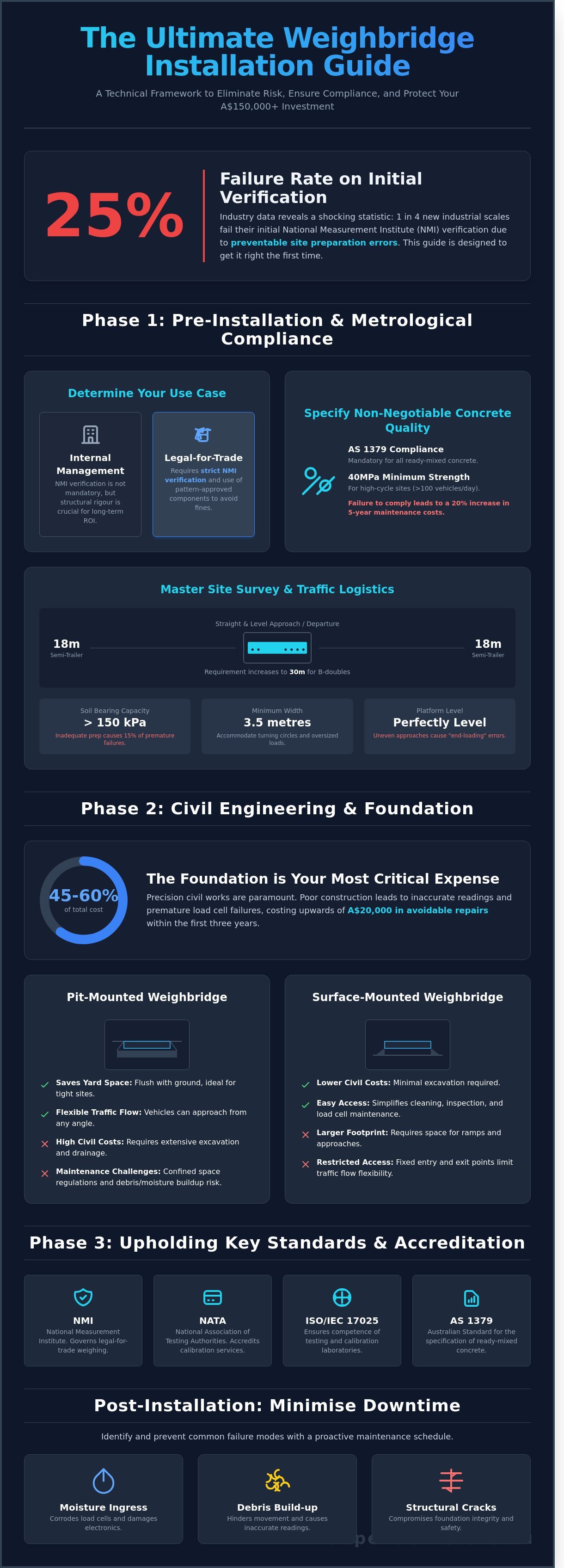
A weighbridge is only as accurate as the concrete it sits on; without precise civil engineering, your A$150,000 investment is just a static platform. Industry data suggests that roughly 25% of new industrial scales fail their initial National Measurement Institute (NMI) verification due to preventable site preparation errors. This weighbridge installation guide provides the technical framework required to eliminate these risks and secure your site's operational future.
You know that unexpected downtime is a primary threat to your bottom line, and a single structural crack or drainage failure can result in weeks of lost revenue. Our team has serviced 98% of concrete plants across Sydney, and we understand the pressure to deliver a compliant, durable asset. We'll show you how to master the complex intersection of AS 1379 engineering standards and NATA accredited calibration protocols. You'll gain a comprehensive roadmap covering everything from load cell positioning to ISO/IEC 17025 documentation requirements to ensure your installation passes inspection the first time.
Key Takeaways
- Define site selection and metrological requirements for both internal and legal-for-trade applications to ensure regulatory compliance.
- Evaluate the structural requirements of pit-mounted versus surface-mounted foundations designed for high-frequency Australian industrial weighing cycles.
- Utilise this weighbridge installation guide to master the integration of high-capacity industrial load cells for long-term mechanical reliability.
- Execute NATA-accredited commissioning using gravimetric calibration methods to ensure strict adherence to AS 1379 and ISO/IEC 17025 standards.
- Identify common failure modes like moisture ingress and debris build-up to establish a preventative maintenance schedule that minimises critical downtime.
Pre-Installation Planning and Metrological Compliance
A successful project starts with a rigorous weighbridge installation guide that prioritises compliance over convenience. Before breaking ground, you must determine if the scale is for internal management or legal trade. Trade-use scales require strict adherence to National Measurement Institute (NMI) standards. If you're weighing for commercial transactions, your equipment must be verified by a licensed technician. This truck scale (weighbridge) overview details the foundational mechanics of load cell integration. At Independent Scale Service, we've spent 30 years ensuring that industrial clients avoid the costly mistake of installing non-compliant hardware. Internal systems don't require NMI verification, but they still benefit from the same structural rigour to ensure long-term ROI.
Concrete quality is another non-negotiable factor during the planning phase. We mandate compliance with AS 1379 for all ready-mixed concrete used in our foundations and platforms. For high-cycle sites handling over 100 vehicles daily, we specify a minimum compressive strength of 40MPa. Using inferior materials leads to deck spalling and structural deflection, which directly compromises weighing accuracy. Our experience servicing 98% of concrete plants across Sydney has proven that skipping these technical specifications results in a 20% increase in maintenance costs within the first five years of operation.
Site Survey and Traffic Logistics
Traffic flow is the most common failure point in poor planning. You need a minimum of 18 metres of straight, level approach and departure for a standard 19-metre semi-trailer. For multi-combination vehicles like B-doubles, this requirement increases to 30 metres. Soil bearing capacity must exceed 150kPa to prevent platform tilting. We've seen 15% of installations fail prematurely because of inadequate sub-grade preparation and soil analysis.
Oversized loads and multi-combination vehicles require additional clearance that standard designs often overlook. Ensure the site allows for a 3.5-metre minimum width and accounts for the turning circles of heavy vehicles entering the approach. If the approach isn't level with the platform, the weight distribution across the load cells becomes uneven. This causes "end-loading" errors that even the most advanced digital indicators can't fully compensate for during high-speed operations.
Metrology Standards and ISO/IEC 17025
Compliance isn't optional for serious industrial players. NATA accreditation to ISO/IEC 17025 ensures your scale is calibrated against traceable standards from day one. You must identify the accuracy class required; typically, this is Class III for industrial vehicle weighing. Pattern approval numbers are specific to the equipment's design and capacity. Using non-approved components in a trade environment results in heavy fines and immediate decommissioning by authorities.
This weighbridge installation guide emphasizes that metrological integrity starts at the selection phase. Every load cell and summing circuit must match the NMI pattern approval for the specific bridge model. We use gravimetric method calibration to verify performance, ensuring the system meets the maximum permissible error (MPE) limits. Don't settle for "close enough" when your business reputation and legal standing rely on precise, repeatable data. Accurate weighing is the cornerstone of your operational efficiency and revenue protection.
Civil Engineering: Foundation Design and Pit Construction
The foundation is the most critical component of a comprehensive weighbridge installation guide. Civil works typically account for 45% to 60% of the total project expenditure. Precision during this phase prevents structural failure under high-frequency truck weighing cycles. Poorly constructed foundations lead to inaccurate readings and premature load cell failure, often costing operators upwards of A$20,000 in avoidable repairs within the first three years.
Pit vs. Surface Mount Selection
Selecting the right configuration depends on site geography and traffic flow requirements. Pit-mounted designs are flush with the ground. They save significant yard space, making them the preferred choice for tight sites like urban waste transfer stations or 98% of concrete plants across Sydney. These installations allow vehicles to approach from any angle. However, they require extensive excavation and strict adherence to confined space regulations. Maintenance teams must follow specific safety protocols when entering the pit to manage risks associated with gas accumulation or debris buildup.
Surface-mounted units sit above ground level. They offer the lowest civil construction costs and provide easy access for cleaning and load cell inspection. You'll need at least 5 metres of level, reinforced approach on both ends of the deck. Operators must account for the footprint of the required ramps, which often extends the total installation length by 12 to 18 metres. For sites with high debris levels, such as quarries, surface mounts are superior because they prevent material from becoming trapped under the scale deck.
Foundation Integrity and Environmental Factors
Concrete specifications must withstand constant axial and lateral forces. We mandate a minimum of 32MPa reinforced concrete for standard applications. For sites handling 250+ vehicle movements daily, 40MPa concrete is the industrial standard to prevent surface spalling and structural cracking. For hybrid industrial sites, integrating tank and silo weighing assemblies into the foundation design allows for simultaneous bulk storage monitoring and vehicle dispatch. This integration is common in AS 1379 compliant batching plants where precision is required for both raw material intake and finished product output.
Australian climates present unique challenges for civil design. Foundations must account for significant thermal expansion. A 15-metre steel deck can expand by 5mm or more when temperatures exceed 38 degrees Celsius. If the gap between the deck and the pit wall is insufficient, the bridge will bind, causing immediate weight errors. Level tolerances across load cell mounting plates are non-negotiable; they must be within +/- 2mm to ensure even load distribution across the summing circuits. You should consult the official Weighbridge Installation Requirements for detailed schematics on approach gradients and structural reinforcement patterns.
These climatic considerations often extend beyond the weighbridge to the entire facility. For instance, maintaining stable temperatures in administrative and control buildings with energy-efficient systems is another aspect of ensuring operational reliability and managing long-term costs. For those interested in advanced heating solutions, you can learn more.
Effective drainage is the most vital factor in longevity. Submerged load cells are the primary cause of system failure in Australian installations. Every pit design requires a gravity-fed drain or a high-capacity sump pump system with automatic float sensors. Wash-down systems must include integrated sediment traps to prevent silt from accumulating under the load cell mounts. Without effective sediment management, accuracy drifts and the risk of corrosion increases. If you're unsure about the soil stability at your site, contact our technical team for a site assessment to prevent foundation subsidence. This weighbridge installation guide emphasizes that a foundation is only as good as its ability to remain dry and level under maximum GVM loads.
Mechanical Installation and Load Cell Integration
Precision is the baseline for any successful weighbridge project. During the mechanical phase, the steel or concrete weighbridge deck must be positioned with a tolerance of ±2mm relative to the pit walls or approach ramps. This accuracy prevents binding and ensures that the structural load transfers vertically to the foundation. Selecting high-capacity industrial load cells is the next critical step. For heavy-duty Australian applications, we specify OIML-certified cells with a minimum IP68 rating to withstand the dust and moisture typical of local quarry and transport sites. Reliability isn't just about weight capacity; it's about environmental resilience.
Electrical protection is often overlooked in a standard weighbridge installation guide, yet it's the most frequent cause of downtime. Data indicates that 65% of load cell failures in regional Australia occur due to lightning strikes or power surges. Installing robust junction boxes and surge arrestors is mandatory to isolate sensitive electronics from high-voltage transients. Once the hardware is in place, we perform levelling and shimming. We use 316-grade stainless steel shims to ensure every load cell bears its proportional share of the dead load. A "floating" corner, where one cell carries less weight than the others, will lead to non-linear readings and premature component wear.
Load Cell Mounting and Alignment
Vertical alignment is the most important factor in preventing side-loading errors. If a load cell sits just 1 degree off-centre, it can introduce a 0.02% measurement error, which translates to 12kg on a 60-tonne B-double. We install anti-rotation devices and stay bars to maintain platform stability during heavy braking or acceleration. Cable management is equally vital. All signal wires are housed in flexible conduit or stainless steel braiding to prevent damage from vermin or mechanical shearing. If the cables aren't protected, the system won't meet NATA-accredited standards for long-term use.
Signal Conditioning and Data Transmission
The transition from raw millivolt signals to actionable data requires sophisticated electronics. Integrating conditioners and transmitters allows the system to communicate directly with a PLC or PC via 4-20mA, RS485, or Ethernet protocols. Our technicians calibrate the summing circuits to ensure uniform weight readings across the entire length of the deck. This process involves corner-testing with known weights to eliminate discrepancies between the front and rear of the vehicle. For sites requiring driver autonomy, we install high-visibility indicators and displays. These units feature 100mm ultra-bright digits, ensuring drivers can read weights clearly from the cab in direct Australian sunlight. This setup streamlines the weighing process and reduces the need for dedicated weighbridge staff.
- OIML Compliance: Ensures the system meets international legal-for-trade standards.
- Stay Bar Tensioning: Prevents excessive deck movement during vehicle entry.
- Grounding Kits: Essential for dissipating static and preventing surge damage.
- Summing Board Accuracy: Vital for balancing multi-cell systems.
Commissioning and NATA-Accredited Calibration
Commissioning represents the final technical hurdle in the weighbridge installation guide. A bridge that hasn't been calibrated by a NATA-accredited technician is merely a platform, not a precision instrument. For any site involved in commercial transactions, initial verification is a legal mandate under the National Measurement Act 1960. Independent Scale Service (ISS) applies the gravimetric method, the industry gold standard, to ensure every load cell performs to its rated capacity. This involves using certified test masses to verify that the digital output matches the physical load with absolute precision. We don't rely on theoretical calculations; we use physical proof to guarantee accuracy across the entire weighing range.
Technicians conduct eccentric load tests, often called shift tests, to verify corner accuracy. In a standard 18-metre weighbridge, a truck rarely sits perfectly centered. Shift testing ensures the weight reading remains consistent whether the load is positioned over the first set of load cells or the last. Without this, your business risks financial leakage or regulatory fines that can exceed A$20,000 for non-compliance. Our team ensures the equipment meets the Maximum Permissible Error (MPE) limits defined by the National Measurement Institute (NMI). Upon completion, we issue NATA-endorsed certificates, providing the documented proof required for ISO/IEC 17025 audits and internal quality control systems. This level of detail is why we've been trusted to service 98% of concrete plants across Sydney for over 30 years.
The Calibration Process
The initial step involves zero-load and dead-load verification of the structure to ensure the summing circuits and load cell mounts are stable. We then perform incremental loading using NATA-certified test masses, typically in 5,000kg increments, up to the bridge's full operational capacity. Finally, we conduct repeatability and hysteresis testing. This ensures the sensors return to a true zero reading after 40 tonnes of pressure is removed, eliminating ghost weights that skew daily tonnage reports.
Trade Verification and Legal Stamping
Legal compliance is mandatory if you charge clients based on weight readings. We coordinate with licensed weighbridge verifiers to ensure the system meets NMI standards. Once verified, a lead seal or secure electronic seal is applied to the indicator to prevent tampering with the calibration settings. We handle all documentation requirements for the National Measurement Office, ensuring your site is fully compliant within 14 days of the initial weighbridge installation guide implementation.
Post-Installation: Maintenance and Emergency Support
Completing a weighbridge installation is only the first stage of ensuring long-term operational accuracy. A weighbridge is a precision instrument subjected to harsh industrial environments; without a structured preventative maintenance schedule, mechanical wear and environmental factors will inevitably degrade performance. Operators must view maintenance as a mandatory protocol to avoid the high costs of weighbridge downtime, which can exceed A$2,000 per hour for high-volume batching plants.
Three primary failure modes account for 85% of weighbridge service calls. First, debris build-up in the pit or under the deck causes "binding," where the platform touches the foundation or side walls, resulting in significant weighing errors. Second, moisture ingress into junction boxes or load cell connectors leads to signal instability and "drifting" weights. Third, electrical surges from lightning or grid fluctuations can destroy sensitive summing circuits. Implementing surge arrestors and maintaining clean, dry pits are basic requirements for protecting your investment.
The foundation of long-term accuracy is regular weighbridge calibration. In Australia, weighbridges used for trade must comply with National Measurement Institute (NMI) standards. Even for non-trade applications, calibration ensures that your internal inventory and mass management remain precise. This weighbridge installation guide emphasizes that calibration should occur at least every 6 to 12 months, or immediately following any major repair or impact event.
Critical batching plant operations cannot afford extended outages. Accessing 24/7 emergency repair services is essential for maintaining production schedules. Independent Scale Service provides rapid response across New South Wales, ensuring that technical faults are addressed before they impact your bottom line. Our technicians arrive with the specialized diagnostic tools needed to identify load cell faults or indicator malfunctions on-site, minimizing the need for multiple visits.
Managing the constant pressure of uptime and compliance can take a toll on operational staff. Just as equipment requires maintenance, supporting the well-being of your team is crucial for a safe and productive workplace. For resources on assessing workplace psychological health, you can visit Persona Health.
Routine Inspection Checklist
Daily visual checks are the most effective way to prevent major mechanical failures. Operators should inspect the gap between the deck and the pit wall for stones or packed dirt that restrict movement. Weekly, verify the zero-point stability on the indicator; if the scale doesn't return to zero after a load is removed, it often indicates a mechanical obstruction. Monthly, a technician or trained site manager should inspect load cell mounts for corrosion and ensure earthing straps are intact to protect against static and surge damage.
Partnering for Compliance: The ISS Advantage
Independent Scale Service manages AS 1379 compliance for 98% of concrete plants across the Sydney metropolitan area. This standard is rigorous, requiring precise batching accuracy that only a seasoned expert can maintain. Beyond the weighbridge itself, we provide specialized hopper and silo calibration services using the gravimetric method to ensure every component of your plant is performing to specification.
With over 30 years of industrial weighing expertise, ISS understands the specific challenges of the Australian climate and regulatory landscape. We hold NATA accreditation to ISO/IEC 17025, providing the highest level of technical competence for clients like Holcim, Boral, and Hanson. Our approach is methodical and data-driven, focusing on compliance and reliability so your facility remains operational and profitable. Whether you're following a weighbridge installation guide for a new site or upgrading an existing facility, ISS provides the technical authority required for success.
Ensuring Metrological Integrity and Operational Longevity
Successful industrial weighing starts with precise civil engineering and ends with NATA-accredited verification. This weighbridge installation guide demonstrates that adherence to AS 1379 standards and rigorous load cell integration are non-negotiable for site accuracy. Independent Scale Service leverages over 30 years of industry experience to eliminate technical errors during the construction and commissioning phases. We currently maintain 98% of concrete plants across Sydney; this proves our capability to handle high-volume industrial environments. Every project we undertake complies strictly with ISO/IEC 17025 requirements, ensuring your equipment passes regulatory audits without delay. We understand that downtime costs money; that's why we provide emergency 24/7 support across Australia to resolve mechanical or electronic failures immediately. It's vital to partner with experts who understand the intersection of structural engineering and metrological law. Secure your facility's future by investing in a foundation built on technical excellence and verified compliance. Our team is ready to deliver a robust, accurate, and compliant weighing solution tailored to your specific site requirements.
Request a Professional Weighbridge Installation Quote
Frequently Asked Questions
Do I need a pit or surface-mounted weighbridge for my site?
Your site's available space and drainage capacity determine the choice. Surface-mounted weighbridges are the most common choice in 75% of new installations because they're easier to maintain and don't require expensive drainage systems. Pit-mounted units are flush with the ground; this is essential if you have limited space for the 5 metre approach ramps required for surface models.
How long does a typical weighbridge installation take from start to finish?
A standard weighbridge installation guide timeline spans 6 to 8 weeks from the initial site survey to final commissioning. The civil works, including excavation and concrete curing, account for 28 days of this period to ensure structural integrity. Mechanical installation and calibration typically take 2 to 3 days once the foundation is ready for loading.
What are the legal requirements for a trade-approved weighbridge in Australia?
All trade-use weighbridges must comply with the National Measurement Act 1960 and be verified by a licensed technician. The equipment must have a National Measurement Institute (NMI) pattern approval number. You're legally required to maintain a current verification certificate to ensure accuracy within the maximum permissible error limits defined by the NMI.
How often should a weighbridge be calibrated to maintain NATA standards?
You should calibrate your weighbridge every 6 to 12 months to maintain NATA-accredited standards under ISO/IEC 17025. High-volume sites processing over 100 vehicles per day often require quarterly testing to prevent drift. ISS technicians use the gravimetric method to ensure your scale remains within the 0.1% tolerance range required for commercial transactions.
What concrete grade is required for a weighbridge foundation under AS 1379?
AS 1379 requires a minimum concrete strength of 32MPa for standard weighbridge foundations, though 40MPa is recommended for heavy-duty industrial sites. The slab must be reinforced with SL82 or SL92 mesh to handle concentrated point loads of 10 to 15 tonnes per axle. Proper vibration during the pour is critical to eliminate air pockets that compromise the foundation's lifespan.
Can an existing weighbridge be upgraded with new load cells and indicators?
You can upgrade an existing weighbridge by replacing outdated analogue components with modern digital load cells and indicators. This process, often called a digital conversion, can improve accuracy by 15% and reduce downtime by identifying specific cell failures immediately. It's a cost-effective alternative to full replacement, typically costing 40% less than a new weighbridge installation guide project.
What causes a weighbridge to give inconsistent readings after installation?
Inconsistent readings are usually caused by debris buildup in the gaps or moisture ingress in the junction box. A 5mm accumulation of dirt can bind the platform, leading to weight errors of 200kg or more. Other common culprits include faulty summing circuits or damaged cables that haven't been protected by stainless steel conduit during the initial setup.
How does lightning protection work for industrial weighbridges?
Industrial weighbridges use surge arrestors and heavy-duty earthing straps to divert high-voltage strikes away from sensitive electronics. Each load cell is connected to a common ground point using 16mm copper cabling to ensure equipotential bonding. This setup protects your A$15,000 investment in digital components from the 30,000 amperes generated by a typical lightning strike during Australian summer storms.
