


S-Type Load Cell for Sale Australia: The Industrial Buyer’s Guide to Precision and Compliance
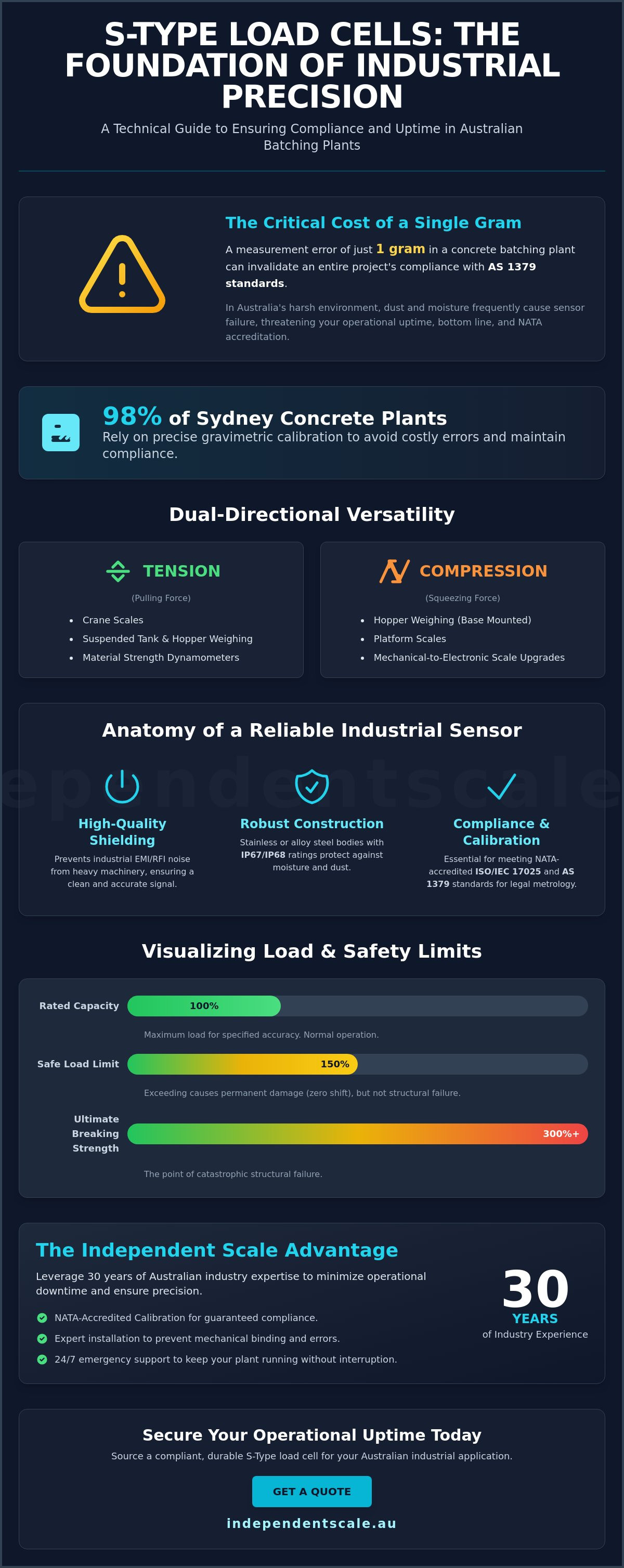
A single gram of measurement error in a batching plant can invalidate an entire project's compliance with AS 1379 standards. In the harsh Australian environment, where dust and moisture frequently cause sensor failure, choosing the correct s-type load cell for sale Australia is a critical decision for maintaining operational uptime. You understand that equipment downtime is not just an inconvenience; it's a direct threat to your bottom line and your NATA accreditation status. Independent Scale Service has observed that 98% of concrete plants in Sydney rely on precise gravimetric calibration to avoid these costly errors.
This guide provides the technical specifications and compliance requirements needed to select a high-quality, IP-rated weighing solution that withstands local conditions. We draw on 30 years of industrial experience to show you how to ensure your systems meet NATA-accredited ISO/IEC 17025 standards. You'll learn how to identify durable sensors, implement proper surge protection, and secure the expert calibration support necessary to keep your plant running 24x7 without interruption. We'll cover everything from summing circuits to the essential gravimetric methods used by industry leaders like Boral and Hanson.
Key Takeaways
- Understand the technical advantages of S-Type transducers for tension and compression applications, including hanging scales and hopper conversions.
- Learn how to evaluate safe load limits and material durability when selecting between stainless steel and alloy steel for industrial environments.
- Identify the critical steps to source a compliant s-type load cell for sale Australia that meets rigorous AS 1379 standards for concrete batching.
- Discover why NATA-accredited calibration and professional installation are essential for maintaining legal metrology and preventing mechanical binding.
- Leverage 30 years of Australian industry expertise to minimize operational downtime through 24/7 emergency support and precise weighing solutions.
Understanding S-Type Load Cells for Australian Industrial Applications
The S-Type load cell is a specialized force transducer designed for both tension and compression measurements. Its unique S-shaped profile allows for easy integration into existing mechanical structures, making it the primary choice for mechanical-to-electronic scale conversions. When looking for an s-type load cell for sale Australia, industrial buyers prioritize sensors that utilize high-precision strain gauge technology. This technology ensures a linear electrical output relative to the applied force, usually measured in millivolts per volt (mV/V).
In the Australian market, demand for these sensors is driven by the construction and material testing sectors. Independent Scale Service provides expert support for these components, particularly in concrete batching plants where compliance with AS 1379 is mandatory. With over 30 years of experience, we understand that a reliable load cell must withstand the harsh environmental conditions found in Sydney and throughout regional Australia. These sensors are essential for maintaining the accuracy of hanging scales, hoppers, and suspended tanks.
Tension vs. Compression: Dual-Directional Versatility
S-Type sensors offer dual-directional versatility, meaning they function accurately whether they're being pulled apart or squeezed together. This makes them more flexible than single-point or shear beam alternatives. Common applications include:
- Tension use cases: Crane scales, suspended tank weighing, and dynamometers used in material strength testing.
- Compression use cases: Hopper weighing, platform scales, and mechanical scale upgrades.
This versatility is why finding the right s-type load cell for sale Australia involves assessing the specific mounting requirements of your facility. Most industrial setups utilize threaded holes at the top and bottom of the "S" to secure eye bolts or specialized mounting hardware.
Key Components of a Reliable Industrial Sensor
A high-quality sensor relies on an internal strain gauge bridge. This bridge must be perfectly balanced to provide accurate data to your digital indicators. Sensitivity levels are critical; most industrial-grade S-Type cells offer 2mV/V or 3mV/V outputs to ensure compatibility with standard controllers. Independent Scale Service emphasizes these technical specifications to guarantee long-term reliability:
- Cable Shielding: High-quality shielding prevents industrial EMI/RFI noise from degrading the signal, which is vital in plants with heavy machinery.
- Robust Construction: Stainless steel or nickel-plated alloy steel bodies protect internal circuits from moisture and dust, often meeting IP67 or IP68 standards.
- Calibration Compliance: Every sensor should be integrated into a system that meets AS 1379 compliant standards for concrete production.
We prioritize robust construction because industrial downtime costs businesses thousands of dollars per hour. Choosing the correct load cell reduces the frequency of emergency repairs and ensures your weighing systems remain accurate and operational under heavy load cycles. Independent Scale Service currently services 98% of concrete plants across Sydney, providing the technical competence required for these high-stakes environments.
Technical Specifications: Choosing the Right Capacity and Material
Selecting an s-type load cell for sale Australia requires a precise evaluation of mechanical limits and operational environment. Rated capacity is the maximum load a cell is designed to measure within its specified accuracy. However, industrial buyers must distinguish between "Safe Load Limits" and "Ultimate Breaking Strength." A standard safe load limit is typically 150% of the rated capacity. Exceeding this threshold causes permanent zero shift and internal damage, though the unit remains structurally intact. Ultimate breaking strength, often 300% or higher, is the point of catastrophic structural failure. In high-vibration environments like concrete batching plants, engineers should select a capacity that operates at 50% to 60% of its rated limit to ensure longevity and maintain compliance with AS 1379 standards.
Regional Australia presents unique thermal challenges that impact measurement precision. Temperatures in the Pilbara can exceed 48°C, while southern highlands often drop below 0°C. High-quality load cells feature temperature compensation, which stabilizes the "zero balance" and "sensitivity" despite these fluctuations. Without this compensation, measurement drift can exceed 0.05% per 10°C. This drift compromises batching accuracy and can lead to significant material wastage over a 12-month production cycle. If you are unsure about the specific requirements for your site, our team provides expert load cell calibration and selection advice to ensure your system meets NATA standards.
Material Comparison: Stainless Steel vs. Nickel-Plated Alloy
Stainless steel, specifically grade 17-4 PH, is the industry standard for food processing, chemical plants, and coastal mining operations. It provides superior resistance to oxidation and harsh caustic cleaning agents. Nickel-plated alloy steel offers a cost-effective alternative for indoor, dry industrial applications where moisture is minimal. For Australian sites located within 50km of the coast, stainless steel is essential to prevent salt-air corrosion from degrading the sensor body and seizing the load string.
IP Ratings and Environmental Sealing
IP ratings define the ingress protection against solids and liquids. IP67-rated cells typically use "potted" seals, where a resin or rubber compound covers the strain gauge cavity. These are adequate for dust and occasional splashes. For heavy wash-down areas or permanent outdoor exposure, IP68 hermetically sealed cells are mandatory. These units feature laser-welded covers that prevent moisture ingress even under pressure. Potted seals often fail in high-humidity Australian environments because the resin expands and contracts at different rates than the metal body, eventually creating micro-gaps that allow moisture to reach the sensitive strain gauges.
Critical Applications in Concrete Batching and Tension Testing
S-Type cells are the primary weighing component for Australian industrial operations that require high-capacity tension and compression measurement. These sensors serve as the technical backbone for concrete production, specifically within aggregate and cement hoppers. Their design allows them to be suspended, which simplifies the weighing of hanging loads while maintaining high accuracy levels. If you're searching for an s-type load cell for sale Australia, you must select components that can withstand the harsh, dusty environments of a batching plant while delivering precision that meets national standards.
Beyond material batching, these cells are essential for utility and infrastructure projects. Technicians use S-Type sensors for power line tensioning and underground cable pulling to monitor force in real time. This prevents cable breakage and ensures structural integrity during installation. Integrating these sensors with tank and silo weighing assemblies allows for a stabilized measurement environment, even when environmental factors like wind or vibration are present.
AS 1379 Compliance for Concrete Plants
Concrete quality control starts with the gravimetric method of batching. AS 1379 specifies strict tolerances for the measurement of cement, water, and aggregates. Accurate weighing is the only way to ensure the chemical properties of the mix remain consistent. S-Type cells facilitate this by providing linear output across their entire capacity range. Independent Scale Service leverages over 30 years of experience to help plants pass annual NATA inspections. Component quality directly impacts these results; a single failing sensor can halt production for an entire facility. We currently service 98% of concrete plants across Sydney, ensuring their weighing systems remain compliant and operational.
Hanging Scales and Silo Weighing Systems
Many legacy industrial sites still rely on mechanical lever scales. Converting these to digital systems is a cost-effective way to improve data logging and accuracy. S-Type sensors are the preferred tool for these retrofits because they easily replace mechanical links. When installing these in hopper and silo systems, precision is mandatory. You must manage side loads and mechanical interference, as these factors create significant measurement errors. Using rod-end bearings or stay rods helps isolate the vertical force. This ensures the s-type load cell for sale Australia you purchase provides the exact data needed for inventory management and batching accuracy. High-vibration environments also require specific filtering at the indicator level to maintain a steady reading.
Installation and Calibration: Ensuring Measurement Accuracy
Professional installation isn't optional for industrial weighing systems. It's a technical requirement for operational integrity. When you source an s-type load cell for sale Australia, the hardware's quality only matters if the mechanical setup prevents binding and shunting. Shunting occurs when a parallel load path bypasses the sensor, leading to weight discrepancies that can exceed 10% of the total load. Accurate signal processing relies on high-quality conditioners and transmitters to convert low-voltage millivolt signals into clean, usable data for your PLC or digital indicator.
The Importance of NATA Accredited Calibration
A standard "calibration check" doesn't meet the compliance requirements for Tier-1 construction or government infrastructure projects. NATA accredited calibration ensures your equipment adheres to ISO/IEC 17025 standards. This provides a documented chain of traceability to national standards, which is vital for legal metrology and contract fulfillment. In the Australian concrete industry, 98% of plants must adhere to AS 1379, requiring precise gravimetric calibration to maintain certification.
For most industrial applications, you should calibrate your S-Type load cells every 6 to 12 months. High-vibration environments or facilities with 24/7 duty cycles often require quarterly intervals to maintain a 0.1% accuracy threshold. Choosing a high-quality s-type load cell for sale Australia is only the first step; maintaining its precision through NATA-certified testing is what protects your bottom line from material giveaway or batch failures.
Common Installation Pitfalls to Avoid
Incorrect rod-end alignment is the most frequent cause of measurement failure. S-Type cells are designed strictly for axial loading. If the rod-ends aren't perfectly vertical and aligned, side-loading forces introduce non-linear errors that software cannot correct.
- Surge Protection: Many Australian regions experience high electrical storm activity. Failure to install surge arrestors often results in total sensor failure during summer months, costing businesses thousands in downtime.
- Over-tightening: Applying excessive torque to mounting bolts can shift the sensor's zero-balance by as much as 5%. This permanently damages the internal strain gauge bridge before the system is even commissioned.
- Mechanical Binding: Ensure no rigid conduit, paint buildup, or debris creates a bridge between the live and dead sections of the weighing assembly. Even a small piece of gravel can cause a 50kg variance in a 2,000kg hopper.
Ensure your equipment meets all Australian regulatory standards by booking a NATA accredited calibration service today.
Where to Buy S-Type Load Cells in Australia: The ISS Advantage
Independent Scale Service (ISS) provides technical expertise backed by over 30 years of Australian weighing industry experience. Finding a reliable s-type load cell for sale Australia involves more than a simple transaction; it requires securing a partner capable of maintaining system uptime. ISS operates as a full-service provider, managing everything from load cell supply to complex system repairs. The company services major industrial hubs including Sydney and Melbourne, alongside critical regional locations across the country.
Reliability is built into the ISS service model through 24/7 emergency support. Industrial operations don't stop at 5:00 PM, and neither does the need for precision. By providing around-the-clock responsiveness, ISS minimizes industrial downtime that can otherwise cost facilities thousands in lost productivity. This commitment to service has made ISS a primary choice for heavy industries that demand immediate technical intervention.
On-Site Repairs and Emergency Fault Diagnosis
Failed sensors in concrete batching plants cause immediate bottlenecks in construction supply chains. ISS technicians provide rapid response to these failures, arriving on-site with the diagnostic tools required to identify the root cause. This isn't limited to the load cell itself. Technicians perform comprehensive diagnostic testing of summing circuits and junction boxes to ensure electrical signals remain clean and accurate.
Once the hardware is secured, the integration phase is handled with technical precision. This includes the programming of indicators and displays to ensure the new hardware communicates perfectly with existing plant software. ISS ensures that every component in the weighing string is optimized for the specific tension or compression demands of the application, preventing future signal drift or mechanical failure.
Custom Weighing Solutions for Your Facility
Every industrial facility has unique engineering requirements that off-the-shelf solutions might not meet. ISS specializes in tailoring load cell selection to these specific environmental and mechanical stresses. Whether the application involves high-capacity silos or precise hopper scales, the selection process focuses on long-term durability and accuracy. ISS currently services 98% of concrete plants across the Sydney metropolitan area, a statistic that reflects their status as a trusted authority for high-stakes industrial weighing.
Compliance is a core pillar of the ISS service offering. All work is performed with a strict adherence to AS 1379 standards for concrete production and NATA-accredited ISO/IEC 17025 requirements. This ensures that when you source an s-type load cell for sale Australia through ISS, the equipment meets the rigorous legal and quality benchmarks required for trade and safety. Contact Independent Scale Service today for a technical quote on S-Type load cells and to schedule NATA-accredited calibration for your facility.
Secure Your Industrial Precision and Compliance
Selecting the correct s-type load cell for sale Australia is a critical technical decision that directly impacts your plant's operational uptime and legal standing. You've seen how specific material choices and load capacities prevent mechanical failure in tension testing and concrete batching applications. Precision measurement isn't optional when meeting AS 1379 standards for the Australian construction industry. Independent Scale Service provides the technical expertise to ensure your hardware integrates seamlessly with existing systems while maintaining peak accuracy.
Our team is NATA Accredited to ISO/IEC 17025, which means your calibrations meet the highest global benchmarks for reliability. We don't just supply equipment; we offer a 24/7 emergency industrial support network to keep your production lines moving. Reliability is built on verified data and expert installation. Take the next step to harden your infrastructure against measurement drift and compliance risks. We're ready to support your next project with precision-engineered solutions.
Request a Quote for S-Type Load Cells and NATA Calibration
Frequently Asked Questions
What is the standard lead time for S-Type load cell delivery in Australia?
Lead times for an s-type load cell for sale Australia typically range from 24 to 48 hours for standard stock items held in our local warehouses. If your specific capacity or environmental rating requires a factory order, expect a lead time of 10 to 20 business days. We prioritise minimising downtime by maintaining a critical inventory of common capacities like 250kg and 500kg for immediate dispatch to site.
Can S-Type load cells be used for both tension and compression simultaneously?
S-Type load cells are designed to measure both tension and compression forces, though they can't measure both at the exact same moment in a single application. You must calibrate the sensor specifically for the direction of force it'll encounter in your industrial setup. Most Australian applications, such as suspended hopper scales or mechanical scale conversions, utilise the tension mode to achieve the highest possible accuracy levels.
How do I know if my S-Type load cell needs NATA calibration or just a repair?
You need NATA calibration if your equipment must comply with AS 1379 or ISO/IEC 17025 standards for legal-for-trade or quality assurance purposes. If the sensor shows physical damage, zero-shift errors exceeding 3%, or bridge resistance imbalances, it requires a technical assessment for repair or replacement. We recommend NATA-accredited testing every 6 to 12 months to ensure continued compliance and precision in your weighing processes.
What is the difference between a 4-wire and 6-wire S-Type load cell?
The primary difference lies in the 6-wire sensor's ability to compensate for voltage drops over long cable runs using two additional sense wires. This feature is critical when the load cell is located more than 10 metres from the weighing indicator. While 4-wire models are standard for short connections, 6-wire configurations provide superior thermal stability and accuracy in large-scale industrial installations across Australia.
Are S-Type load cells suitable for outdoor use in harsh Australian climates?
S-Type load cells are suitable for outdoor use provided they carry a minimum ingress protection rating of IP67 or IP68. In Australian environments where dust and moisture are prevalent, stainless steel models with hermetic sealing offer the best protection against corrosion. It's essential to install surge arrestors to protect the internal strain gauges from lightning strikes, which account for approximately 15% of outdoor sensor failures.
What happens if I overload an S-Type load cell beyond its rated capacity?
Overloading an S-Type load cell beyond its safe limit, usually 150% of rated capacity, causes permanent plastic deformation of the metal element. This results in a permanent zero shift and renders the sensor inaccurate and non-compliant with industry standards. Once the load exceeds the ultimate overload rating, often 300%, the structural integrity fails completely, posing a safety risk in suspended weighing applications.
How do I choose between an alloy steel and a stainless steel S-Type sensor?
Choose alloy steel for indoor, dry environments where cost efficiency is a priority for your s-type load cell for sale Australia purchase. Alloy steel provides excellent ruggedness for general industrial weighing. However, you should select stainless steel for food processing, chemical plants, or high-humidity areas. Stainless steel's resistance to oxidation ensures a service life that's often 2 to 3 times longer in corrosive conditions.
