


Reducing Material Waste in Concrete Batching: A Guide to Precision and Profitability
If your facility consistently relies on cement overages to guarantee strength, you aren't just meeting specifications; you're eroding your profit margin with every load. Reducing material waste in concrete batching is primarily a measurement challenge, not a process failure. With the high cost of rejected loads and the rising expense of industrial waste disposal across Australia, the financial penalty for batching errors is higher than ever before.
We understand the operational strain of high cement costs and the risk of non-compliance with Australian Standards. It's a technical hurdle that requires more than just careful oversight. This guide shows you how to eliminate costly overages and improve concrete yield through technical precision and AS 1379 compliance. We'll detail how NATA-accredited calibration and advanced load cell systems secure consistent strength while protecting your bottom line.
Key Takeaways
- Analyze the economic impact of the "cement giveaway" and how rejected loads increase disposal and transport costs.
- Identify the technical causes of measurement drift and how precise plant calibration is essential for reducing material waste in concrete batching.
- Select high-performance load cells and silo weighing assemblies that maintain accuracy in harsh industrial environments.
- Implement operational controls for moisture compensation and gate maintenance to eliminate the primary causes of aggregate weighing errors.
- Leverage NATA-accredited standards and AS 1379 compliance to guarantee consistent concrete quality and minimize regulatory risk.
The Economic Impact of Material Waste in Concrete Production
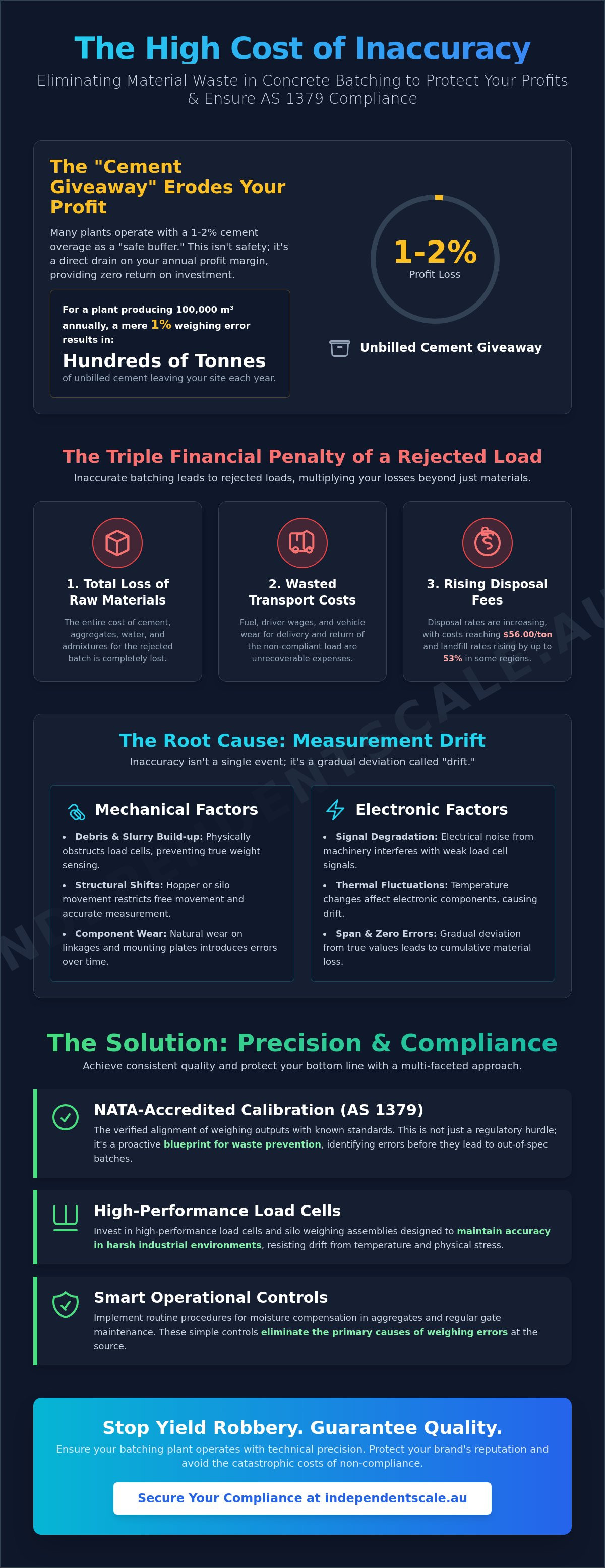
Reducing material waste in concrete batching isn't a secondary operational concern; it's a fundamental requirement for maintaining industrial profitability. Many plants operate under the false assumption that a 1% to 2% over-batch of cement is a safe buffer for guaranteeing strength. This "cement giveaway" directly erodes annual profit margins without adding value to the final product. For high-volume producers, these minor weighing inaccuracies accumulate into significant overhead costs that provide zero return on investment.
Australian Standard AS 1379 dictates strict batching tolerances to ensure structural reliability and consistency. When these tolerances are ignored or missed due to equipment drift, the result is often a rejected load. A rejected load carries a triple financial penalty: the total loss of raw materials, the cost of transport, and the rising fees for disposal. As of early 2026, disposal rates for clean concrete have reached $56.00 per ton in some regions, while other jurisdictions are facing landfill rate increases of up to 53%. While modern concrete recycling methods can mitigate some environmental impact, the most effective financial strategy is preventing the waste at the batching gate.
Financial Loss from Over-Batching Cement
Cement is the most expensive variable in any mix design. In a plant producing 100,000 cubic meters annually, a mere 1% error in cement weighing results in hundreds of tonnes of unbilled material leaving the site. This "yield robbery" occurs because the weighing systems aren't maintained to the precision required for high-performance mixes. Implementing AS 1379 compliant calibration is the only method to ensure that batched weights match the mix design exactly. Precision weighing protects your bottom line by ensuring you only use the material necessary to meet the engineering specifications.
The Cost of Non-Compliance and Structural Integrity
The risks of batching errors extend well beyond material costs. Delivering concrete that fails strength tests due to inconsistent water-to-cement ratios exposes a company to massive legal and insurance liabilities. If structural integrity is compromised on a project, the cost of demolition and rework far exceeds the expense of routine maintenance. Reliable weighing systems are necessary to meet CCAA guidelines for sustainable and compliant production in 2026. Maintaining verified batching accuracy is the primary method for protecting your brand's reputation and avoiding the catastrophic costs associated with structural failure or project delays.
How Calibration Directly Reduces Batching Inconsistency
Batching plant calibration is the verified alignment of weighing outputs with known standards. It's the technical foundation for reducing material waste in concrete batching. Without precise alignment, your control system operates on inaccurate data, leading to the over-batching and rejected loads discussed previously. Accuracy isn't a static state; it's a condition that requires regular, methodical verification to ensure that what's programmed in the batching software is what's actually discharged into the truck.
The Science of Weighing Drift
Mechanical factors often introduce significant errors before they're visually apparent. In a concrete plant, binding from hardened slurry, debris build-up around load cell mounting plates, and structural shifts in the hopper can all restrict free movement. These physical obstructions prevent the load cell from sensing the true weight of the material, causing the system to overfill to reach a target weight that's physically impossible to measure accurately.
Electronic factors are equally critical to plant performance. Signal degradation in conditioners and transmitters occurs due to thermal fluctuations and electrical noise from heavy industrial machinery. Calibration drift is the gradual deviation of a weighing system from its true value. Identifying this drift early prevents the cumulative material loss that occurs when systems report a target weight but are actually discharging excess material due to a shifted zero point or span error.
Standard AS 1379 Compliance for Waste Prevention
The Australian Standard AS 1379 sets mandatory calibration intervals and specific tolerances for cement, aggregates, and admixtures. Compliance isn't just a regulatory hurdle; it's a blueprint for waste prevention. Regular concrete batching plant calibration identifies weighing errors before they manifest as out-of-spec batches. This proactive approach aligns with international principles of Sustainable Materials Management, focusing on source reduction to minimize environmental and economic impact.
Proper documentation and audit trails are necessary for quality assurance and regulatory defense. A simple internal "check" using a known weight doesn't provide the same reliability as a NATA-accredited calibration. NATA accreditation ensures that the testing equipment and the technician's methodology meet ISO/IEC 17025 standards. This level of verification provides the legal and technical certainty required for major infrastructure projects. If your current schedule doesn't include NATA-accredited verification, it's worth reviewing your calibration frequency to ensure it meets operational demands.
Technical Solutions: High-Performance Load Cells and Indicators
Precision hardware is the technical backbone of any strategy aimed at reducing material waste in concrete batching. While calibration ensures the system is aligned, the quality of the components determines how long that alignment holds under industrial stress. In a concrete plant, equipment must withstand constant vibration, abrasive dust, and moisture. Choosing the correct load cells is a technical necessity, not an optional upgrade. High-performance hardware minimizes scale settle times and maximizes measurement resolution, allowing the control system to make faster, more accurate decisions during the batching cycle.
Modern compression load cells have significantly improved plant efficiency. Recent industry data shows that these units can reduce scale settle times to as low as 2 seconds, compared to the 3 or 4 seconds required by older "S" type load cells. This increased speed allows for higher production capacity while maintaining a material measurement accuracy of up to 98.5%. These technical improvements are recognized by organizations like the Construction & Demolition Recycling Association as vital for improving material efficiency and reducing the volume of waste generated by the construction sector.
Load Cell Selection for Durability and Precision
Corrosion is a primary cause of load cell failure in wet batching environments. Stainless steel load cells offer superior resistance compared to alloy steel alternatives, especially when exposed to chemical admixtures and wash-down procedures. For maximum reliability, components must feature hermetic sealing with IP68 or IP69K ratings. This level of protection prevents moisture ingress that causes signal instability and phantom weight readings. Additionally, utilizing specialized mounting kits is necessary to eliminate side-loading errors caused by structural expansion or mixer vibration, ensuring the force is always directed through the primary axis of the cell.
Inventory management is another critical area where precision prevents loss. Using dedicated tank and silo weighing assemblies provides real-time data on cement and fly ash levels. This prevents overfilling during delivery and ensures the plant doesn't run dry mid-batch, which often results in a rejected load of partially mixed concrete.
Advanced Indicators and Batch Controllers
The interface between the load cell and the operator is equally important. Modern indicators and displays use sophisticated algorithms to handle "inflight" material compensation. This feature predicts the amount of material still falling through the air after the gate closes, adjusting the cut-off point in real-time to prevent over-batching. To maintain signal integrity in environments with high electrical noise from large motors and conveyors, the use of conditioners and transmitters is essential. These devices convert weak analog signals into robust digital outputs, ensuring the batch controller receives clean data for every load.
Operational Strategies to Minimise Material Loss
Daily operational precision is as vital as annual calibration. Hardware alone cannot account for environmental shifts or mechanical wear that occurs between service intervals. Reducing material waste in concrete batching requires rigorous protocols for zeroing scales and verifying tare weights to ensure every batch starts from a true baseline. Without these checks, cumulative errors in the weighing system lead to significant material discrepancies over a single shift.
Managing Aggregate Moisture Content
Moisture is the primary variable affecting aggregate accuracy. When sand holds excessive water, the weighing system counts that water as aggregate, resulting in a lean mix that fails to meet yield expectations. High-volume plants often utilize automatic microwave sensors for real-time data, but manual testing remains a necessary fallback for verification. Adjusting batch recipes in real-time is necessary to maintain yield consistency and prevent the production of out-of-spec loads. If the water-to-cement ratio isn't adjusted for aggregate moisture, the concrete's structural integrity is compromised, leading to rejected loads and wasted material.
Preventative Maintenance of Mechanical Components
Material "hang-up" in hoppers is a common cause of batching inconsistency. If material sticks to the side of a hopper, the next batch will be inaccurate by that exact amount. Flexible connections between the hopper and the plant frame must be inspected regularly. If these connections are too tight or caked with concrete, they cause mechanical binding that prevents load cells from sensing the true weight. If your plant is experiencing persistent weighing errors despite software adjustments, professional hopper calibration services are required to identify hidden mechanical or electronic faults.
Lubrication and alignment of discharge gates are essential to stop "trickle" waste. A gate that doesn't close fully allows material to leak into the mixer or onto the ground, costing the plant money every hour. Operators must also be trained to recognize weighing system "sluggishness." If the display responds slowly or fluctuates unexpectedly, it's often a sign of mechanical interference or a failing component. Early intervention prevents a minor technical glitch from turning into a day of rejected loads and lost profit.
Consistent "zeroing" procedures must be performed throughout the day. Debris build-up on the weigh belt or inside the hopper changes the tare weight of the system. If the operator doesn't zero the scale, the system assumes the weight of the debris is the weight of the material being batched. This results in under-batching, which affects the final volume and can lead to structural failures on the job site. Maintaining a clean plant isn't just about aesthetics; it's a technical requirement for weighing accuracy.
The Role of NATA Accreditation in Waste Reduction
While technical hardware and operational protocols provide the framework for reducing material waste in concrete batching, NATA accreditation serves as the final layer of verification. In the Australian industrial landscape, a calibration report is only as reliable as the accreditation backing it. For concrete producers, this means ensuring that all weighing equipment is serviced by a laboratory accredited to ISO/IEC 17025. This standard is the international benchmark for testing and calibration, providing the technical certainty that your plant's output remains within the strict tolerances defined by AS 1379.
Why ISO 17025 Matters for Concrete Plants
ISO/IEC 17025 accreditation guarantees the traceability of test weights to national standards. It's a rigorous process that verifies not only the equipment used but also the specific competency of the technician performing the calibration. Without this level of oversight, "calibration" is merely a comparison without a verified baseline. NATA accreditation ensures the highest level of technical competence and data integrity. This level of precision is necessary for high-volume plants where a minor deviation in traceability can lead to thousands of dollars in unbilled cement or rejected loads across a single project.
Maximising Plant Uptime with Independent Scale Service
Independent Scale Service provides the authoritative expertise required to maintain these standards across Sydney, Melbourne, and regional Australia. We understand that precision is irrelevant if the plant is offline. Our approach focuses on reducing material waste in concrete batching through a combination of proactive maintenance and rapid response. By utilizing custom maintenance schedules tailored to your specific plant volume and AS 1379 requirements, we identify potential component failures before they cause a batching halt.
Our service capabilities include emergency load cell supply and repair, as well as diagnostics for batching indicators and transmitters. For major infrastructure projects, a NATA-endorsed calibration certificate is often a non-negotiable "license to operate." Tier 1 contractors and government bodies require documented proof of compliance to mitigate structural risks. Partnering with a NATA-accredited provider ensures your documentation is audit-ready and your plant is optimized for maximum yield and profitability. Protect your margins with NATA accredited concrete plant calibration to ensure your facility meets every regulatory and financial benchmark.
Securing Batching Precision and Plant Profitability
Achieving a zero-waste production environment requires a technical commitment to accuracy. By integrating high-performance load cells and maintaining rigorous moisture compensation protocols, you protect your facility from the hidden costs of over-batching. Reducing material waste in concrete batching is a continuous process of verification and adjustment. Every gram of cement saved through precise weighing contributes directly to your bottom line while ensuring full compliance with Australian Standards. The combination of reliable hardware and operational discipline prevents the rejected loads that often compromise project timelines.
Independent Scale Service has functioned as a specialist in AS 1379 compliance since 1994. Our expert technicians are strategically positioned across Sydney and Melbourne to provide rapid response and expert diagnostics. As a laboratory NATA Accredited to ISO/IEC 17025, we provide the technical certainty that your measurement data is traceable and audit-ready. Don't let inaccurate weighing systems erode your project margins or risk your facility's reputation. Request an AS 1379 Compliant Calibration Service today to verify your system's performance. Precise measurement is the most effective tool for building a more profitable and dependable operation.
Frequently Asked Questions
How often should a concrete batching plant be calibrated under AS 1379?
AS 1379 specifies that weighing and measuring equipment must be calibrated at intervals not exceeding six months. This frequency ensures that the plant remains within the allowable tolerances for cement, water, and aggregates. For facilities operating at high capacities or under strict project specifications, more frequent verification is recommended to prevent drift from impacting mix consistency and profitability.
What are the main causes of material waste in concrete production?
The primary causes are inaccurate weighing systems, uncompensated aggregate moisture, and mechanical issues like gate leakage. These factors result in the "cement giveaway" where excess material is batched to ensure strength. Addressing these through precision technology is the most effective method for reducing material waste in concrete batching and protecting operational margins.
Can faulty load cells cause over-batching of cement?
Faulty load cells are a leading cause of over-batching because they often under-report the actual weight in the hopper. When a cell fails to sense the full force, the batch controller continues to discharge material until the target weight is reached electronically. This results in a physical overage that increases material costs and can alter the chemical properties of the mix.
What is the difference between a standard calibration and a NATA accredited one?
Standard calibration is a basic alignment, while NATA accredited calibration is performed by a laboratory certified to ISO/IEC 17025. NATA endorsement provides verified traceability to national standards and confirms the technical competency of the service provider. This level of certification is a mandatory requirement for most major Australian infrastructure and Tier 1 construction projects.
How does moisture in aggregates affect batching accuracy?
Moisture increases the mass of the aggregate, which the weighing system records as dry material. If the plant doesn't adjust for this water weight, the final batch will have less aggregate and a higher water-to-cement ratio than the design requires. This imbalance compromises structural integrity and often leads to the rejection of entire loads at the job site.
What should I do if my batching indicator shows a "drift" in weight?
You should first inspect the hopper for mechanical binding or material hang-up that might be interfering with the load cells. If the physical components are clear, the drift likely indicates an electronic fault or signal degradation. Professional diagnostics are required to determine if the issue lies within the load cell, the transmitter, or the batching indicator itself.
Are digital load cells better for reducing waste than analog ones?
Digital systems generally provide better accuracy due to their immunity to electrical noise and higher signal resolution. They allow for faster scale settle times, which improves batching speed without sacrificing precision. These technical advantages make digital components a superior choice for facilities focused on reducing material waste in concrete batching through improved measurement control.
Can I calibrate my own concrete batching plant hoppers?
Internal checks provide daily assurance, but they don't replace the need for professional calibration by a qualified technician. Compliance with AS 1379 requires documented proof of accuracy using traceable test weights. Professional service providers ensure that the entire weighing chain, from the load cell to the display, meets the rigorous standards required for industrial certification.
