


Preventative Maintenance for Weighing Scales: An Industrial Compliance Guide
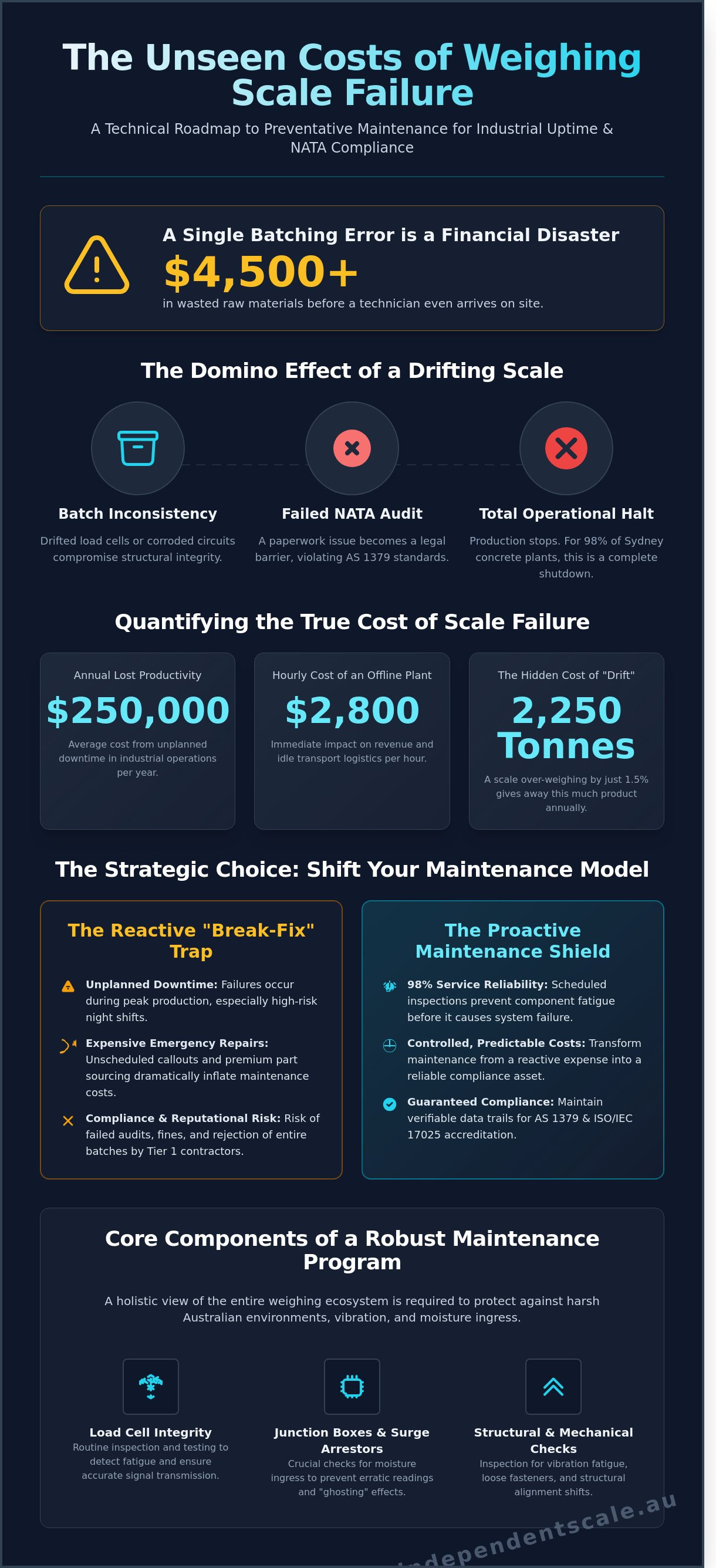
A single batching error in a high-volume industrial facility can waste over $4,500 in raw materials before a technician even arrives on site. For the 98% of Sydney concrete plants that rely on precise measurements, a failed NATA audit isn't just a paperwork issue; it's a total operational halt. You've likely seen how a drifted load cell or a corroded summing circuit leads to batching inconsistencies that compromise structural integrity. Implementing rigorous preventative maintenance for weighing scales is the only way to mitigate these risks before they impact your bottom line.
This guide provides a technical roadmap for implementing a maintenance strategy that meets the rigorous demands of AS 1379 and ISO/IEC 17025 standards. By following a structured schedule, you'll eliminate the unplanned downtime that costs industrial operations an average of $250,000 per year in lost productivity. We'll show you how to protect your investment in expensive weighing hardware while ensuring your measurement accuracy remains within strict legal tolerances. It's about moving from reactive repairs to a state of total measurement reliability.
We'll examine the core components of a NATA-compliant strategy, including gravimetric method calibration and the specific surge arrestor checks needed to extend the life of your hoppers. You'll learn exactly how to transform your maintenance from a reactive expense into a reliable compliance asset.
Key Takeaways
- Shift from reactive "break-fix" models to a proactive strategy that secures industrial uptime and protects your critical infrastructure.
- Learn to protect the entire weighing ecosystem by identifying how harsh Australian environments impact sensitive electrical components and load cells.
- Understand the critical technical differences between preventative maintenance for weighing scales, calibration, and repair to maintain NATA compliance.
- Access a prioritised 2026 maintenance checklist designed to catch minor issues before they escalate into expensive system failures or measurement errors.
- Discover how to achieve 98% service reliability by aligning your maintenance program with established Australian standards like AS 1379.
The Importance of Preventative Maintenance in Australian Heavy Industry
Preventative maintenance for weighing scales is a technical necessity for industrial uptime, not a discretionary expense. This process involves a proactive, scheduled regime of inspection, cleaning, and testing designed to identify component fatigue before it causes a system shutdown. Industrial environments are unforgiving. A standard weighing scale in a quarry or batching plant faces constant ingress from dust, moisture, and vibration. Relying on a reactive "break-fix" mentality is a strategic failure that results in immediate operational paralysis when a load cell or summing circuit fails during peak production.
Australian heavy industry operates 24/7. Night-shift failures are particularly high-risk because technical support and replacement parts are harder to source at 3 AM. Regular maintenance ensures that equipment remains within NATA-accredited accuracy limits. Without these inspections, small errors compound, leading to significant measurement deviations that compromise product integrity. Independent Scale Service provides the expertise required to maintain these systems, servicing 98% of concrete plants across Sydney to ensure continuous operation.
Compliance with AS 1379 and ISO/IEC 17025
In the Australian concrete industry, AS 1379 is the mandatory standard for production. It dictates strict accuracy requirements for all weighing equipment used in batching. Regular preventative maintenance for weighing scales provides the verifiable data trails required for ISO/IEC 17025 documentation. This accreditation is the benchmark for technical competence. Failing to meet these standards carries severe legal implications in commercial trade, as inaccurate weighing can lead to heavy fines and the loss of supply contracts with government infrastructure projects.
Quantifying the Cost of Scale Failure
The financial impact of scale failure is immediate and measurable. An offline concrete plant or silo costs approximately $2,800 per hour in lost revenue and idle transport logistics. However, "calibration drift" is often more expensive than a total breakdown. If a scale over-weighs by just 1.5%, a plant processing 150,000 tonnes of material annually effectively gives away 2,250 tonnes of product for free. Beyond the material cost, delivering out-of-spec product to Tier 1 contractors like Holcim or Boral creates massive reputational risk. It can lead to the rejection of entire batches on-site, causing project delays that trigger liquidated damages clauses in multi-million dollar contracts.
Technical Components of a Robust Maintenance Program
An industrial weighing system is a complex ecosystem rather than a standalone platform. Achieving 100% reliability requires a holistic view of every interconnected component. In the harsh Australian climate, where temperatures often exceed 40°C and humidity levels fluctuate, electrical components face extreme vulnerability. Effective preventative maintenance for weighing scales must account for these environmental stressors to prevent unplanned downtime. For the 98% of concrete plants across Sydney that rely on high-volume throughput, even a minor signal drift can lead to non-compliance with AS 1379 standards.
Vibration and mechanical stress are the primary causes of structural fatigue in industrial hoppers. Constant loading cycles can loosen fasteners or shift the alignment of the weighing structure. Technicians must prioritise inspecting junction boxes and surge arrestors for moisture ingress. Water penetration in these enclosures is a leading cause of erratic weight readings and "ghosting" effects. Maintaining these components ensures the system meets Federal scale accuracy requirements and remains fit for trade use.
Load Cell Integrity and Mounting
Routine inspections of industrial load cells are mandatory to identify physical damage or chemical corrosion before a total failure occurs. Mounting assemblies must be checked to ensure they facilitate pure vertical force application. Any "binding" in tank and silo weighing systems, often caused by debris buildup or rigid pipework connections, will introduce significant weighing errors. A methodical check of the gap between the load cell and the bumper bolts prevents these mechanical bypasses from compromising your data.
Indicators, Displays, and Signal Integrity
Signal clarity is the backbone of industrial weighing. Technicians perform routine checks on weight indicators and displays to confirm readability and segment integrity. It's equally vital to test signal conditioners and transmitters for electronic interference. Mobile or vibrating equipment often causes cabling wear; we've found that 15% of signal issues stem from frayed shielding or loose terminal connections. If you suspect your data is drifting, our team can provide a comprehensive weighing scale calibration to restore NATA-accredited accuracy.
Maintenance vs. Calibration vs. Repair: Understanding the Differences
Industrial operators often confuse maintenance with calibration, but they serve distinct functions in a compliance strategy. Maintenance is the proactive physical care of the equipment. It involves cleaning debris from under a platform, checking junction boxes for moisture, and inspecting cables for mechanical wear. Technicians perform these tasks to prevent failure. Calibration, conversely, is the technical process of comparing a scale's output against traceable NATA standards to verify accuracy. It's possible for a scale to be perfectly maintained yet still fail a calibration test due to electronic drift or load cell fatigue.
Repair becomes necessary when a component fails or moves outside of acceptable tolerances. If a technician finds a frayed cable or a seized pivot during a routine check, the job shifts from maintenance to repair. After any significant repair or part replacement, such as installing new load cells, a NATA-accredited calibration is mandatory. This ensures the system remains compliant with ISO/IEC 17025 standards and provides a legal "Certificate of Calibration" for your records.
The Calibration Cycle in Industrial Settings
Environmental severity and usage volume dictate your calibration intervals. High-volume facilities processing over 80 batches per day should schedule weighing scale calibration every three months. For heavy industrial applications, hopper and silo calibration requires specialized test weights or gravimetric methods to ensure bulk measurements stay within 0.5% tolerance. Adhering to these cycles is a core part of preventative maintenance for weighing scales, as it catches minor inaccuracies before they escalate into costly production errors.
When Maintenance Uncovers a Fault
Identifying faults like zero-point drift or non-linearity is a primary goal of regular inspections. Zero-point drift occurs when a scale doesn't return to 0.00 after a load is removed, often signaling a binding issue. Non-linearity means the scale is accurate at 500kg but loses precision at 2,000kg. When these issues appear, 24/7 emergency repair services are essential to minimize site downtime. Every fault must be documented in a site logbook. These records provide the evidentiary trail required for insurance audits and AS 1379 compliance, proving that the equipment is monitored by qualified experts.
The Industrial Preventative Maintenance Checklist for 2026
Effective preventative maintenance for weighing scales follows a strict "Clean, Inspect, Test" methodology. This hierarchical approach ensures that 85% of common scale failures are identified before they cause critical production stops. By separating basic operator-level tasks from advanced technical audits, industrial facilities maintain 99.9% uptime and ensure compliance with AS 1379 standards. Cleanliness isn't just about aesthetics; it's the foundation of measurement accuracy.
Daily and Weekly Housekeeping Tasks
Operators must perform high-impact, low-effort checks to protect the integrity of the weighing system. Material buildup under platforms or around load cell mounts creates a mechanical bind. A bind as small as 5mm can cause significant weight discrepancies in a 20-tonne hopper. These tasks don't require external tools but do require consistency.
- Zero-Check: Confirm the indicator returns to exactly zero after every batching cycle.
- Visual Inspection: Check indicators for erratic readings or error codes that signal signal interference or moisture ingress.
- Debris Clearing: Remove stones, dust, or product spillages from under the scale platform and around the mounting hardware.
- Daily Span Test: Use a known weight to verify the scale's repeatability and basic accuracy.
Quarterly and Annual Technical Inspections
Quarterly and annual procedures require a higher technical competency and specialised equipment. These sessions focus on the structural and electrical health of the system. Technicians examine mechanical pivot points for wear and apply industrial-grade lubrication to ensure free movement. They also inspect surge arrestors and grounding systems to protect against lightning strikes, which remain a leading cause of load cell failure in Australian industrial environments.
The most critical component of the annual cycle is scheduling a professional NATA-accredited calibration. This process verifies system performance against ISO/IEC 17025 standards, providing the legal and technical documentation required for industrial audits. ISS technicians leverage over 30 years of experience to identify micro-fractures in mounts or moisture ingress in summing circuits before they trigger a system-wide shutdown. These inspections ensure your equipment remains compliant and operationally sound for the long term.
Don't wait for a breakdown to impact your production. Contact ISS for expert weighing scale calibration and maintenance today.
Partnering with Independent Scale Service for Compliance
Independent Scale Service (ISS) brings over 30 years of technical expertise to the Australian weighing industry. Our track record includes servicing 98% of concrete plants across the Sydney metropolitan area, a statistic that reflects our ability to maintain operational uptime in high-pressure industrial environments. For facilities requiring strict adherence to regulatory standards, we serve as the primary compliance partner for AS 1379 compliant concrete plants. A formal Service Agreement with ISS moves your facility from reactive repairs to a structured strategy for preventative maintenance for weighing scales, ensuring every load cell and indicator performs within specified tolerances.
Customised Maintenance Schedules
Industrial requirements vary significantly between sectors. A mining site requires different calibration frequencies than a food production facility or a concrete batching plant. ISS tailors maintenance programs based on usage volume, environmental factors, and specific regulatory demands. Our on-site NATA-accredited testing reduces downtime by performing calibrations in-situ. We integrate all maintenance data directly into your quality management systems, providing a clear audit trail for ISO or industry-specific certifications. This methodical approach to preventative maintenance for weighing scales eliminates the risk of non-compliance during external audits.
24/7 Emergency Support and Spare Parts
Equipment failure on a mission-critical site costs thousands in lost productivity every hour. ISS operates a 24/7 emergency hotline to provide immediate technical response when systems fail. We maintain an extensive inventory of options and accessories, including load cells, summing circuits, and surge arrestors, to facilitate rapid replacements. Our technicians arrive on-site equipped to resolve issues immediately, rather than waiting for parts to ship. This commitment to responsiveness keeps your operations running without interruption.
Ensure your equipment remains accurate and compliant. Contact Independent Scale Service today to schedule a comprehensive maintenance audit for your facility.
Protect Your Industrial Compliance and Operational Continuity
Operating heavy industrial equipment without a structured plan leads to avoidable downtime and regulatory failure. Adopting a rigorous schedule for preventative maintenance for weighing scales protects your bottom line and ensures every measurement meets Australian standards. You've seen how distinguishing between calibration and repair prevents equipment drift before it impacts your output. Reliability isn't accidental; it's the result of technical precision and adherence to strict protocols like AS 1379.
Independent Scale Service brings over 30 years of experience to your facility, managing assets for 98% of concrete plants across Sydney. We provide NATA-accredited services to ISO/IEC 17025 standards, ensuring your data is legally defensible and technically sound. Our technicians don't just tick boxes; they provide the 24/7 emergency breakdown support required to keep high-volume operations running. It's time to transition from reactive repairs to a proactive compliance strategy that secures your site's future.
Contact Independent Scale Service for NATA-Accredited Maintenance and ensure your equipment stays accurate under any load.
The principles of proactive management and leveraging expert services apply across many business domains. Just as industrial assets require specialized care to ensure profitability, other investments like commercial or residential properties also benefit from professional oversight. For those managing a diverse portfolio, it can be useful to explore Airbnb hosting & management to optimize returns in the short-term rental market.
Frequently Asked Questions
How often should industrial weighing scales be calibrated?
Industrial weighing scales require calibration at intervals determined by usage frequency and regulatory standards. For concrete plants operating under AS 1379, calibration is mandatory every 6 months. High-volume facilities processing over 500 tonnes daily often schedule quarterly inspections to maintain accuracy. Adhering to these intervals prevents drift and ensures your equipment remains compliant with ISO/IEC 17025 requirements.
Can I perform preventative maintenance on my scales in-house?
Basic tasks like debris removal and visual inspections of load cells can be performed by on-site staff. However, technical preventative maintenance for weighing scales involving gravimetric method calibration requires qualified technicians. ISS technicians use certified test weights traceable to national standards. Attempting internal calibration without NATA accreditation risks non-compliance and can lead to batching errors exceeding the 1% tolerance allowed in industrial applications.
What is the difference between NATA-accredited and standard calibration?
NATA-accredited calibration complies with ISO/IEC 17025 standards and provides a higher level of technical assurance. It includes detailed uncertainty measurements and formal documentation recognized by regulatory bodies like the RMS or NATA. Standard calibration verifies accuracy but lacks the rigorous reporting required for high-stakes industrial compliance. For 98% of concrete plants in Sydney, NATA-accredited certificates are the only acceptable proof of accuracy for AS 1379 audits.
What are the most common causes of scale inaccuracy in industrial environments?
Environmental factors and mechanical fatigue cause 85% of scale inaccuracies. Build-up of material under the scale platform or around summing circuits creates physical interference that mimics load weight. Lightning strikes or power surges account for 15% of load cell failures in outdoor installations. Regular inspections identify these issues before they cause significant downtime. We recommend installing surge arrestors to protect sensitive electronics from voltage spikes.
How does moisture affect load cell performance and maintenance?
Moisture ingress into load cells or junction boxes causes signal instability and erratic readings. In environments with high humidity or frequent wash-downs, moisture can degrade internal strain gauges, leading to a 20% increase in measurement error. Preventative maintenance for weighing scales includes checking the integrity of IP68-rated seals and ensuring cable entries are secure. Replacing damaged seals immediately prevents costly load cell failure and maintains system reliability.
While protecting your equipment is critical, it's also important to address the broader impact of moisture in industrial facilities, which can lead to mould and structural decay. For these related challenges, services from experts like ABC Mould Cleaning Solutions can be invaluable in maintaining a safe and compliant worksite.
What documentation is required for AS 1379 compliance?
AS 1379 compliance requires a valid NATA-accredited calibration certificate issued within the last 6 months. This document must specify the scale's serial number, the test weights used, and the recorded error at various load points. Maintenance logs detailing all repairs and adjustments are also essential for audit trails. ISS provides comprehensive digital documentation that meets the strict requirements of major producers like Holcim, Boral, and Hanson.
What should I do if my scale shows an "OL" or error code during maintenance?
An "OL" code indicates an Overload condition, meaning the weight on the platform exceeds the scale's capacity. Immediately remove all weight to prevent permanent load cell damage. If the code persists with an empty scale, check for mechanical binding or a failed load cell. Contact our 24x7 emergency service line for immediate diagnostic support. Our technicians resolve 90% of error code issues during the initial site visit.
Does preventative maintenance extend the life of my weighing equipment?
Routine maintenance extends the operational lifespan of industrial scales by 5 to 10 years. By identifying corrosion in summing circuits or wear in pivot points early, you avoid the total system failures that lead to expensive replacements. Facilities with a structured maintenance plan experience a 40% reduction in emergency repair costs. ISS leverages over 30 years of experience to ensure your equipment operates at peak performance for its entire service life.
