


Presenting Calibration ROI to Stakeholders: 2026 Guide
Calibration is more than a compliance expense. For Australian industrial operations, it can help control product quality, equipment performance and business risk. The challenge in presenting calibration ROI to stakeholders is to express the case in terms they can assess: finance teams need defensible assumptions, while technical findings must connect to operational outcomes.
Potential savings from less rework, reduced downtime or avoided quality failures can be difficult to quantify without a reliable baseline. Calibration records alone don’t make the business case. A credible return depends on evidence, transparent calculations and a clear distinction between verified results and estimated risk reduction.
This guide shows how to build that case. You’ll learn to establish a baseline, identify relevant costs and benefits, calculate ROI, and present assumptions so decision-makers can evaluate them. It also explains how to connect calibration evidence, such as recorded measurement drift, to quality, operational and compliance priorities without promising savings the data can’t support. The result is a practical framework for decisions about calibration scope, timing and resources.
Key Takeaways
- Define the decision, analysis period and equipment scope before calculating calibration ROI, so stakeholders can assess what the figures represent.
- Build a transparent calculation from recorded benefits and total calibration costs. Make assumptions visible rather than presenting estimates as confirmed savings.
- Connect calibration records to quality, compliance and operational indicators, and assign a source, owner and review interval to each proposed benefit.
- When presenting calibration ROI to stakeholders, tailor the level of detail to finance, operations and quality teams while keeping supporting technical evidence available.
- Turn the presentation into an action plan by stating the decision required and assigning owners and dates for data collection and review.
Why Presenting Calibration ROI Matters to Industrial Stakeholders
Calibration is often recorded as a scheduled expense, while its contribution to process control and measurement confidence is less visible. A useful business case makes that contribution easier to assess. Calibration ROI compares evidenced benefits with calibration costs over a stated period. It can include direct financial benefits, operational improvements and reduced exposure to measurement error. Report these categories separately rather than combining them into an unsupported savings claim.
Metrology, the science of measurement, underpins decisions made using industrial measurements. Weighing data, for example, can inform batch quantities, stock records and production decisions. Reviewing calibration evidence for a scale or load cell helps assess whether the measurement system is performing as expected. For service details, see industrial weighing scale calibration.
Calibration supports informed decisions, but it can’t guarantee zero errors or a financial return. Its business value may include more reliable measurements, stronger process control and better evidence for quality and audit processes. These outcomes can support risk management even when they can’t be expressed as confirmed cash savings.
What stakeholders need to see in a calibration business case
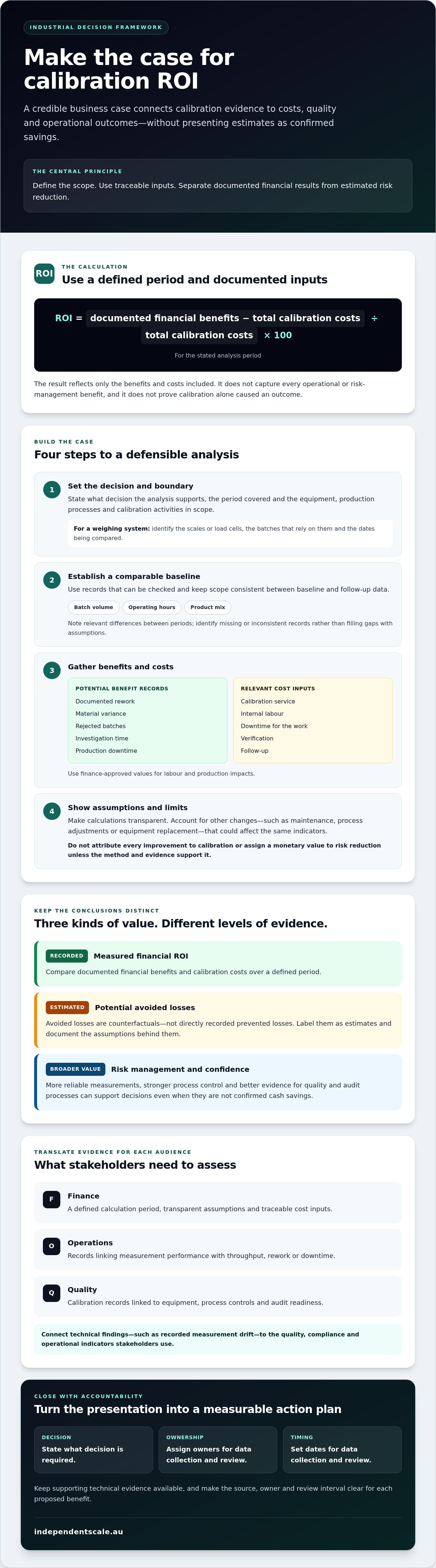
Different teams assess value using different evidence. Finance needs a defined calculation period, transparent assumptions and traceable cost inputs. Operations needs records that connect measurement performance with throughput, rework or downtime. Quality teams need calibration records linked to equipment, process controls and audit readiness. Identify what evidence each group will use, rather than relying on technical findings alone.
Why calibration benefits can be difficult to quantify
Avoided losses are counterfactuals: they describe what might have happened without an intervention, not a loss directly recorded as prevented. Label these figures as estimates and document the assumptions behind them. Account for other changes, too. Maintenance, process adjustments or equipment replacement may affect the same performance indicators, so don’t attribute every improvement to calibration.
Measured ROI compares documented financial benefits and calibration costs over a defined period. Broader risk-management value includes improved measurement confidence and reduced exposure to error, even where avoided losses can’t be verified as financial gains. Keeping these conclusions distinct makes presenting calibration ROI to stakeholders more credible and supports better decisions about scope and resources.
Build a Defensible Calibration ROI Calculation from Baseline Data
A defensible calculation starts with a clear boundary. Define the analysis period and list the equipment, production processes and calibration activities included. For a weighing system, specify which scales or load cells are in scope, which batches rely on their measurements, and the dates covered by the comparison. Keep the scope consistent when comparing baseline and follow-up data.
Calibration ROI is the documented financial benefit minus total calibration costs, divided by those costs, then multiplied by 100 for the stated analysis period. The result reflects only the benefits and costs included in the calculation. It doesn’t capture every operational or risk-management benefit, and it doesn’t prove calibration alone caused an outcome.
Choose credible inputs for benefits and costs
Use records that can be checked, not broad estimates. Potential benefit inputs include documented rework, material variance, rejected batches, investigation time and production downtime. Include relevant costs such as the calibration service, internal labour, downtime for the work, verification and follow-up. Use finance-approved values for labour and production impacts. Don’t assign a monetary value to risk reduction unless the method and evidence support it.
Compare like with like. Changes in batch volume, operating hours or product mix may affect the results, so note relevant differences between periods. Identify missing, inconsistent or incomplete records instead of filling gaps with assumed values. Label each input as observed, forecast or an avoided-cost estimate.
Show the calculation without overstating precision
Present the formula alongside the result, analysis period, data sources, assumptions and exclusions. A concise table can make the inputs easier to review:
- Benefits: documented financial gains or cost reductions, with source records.
- Costs: service, internal labour, downtime, verification and follow-up, where applicable.
- Limitations: estimated avoided costs, data gaps and other changes that may affect the result.
For an industrial weighing system, compare relevant production and quality records with calibration findings. Disclose other changes, such as maintenance or process adjustments, that could influence the same indicators. If an assumption materially affects the estimate, show conservative, central and higher-benefit scenarios rather than presenting one projection as certain.
Keep payback period separate from ROI. ROI expresses the return relative to cost over the defined period; payback period estimates how long it takes for benefits to recover the initial cost. State the method and assumptions for each. This transparency makes presenting calibration ROI to stakeholders more credible and supports a reasoned decision about scope. For context on industrial weighing work, review weighing scale calibration and confirm the service scope relevant to your equipment.
Connect Calibration Evidence to Quality, Compliance, and Operational Outcomes
Calibration records become more useful to decision-makers when they’re linked to a defined business outcome. For each proposed benefit, identify the supporting record, the person responsible for it and how often it will be reviewed. This creates a traceable line from a technical finding to an operational or quality indicator without claiming that calibration alone caused a change.
Compare current results with historical records, and note relevant differences such as production volume, equipment changes or process adjustments. For compliance reporting, confirm the applicable requirement for the equipment and work in question. NATA accreditation to ISO/IEC 17025 is relevant only when the specific calibration falls within the laboratory’s accredited scope. Likewise, refer to AS 1379 only after confirming its current applicability to the plant, process and project. A standard reference should clarify the evidence required, not imply an obligation that hasn’t been verified.
Select indicators that matter to the operation
Choose a small set of indicators with consistent records and a clear owner. For an industrial weighing process, relevant measures may include recorded measurement deviations, batch adjustments, rejected product, rework and unplanned interruptions. Select indicators that can be reviewed repeatedly, rather than adding measures simply because they’re available.
Separate leading measures from lagging outcomes. The number of overdue instruments or outstanding corrective actions can signal control gaps before a production issue occurs. Rework, rejected batches and interruptions are lagging indicators: they record outcomes after the event. Neither type proves causation by itself, but together they can show whether control actions and operational performance are moving in the same direction.
Translate technical records into decision-ready evidence
Summarise calibration certificates, as-found results, out-of-tolerance findings, corrective actions and relevant trend data. Keep detailed records available, but present the key finding, its operational relevance and any limitations in plain language. An evidence table helps stakeholders review the connection:
- Business outcome: fewer batch adjustments. Evidence: batch records and adjustment logs.
- Control indicator: overdue equipment. Evidence: calibration register and assigned owner.
- Quality response: action after an out-of-tolerance result. Evidence: investigation and corrective-action records.
For an Australian example, review guidance on concrete batching plant calibration, then confirm which requirements apply to your operation. When presenting calibration ROI to stakeholders, this evidence map connects technical findings to measurable priorities while distinguishing documented outcomes from estimates.
Tailor the Calibration ROI Case to Finance, Operations, and Quality Teams
Start with the decision you need, such as approving a calibration review, defining equipment scope or funding a data-gathering phase. Then show the evidence and assumptions behind that request. Keep the main presentation concise, with calibration records, calculation workings and technical detail available in an appendix. This gives each audience a clear decision path without removing the evidence needed to check it.
Each team needs the same underlying facts presented in language relevant to its responsibilities:
- Finance: Show included cost categories, calculation boundaries, source records and how sensitive the result is to key assumptions.
- Operations: Explain potential effects on process performance, equipment availability and practical corrective actions, using relevant production records.
- Quality: Connect calibration records with measurement traceability, process controls and requirements verified as applicable to the operation.
For equipment-specific context, refer to relevant industrial weighing scale calibration information, and confirm that the service scope suits the equipment and task.
Prepare for questions about attribution and uncertainty
Stakeholders may reasonably question whether a cost was truly avoided. Don’t present an incident that didn’t occur as a certain saving. Explain the baseline’s limits, identify alternative causes of observed changes, and separate documented results from estimates and unquantified risks. For example, a change in rework may coincide with calibration, but process changes or maintenance could also have contributed.
Keep these evidence categories distinct:
- Verified results: supported by records, such as completed calibration findings or documented rework.
- Reasonable estimates: calculated from stated assumptions and clearly labelled as projections or avoided-cost estimates.
- Unquantified risk: relevant exposure that can be described but not reliably assigned a financial value.
Use a compact slide structure
A single summary slide can state the decision, followed by the analysis period and equipment scope, the ROI method and result, key evidence, material assumptions and limitations, and the action requested. Avoid placeholder savings or implied certainty where the records don’t support it. Put detailed calibration certificates, cost inputs and sensitivity scenarios in the appendix.
Presenting calibration ROI to stakeholders is more effective when the recommendation is clear and uncertainty is visible. For industrial weighing equipment calibration information, contact the calibration team.
Turn the Calibration ROI Presentation into a Measurable Action Plan
A presentation should end with a decision stakeholders can approve, not a general request to “invest in calibration”. Ask for a defined next step, such as authorising a review of selected equipment, confirming a proposed calibration scope or collecting baseline data before committing resources. State what approval covers, who is accountable and when the result will be reviewed.
Assign owners and due dates for each part of the plan. Operations can coordinate baseline production records, the equipment owner can confirm the asset list and calibration records, and finance can validate cost inputs. Set an evaluation point before work begins. At that review, compare actual results with the original assumptions and document changes, unexpected findings or data gaps. This keeps the business case open to correction.
Build a pilot that tests the business case
A pilot can help establish whether the proposed measures are practical before applying them more broadly. Select a representative weighing process with accessible production data and calibration records. Agree in advance on the equipment scope, indicators, responsible owners and review timing. After the pilot, record what the evidence shows, including results that don’t support the initial assumptions, and revise the calculation transparently.
Keep the action plan simple and auditable:
- Before the review: confirm scope, owners, baseline sources and decision criteria.
- During the work: retain relevant calibration records and log operational changes that could affect the indicators.
- At evaluation: compare findings with the baseline, review assumptions and recommend whether to continue, adjust or stop the approach.
Connect the next step with relevant calibration support
For a load-cell example, review the load cell calibration service. For weighing equipment, see the weighing scale calibration service. Confirm the applicable service scope for the equipment and work required. Calibration evidence can support technical evaluation, but it doesn’t guarantee a financial return.
Independent Scale Service provides calibration for industrial weighing equipment, including load cells and scales. As you move from presenting calibration ROI to stakeholders to defining the work, you can discuss your application with the provider and clarify the technical scope relevant to your operation.
Make the Next Calibration Decision Evidence-Based
A credible calibration business case starts with a defined scope and reliable baseline. Compare documented benefits and costs over a stated period, label estimates clearly, and avoid presenting potential avoided losses as guaranteed savings.
Then connect calibration records to the indicators that matter to finance, operations and quality. Set owners, review dates and a follow-up point so stakeholders can assess results against the original assumptions and decide what to do next. This makes presenting calibration ROI to stakeholders a disciplined decision process, not just a request for budget.
Independent Scale Service supports calibration for industrial weighing equipment across Sydney, Melbourne and regional Australia. The business is NATA accredited to ISO/IEC 17025; confirm that the relevant calibration service falls within its accredited scope when assessing your requirements. Calibration evidence can support technical and operational decisions, but it doesn’t guarantee a financial return.
Discuss your industrial calibration requirements and clarify the technical scope for your equipment. With a sound baseline and a clear review plan, you can move forward with greater confidence.
Frequently Asked Questions
How do you calculate the ROI of calibration?
Calculate calibration ROI by subtracting total calibration costs from evidenced financial benefits, dividing the result by total calibration costs, then multiplying by 100. Define the analysis period and equipment scope first. Use documented benefits, such as recorded reductions in rework, and show assumptions separately from observed results. The calculation measures the return represented by those inputs; it doesn’t capture every risk-management benefit or prove calibration alone caused a change.
What costs should be included in a calibration ROI calculation?
Include all costs relevant to the chosen scope and period. These may include the calibration service, internal staff time, production downtime associated with the work, verification and follow-up actions. Record the source for each input and use finance-approved values where available. Apply the same boundaries throughout the calculation, and disclose exclusions or incomplete records so decision-makers can see what the result does and doesn’t represent.
Can calibration reduce production downtime?
Calibration may help identify measurement deviations that could affect production decisions, but it doesn’t guarantee less downtime. Check any claimed improvement against downtime logs and calibration findings, while considering other causes such as maintenance, process changes or equipment replacement. Track the relevant measure before and after the work, define the comparison period and record operational changes. Treat a potential reduction as a hypothesis until the evidence supports it.
How do you prove calibration has delivered a financial return?
Use traceable records to show the financial outcome, such as verified changes in rework, rejected product, material variance or downtime costs. Compare like-for-like periods and document the calculation method, source data and assumptions. Separate observed results from estimates of avoided costs, since an incident that didn’t happen can’t be confirmed as a saving. Consider other factors that may explain the change before attributing any portion of the return to calibration.
What calibration data should be presented to management?
Present the equipment and process scope, analysis period, calibration status, relevant certificate findings, out-of-tolerance results and corrective actions. Add a small set of operational or quality indicators, such as batch adjustments, rework or interruptions, with their data sources and owners. Summarise the implications and limitations in the main presentation, and retain detailed records and calculations in an appendix. This helps management assess the decision while keeping supporting evidence available.
How does NATA-accredited calibration support a business case?
NATA accreditation to ISO/IEC 17025 can provide evidence of a laboratory’s competence for calibration activities within its accredited scope. It can strengthen the technical documentation supporting a business case, but it doesn’t establish a financial return or guarantee an operational outcome. Before relying on accreditation for a specific instrument or service, check the current scope and confirm that it covers the calibration required.
How often should a business review calibration ROI?
Set the review frequency to match the analysis period, availability of reliable records and timing of relevant operational decisions. Establish a baseline, then evaluate results at the agreed follow-up point. Review sooner if the equipment scope, production process or underlying assumptions change materially. Use a consistent method each time, and record missing data or alternative explanations. The review schedule should support decisions, not create a claim of return unsupported by evidence.
