


Portable Axle Weigh Pads Australia: The 2026 Compliance & Technical Guide
As of August 1, 2026, the margin for error in heavy vehicle mass management has effectively disappeared under the latest HVNL amendments. Deploying portable axle weigh pads Australia-wide is no longer just a convenience for remote sites; it is a critical defensive strategy against the National Heavy Vehicle Regulator’s updated enforcement protocols. You likely recognize the constant pressure of avoiding heavy fines while managing tight site footprints that cannot accommodate permanent weighbridges. The high cost and operational disruption of civil works make portable precision a necessity rather than an alternative.
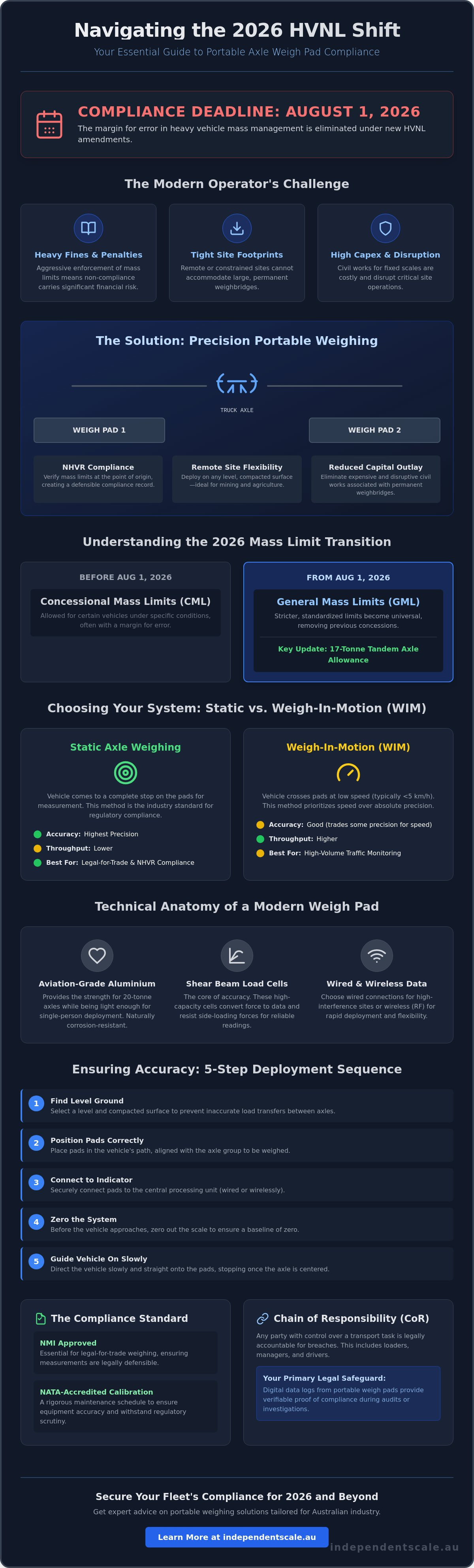
This technical guide ensures you master the specific compliance standards and selection criteria required for modern transport operations. We will detail the 2026 transition from Concessional Mass Limits to the new General Mass Limits, including the increased 17-tonne tandem axle allowance. You will learn how to navigate National Measurement Institute (NMI) approvals for legal-for-trade weighing and why NATA-aligned calibration is the only way to minimize equipment downtime. This overview provides the technical framework to keep your fleet compliant and your remote site operations efficient.
Key Takeaways
- Understand how the 2026 HVNL amendments redefine mass limits and why portable axle weigh pads Australia are critical for maintaining NHVR compliance on remote sites.
- Identify key technical specifications, including the advantages of aviation-grade aluminium and the integration of high-capacity shear beam load cells for industrial durability.
- Master the physics of vehicle leveling and the five-step deployment sequence required to prevent inaccurate load transfers during on-site weighing.
- Establish a rigorous maintenance schedule based on NATA-accredited calibration standards to ensure your equipment withstands regulatory scrutiny.
- Learn how to minimize operational downtime through expert load cell supply and technical support tailored for Australian transport and industrial sectors.
What are Portable Axle Weigh Pads and Why Does Australian Industry Need Them?
Portable axle weigh pads Australia are high-capacity, low-profile weighing platforms engineered to capture the mass of individual wheels or entire axle groups. These systems offer a modular alternative to permanent infrastructure, comprising durable pads and a central processing indicator. In the current regulatory environment, they're indispensable for operators needing to verify compliance with National Heavy Vehicle Regulator (NHVR) standards without the overhead of fixed civil works.
While traditional weighbridge and truck scale technology requires significant site preparation and concrete foundations, portable pads function on any level, compacted surface. This flexibility is critical for Australia's mining and agricultural sectors, where loading points frequently shift across remote territories. By eliminating the need for permanent civil works, businesses reduce capital expenditure while maintaining the ability to weigh vehicles at the point of origin.
The Legal Framework: Chain of Responsibility (CoR) in 2026
The Chain of Responsibility (CoR) framework ensures that any party with control over transport tasks is held accountable for breaches. Following the August 1, 2026, HVNL amendments, the NHVR has shifted toward more aggressive enforcement of mass limits. Accurate axle measurement isn't optional; it's a legal safeguard. Modern portable axle weigh pads Australia systems generate digital data logs that serve as verifiable evidence of compliance during roadside audits or incident investigations. As penalties for overloading continue to rise, having a documented weighing process at the loading site is the primary method for mitigating corporate and personal liability. To further strengthen your compliance strategy, engaging with a professional logistics provider like Freight and More Pty Ltd ensures that every link in your transport chain is managed with precision and expertise.
Static vs. Weigh-In-Motion (WIM) Portable Systems
Operators must choose between static and dynamic weighing based on their specific site requirements. Static axle weighing requires the vehicle to come to a complete stop on the pads. This method utilizes high-precision load cells to provide the most accurate mass readings, making it the preferred choice for legal-for-trade applications. Conversely, Weigh-In-Motion (WIM) systems allow vehicles to cross the pads at speeds typically under 5 km/h. While WIM systems improve throughput for high-volume traffic sites, they often trade a degree of accuracy for speed. For strict regulatory compliance and NHVR-aligned accuracy, static weighing remains the industry standard.
Technical Anatomy: Load Cells, Indicators, and Data Integration
The operational reliability of portable axle weigh pads Australia depends on the precise engineering of their internal components. At the core of every pad is the load cell, typically a high-capacity shear beam or compression variant. Shear beam cells are often preferred for their ability to handle high-impact loads and resist side-loading forces, which occur when a vehicle doesn't enter the pad perfectly straight. These components convert mechanical force into a precise electrical signal, forming the basis of all weight data under the Heavy Vehicle National Law (HVNL) compliance framework.
Material selection determines the balance between durability and portability for portable axle weigh pads Australia. While steel offers extreme rigidity, most modern units utilize aviation-grade aluminium. This material provides the necessary structural integrity to support 20-tonne axle groups while remaining light enough for single-person deployment. In remote Australian environments, aluminium's natural resistance to corrosion is a significant advantage over powder-coated steel, which can degrade when the finish is chipped by road debris or harsh gravel.
Data transmission between the pads and the indicator occurs via wired or wireless (RF) connections. Wired systems remain the standard for high-interference environments, such as near heavy electrical machinery or mining equipment, as they eliminate signal dropouts. Wireless units offer faster deployment but require robust power management. Most industrial systems now feature high-capacity lithium-ion batteries, with some remote configurations utilizing solar trickle-charging to maintain uptime in permanent roadside inspection points where mains power is unavailable.
Signal Processing: Indicators and Conditioners
Raw electrical signals from the pads require sophisticated processing to be useful for compliance. High-resolution indicators and displays are essential for field operators to read weights in direct sunlight. To integrate this data into broader site management software, conditioners and transmitters convert the signals into standardized digital formats. Given the harsh Australian climate, all electronic enclosures should meet IP67 or IP68 standards to ensure total protection against fine dust ingress and moisture during seasonal rains.
Load Cell Integrity in Portable Units
Portable systems face unique mechanical stresses compared to static scales. Sensitive load cells must be protected by internal shock-absorbing mounts to prevent damage from sudden braking or acceleration on the pads. Common failure points often involve the physical connectors and wiring harnesses, which are susceptible to strain and environmental wear. For systems deployed in regional areas prone to electrical storms, the inclusion of surge arrestors is a critical defensive measure for protecting the indicator's internal circuitry. If your current system's accuracy is fluctuating, it's often more efficient to perform a targeted load cell calibration or replacement than to decommission the entire unit.
Ensuring Accuracy: Deployment, Leveling, and Physics
Achieving regulatory-grade accuracy with portable axle weigh pads Australia requires more than high-quality hardware. It demands strict adherence to the physics of mass distribution. When an axle is raised onto a weighing platform, the vehicle's center of gravity shifts. Without proper compensation, this creates a "load transfer" effect, where the weighed axle appears heavier than its true mass while the adjacent axles appear lighter. This geometric error is the most common reason for failed NHVR audits on-site. You don't want to risk a 5% error margin simply because of poor leveling.
Surface stability is the foundation of any accurate measurement. Reinforced concrete is the ideal substrate for deployment. If you're using asphalt or compacted gravel, you must ensure the surface can withstand the concentrated point-loading of the pads without rutting. Even a 1% slope can introduce lateral forces that degrade load cell performance. Environmental conditions also play a role. High winds can exert several hundred kilograms of vertical force on high-sided trailers, leading to unstable readings. You'll need to monitor these fluctuations on your indicator to ensure a clean capture.
The Importance of Leveling Mats
Leveling mats are non-negotiable for weighing multi-axle groups, such as tri-axles and quad-axle configurations. To eliminate load transfer, the entire vehicle must remain on a perfectly horizontal plane during the weighing process. This requires leveling tracks that extend several meters in both directions from the pads. If the vehicle is "out of level" by as little as 25mm, the resulting measurement error can exceed 5% of the total vehicle mass. For operators, this discrepancy is the difference between a compliant load and a severe financial penalty. You can find specialized leveling tracks and other options and accessories to mitigate these risks during field deployment.
Field Setup Checklist for Site Supervisors
Effective deployment follows a non-negotiable five-step sequence to ensure data integrity:
- Step 1: Ground Verification. Use a digital level to confirm the site is flat within a 0.5% grade. Ensure the ground is compacted to prevent the pads from sinking under load.
- Step 2: Pad Alignment. Position the pads to match the vehicle's axle track. Misaligned tyres that overhang the pad edges will cause uneven load distribution and potential sensor damage.
- Step 3: System Initialization. Zero the indicators and displays once the pads are in position. Verify that the signal is stable and free from radio frequency interference.
- Step 4: Weigh-Stop-Weigh Sequence. Execute a controlled sequence where the vehicle stops completely on each axle group. Release all brakes to ensure no mechanical tension is "locked" into the suspension, which skews the results.
- Step 5: Documentation. Record the final readings and verify them against the General Mass Limits (GML) applicable to the specific vehicle configuration.
Calibration and Maintenance: The NATA Accredited Standard
Relying on factory calibration for portable axle weigh pads Australia is a high-risk strategy in the 2026 regulatory environment. While a new unit leaves the manufacturer with a certificate of conformance, this document loses its validity the moment the pads encounter field vibrations, temperature extremes, and structural stress. Ongoing NHVR compliance requires a documented history of weighing scale calibration performed under local conditions. Without a current calibration sticker from an accredited provider, your weight data may be deemed inadmissible during a Chain of Responsibility (CoR) inquiry.
Standard commercial testing is often confused with formal calibration. A standard "check" simply involves placing a known weight on the pad to see if it reads correctly. In contrast, NATA-accredited calibration involves a multi-point linearity test, repeatability checks, and eccentricity testing to ensure the pad performs accurately across its entire capacity range. Most industrial sites require these checks every 6 to 12 months, though high-volume mining and logistics hubs often implement quarterly schedules to minimize the risk of cumulative measurement errors.
Preventative maintenance is the primary defense against equipment downtime. You should establish a weekly routine that includes cleaning debris from the pad underside, as trapped stones can interfere with load cell deflection. Lubricate all electrical connectors with dielectric grease to prevent pins from corroding in high-moisture environments. A quick structural inspection for hairline fractures in the chassis is also essential; even minor cracks can cause non-linear readings that are impossible to calibrate out.
NATA Accreditation and ISO/IEC 17025
NATA-accredited load cell calibration provides a legal safe harbour for transport businesses. This accreditation confirms that the facility meets the ISO/IEC 17025 international standard for testing and calibration laboratories. It guarantees that the mass standards used are traceable to the National Measurement Institute (NMI). Independent Scale Service maintains this standard to ensure that every measurement you take can withstand the highest level of legal and technical scrutiny. For guaranteed accuracy, schedule your next weighing scale calibration with our technical team to verify your equipment against NATA standards.
Troubleshooting Field Inaccuracies
Identifying "drift" is the first step in diagnosing a failing system. If the zero value on your indicator fluctuates or the weight reading takes more than a few seconds to stabilize, moisture ingress in the load cell is the likely culprit. In high-EMI environments, such as those near overhead power lines or heavy generators, wireless data transmission may suffer from signal packet loss. If moving the indicator doesn't resolve the signal stability, it's time to pull the pad from service. Professional load cell calibration or repair can often salvage a unit that appears to be failing, saving the cost of a full system replacement.
Choosing Independent Scale Service for Portable Weighing
Independent Scale Service has established a reputation for technical excellence in the Australian industrial weighing sector since its inception. Our operational footprint extends across Sydney, Melbourne, and deep into regional Australia, ensuring that heavy vehicle operators have access to precision measurement tools wherever they operate. Managing portable axle weigh pads Australia requires a partner who understands the intersection of mechanical durability and electronic precision. We don't just sell equipment; we provide a comprehensive technical ecosystem that includes supply, NATA-accredited calibration, and specialized repair services.
Our deep background in concrete batching plant calibration provides a unique advantage for transport clients. The rigorous accuracy required for AS 1379 compliance in batching plants translates directly to the high-stakes environment of vehicle mass management. This cross-sector expertise ensures that your weighing systems are installed and maintained with a level of precision that exceeds standard commercial requirements. We understand that in industrial weighing, a small percentage of error leads to large financial and legal consequences.
Maintaining precision across all vehicle systems is essential for long-term operational success. While weighing ensures compliance, you can also explore Mainline ProHub Dyno Tuning to optimize engine performance and ensure your fleet operates at its full potential.
Beyond the Pads: Total Site Weighing Solutions
Industrial sites often require more than just axle weighing to maintain efficient operations. We specialize in integrating portable pads with broader inventory control systems to streamline site data. This includes the installation of tank and silo weighing assemblies for real-time bulk material monitoring. For facilities with integrated loading points, our hopper calibration services ensure that every load is accurate before the vehicle even reaches the pads. Additionally, we provide special purpose and shackle pins for heavy lifting and tension monitoring applications, rounding out a complete site-wide weighing strategy.
The Independent Scale Service Advantage
Choosing a service provider is a decision that impacts your operational uptime and legal compliance. We offer direct access to technical experts who understand the specific challenges of your industry, rather than sales representatives focused on turnover. Our commitment to minimizing client downtime is reflected in our rapid response times for critical equipment breakdowns across the industrial sector. By adhering to the highest Australian regulatory standards, including AS 1379 and ISO 17025, we ensure that your measurement data is technically sound and legally defensible. Whether you're operating a single fleet or a multi-site mining operation, our team provides the reliability necessary for serious industrial clients who cannot afford equipment failure.
Securing Your 2026 Compliance Strategy
The 2026 HVNL amendments have fundamentally changed the requirements for heavy vehicle mass management. Operating without verified data creates unacceptable legal and financial exposure for your business. By integrating high-capacity portable axle weigh pads Australia wide, you gain the ability to verify compliance at the point of loading, even in the most remote industrial environments. Precision is the only reliable defense against the National Heavy Vehicle Regulator's stricter enforcement protocols.
Maintaining your equipment through NATA-accredited calibration ensures that your measurements remain technically sound and legally defensible. Independent Scale Service provides the expertise necessary to keep your fleet moving safely. We are NATA Accredited to ISO/IEC 17025 and provide AS 1379 compliant services across Sydney, Melbourne, and regional Australia. Request a technical quote for portable axle weigh pads and NATA calibration today to secure your site's operational integrity and ensure your business is ready for the future of transport regulation.
Frequently Asked Questions
Are portable axle weigh pads as accurate as a full-size weighbridge?
Static portable axle weigh pads Australia provide accuracy levels comparable to permanent weighbridges when deployed with a full set of leveling tracks. While a weighbridge captures the entire vehicle mass simultaneously, portable pads utilize high-precision load cells to measure individual axle groups. To achieve regulatory-grade results, the vehicle must remain on a perfectly horizontal plane during the weighing process to prevent load transfer between axles.
How often do portable weigh pads need to be calibrated in Australia?
Industrial weighing equipment generally requires professional calibration every 6 to 12 months to maintain NHVR compliance. High-traffic environments or remote mining sites with extreme temperature fluctuations often necessitate more frequent quarterly checks. Regular testing ensures that the internal sensors haven't developed "drift" due to mechanical fatigue or environmental stress, which can lead to significant measurement errors over time.
Do I need NATA-accredited calibration for my axle pads to be legal?
NATA-accredited calibration is essential if your weight data is used for commercial transactions or as legal evidence in Chain of Responsibility (CoR) audits. This accreditation confirms that the calibration process is traceable to national mass standards and meets ISO/IEC 17025 requirements. Standard commercial checks don't provide the same level of legal safe harbour during regulatory investigations or roadside inspections.
Can portable weigh pads be used on unsealed or gravel surfaces?
You shouldn't use weigh pads on loose gravel or unsealed surfaces unless they are professionally compacted and perfectly level. Any ground deflection under the weight of a heavy vehicle causes the pad to tilt, which results in inaccurate readings. Concrete or reinforced asphalt provides the necessary stability to ensure the load cell remains vertical and the measurement remains within the required tolerance.
What is the maximum weight capacity of a standard portable axle pad?
Standard industrial pads typically feature a capacity of 10,000kg to 20,000kg per platform. This allows a pair of pads to manage the 17-tonne tandem axle limits introduced in the 2026 HVNL amendments. It's critical to verify the individual pad capacity against your heaviest expected axle group to prevent structural overloading of the internal load cells and potential sensor failure.
Do portable weigh pads calculate the total vehicle weight automatically?
Modern digital indicators automatically sum the weights of each axle group to provide the Gross Vehicle Mass (GVM). The operator sequences the weighing of steer, drive, and trailer axles, while the indicator stores each value before generating a final total. This data can be printed or exported directly to site management software to serve as verifiable evidence of compliance.
What happens if my portable weigh pads get wet or submerged?
Most high-quality portable axle weigh pads Australia are IP67 or IP68 rated, meaning they're resistant to dust ingress and temporary submersion. However, long-term exposure to moisture can still lead to corrosion in the connector pins or wiring harnesses. If pads are submerged during seasonal rains, they should be cleaned with fresh water and thoroughly dried before the next use to prevent signal degradation.
Is wireless or wired better for portable axle weighing on remote sites?
Wired systems are superior for remote sites with high electromagnetic interference (EMI) or where signal reliability is the primary concern. Wireless systems offer faster deployment and eliminate trip hazards but can suffer from signal dropouts in areas with heavy radio traffic or physical obstructions. For permanent roadside inspection points where reliability is paramount, wired connections remain the industry standard.
