


On-Site Scale Calibration: The Industrial Guide to Compliance & Accuracy
A 1% deviation in batching accuracy at a standard Sydney concrete plant can result in over A$50,000 of wasted raw materials every year. While these losses often go unnoticed during daily operations, the financial impact is absolute. Reliability in heavy industrial weighing isn't just about the hardware; it's about the precision of your on-site scale calibration schedule. You already understand that maintaining consistent throughput while adhering to strict AS 1379 requirements is a critical operational challenge that leaves no room for error.
This guide delivers the technical expertise required to achieve full NATA certification while significantly reducing the risk of operational disruption. We'll show you how to leverage ISO/IEC 17025 accredited processes to guarantee accuracy for high-volume production lines. You'll master the requirements for gravimetric testing and discover how a structured maintenance plan eliminates the threat of non-compliance. This is the industrial roadmap to ensuring your facility remains both legally compliant and commercially profitable.
Key Takeaways
- Understand why lab-based testing is insufficient for fixed assets and how professional on-site scale calibration ensures accuracy under real-world industrial conditions.
- Navigate the hierarchy of Australian standards, specifically the legal weight of NATA-endorsed reports and ISO/IEC 17025 accreditation for industrial compliance.
- Determine the optimal technical approach for high-capacity weighing systems by evaluating the differences between gravimetric and material substitution methodologies.
- Learn how to minimise operational downtime and service costs by mastering site preparation requirements, including LOTO and confined space safety protocols.
- Discover how to maintain 24/7 reliability for critical weighing infrastructure through expert maintenance strategies and rapid emergency response.
The Critical Role of On-Site Scale Calibration in Industry
On-site scale calibration is the technical process of verifying the accuracy of weighing equipment at its permanent installation point under actual operating conditions. While laboratory testing is suitable for portable tools, industrial assets like hoppers, silos, and batching plants require an evaluation that accounts for their specific environment. To understand what is calibration in a professional context, one must view it as a comparison between a measurement device and a NATA-accredited traceable standard. For heavy industry, this comparison must happen on the factory floor to be valid.
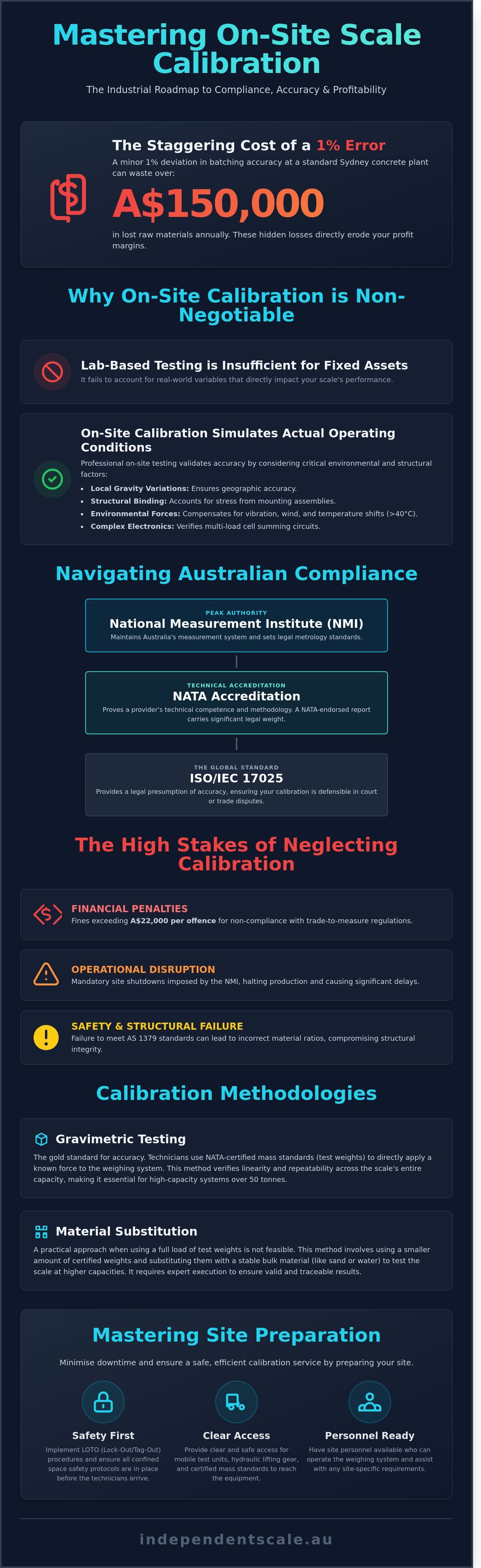
Lab-based calibration is insufficient for fixed assets because it doesn't account for local gravity variations, structural binding, or the complex summing circuits found in multi-load cell systems. When a scale is installed, factors such as the rigidity of the mounting assembly and the torque of the bolts influence the final reading. Environmental variables in Australian industrial sites, including vibrations from nearby crushers, temperature fluctuations exceeding 40°C, and wind loading on outdoor silos, directly impact load cell performance. On-site testing ensures the system remains accurate despite these external pressures.
Neglecting regular on-site scale calibration leads to severe operational risks. In the Australian construction sector, failing to meet AS 1379 standards can result in structural failures due to incorrect material ratios. Beyond safety, the National Measurement Institute (NMI) enforces strict regulations for trade-to-measure transactions. Non-compliance often results in mandatory site shutdowns and fines exceeding A$22,000 per offence, making technical precision a legal necessity rather than an operational preference.
Fixed vs. Mobile Weighing Systems
Calibrating fixed infrastructure presents unique logistical challenges. You can't transport a 100-tonne cement silo to a laboratory; therefore, the laboratory must come to the site. This requires specialised mobile test units equipped with certified mass standards and hydraulic lifting gear. For systems exceeding 50 tonnes, technicians often utilise a combination of known weights and the gravimetric method to ensure linearity across the entire weighing range. Maintaining accuracy in these high-capacity systems is essential for inventory management and preventing the overloading of transport vehicles, which carries heavy penalties under Chain of Responsibility laws.
The Economic Impact of Accuracy
The financial consequences of a seemingly minor 1% calibration error are substantial. In a standard Australian concrete batching plant producing 100,000 cubic metres annually, a 1% overfill of cement powder can cost the business over A$150,000 in lost material every year. Precise on-site scale calibration identifies these discrepancies before they erode profit margins. Furthermore, certified calibration records serve as a legal defence in trade disputes, proving that the quantity of goods delivered matches the quantity invoiced. This technical transparency is vital for maintaining Tier 1 contractor relationships and avoiding litigation.
Scheduled NATA-accredited calibration provides a measurable ROI by preventing A$150,000 in annual material giveaway while ensuring 100% compliance with AS 1379 standards.
Australian Standards and NATA Accreditation
Australia's regulatory framework for weighing equipment is rigorous and hierarchical. At the peak sits the National Measurement Institute (NMI), which maintains the Australian measurement system. While the NMI sets the legal metrology standards, the National Association of Testing Authorities (NATA) provides the accreditation that proves a service provider's technical competence. For any industrial operation, understanding the difference between a basic "calibration" and a NATA-accredited on-site scale calibration is the difference between legal protection and significant liability.
A NATA-endorsed calibration report carries immense legal weight in Australian courts. If your business faces a dispute over product weight, structural integrity, or trade measurements, a standard service report won't suffice. NATA accreditation to ISO/IEC 17025 provides a legal presumption of accuracy. It proves that the equipment was tested using traceable weights and that the technician followed a validated, peer-reviewed methodology. Without this endorsement, your quality assurance data can be easily challenged during litigation or a regulatory audit.
Frequency of re-certification is rarely a matter of choice; it's a matter of compliance. Most industrial sectors require re-calibration every 6 to 12 months, depending on the risk profile and usage volume. Independent Scale Service currently maintains 98% compliance for concrete and manufacturing plants across Sydney by managing these cycles proactively. We don't wait for your equipment to fail; we schedule on-site scale calibration before your certification expires, ensuring your plant remains operational and audit-ready at all times. For businesses looking to secure their compliance status, engaging an expert calibration partner is the most reliable strategy.
AS 1379: The Gold Standard for Concrete Production
In the concrete industry, precision isn't optional. The AS 1379 standard dictates strict requirements for scale accuracy in batching plants. Our AS 1379-compliant services focus on the 6-month verification intervals required for weigh hoppers and admixture dispensers. These standards demand independent third-party audits to verify that the plant's internal measurements align with national standards. We provide the comprehensive documentation and digital record-keeping necessary to pass these high-stakes quality assurance audits without friction.
ISO/IEC 17025 and Technical Competence
ISO/IEC 17025 is the international benchmark for testing and calibration laboratories. When a provider is NATA accredited to this standard, it means their equipment, staff, and processes have been rigorously vetted. Traceability is the core of this standard; it's the unbroken chain of comparisons linking your on-site measurements back to the national primary standards held by the NMI. Before hiring a technician, always evaluate their Scope of Accreditation. This document specifies exactly which types of weighing equipment they're authorized to calibrate and the lowest uncertainties they can achieve. If your provider's scope doesn't cover your specific scale capacity, your calibration certificate may be technically invalid for compliance purposes.
Calibration Methodologies: Gravimetric vs. Substitution
The gravimetric method is the industry benchmark for accuracy in industrial weighing. It involves applying NATA-certified test weights directly to the weighing vessel. For a standard 2,000kg aggregate hopper, technicians apply weights in specific increments to verify performance across the entire range. This ensures the system meets AS 1379 requirements for concrete production. It's the most reliable way to confirm that 1,000kg on the display is exactly 1,000kg of mass.
When dealing with ultra-high capacity systems, such as 100-tonne cement silos, transporting 100 tonnes of physical weights is logistically impossible. In these cases, we use material substitution. We apply a known quantity of certified weights, record the reading, and then substitute that mass with a material like water or aggregate. We repeat this build-up process until we reach the scale's full capacity. This method provides high-level confidence for massive structures where traditional weight sets can't reach.
Accurate on-site scale calibration requires checking for linearity and eccentricity. Linearity testing confirms the scale remains accurate as the load increases from zero to maximum. We typically test five points:
- Zero balance
- 25% of rated capacity
- 50% of rated capacity
- 75% of rated capacity
- 100% of rated capacity
Eccentricity, or corner testing, is critical for multi-load cell systems. If one load cell is misaligned or failing, the scale shows different weights depending on where the material lands. We correct these errors by adjusting the potentiometers within the summing junction box. This balances the millivolt output from each sensor to ensure uniformity across the entire platform or hopper.
Calibrating Load Cells in Situ
Performing load cell calibration in situ prevents unnecessary downtime. We diagnose summing circuit faults by measuring individual cell outputs under a dead load. Moisture ingress is a common failure point in Australian wash-down environments; we use insulation resistance testers to identify compromised seals. Modern indicators and displays are vital here. They translate raw mV/V signals into digital data, allowing technicians to spot signal fluctuations or drifting that indicates a failing sensor before a total system breakdown occurs.
Liquid Flowmeter and Hopper Calibration
Accuracy in chemical admixtures and water batching relies on liquid flowmeter calibration using the weighing method. We divert the liquid into a tared container on a high-precision scale to verify the meter's pulse output against actual mass. For a hopper calibration service in abrasive environments like quarries, we account for mechanical binding caused by dust buildup. Managing live loads requires isolating the hopper from external vibrations and ensuring flexible connections don't exert force on the weighing assembly. This methodical approach maintains the 0.5% tolerance required for NATA compliance and ISO/IEC 17025 standards.
Preparing Your Site for a Calibration Visit
Efficient preparation is the most effective way to control the total cost of on-site scale calibration. Every hour a NATA-accredited technician spends waiting for site access or equipment cleaning is an unnecessary expense added to your invoice. Clients who strictly follow a pre-visit checklist typically reduce their service bill by 18% compared to sites that require on-the-spot remediation. Preparation isn't just about speed; it's about ensuring the environment is stable enough to meet the rigorous requirements of ISO/IEC 17025 standards.
Safety remains the primary barrier to a successful calibration. Technicians won't commence work if LOTO (Lockout-Tagout) procedures aren't ready or if the environment doesn't meet Australian safety standards. If your weighing equipment is located in a pit, it's classified as a confined space, requiring specific permits and often a second safety observer. For silo calibrations, height safety systems must be certified and accessible. If these elements aren't in place, the technician may be forced to abort the visit, resulting in a minimum call-out fee of approximately A$250 to A$450 depending on the location.
To effectively communicate these critical safety procedures and site preparation requirements to staff, many facilities develop internal training videos. For more on how professional video content can enhance operational readiness and safety compliance, you can read more.
Physical access for heavy machinery is the next critical factor. A standard test weight trailer or crane truck requires a clear, level path with a minimum width of 3.5 metres. If the technician cannot position the crane within 4 metres of the scale deck, the heavy-mass testing cannot proceed. Ensure that parked vehicles, pallets, or raw material stockpiles are cleared 60 minutes before the scheduled arrival time.
Pre-calibration cleaning is a technical necessity, not an aesthetic one. Debris, dried concrete, or packed mud on a weighbridge deck or under the scale bridge invalidates the test. Even 10kg of build-up on a 60-tonne bridge creates a zero-load error that prevents accurate span adjustment. Use a high-pressure hose to clear the scale 24 hours before the visit, allowing sufficient time for the load cells and junctions to dry completely.
Technical Readiness Checklist
Mechanical interference is the most common cause of calibration failure. You must verify that tank and silo weighing assemblies are completely free-standing. Rigid piping or conduit connections act as a shunt, absorbing weight and causing significant linearity errors. Additionally, inspect junction boxes and surge arrestors for physical damage or moisture ingress. Ensure your digital indicators have been powered on for at least 30 minutes prior to the technician's arrival to allow the internal electronics to reach thermal stability.
Personnel and Logistics
Logistical planning minimises production interference. We recommend scheduling on-site scale calibration during low-volume windows, such as the 05:00 to 08:00 block, to avoid peak truck movements. Have all site inductions and hot-work permits ready at the gate. A designated site contact with the authority to sign off on NATA certificates must be present. This prevents delays in the final hand-over and ensures your compliance documentation is processed immediately, keeping your plant 100% compliant with AS 1379 requirements.
Don't let poor site preparation delay your compliance. Book your expert scale calibration service with Independent Scale Service today.
Independent Scale Service: Expert On-Site Solutions
Critical breakdowns don't happen on a convenient schedule. We offer a 24/7 emergency response service to address equipment failures the moment they occur. This level of dedication is why industry leaders like Holcim, Boral, and Hanson rely on ISS for their compliance needs. We currently maintain the weighing systems for 98% of concrete plants across the Sydney metropolitan area. Our technicians are experts in AS 1379 and ISO/IEC 17025 standards. We don't just provide a compliance sticker; we provide the technical assurance that your plant is operating within strict legal and structural tolerances. This reliability ensures that your production lines stay active and your batching remains accurate to the gram.
- 30+ Years of Experience: Deep industry knowledge across Australian metropolitan and regional sites.
- 24/7 Emergency Response: Rapid deployment for critical weighing equipment breakdowns to prevent costly plant stoppages.
- NATA Accreditation: All services are performed to ISO/IEC 17025 standards, ensuring global traceability.
- End-to-End Support: We manage everything from hardware procurement to final certification.
Beyond Calibration: Total System Health
Calibration is a snapshot in time, but system health is an ongoing requirement. During the on-site scale calibration process, our technicians perform a comprehensive fault diagnosis. We look for electrical drift in summing circuits and mechanical wear in mounting kits that others might overlook. If your system is aging, we provide clear path-to-upgrade solutions. We replace obsolete hardware with high-performance conditioners and transmitters to ensure digital signals remain clean and accurate. For specialized industries, we offer custom-engineered special purpose and shackle pins. These components are essential for heavy lifting and high-capacity tension monitoring where standard off-the-shelf parts fail. We ensure every component, from the surge arrestor to the indicator, works in harmony to prevent future failures.
Starting Your Compliance Journey
Securing your site's accuracy begins with a tailored consultation. We don't offer generic service packages because no two industrial sites are identical. When you request a quote, we analyze your specific equipment roster and operational frequency to build a service schedule that fits your workflow. The ISS commitment is centered on three core values: accuracy, reliability, and absolute compliance. We take the guesswork out of NATA audits by providing documentation that is technically sound and legally defensible. Our methodical approach has made us the trusted authority for Australia's largest construction and logistics firms. We focus on the technical details so you can focus on your core business operations.
Contact Independent Scale Service for NATA-Accredited Calibration and ensure your equipment meets every Australian standard today.
Secure Your Industrial Compliance and Operational Accuracy
Maintaining precise weighing standards isn't just a best practice; it's a fundamental requirement for industrial integrity. Adhering to AS 1379 standards through rigorous on-site scale calibration ensures your facility avoids the legal and financial risks associated with measurement errors. Whether your site requires gravimetric verification or substitution methods, selecting the right methodology is critical for long-term reliability. Precise preparation ensures technicians can perform their duties efficiently without extending downtime. Independent Scale Service brings over 30 years of technical expertise to every site. We're NATA accredited to ISO/IEC 17025, which guarantees the highest level of technical competence and equipment traceability.
Our team currently services 98% of concrete plants across Sydney, proving our capability to handle the most demanding industrial environments. If a critical failure occurs, our emergency 24x7 support team is available to get your operations back online immediately. Professional calibration protects your reputation and ensures your outputs consistently meet strict Australian quality benchmarks. Your facility deserves the certainty that only expert, accredited weighing services can provide.
Book Your NATA-Accredited On-Site Calibration Today
Reliable accuracy is the foundation of every successful industrial operation.
Frequently Asked Questions
What is the difference between scale calibration and scale verification?
Calibration involves comparing a scale's output to a known standard and adjusting it to meet accuracy requirements; verification only confirms it's within tolerance. Our technicians perform formal calibrations under ISO/IEC 17025 standards to ensure absolute accuracy for industrial clients. Verification is a routine check that doesn't include the same level of technical adjustment or certification. This distinction's vital for maintaining legal compliance in heavy industry and avoiding measurement errors.
How often should industrial scales be calibrated on-site?
Industrial scales require on-site scale calibration at least every 6 to 12 months to maintain compliance and accuracy. High-volume facilities, such as those servicing 98% of Sydney's concrete plants, often schedule quarterly intervals to mitigate the risk of measurement drift. Regular intervals prevent costly material giveaway and ensure your facility meets Australian standards. We tailor the frequency based on your plant's specific throughput and environmental conditions.
Does AS 1379 require NATA-accredited calibration for concrete plants?
Yes, AS 1379:2007 mandates that weighing systems in concrete batching plants undergo regular calibration by a NATA-accredited laboratory. Compliance with ISO/IEC 17025 ensures that the gravimetric method calibration meets the strict accuracy requirements for concrete production. Using a non-accredited service provider risks your plant's certification and the quality of your final product. We ensure every scale meets the required 0.5% accuracy threshold for cementitious materials.
Can you calibrate scales on-site during rain or high winds?
High winds and heavy rain compromise the accuracy of load cell readings and are unsuitable for precise calibration. Wind speeds exceeding 20 kilometres per hour cause fluctuations in the scale's zero point, which leads to significant measurement errors. We schedule work during stable weather to ensure results remain within the 0.1% tolerance limit. Precise measurements are impossible when environmental factors interfere with the sensitivity of high-precision industrial weighing equipment.
What happens if my weighing equipment fails the calibration test?
If equipment fails, our technicians immediately diagnose the fault, which often involves testing load cells, summing circuits, or surge arrestors. We provide an on-site repair quote in AUD and aim for same-day rectification to minimise downtime. A follow-up calibration is performed once the repair is complete to issue a new certificate of compliance. This ensures your operations remain compliant with AS 1379 without lengthy delays in production.
How long does a typical on-site calibration take for a batching plant?
A standard on-site scale calibration for a concrete batching plant typically takes 2 to 4 hours per scale. This timeframe includes the setup of certified test weights and the execution of the gravimetric method. Efficiency is critical, as we understand that every hour of downtime impacts production schedules for major contractors like Boral or Holcim. Our methodical approach ensures we complete the job quickly while maintaining the highest technical standards.
Are your test weights certified and traceable to national standards?
All our test weights are NATA-certified and fully traceable to the national standards maintained by the National Measurement Institute (NMI). We maintain a rigorous 12-month re-certification cycle for our mass standards to ensure total accuracy. This ensures that every kilogram measured during a site visit is legally defensible and technically accurate. You'll receive documentation proving this traceability with every calibration report we issue for your facility's records.
Do you provide emergency 24/7 calibration services for breakdowns?
We provide emergency 24/7 support through our dedicated response line to address critical equipment breakdowns immediately. Our technicians arrive on-site with the necessary components to repair load cells or summing circuits. This responsive service model supports 98% of Sydney's concrete plants, ensuring they return to full production capacity without delay. We understand that downtime costs money, so we prioritise rapid response for all our contracted industrial clients.
