


On-Site Load Cell Calibration Sydney: The Industrial Compliance Guide
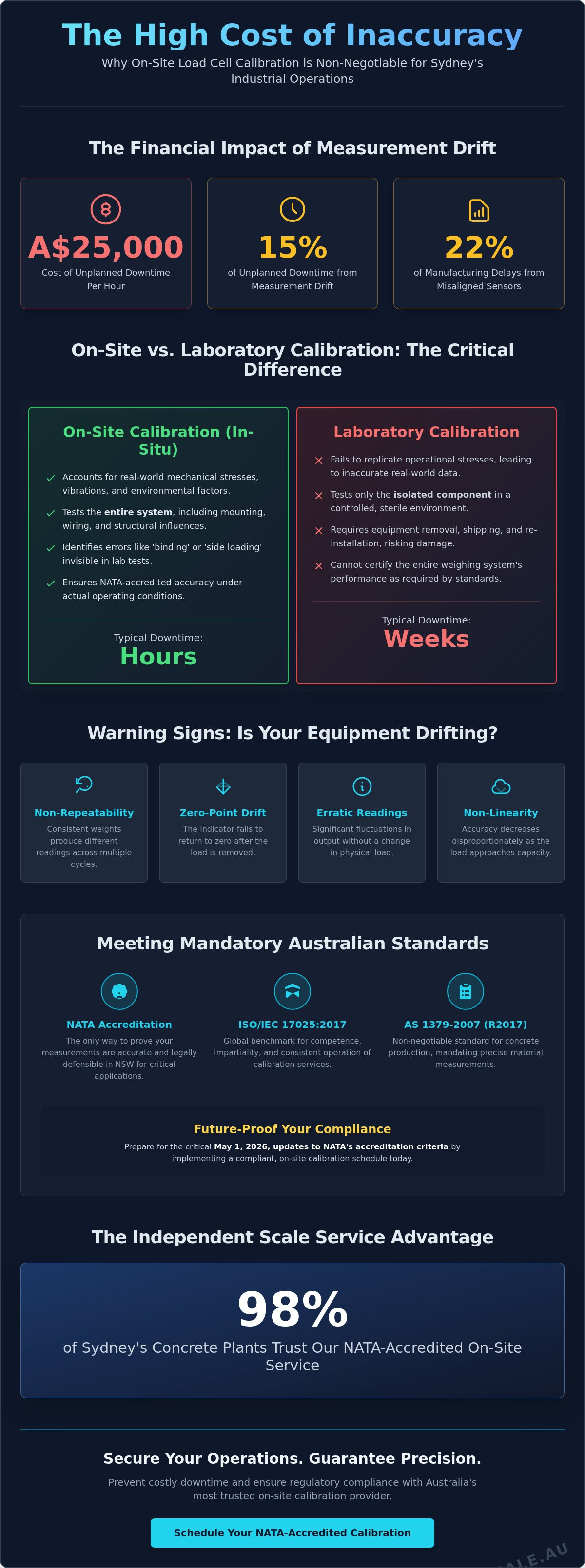
Undetected measurement drift causes 15% of unplanned downtime in Australian manufacturing plants, yet many operators still rely on laboratory calibrations that fail to account for real-world mechanical stresses. When a production halt costs up to A$25,000 per hour, you cannot afford the risks associated with equipment removal or inaccurate data. Securing professional on-site load cell calibration Sydney is the only way to verify performance under actual load conditions while maintaining zero-downtime operations.
We understand that meeting the rigorous demands of AS 1379-2007 (R2017) is a non-negotiable part of your daily operations. You need precision that stands up to regulatory scrutiny without sacrificing productivity. This guide outlines the essential technical requirements for NATA-accredited calibration and the latest ISO/IEC 17025:2017 standards. By following these protocols, you'll ensure your Sydney facility remains fully compliant and operationally efficient.
We'll examine the critical May 1, 2026, updates to NATA's accreditation criteria and explain how to implement a calibration schedule that eliminates material waste. You'll learn how to navigate the complexities of gravimetric methods and summing circuits to achieve certified accuracy on every batch.
Key Takeaways
- Understand how on-site calibration accounts for real-world mechanical stresses and environmental variables that laboratory testing cannot replicate.
- Learn the essential differences between ISO/IEC 17025:2017 and AS 1379-2007 (R2017) to ensure your facility meets mandatory Australian standards for concrete production.
- Discover how professional on-site load cell calibration Sydney reduces equipment downtime from weeks to hours by eliminating the need for component removal and shipping.
- Identify the specific logistical and safety requirements needed to prepare your site for a NATA-accredited mobile calibration unit.
- Leverage the expertise of a provider servicing 98% of Sydney's concrete plants to protect your operation against the A$25,000 per hour cost of unplanned downtime.
Why On-Site Load Cell Calibration is Critical for Sydney Industry
On-site load cell calibration Sydney is the systematic process of verifying sensor accuracy within the specific mechanical environment where the equipment operates. Unlike laboratory testing, this method accounts for structural stresses, cable lengths, and mounting hardware that directly influence measurement output. Calibration is not merely a maintenance task; it's a technical requirement for ensuring that your weighing systems provide repeatable results under industrial conditions. By testing the system in-situ, technicians identify errors caused by "side loading" or "binding" that are invisible in a controlled lab setting.
Sydney's industrial landscape presents unique challenges. High humidity levels and consistent vibration from heavy machinery contribute to electronic drift in sensitive components. When sensors lose alignment, the consequences are immediate. A 2024 industry report indicates that 22% of manufacturing delays stem from misaligned sensors, with unplanned halts costing up to A$25,000 per hour. For facilities managing concrete batching plant calibration, even minor inaccuracies lead to material wastage or structural liabilities that violate AS 1379-2007 (R2017) standards. NATA accreditation is the only way to prove your measurements are legally defensible in NSW.
The Role of Calibration in Sydney's Infrastructure Boom
Major projects like the Sydney Metro and Western Sydney Airport demand high-spec materials that leave no room for error. Government contracts strictly mandate NATA-accredited verification to ensure every cubic meter of concrete meets load-bearing specifications. Inaccurate weighing doesn't just waste material; it threatens project completion timelines and legal standing. Using on-site load cell calibration Sydney ensures your facility remains a qualified supplier for these critical developments. Accuracy is the difference between a successful pour and a costly demolition order.
Identifying Signs of Load Cell Drift
Environmental stressors in Sydney, such as coastal salt air and heavy thermal cycling, accelerate component degradation. Operators must monitor for specific symptoms that indicate a system is no longer compliant. If your equipment shows these signs, immediate intervention is required to avoid the 15% of unplanned downtime typically caused by measurement drift.
- Non-repeatability: Consistent weights produce different readings across multiple cycles.
- Zero-point drift: The indicator fails to return to zero after the load is removed.
- Erratic readings: Significant fluctuations in digital output without a change in physical load.
- Non-linearity: The system is accurate at low weights but shows increasing error as it reaches capacity.
Technical Standards: NATA, ISO/IEC 17025, and AS 1379
Adherence to international and national standards ensures that measurement data is both accurate and legally defensible. ISO/IEC 17025:2017 is the global benchmark for the competence of testing and calibration laboratories. It specifies the general requirements for the competence, impartiality, and consistent operation of labs. For Sydney industrial operators, this accreditation proves that a service provider has the technical proficiency to perform on-site load cell calibration Sydney to a verifiable standard. The National Measurement Institute (NMI) maintains the primary standards, but NATA accreditation provides the practical bridge to industrial application.
The gravimetric method is the industry-preferred practice for on-site verification. This involves the physical application of certified test masses to the weighing system. Unlike electronic simulation, which only tests the indicator's ability to process a signal, the gravimetric method tests the entire mechanical chain. It accounts for friction, binding, and structural deflection. Using non-accredited services for commercial weighing or safety-critical applications creates significant legal exposure. If a structural failure occurs, measurements from a non-accredited source won't hold up under regulatory or judicial scrutiny.
Understanding NATA Accreditation
NATA (National Association of Testing Authorities) is Australia's sole accreditation body for laboratories. A NATA-endorsed report is a technical document that carries the NATA emblem, signifying that the results are traceable to national standards. This differs from a standard "certificate of accuracy," which lacks independent verification of the technician's methods. Technicians must undergo rigorous, recurring audits where NATA assessors evaluate their equipment, procedures, and technical competence. This ensures every NATA-accredited calibration meets the highest possible accuracy thresholds.
Compliance for Concrete Batching Plants
For the construction sector, AS 1379-2007 (R2017) is the mandatory standard for the specification and supply of concrete. This standard dictates strict weighing accuracy tolerances that batching plants must maintain. Cementitious materials require an accuracy of +/- 1%, while aggregates and water typically require +/- 2%. Sydney plants must perform regular concrete batching plant calibration at least every six months to remain compliant. Failure to meet these tolerances leads to inconsistent concrete strength, which can compromise the integrity of major infrastructure projects. If your readings are drifting, you should consider a professional load cell repair to restore system integrity before your next audit.
On-Site vs. Laboratory Calibration: Choosing the Right Method
A load cell's performance is inextricably linked to its physical installation. While a laboratory offers a controlled environment, it cannot replicate the specific mounting stresses or mechanical interference present at your facility. Choosing on-site load cell calibration Sydney ensures that the calibration accounts for the "Installed Condition." This includes the critical effects of rigid piping, structural deflection, and the specific orientation of tank and silo weighing assemblies. Calibrating a sensor in isolation ignores the 15% of measurement errors caused by the surrounding hardware.
Logistics and downtime represent the most significant differences between these methods. Lab calibration requires equipment removal, packing, and shipping, a process that typically takes 5 to 14 business days. During this window, your production line is either non-functional or operating without verified accuracy. Conversely, on-site services complete the verification in 2 to 6 hours. Given that unplanned production halts in Australian manufacturing can cost as much as A$25,000 per hour, the efficiency of on-site verification is a critical business priority. You don't just save time; you protect your bottom line from the high cost of equipment removal.
Transit risks also play a role in this decision. Shipping sensitive electronics introduces the risk of "shock loading" or moisture ingress during transit. A load cell that left your facility in working order might arrive at the lab with damaged strain gauges or compromised seals. By performing the work at your location, you eliminate these variables. The National Association of Testing Authorities (NATA) provides accreditation for both environments, but the practical reliability of on-site testing for heavy industrial equipment is superior for maintaining AS 1379 compliance.
Why On-Site Wins for Heavy Industry
Technicians don't just look at the sensor. They evaluate the entire weighing string, including summing circuits and digital indicators. This allows for the diagnosis of mechanical "binding" or "shunting" where the load is physically diverted away from the cell. These issues are common in Sydney's high-vibration environments and are impossible to detect if the cell is removed and sent to a laboratory. On-site verification ensures the system works as a cohesive unit under real-world batching pressures.
When to Consider Lab Calibration
Lab-based testing remains the standard for ultra-low capacity sensors or high-precision instruments that require a climate-controlled environment free from drafts and temperature swings. If you're using portable equipment or bench-top sensors, our force gauge calibration service provides the necessary precision under ISO/IEC 17025:2017 standards. This is ideal for equipment that's easily transported without disrupting your primary production infrastructure.
Preparing Your Sydney Site for a Calibration Visit
Efficient site preparation is the most effective way to minimize production downtime during on-site load cell calibration Sydney. A technician's ability to perform accurate gravimetric testing depends on the physical state of your weighing system. Before the arrival of a mobile unit, you must ensure that all hoppers, silos, and tanks are completely empty. Even a small amount of residual material can create non-linear errors during the span calibration process. Cleaning the external mounting hardware is equally important; accumulated debris or hardened concrete around the load point can cause "binding" that invalidates NATA-certified results.
A thorough pre-calibration check identifies potential failures before they lead to an audit non-compliance. Inspect all visible cabling for signs of abrasion or moisture ingress. Check your junction boxes for corrosion or loose terminal connections. If a sensor is physically damaged, the calibration process will fail, leading to additional service visits. Identifying these faults early allows for a pre-emptive load cell repair, ensuring the technician can proceed with the formal verification immediately. A typical on-site visit for a single batching plant takes between 2 and 6 hours, provided the site is prepared and the equipment is accessible.
Site Safety and Access Requirements
Compliance with NSW safety regulations is mandatory for all industrial sites. You must provide a current Safe Work Method Statement (SWMS) and facilitate any necessary site-specific inductions for the calibration team. Securing safe access for on-site load cell calibration Sydney involves more than just a clear driveway. Mobile calibration units require stable, level ground to safely deploy heavy test weights. Clear overhead access is essential for cranes or lifting equipment used during the process. Having a site representative available for functional testing ensures that the system integrates correctly with your plant's software after the physical calibration is complete.
Technical Preparation Checklist
To streamline the technical verification, verify that all indicators and displays are powered on at least 30 minutes before the technician arrives. This allows the electronics to reach a stable operating temperature. Use this checklist to finalize your preparation:
- Check Rods and Stays: Ensure all mechanical restraints are loose and not shunting the load.
- Power Supply: Confirm that voltage levels are stable and surge arrestors are functional.
- Material Clearance: Verify hoppers are 100% clear of product.
- Fault Documentation: Provide the technician with a log of any recent erratic readings or zero-point drift.
If you're unsure about your site's readiness for an AS 1379 audit, contact us to schedule a pre-compliance inspection today.
The Independent Scale Service Advantage in Sydney
Independent Scale Service (ISS) maintains a dominant presence in the NSW industrial sector, backed by over 30 years of specialized experience. We currently service 98% of concrete plants across the Sydney metropolitan area, providing a level of technical depth that generalist providers cannot match. Our approach to on-site load cell calibration Sydney extends beyond simple verification. We utilize a "Total System" methodology that integrates electrical fault diagnosis with mechanical repair expertise. If a calibration reveals a discrepancy, we don't just record the error; we identify and rectify the underlying cause, whether it's a failing summing circuit or a compromised mechanical mount.
Industrial operations don't stop at 5:00 PM. We provide a 24/7 emergency response capability to address critical system failures immediately. This responsiveness is essential when the cost of an unplanned production halt reaches A$25,000 per hour. Our technicians arrive on-site equipped to handle both the technical calibration and the physical repairs necessary to restore full NATA-compliant operation. By combining high-level accreditation with practical mechanical skills, we ensure your facility meets the rigorous demands of AS 1379-2007 (R2017) without the need for multiple contractors.
Comprehensive Load Cell Solutions
We maintain an extensive local inventory of load cells to ensure immediate replacement if a component fails during testing. Our team possesses the technical proficiency to program indicators and install conditioners or transmitters on-site. This eliminates the need for multiple service visits or third-party contractors. By managing the entire weighing string, we guarantee that every component, from the sensor to the digital display, meets the requirements of ISO/IEC 17025:2017. Our local Sydney presence allows for rapid deployment, ensuring your equipment stays within its mandatory accuracy tolerances.
Booking Your NATA-Accredited Service
Proactive scheduling is the most effective way to avoid compliance lapses and the associated legal risks. We recommend booking your AS 1379-compliant inspections at least 30 days before your certificate expiry. This ensures you maintain continuous operation without the pressure of emergency fees. Whether you operate a single hopper in Western Sydney or a high-volume batching plant in the CBD, we provide tailored quotes for all Sydney and regional NSW sites. Contact Independent Scale Service for your NATA-accredited on-site calibration to secure your facility's accuracy and compliance today.
Secure Your Operational Accuracy and Regulatory Standing
Maintaining precise measurements is a technical necessity for any facility contributing to Sydney's infrastructure. We've established that on-site verification accounts for mechanical variables like structural deflection and side-loading that laboratory tests simply miss. Adhering to the AS 1379 standard protects your operation from material waste and the A$25,000 hourly cost of unplanned production halts. Proactive site preparation and regular audits are the only ways to ensure your data remains legally defensible under NATA scrutiny.
Independent Scale Service brings over 30 years of industry experience to every site visit. As a provider servicing 98% of Sydney's concrete plants, we understand the urgency of maintaining NATA-accredited accuracy to ISO/IEC 17025 standards. Our 24/7 emergency support ensures that your facility remains operational even when critical faults occur. Ensuring your facility maintains a rigorous schedule for on-site load cell calibration Sydney is the most effective way to prevent measurement drift and ensure full regulatory compliance.
Don't wait for an audit failure or structural issue to address your sensor health. Reliable weighing systems are the foundation of a successful industrial operation. Book Your NATA-Accredited On-Site Calibration in Sydney Today to secure your facility's accuracy.
Frequently Asked Questions
How often should load cells be calibrated for AS 1379 compliance?
Concrete batching plants must undergo calibration every six months to maintain compliance with AS 1379-2007 (R2017) standards. This mandatory interval ensures that measurement drift does not compromise concrete strength or material ratios. Facilities operating in high-vibration environments may require more frequent checks to manage the accelerated electronic drift common in Sydney industrial sites.
Can you calibrate load cells on-site if they are part of a large silo?
We specialize in verifying the accuracy of large silos and hoppers while they remain in their installed environment. This process uses certified test weights to apply a known physical load, ensuring the entire mechanical chain is tested under real-world conditions. Performing on-site load cell calibration Sydney for silos is essential because it accounts for structural influences that laboratory testing cannot replicate.
What is the difference between a NATA-accredited calibration and a standard service?
A NATA-accredited service provides technical reports that are traceable to national standards and recognized under ISO/IEC 17025:2017. Standard services often lack the rigorous audit process and independent verification required for legal and safety compliance. For industries like concrete production, only NATA-endorsed certificates satisfy regulatory auditors and the requirements of major infrastructure projects.
Do I need to empty my hopper or tank before the calibration technician arrives?
Hoppers, tanks, and silos must be 100% clear of material before the technician begins work. Residual product prevents the establishment of an accurate zero point and interferes with the span calibration process. Ensuring equipment is clean and empty allows the technician to identify mechanical issues like binding that might otherwise be hidden by the weight of the material.
How long does a typical on-site load cell calibration take in Sydney?
A typical calibration visit for a single batching plant usually takes between 2 and 6 hours. The exact duration depends on the accessibility of the load cells and the number of scales being verified. Proper site preparation, including having site-specific inductions completed and equipment powered on, helps our technicians complete the work within this timeframe.
What happens if my load cell fails calibration during the on-site visit?
Our technicians carry a comprehensive inventory of replacement load cells and junction boxes to address failures immediately. If a component fails to meet the required accuracy thresholds, we can often perform a repair or replacement during the same visit. This approach prevents extended downtime and ensures your facility returns to a compliant state without requiring a follow-up appointment.
Is on-site calibration available for all types of industrial scales?
On-site calibration is available for almost all fixed industrial weighing systems, including batching plants, silos, and large floor scales. These systems are typically too large or integrated for transport to a laboratory. For heavy industrial installations, on-site load cell calibration Sydney is the required method to ensure the system performs accurately within its specific mechanical mounting.
Can Independent Scale Service provide 24/7 emergency repairs in Sydney?
We provide 24/7 emergency repair services to address critical system failures at any hour. Our Sydney-based team is available to respond to breakdowns that threaten production timelines or safety compliance. This service includes both electrical fault diagnosis and mechanical repairs, ensuring that your weighing infrastructure is restored to full operational capacity with minimal delay.
