


On-Site Calibration: A Comprehensive Guide for Industrial Operations
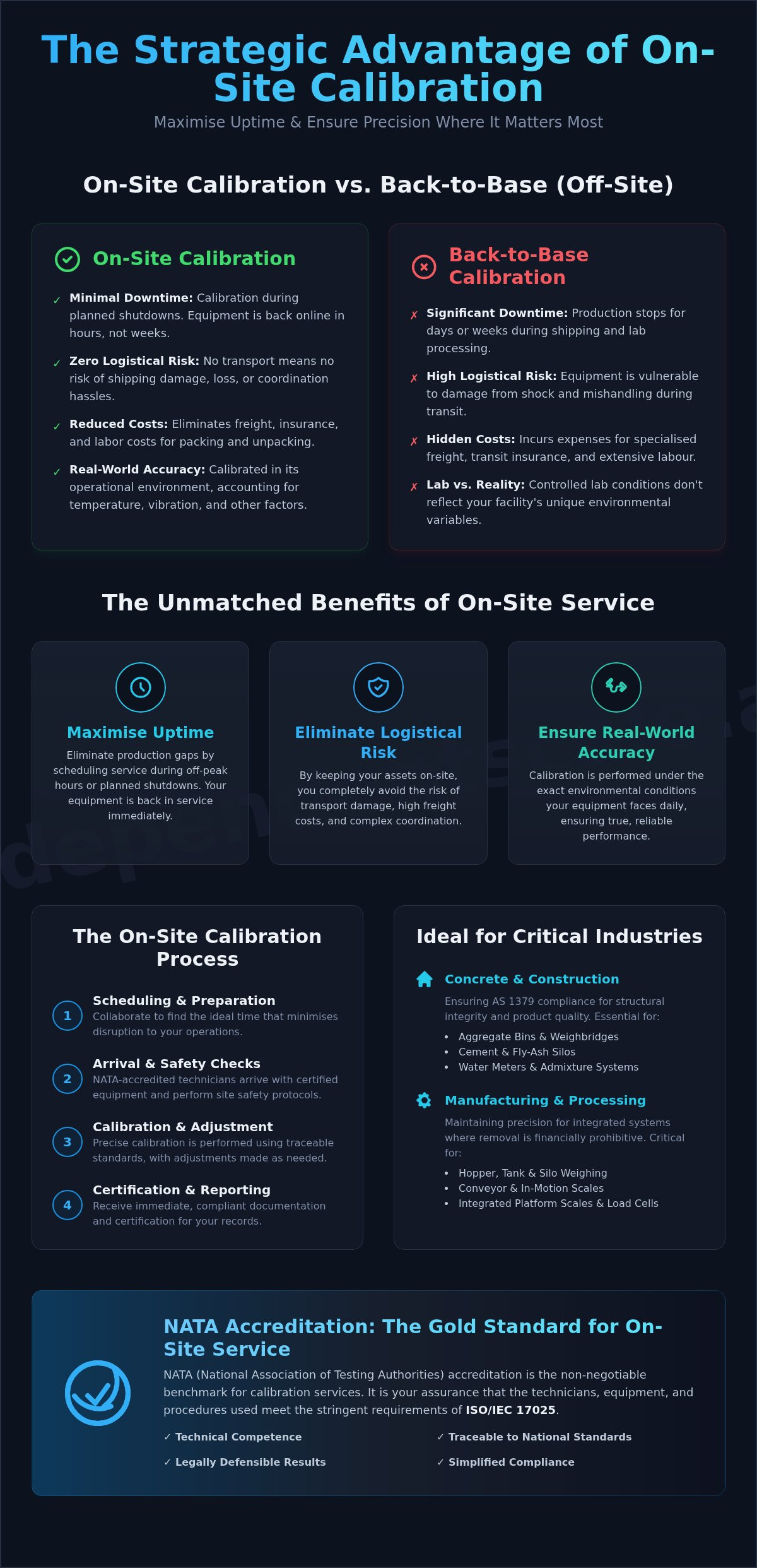
Every hour of operational downtime is a direct loss to your bottom line. The conventional process of decommissioning critical equipment, shipping it for external calibration, and enduring the subsequent wait creates significant production gaps, logistical risks, and unnecessary costs. For heavy or fixed industrial assets, this process is not merely inefficient; it is often impractical. This is where on-site calibration delivers a decisive advantage, eliminating these challenges to keep your operations running at full capacity.
This comprehensive guide details the strategic benefits of bringing NATA-accredited technicians directly to your facility. You will discover how on-site calibration minimises operational downtime, ensures the certified accuracy of your most critical equipment, and simplifies compliance with key Australian standards like AS 1379 and ISO/IEC 17025. Learn what to expect from the process and how to ensure your fixed and heavy equipment performs with certified precision-without ever leaving your premises.
Key Takeaways
- Learn how bringing calibration services to your facility significantly reduces operational downtime and logistical costs compared to back-to-base methods.
- Understand why NATA accreditation is the essential benchmark for technical competence, ensuring your equipment's accuracy is compliant and legally defensible.
- Discover the step-by-step process of on-site calibration and identify which critical equipment in manufacturing, construction, and heavy industry benefits most.
- Identify the key criteria for selecting a qualified calibration partner to guarantee regulatory compliance and maximise your asset's performance and lifespan.
What is On-Site Calibration and Why Is It Business-Critical?
On-site calibration is the process of bringing a NATA-accredited laboratory's certified equipment and expert technicians directly to your facility. Instead of decommissioning, packing, and shipping your critical instruments for back-to-base lab calibration, the service is performed in the exact environment where the equipment operates. While understanding what is calibration is the first step, understanding its delivery method is crucial for operational efficiency. The primary driver for choosing this service is the mitigation of costly, productivity-halting downtime.
This approach is essential for assets that are too large, heavy, or deeply integrated into a production line to be moved. Consider industrial weighbridges, large-capacity silos, or fixed manufacturing machinery. For these systems, removal is not just impractical; it's often financially prohibitive. On-site calibration ensures these vital assets remain operational, compliant, and accurate without disrupting the integrity of your production environment.
The Core Benefit: Maximising Uptime and Productivity
The true cost of downtime extends far beyond the service fee. It includes lost production, idle labour costs, and potential contractual penalties, which can amount to thousands of dollars per hour. On-site services directly address this by allowing calibration to be scheduled during planned shutdowns or off-peak hours. As a result, your equipment is returned to service immediately upon completion, eliminating days or even weeks of lost productivity.
Eliminating Logistical and Transportation Risks
For businesses operating across Australia, logistics present a significant challenge. The costs and risks associated with transporting heavy or sensitive equipment to a laboratory are substantial. On-site calibration removes these hurdles entirely.
- Reduced Costs: Avoids specialised freight charges, transit insurance, and potential overtime for packing and unpacking.
- Damage Prevention: Eliminates the risk of damage from vibration, shock, or mishandling during transport.
- Simplified Coordination: Removes the need to manage third-party logistics providers, streamlining the entire process.
Ensuring Real-World Accuracy
Calibrating an instrument in its actual operating environment provides a more accurate and reliable result. A controlled laboratory cannot replicate the specific environmental factors of your facility, such as temperature fluctuations, humidity, vibration, and power supply variations. Our technicians can observe the equipment in situ, identify potential operational issues, and ensure the calibration accounts for the real-world conditions it will face every day, guaranteeing true performance accuracy.
Key Industries and Equipment for On-Site Calibration
For many industrial sectors, sending equipment to a laboratory for calibration is operationally and logistically unfeasible. Industries where uptime is critical and equipment is large, integrated, or environmentally sensitive demand a specialised approach. The accuracy of these systems is tied to fundamental measurement standards, like those upheld by global authorities such as the National Institute of Standards and Technology (NIST), which underpins the traceability required for compliant operations. For these applications, professional on-site calibration is the only viable solution to ensure accuracy, compliance, and minimal disruption.
Concrete and Construction: AS 1379 Compliance
Concrete batching plants are a prime example where on-site service is non-negotiable. The accuracy of every component in the batching process directly impacts the structural integrity and quality of the final product. To maintain compliance with Australian Standard AS 1379, regular and precise calibration is essential for:
- Aggregate bins
- Cement and fly-ash silos
- Water meters and admixture systems
Ensuring these systems are calibrated in their operational environment guarantees that every batch meets stringent engineering specifications.
Manufacturing and Processing Plants
In manufacturing environments, weighing systems are often deeply integrated into production lines and process control systems. Removing these components for off-site service would cause significant downtime and production loss. On-site calibration is essential for a range of integrated equipment, including:
- Hopper, tank, and silo weighing systems
- Conveyor and in-motion scales
- Platform scales integrated into production floors
- Load cells embedded within machinery and structural supports
Accurate calibration of these assets ensures precise recipe formulation, reliable inventory management, and consistent product quality.
Logistics, Transport, and Mining
The sheer scale and fixed nature of equipment in the logistics, transport, and mining sectors make mobile calibration services a necessity. These assets are fundamental to commercial operations, safety, and regulatory compliance. Key equipment requiring on-site service includes:
- Road and rail weighbridges
- Axle weighers and truck scales
- High-capacity crane scales and overhead weighing systems
- Systems for bulk material handling and load-out
Regular, accurate calibration ensures fair trade, prevents vehicle overloading, and maintains operational safety standards. See if your equipment requires on-site service.
The On-Site Calibration Process: A Step-by-Step Walkthrough
A professional on-site calibration service is a systematic, three-phase process designed to verify and adjust your equipment with maximum efficiency and minimal operational disruption. Understanding these key phases-from initial planning to final certification-demystifies the service and sets clear expectations for both parties. This structured approach ensures a seamless experience and guarantees your instruments meet stringent industry and regulatory standards, such as ISO/IEC 17025.
Phase 1: Scheduling and Preparation
The process begins with a detailed consultation to establish a precise scope of work, identifying every asset requiring calibration and its specific tolerance requirements. On your end, the key responsibilities are to provide technicians with clear, safe access to the equipment and to gather any existing service history or previous calibration certificates. This documentation provides critical context. Finally, we coordinate to ensure our technicians complete any site-specific safety inductions or permit-to-work requirements before arrival.
Phase 2: The Technician's Visit and Calibration
Our NATA-accredited technician arrives at the scheduled time with fully calibrated test equipment and certified reference standards (e.g., test masses). The first critical step is performing 'as found' tests to record the instrument's current performance and determine its deviation from specifications. If the equipment is found to be out of tolerance, our technician will perform necessary adjustments. The process concludes with comprehensive 'as left' tests to verify that the equipment is now performing accurately, repeatably, and within the required tolerance across its entire operational range.
Phase 3: Documentation and Certification
Following a successful on-site calibration, we provide meticulous documentation that serves as your official record of compliance. You will receive a NATA-endorsed calibration certificate that clearly details 'as found' and 'as left' readings, measurement uncertainty, and traceability to national standards. This NATA endorsement carries global weight through mutual recognition arrangements managed by bodies like the International Laboratory Accreditation Cooperation (ILAC). A durable calibration label is affixed to the equipment, and we provide formal recommendations for any necessary repairs or preventative maintenance to ensure long-term reliability.
NATA Accreditation: The Gold Standard for On-Site Service
In the field of industrial measurement, accreditation is not merely a logo on a certificate; it is a non-negotiable benchmark of quality and technical competence. The National Association of Testing Authorities (NATA) provides this benchmark in Australia. This framework is especially critical for on-site calibration, where environmental variables demand stringent, proven procedures. NATA accreditation establishes an unbroken chain of traceability, ensuring your measurements are not only accurate but also legally defensible during audits or disputes.
What NATA Accreditation to ISO/IEC 17025 Means
A provider accredited by NATA to the ISO/IEC 17025 standard has undergone a rigorous, independent assessment of their entire operation. This confirms several key pillars of their service delivery:
- Robust Quality Management System: The provider operates a documented quality system designed to consistently produce valid and reliable results.
- Verified Technical Competence: All technicians are formally qualified, trained, and proven competent to perform the specific calibrations listed in their scope of accreditation.
- Use of Validated Methods: All calibration procedures are validated, appropriate for the equipment being tested, and produce reliable uncertainty calculations.
- Metrological Traceability: All measurements are proven to be traceable through an unbroken chain of comparisons to Australian national standards held by the National Measurement Institute (NMI).
Why It Matters for Your Business
Engaging a NATA-accredited provider for your calibration needs directly impacts your operational integrity, compliance posture, and risk management. The NATA endorsement on your calibration certificate carries significant weight and delivers tangible business advantages:
- Provides Absolute Confidence: You gain complete assurance that your equipment's measurements are accurate, underpinning your quality control and production processes.
- Ensures Regulatory Compliance: In sectors like construction, manufacturing, and logistics, NATA accreditation is often a mandatory requirement for compliance with Australian Standards and industry regulations.
- Reduces Commercial Risk: It mitigates the risk of costly production errors, product recalls, and legal challenges by providing objective, third-party verified evidence of your due diligence.
- Offers National and International Recognition: Due to mutual recognition agreements, NATA-endorsed certificates are accepted as credible and authoritative across Australia and globally.
When selecting a partner for your critical measurement needs, the NATA logo is your guarantee of precision and accountability. It transforms an essential service into a certified, defensible process. For expert on-site calibration backed by NATA accreditation, contact Independent Scale Service to ensure your operations meet the highest possible standard.
How to Choose the Right On-Site Calibration Partner
Selecting a provider for on-site calibration is a critical decision that directly impacts your operational efficiency, compliance, and product quality. Not all providers offer the same level of technical expertise or service reliability. Looking beyond the initial price to evaluate a partner’s long-term value is essential for maintaining accurate and productive operations.
Verify Their Scope of NATA Accreditation
NATA accreditation to ISO/IEC 17025 is the benchmark for technical competence in Australia. However, accreditation alone is not enough. You must ensure the provider’s specific scope of accreditation aligns precisely with your requirements.
- Equipment Specificity: Does their accreditation cover the exact types of industrial weighing equipment you operate, such as weighbridges, hopper scales, or belt weighers?
- Measurement Uncertainty: Is their Best Measurement Capability (a key indicator of their accuracy) suitable for your process tolerances and regulatory needs?
- Current Status: Always verify their accreditation is current and valid by checking their details on the official NATA website before engagement.
Assess Their Industry Experience and Capabilities
Theoretical knowledge cannot replace decades of hands-on field experience. Your partner must possess deep, industry-specific expertise to handle the unique challenges of your operational environment.
- Proven Specialisation: Do they have a proven track record, such as over 30 years of dedicated service, specifically in heavy industrial weighing?
- Complex Systems: Can their technicians service complex integrated systems, including concrete batching plants or automated multi-component production lines?
- Technician Availability: Do they have experienced, locally-based technicians to ensure a prompt and knowledgeable response?
Evaluate Their Responsiveness and Support
Unplanned downtime is a significant operational and financial risk. A reliable partner provides more than just scheduled on-site calibration; they offer rapid response when equipment fails, minimising disruption and keeping your business moving.
- Emergency Service: Do they offer 24/7 emergency breakdown support to address critical failures immediately?
- Scheduling Lead Time: How quickly can they dispatch a technician to your site for both routine and urgent needs?
- Integrated Solutions: Can they function as a single-source supplier for essential repairs, load cell replacements, and preventative maintenance programs?
Choosing the right partner ensures your equipment remains compliant, accurate, and reliable. For a provider with verified expertise and a commitment to minimising your operational downtime, request a NATA-accredited on-site calibration service to ensure your assets are in expert hands.
Secure Operational Integrity with Expert On-Site Calibration
Ultimately, accurate and reliable equipment is the bedrock of any successful industrial operation. As this guide has detailed, professional calibration minimises costly downtime, ensures product quality, and maintains critical regulatory compliance. Choosing the right partner is not an expense but an investment in operational integrity, with NATA accreditation serving as the definitive benchmark for technical competence.
With over 30 years of industry experience, Independent Scale Service delivers that benchmark of quality. Our technicians provide expert on-site calibration services, backed by NATA accreditation to ISO/IEC 17025 and specialised knowledge in standards such as AS 1379 for concrete plants. We are committed to ensuring your equipment performs with maximum accuracy and efficiency.
Do not leave precision to chance. Schedule your expert on-site calibration service today. Ensure your operations are compliant, efficient, and ready for any challenge.
Frequently Asked Questions About On-Site Calibration
How often does my industrial equipment need on-site calibration?
The required frequency depends on industry standards, manufacturer specifications, and equipment usage. For concrete plants, compliance with AS 1379 mandates calibration every six months. For other critical weighing systems, an annual or semi-annual schedule is standard practice to ensure consistent accuracy and traceability. We assess your specific operational requirements and quality systems to recommend a compliant and effective calibration schedule that mitigates risk and ensures process integrity.
Is on-site calibration more expensive than sending my equipment to a lab?
While the direct service fee may be higher to account for technician travel, the total cost is significantly lower. On-site calibration eliminates freight expenses, the risk of damage in transit, and most importantly, minimises operational downtime. The cost of lost production from having equipment off-site for days or weeks far exceeds the premium for our mobile service. Our service is an investment in your operational continuity and profitability.
What do I need to do to prepare my facility for your technician's visit?
To ensure an efficient service, please provide clear and safe access to all equipment scheduled for calibration. The area should be clean and free of obstructions. Any required plant operators or site personnel should be available to assist with operating the machinery as needed. We will communicate any specific requirements, such as the need for test masses to be accessible, prior to our technician's arrival at your facility.
What geographical areas in Australia do you service for on-site calibration?
Our core service areas for rapid-response on-site calibration include the Greater Sydney region, Newcastle, the Central Coast, and Wollongong in NSW, as well as the greater Melbourne metropolitan area. We regularly service clients in regional NSW and Victoria by appointment. For national contracts or large-scale projects in other states, Independent Scale Service has the logistical capability to provide expert service. Please contact our head office to discuss your specific requirements.
What information is included in a NATA-endorsed calibration certificate?
A NATA-endorsed certificate provides comprehensive, traceable proof of calibration compliant with ISO/IEC 17025. It includes detailed equipment identification, the calibration date, and environmental conditions. The report specifies the "as found" and "as left" readings, a formal statement of measurement uncertainty, and the details of the certified reference standards used. The official NATA emblem and our laboratory accreditation number are prominently displayed to certify authenticity and compliance.
Can you perform repairs during the same on-site visit if a fault is found?
Yes. Our technicians are highly skilled in diagnostics and repair, and our service vehicles are stocked with a wide range of common spare parts like load cells, indicators, and junction boxes. If a fault is identified during calibration, we can typically perform the necessary repairs immediately to restore your equipment to a compliant and accurate state. This integrated approach is designed to minimise your downtime and the need for multiple site visits.
How long does a typical on-site calibration for a concrete plant take?
A standard AS 1379 compliant calibration for a concrete batch plant typically requires 3 to 5 hours to complete. This timeframe can vary based on the complexity of the plant, the number of scales (aggregate, cement, water, admixture) being serviced, and the ease of access for our technicians and equipment. We work efficiently to complete all testing and documentation while ensuring the highest standard of accuracy and compliance is met.
