


NMI Trade Approved Scales: The Complete Compliance Guide for Australian Industry 2026
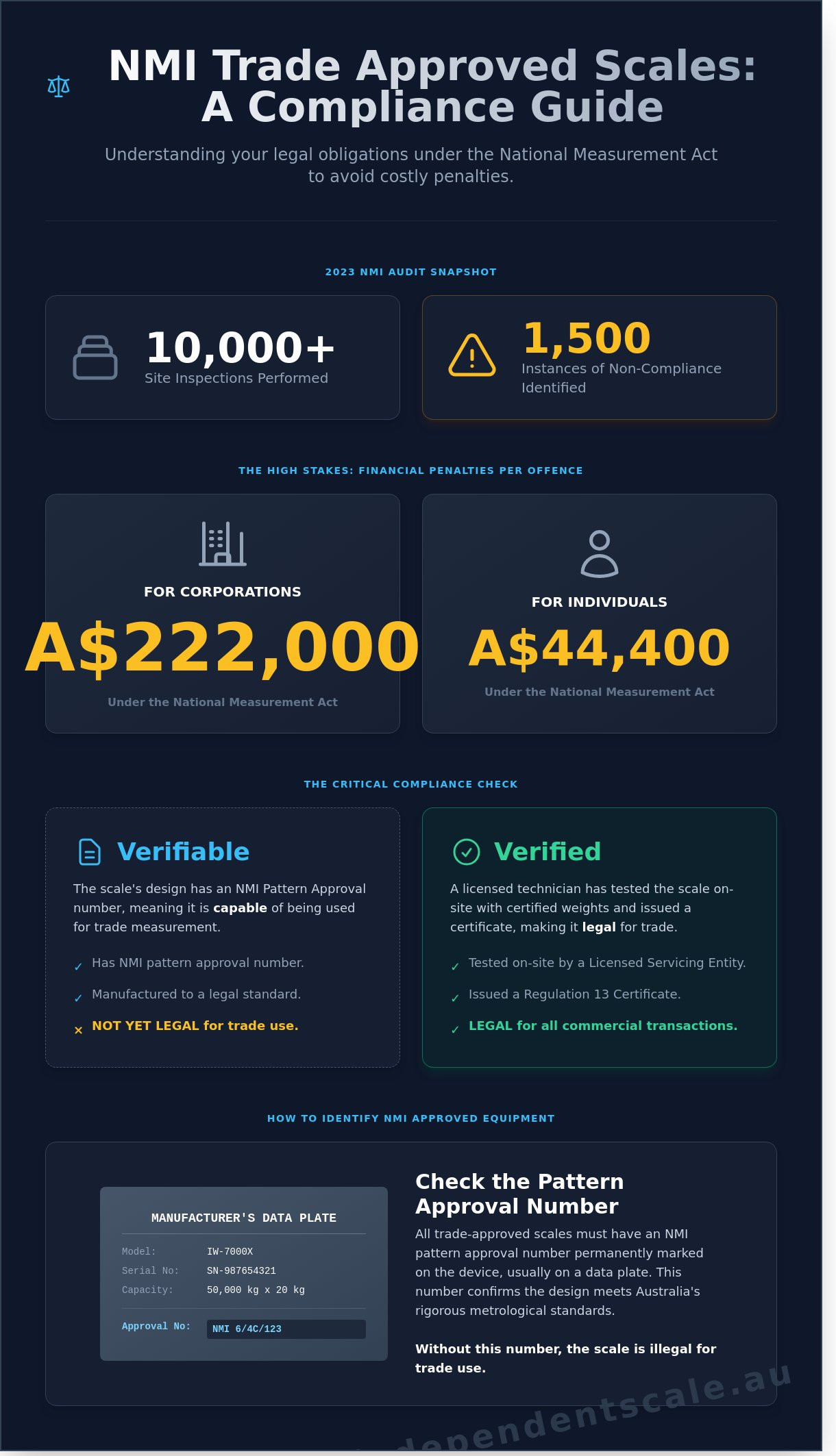
In 2023, the National Measurement Institute (NMI) performed over 10,000 site inspections, identifying 1,500 instances of non-compliance that put Australian businesses at risk. Operating without NMI trade approved scales isn't just a technical oversight; it's a legal liability that carries corporate fines of up to A$222,000 under the National Measurement Act. For industrial operators, the confusion between NATA calibration and NMI verification often leads to unverified equipment and unexpected downtime during regulatory audits.
You understand that accurate data is essential for billing and inventory management, but the complexities of trade measurement law can be difficult to navigate. This guide provides the technical framework you need to master these requirements and ensure your weighing systems remain 100% compliant through 2026. We'll detail the specific verification procedures for industrial load cells, explain the necessity of ISO/IEC 17025 standards, and provide a clear strategy for seamless system integration.
Key Takeaways
- Understand your legal obligations under the National Measurement Act 1960 to ensure total compliance in Australian commercial transactions.
- Identify the essential technical requirements for pattern approval, focusing on the integration of load cells, indicators, and summing circuits.
- Distinguish between mandatory legal verification and NATA-accredited calibration to ensure your NMI trade approved scales meet both regulatory and ISO/IEC 17025 standards.
- Learn why the gravimetric method remains the gold standard for achieving trade-compliant verification in high-capacity industrial environments like silos and tanks.
- Master the maintenance lifecycle by identifying when re-verification by a Licensed Servicing Entity (LSE) is legally required following equipment repairs or component changes.
What are NMI Trade Approved Scales and Why Are They Mandatory?
The National Measurement Institute (NMI) is the peak Australian body responsible for the country's measurement infrastructure. It operates under the Department of Industry, Science and Resources to maintain national measurement standards. Its primary role in commerce is to ensure that any transaction based on weight or measure is accurate, transparent, and legally defensible. This oversight maintains the integrity of the Australian economy by providing a uniform framework for all market participants.
Under the National Measurement Act 1960, any weighing device used to determine the price of a product or service must be "legal-for-trade." Using NMI trade approved scales isn't a suggestion; it's a strict legal requirement for Australian businesses. Non-compliance carries heavy penalties. Corporations face fines of up to A$222,000 per offence, while individuals can be fined A$44,400. These financial risks are compounded by the potential for litigation and severe damage to brand reputation if a client discovers they've been overcharged due to unverified equipment.
When non-compliance points to systemic issues or deliberate misconduct, it's a sign that the organization's culture may need attention. Building a framework of trust and transparency is crucial for long-term operational integrity; you can learn more about Core Integrity and their approach to fostering accountability.
In cases where non-compliance stems from deliberate misconduct or systemic failures, organisations may also require professional workplace investigation services Australia to address the root causes and restore accountability.
The Legal Framework of Trade Measurement
The National Measurement Act 1960 provides the legislative backbone for all commercial weighing in Australia. The NMI enforces these regulations through a national network of inspectors who conduct audits on businesses without prior notice. In sectors like waste management, mining, and agriculture, the precision of bulk weighing is critical for operational viability. A 1% error on a 50-tonne weighbridge results in 500kg of lost revenue or overcharged product, which quickly scales into massive annual losses.
The legal definition of "trade" is specific and technical. Under the updated 2026 standards, trade is defined as any transaction where a measurement determines the price, charge, royalty, or tax, including the assessment of freight costs or waste levies. If a scale output influences a financial transfer, it must be trade approved. This ensures a level playing field across Australian industrial sectors, preventing unscrupulous operators from undercutting competitors through inaccurate measurement. It's about ensuring every kilogram is accounted for exactly as the law requires.
Distinguishing Between Approved and Non-Approved Equipment
Identifying NMI trade approved scales requires checking for a specific pattern approval number. This number, issued by the NMI, confirms that the scale design has undergone rigorous testing and meets the required metrological standards. It's usually found on a permanent data plate attached to the device or displayed on the digital indicator. Without this number, the scale cannot be used for any commercial transaction.
Understanding the difference between "verifiable" and "verified" equipment is essential for compliance:
- Verifiable: The scale has an NMI pattern approval number and is manufactured to a standard that is capable of being used for trade.
- Verified: A licensed technician has tested the scale on-site with certified weights and issued a Regulation 13 certificate, officially clearing it for commercial use.
Accuracy is not the same as legal compliance. A high-precision laboratory scale might be accurate to 0.001g, but if it lacks an NMI pattern approval number, it's illegal for trade use in Australia. "Off-the-shelf" scales from non-specialist retailers often lack the internal sealing and tamper-proof mechanisms required by the National Measurement Act. Compliance requires that the equipment is both approved by design and verified by a qualified professional in its final operating environment. This professional verification is the only way to protect your business from the A$222,000 penalties associated with non-compliant weighing.
Technical Requirements for NMI Pattern Approval
Pattern approval ensures every design for NMI trade approved scales meets rigorous national standards before it reaches an industrial site. The National Measurement Institute (NMI) evaluates weighing equipment to confirm it performs reliably under varied environmental stressors. For instance, systems must maintain accuracy across temperature fluctuations ranging from -10°C to 40°C. They also need to resist electromagnetic interference (EMI) from heavy industrial machinery like 500kW motors or high-frequency transmitters. Vibration is another critical factor. Industrial environments often produce high-frequency oscillations that can disrupt sensitive measurements, so the NMI tests the equipment's ability to filter this noise without losing data integrity.
Physical security is a non-negotiable aspect of the approval process. Every trade-certified system requires lead or adhesive seals and anti-tamper mechanisms. These safeguards prevent unauthorised calibration adjustments. If a seal is broken, the scale's legal-for-trade status is immediately voided. This level of security ensures that the weighing data remains 100% compliant from the moment of installation through years of heavy use in sectors like concrete production or waste management.
The Core Components: Load Cells and Indicators
Selecting the right hardware is the primary step in achieving compliance. Only NMI approved load cells are permitted in trade systems. These components undergo specific testing for creep, hysteresis, and temperature sensitivity. Using a non-approved cell, even one with high precision, results in a system that cannot be legally verified for trade. The processing side is equally vital. High-resolution weighing indicators and displays provide the necessary computational power to translate raw millivolt signals into legal-for-trade weight data.
The choice between digital and analogue components significantly impacts the pattern approval path. Digital load cells often simplify the process because they offer built-in error checking and superior noise rejection. Analogue setups, while common, require more robust cabling and frequent verification. This is because they're more susceptible to signal degradation over cable runs exceeding 15 metres. Regardless of the technology, the indicator must be compatible with the load cell's output range to maintain the required 3,000 to 6,000 division accuracy levels standard in Australian industry.
System Integration and Summing
Signal integrity depends on the hardware connecting the sensors to the display. The use of high-quality junction boxes and surge arrestors prevents voltage spikes from damaging sensitive electronics during electrical storms or power surges. In complex builds like concrete batching hoppers, multiple load cells must be summed correctly through a summing circuit. These systems often achieve a combined pattern approval that covers the entire mechanical assembly and its electronic components as a single unit.
Component-level approval is the mandatory foundation of full system compliance; a single non-compliant part causes a total failure during a trade verification audit. This is why 98% of concrete plants across Sydney rely on pre-approved component packages. If you're upgrading an existing hopper or silo, consulting with technical experts ensures your integration meets the latest NMI requirements without costly rework. Proper system integration ensures that your NMI trade approved scales remain accurate even when subjected to the 24/7 demands of high-volume industrial production.
NMI Trade Verification vs. NATA Calibration: Which Do You Need?
Understanding the distinction between legal metrology and technical calibration is critical for industrial compliance. NMI trade verification ensures your NMI trade approved scales meet the National Measurement Act 1960 requirements for commercial transactions. This is mandatory whenever goods are sold by weight. In contrast, NATA calibration to ISO/IEC 17025 focuses on the technical competence of the testing laboratory and the traceability of measurements to national standards. It's about precision and process control rather than legal trade authority.
For many industrial sites, the choice isn't between one or the other; it's about how they work together. Verification is a "pass or fail" assessment. Calibration provides a detailed report of the scale's performance across its entire range. If you're operating in high-stakes environments like chemical manufacturing or civil engineering, you need the technical data that only a NATA-endorsed certificate provides.
The Compliance Matrix
- Verification (Legal Trade): Used for buying or selling goods. It's a legal requirement under the National Measurement Act. Certificates are issued as a Regulation 13 or similar verification mark. Expiry varies by state and industry but often spans 1 to 3 years.
- NATA Calibration (Technical): Used for internal quality control and process accuracy. It's a requirement for ISO 9001 or ISO/IEC 17025 accredited facilities. Certificates are NATA-endorsed with full uncertainty budgets. Expiry is typically 6 to 12 months based on risk.
Industrial sites require both when they're audited by third parties or government bodies. While NATA calibration ensures your internal recipes are perfect, it won't protect you from a National Measurement Institute (NMI) audit if those scales are used to invoice clients. You must have the verification mark to avoid fines that can exceed A$22,200 per offence for companies.
Specific standards like AS 1379 govern the specification and supply of concrete. In this sector, compliance is non-negotiable. Major players like Holcim, Boral, and Hanson demand rigorous adherence to these standards. Because 98% of concrete plants across Sydney rely on precise batching, the integration of AS 1379 requirements with NMI trade verification is the only way to ensure both legal and structural integrity.
NATA Calibration for Industrial Accuracy
While NMI verification satisfies the law, weighing scale calibration through a NATA-accredited laboratory provides the gravimetric data needed for high-precision manufacturing. Calibration intervals are typically shorter than verification cycles. We recommend a 6-month interval for high-use equipment to prevent drift. A proactive approach reduces the risk of batch failure. In large-scale chemical processing, a 0.5% drift in accuracy can lead to A$50,000 in lost product over a single quarter. High-precision calibration standards are the only safeguard against these invisible losses.
Maintaining dual accreditation carries a higher upfront cost, usually 30% more than a single service. However, the cost-benefit analysis favors this investment. Dual-certified NMI trade approved scales provide a complete defense during audits. They prove you're not only trading legally but also operating with technical excellence. This level of diligence is what separates industry leaders from those prone to downtime and regulatory intervention. Don't risk your reputation on a single layer of compliance when the technical demands of your industry require a more robust framework.
Implementing NMI Approved Scales in Heavy Industrial Environments
Deploying NMI trade approved scales in heavy industrial sectors requires more than just high-capacity hardware. For systems like 200-tonne silos or massive chemical tanks, the verification process is complex because these structures are fixed assets. You can't transport a 150-tonne cement silo to a lab for testing. Instead, technicians must bring the laboratory to the site. The gravimetric method remains the gold standard for this high-capacity verification. It involves using NATA-certified weights or high-precision transfer standards to measure the actual mass applied to the system. This method eliminates the variables that often plague theoretical or electronic-only calibrations, providing the legal certainty required for trade.
Achieving compliance starts with the hardware foundation. Integrating tank and silo weighing assemblies that carry NMI pattern approval is mandatory for any commercial transaction. These assemblies aren't just load cells; they're engineered mounts designed to handle thermal expansion, wind loading, and vibration while maintaining a vertical load path. Without these specific components, even the most expensive indicator won't meet the legal requirements for trade in Australia. In high-capacity environments, the margin for error is slim, and the NMI trade approved scales status ensures that every kilogram of bulk material is accounted for accurately.
Concrete Batching and AS 1379 Compliance
In the construction sector, the accuracy of batching plants is a critical legal requirement. The sale of "ready-mix" products is governed by AS 1379, which mandates strict tolerances for material measurement. We provide specialized concrete batching plant calibration and repair to ensure every load meets these rigorous standards. If your scales aren't trade-approved, you cannot legally sell concrete by the cubic metre or tonne. Major contractors like Holcim, Boral, and Hanson perform regular audits on their suppliers. Failing to produce a current NMI verification certificate can lead to immediate contract termination. We currently service 98% of concrete plants across Sydney, ensuring they pass these high-stakes audits through precise gravimetric testing and rapid response repairs.
Silos, Hoppers, and Bulk Weighing
Bulk weighing systems face technical hurdles that standard platform scales never encounter. Environmental factors like wind shear on a 20-metre silo can create false weight readings that exceed the legal limit of error. Professional hopper calibration services address these issues by evaluating the entire mechanical structure, not just the electronics. For tension-based systems, the use of special purpose and shackle pins is often necessary to integrate trade-approved load cells into existing infrastructure. These pins must be NMI-compliant to ensure the force transfer is accurate. Maintaining this accuracy in harsh, outdoor environments requires regular inspection of summing circuits and surge arrestors to prevent moisture ingress or lightning damage from compromising your trade certification.
Ensure your heavy industrial systems remain compliant and operational 24/7. Contact Independent Scale Service for NMI-certified calibration and repairs.
The Maintenance Lifecycle: Verification, Repair, and Re-Verification
Under the National Measurement Act 1960, NMI trade approved scales must maintain accuracy within the maximum permissible error (MPE) limits at all times. Any repair that involves breaking a physical or electronic seal immediately voids the existing verification. This isn't a suggestion; it's a strict legal requirement. If your equipment is used for trade after a seal is broken but before re-verification, your business is non-compliant. NMI enforcement policies allow for fines exceeding A$222,000 for corporations that fail to meet these standards.
A Licensed Servicing Entity (LSE) performs the vital role of bridge between your operations and federal law. Only an LSE has the legal authority to test and mark scales for trade use in Australia. When a component like a summing circuit or load cell is replaced, the LSE must perform a series of tests to ensure the instrument still meets its certificate of approval. They then apply a new verification mark, which signifies the device is legal for trade. Without this mark, your weight readings have no legal standing in commercial transactions.
Site preparation is essential to minimise downtime during an NMI inspection or a third-party audit. You should ensure clear access for heavy test trucks and confirm the scale pit is free of debris. Inspectors require a safe working environment and documented proof of previous calibrations. 15% of verification failures result from simple environmental factors like moisture in junction boxes or material build-up under the scale platform. Implementing a routine cleaning schedule and using surge arrestors to protect electronics from lightning strikes are effective preventative strategies to avoid verification failure.
Post-Repair Compliance Steps
Replacing a load cell changes the electrical characteristics of the entire weighing system. This hardware change necessitates immediate re-verification to confirm the digital output accurately reflects the physical mass. Once the LSE confirms accuracy, they apply a new verification mark. This typically takes the form of a lead seal or a destructible adhesive sticker. You must record these changes in a compliant equipment register. This register needs to list the repair date, the LSE license number, and the serial numbers of any replaced components to satisfy NATA or NMI auditors.
Choosing a Compliance Partner
Experience is the most critical factor when navigating the complex overlap between NMI trade requirements and NATA-accredited ISO/IEC 17025 standards. Independent Scale Service provides over 30 years of technical expertise. We currently service 98% of concrete plants across Sydney, ensuring they remain compliant with AS 1379 standards. When trade-critical NMI trade approved scales fail during peak production, 24/7 emergency support isn't a luxury; it's a necessity for business continuity.
- Current LSE license status for trade verification.
- NATA accreditation to ISO/IEC 17025 for technical competence.
- Documented safety protocols for high-risk industrial sites.
- Availability of certified test masses and heavy vehicle equipment.
- Proven track record with major Tier 1 contractors like Holcim or Boral.
Maintaining the integrity of your weighing equipment requires a methodical approach to the maintenance lifecycle. By partnering with a seasoned expert, you ensure your equipment remains accurate, your documentation stays audit-ready, and your business avoids the significant financial penalties associated with non-compliance. Reliability in the industrial sector is built on precision and adherence to national standards.
Securing Your Operational Compliance for 2026
Maintaining legal compliance in 2026 requires strict adherence to National Measurement Institute standards. Operating without NMI trade approved scales exposes your business to significant regulatory risks and financial penalties under Australian trade measurement law. It's essential to ensure every piece of weighing equipment undergoes initial verification and regular re-verification after any repairs. Technical precision isn't optional for heavy industrial sites. It's the foundation of your operational integrity and protects your bottom line from costly disputes.
Independent Scale Service provides the technical expertise required to meet these rigorous demands. We're NATA Accredited to ISO/IEC 17025 and ensure all equipment is AS 1379 Compliant for concrete plants. With over 30 years of industry experience, our technicians currently service 98% of concrete plants across Sydney. We provide 24/7 emergency support to minimise downtime on critical industrial sites, ensuring your facility remains productive around the clock. Don't leave your regulatory standing to chance when professional verification is a phone call away.
Ensure your industrial scales are NMI compliant; contact Independent Scale Service today
Frequently Asked Questions
What is the difference between an NMI approved scale and a standard industrial scale?
An NMI approved scale has undergone rigorous pattern approval testing by the National Measurement Institute to ensure it maintains accuracy across varying temperatures and electrical interference. Standard industrial scales lack the specific Pattern Approval number required by the National Measurement Act 1960 for commercial transactions. Without this certification, a scale cannot be legally used to determine the price of goods based on weight in Australia.
How often do NMI trade approved scales need to be re-verified?
Australian regulations generally require trade scales to be re-verified every 12 months to ensure continued compliance with the National Measurement Act. Specific industries, such as concrete production following AS 1379 standards, demand annual calibration to maintain operational integrity. It's essential to schedule regular inspections, as environmental wear can shift a scale's accuracy beyond the Maximum Permissible Error limits within a single year of heavy use.
Can I use a non-approved scale if I am only weighing products for internal use?
You can legally use non-approved scales for internal process monitoring or inventory checks where no financial transaction occurs. However, if the weight measurement determines a price, tax, or royalty, you must use NMI trade approved scales to avoid legal liability. Using non-approved equipment for trade purposes can result in corporate fines exceeding A$222,000 under current Australian sentencing guidelines.
What happens if an NMI inspector finds my scales are out of calibration?
If an inspector determines your scale exceeds the Maximum Permissible Error, they will issue a non-compliance notice or a formal "notice to remedy." You must immediately stop using the instrument for trade until a licensed technician performs repairs and a new verification. Failure to rectify the issue can lead to A$1,100 on-the-spot infringement notices or federal prosecution for persistent breaches of measurement standards.
Do I need a new NMI verification if I move my scale to a different location?
You must re-verify any fixed scale or weighbridge if it's relocated to a new site, as changes in gravity and local environmental conditions impact load cell performance. Relocation effectively voids the existing verification mark under National Measurement Institute guidelines. A Servicing Licensee must test the scale at the new installation point to confirm it meets the 0.1% to 0.5% accuracy tolerance required for legal trade.
Is NATA calibration the same as NMI trade verification?
NATA calibration to ISO/IEC 17025 standards focuses on technical competence and measurement uncertainty for quality control or laboratory environments. NMI trade verification is a specific legal requirement for commercial transactions to ensure a scale is "legal for trade." While NATA accreditation proves a laboratory's high technical standing, it doesn't replace the mandatory trade verification mark required by Australian law for selling goods by weight.
Can any technician verify my trade scale, or do they need a specific license?
Only a technician employed by a business holding a current Servicing License issued by the NMI can legally verify a scale for trade. While general mechanics can perform basic repairs, they don't have the legal authority to apply the verification mark or lead seals. Using an unlicensed individual for verification renders the scale illegal for trade use and exposes your business to significant regulatory risk.
What specific markings should I look for on an NMI approved load cell?
An approved load cell must display a Pattern Approval number, typically formatted as "NMI S" followed by a three or four-digit code. These NMI trade approved scales components should also clearly state the manufacturer's name, the maximum capacity, and the accuracy class, such as Class III. These markings ensure the component is compatible with your weighing system and meets the specific 2024 compliance standards for Australian commercial use.
